Opera ingenu Nicholas Marlowe (my co-reviewer for CultureVulture.net) went to see ENO’s production of Puccini’s La Fanciulla del West.

Often laughed off as the first Spaghetti Western,  La Fanciulla del West remains the least known of Puccini’s major works. Set during the California gold rush of 1849-50, it was first performed to universal acclaim at the Metropolitan Opera in New York in 1910 (a far cry from the disastrous opening of Madame Butterfly at La Scala six years earlier). And yet Richard Jones’s new production is the first at the ENO for fifty years.

La Fanciulla tends to appeal to serious aficionados of Puccini’s score rather than the ordinary opera-goer, and it’s not hard to see why. The paucity of stand-alone arias – never mind a ‘Nessun Dorma’ – is a major stumbling block, the only real crowd-pleaser being ‘Quello che tacete’ in Act I, strongly reminiscent (I wonder why?) of ‘Song of the Night’ in Andrew Lloyd-Webber’s Phantom of the Opera. It also has one of the most preposterous plots in all opera, and characterisation that veers dangerously close to cardboard: saloon-owner-with-a-heart-of-gold Minnie, miraculously-reformed bandit Ramerrez aka Dick Johnson and sleazy Sheriff Jack Rance. You might think that singing it in English would have smoothed things a little, but I rather missed the cries of “Howdy, ragazzi!” and “Whiskey per tutti!”

Peter Auty and Susan Bullock in The Girl of the Golden West. (Photograph: John Snelling/Getty Images)
Nevertheless, the entire ensemble did well in what was largely a production of firsts. Highly-regarded British soprano Susan Bullock ruled the roost in a feisty stage debut as Minnie (she previously sang the role in concert at the Edinburgh festival in 2010). It was tenor Peter Auty’s debut as Dick, and American bass baritone Craig Colclough’s as Rance. Canadian conductor Keri-Lynn Wilson, meanwhile, made her UK operatic debut in the pit. Sterling support came from an ENO chorus that shifted convincingly from bible class to lynch mob.
 
The opening act in the Polka saloon I thought suffered from a lack of clear definition in the male roles, although some were still very good indeed; I particularly liked Graham Clark as Nick the bartender. Act II, set in Minnie’s cabin, was somewhat knockabout, provoking a certain amount of tittering in the Colisseum audience, and at this stage I began to wonder if Jones and co were playing the whole thing for laughs. All came good in the final act, however, particularly in Auty’s poignant rendition of Dick’s final despairing aria, well matched by Bullock’s gutsy performance as she pulled out all the stops to save her fella from the noose. 
La Fanciulla del West continues at ENO at the Coliseum.

Xerxes (Alice Coote) sings to his beloved plane tree

In the opening scene of Handel’s Xerxes (or Serses) we witness the King of Persia (Xerxes) singing a love song to a plane tree (“Ombra Mai Fu”). As the narrative of this opera unfolds – a tale of love triangles, frustrated desire, disguise and general chicanery – we begin to wonder whether Xerxes should have stuck with loving the tree, rather than anyone else, for trees tend to be rather simpler to deal with.

In fact, the plot of Xerxes is fairly straightforward, and in Nicholas Hytner’s acclaimed production, first seen in 1985 and now in its sixth revival, it becomes incidental to the charming setting, and witty and delightful progression of the narrative. An entertaining cast of characters inhabit a setting which recalls Vauxhall Pleasure Garden and Versailles (complete with modern-day red cordons), with a nod to Hogarth’s Marriage à la Mode in the costumes of the servants/chorus and a glimpse of ancient Persia in the form of a giant statue of a winged lion (which one might view in the British Museum) and the tiny ancient city at the rear of the set.

Xerxes (Alice Coote), Romilda (Sarah Tynan) and Arsamenes (Andrew Watts). Picture credit Mike Hoban

The all-British cast gel brilliantly, all winks and nods and cheeky asides, and Xerxes, sung by Alice Coote (making her role debut) is thigh-slappingly wonderful, at once swaggering principal boy and deluded, love-lorn King, the full weight of emotion given rein in her rich enunciation of words like “Desire”. Romilda, beautifully sung by Sarah Tynan, is coquettish and proud, while Atalanta (Rhian Lois) is downright louche, particularly in Act 1. There are also some delightful comic cameos from Arsamenes (sung by counter-tenor Andrew Watts) and his servant Elivro, whose disguise as a “mockney” flower seller (complete with floral frock) gets all the laughs in Act 2.

The production combines a cool rococo elegance with wit and genuine humour (the welcoming home of the old soldiers from battle, taking tea en plein air, and the hedge-trimming), while the music is energetically directed by Michael Hofstetter and crisply articulated by the orchestra. All in all, this was a rollicking evening, delightfully piquant, charming and above all entertaining. It’s a long night (three acts in three-and-a-half hours) but with the quality and pleasure of this production and the commitment and obvious enjoyment of the cast the narrative moves on apace. Highly recommended.

Xerxes continues at ENO, London Coliseum until 3 October

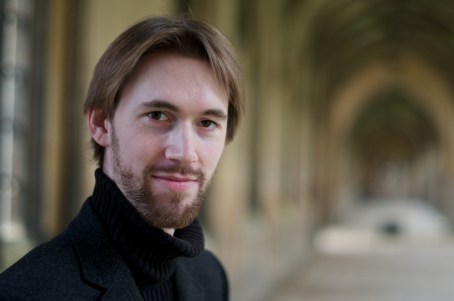
Oliver photoWho or what inspired you to take up composing, and make it your career? 

Like a great many other composers, the initial impetus or inspiration to write came from a deep-seated desire to emulate (and often imitate!) the music I had encountered in childhood and adolescence, through performing and learning music – in my case, through brass bands, orchestras and youth opera (I was blessed by the fact that Leeds County Council has an amazing music service with many inspirational teachers). Over time, I discovered the great power of music to express ideas about the world and about oneself, and this awoke in me the desire to make composition my vocation.

Who or what have been the most important influences on your composing and your musical career to date? 

My initial passions were fired by the English pastoral school, perhaps best represented by Vaughan-Williams and Holst. After this, I went through a Steve Reich phase (pun intended!), which had a very substantial impact upon my development, since it led me to realise that tonality could still be used in original and meaningful ways. Subsequently, I underwent a somewhat obsessive infatuation with Wagner, whose protean use of a wide variety of musical influences to create dramatic works of enormous philosophical depth planted in me the ambition to write opera. At this point, I re-discovered Benjamin Britten, who I came to see as a composer who had achieved equal dramatic mastery and psychological understanding, but in a more English and down-to-earth manner.

What have been the greatest challenges of your career so far? 

Undoubtedly my first two operas. Through these, I have learnt how to synthesise all my musical influences and gradually, from naïve beginnings, to write music and libretti which not only work poetically and musically but which also function well dramatically on the stage. Organising the performances and staging productions was just as much a challenge as the actual composition. For my first opera, The Nightingale and the Rose (after Oscar Wilde), written while I was still an undergraduate, I combined an orchestra of RCM students with the hundred-strong Yorkshire Philharmonic Choir and professional opera singers. My children’s opera, The Owl who was Afraid of the Dark (after Jill Tomlinson), then involved co-ordinating sixty primary-school children from around Cambridgeshire with professional musicians, as well as singers from Cambridge University, which was an even more formidable logistical challenge, since it meant one had to deal not only with some fairly mischievous young spirits, but also with their anxious parents!

What are the particular pleasures/challenges of working with individual artists, ensembles or orchestras? 

I always enjoy working with musicians and artists to bring a project into being. I would consider myself the entrepreneurial type, and tend to gather together a team of creative people to build a project around a dramatic conception. Collaboration involves a balance between allowing plenty of creative freedom to the individuals that you are working with, whilst striving to direct everybody’s energies towards a mutual goal. Maintaining this balance without creating too many frictions and tensions is always a challenge; the trick is to find people who share your ideals.

Please tell us more about your  opera Pincher Martin

Pincher Martin is an operatic adaptation of William Golding’s novel and poetic masterpiece. Recreating on the stage the existential plight of a marooned naval officer who struggles to survive first in the ocean, then on a lonely rocky islet in the middle of the Atlantic, has stretched my imagination to the limit, and has required the use of devices and technology which were previously unfamiliar to me. Throughout the course of the drama, we will be using a silver-screen movie-style cinematic backdrop, both to aid us in realising difficult scenarios such as a man drowning in the Atlantic, and to evoke the drama’s World War II setting.

Just one example of how this will work in practice is a scene in a moving motorcar, where the protagonist terrifies a woman with his dangerous and aggressive driving in a terrible attempt to make her acquiesce to his desires (yes, this is in the book…!). Musically, I have accompanied this scene with continuous unpitched and then pitched fluttertongues in four solo brass instruments, to evoke the sound of a car engine, first stationary and then in faster and faster motion. In terms of staging, this coordinates with the film, in that what is displayed on the screen is the view seen from the back seat of a car, first shaking very slightly as the car is parked in a layby with its engine idling, and then changing as the car moves off down the road. This is combined on-stage with the set, which in this case consists of a car bonnet behind which the protagonists will sit, with the backseat view behind them on the film. The bonnet itself is half-car, half-rock-like in substance, so that we can move expeditiously from a scene taking place on the rocky islet to this memory scene in the car, whilst also suggesting to the audience that the rock is actually an imaginary environment created by Pincher’s subconscious, and that we are dealing with scenes from his past life, which he is recalling during his purgatorial existence on the island.

Using this synthesis of music, film and staging to bring William Golding’s story to life has been an incredibly difficult challenge, but one which I am very glad to be undertaking, as it has expanded my creative world substantially.

What do you consider to be the most important ideas and concepts to impart to aspiring musicians/composers? 

To be yourself whilst learning from others.


Oliver Rudland is an English composer based in Cambridge, UK, known for his accessible style of modern composition. His operas have received particular attention and critical acclaim.

His latest opera, ‘Pincher Martin’, based on the novel by William Golding, was staged at the RCM Britten Theatre in July 2014: ‘This is an eloquent, succinct opera… In music and design…, Pincher Martin pinched and gripped. This opera deserves to live.’ (The Times: ★★★★)

‘Rudland appears to have achieved that rare and valuable object: a contemporary work that is both challenging yet accessible. Despite its disturbing subject matter, Pincher Martin is lyrical, inventive, and above all a thoroughly engaging work.’ (Bachtrack: ★★★★)

His first opera, ‘The Nightingale and the Rose’, after the story by Oscar Wilde, was staged at the Carriageworks Theatre for four nights in 2008 by Leeds Youth Opera. ‘Exceptional talent…Oliver is going to be a big name in the future.’ (Yorkshire Evening Post)

In 2011, his children’s opera, ‘The Owl who was Afraid of the Dark’, based on the classic story by Jill Tomlinson, was staged at the Cambridge University Church, and received very positive reviews from critics and the local community alike: ‘This was children’s opera at its best; it was fun and accessible to people of all ages and backgrounds.’ (GSM News)

‘Benjamin Britten, his Noah, and bad-tempered God must almost regret that a couple of owls made their way into the ark to reproduce themselves towards so effective a rival opera.’ (Music and Vision)

His chamber works have been performed at the Cheltenham International Music Festival, the Southbank Centre, and the DiMenna Center (NYC), as well as at other venues worldwide. His trombone sonata, ‘The Conquests of Zeus’, commissioned by Matthew Gee, principal trombonist of the London Philharmonic Orchestra, has been performed widely across Europe.

Oliver is currently Composer-in-Residence with the London Choral Sinfonia. He is also working towards a new large-scale, two-act opera due for completion in 2020.

Further information: www.oliverrudland.com

Penny Woolcock’s visually arresting “The Pearl Fishers” returns to the Coliseum in London in a revival of the 2010 English National Opera co-production with the Metropolitan Opera of New York.

The original production was praised for its stunning effects and staging, and this updated production proved mesmerizing, beginning with a beguiling underwater sequence in which pearl fishers, viewed through a gauzy screen, dive and swim, digitally-generated air bubbles trailing their lithe, fluid bodies (in fact, actors suspended on harnesses). When the curtain goes up, the scene is an exotic Ceylonese shanty town: rough wooden houses crowd higgledy-piggledy around the shoreline, tiny lights prick the early morning sky, telegraph cables sag between the buildings, and a cleverly conceived reflective surface across the entire stage creates the sense of water. The villagers gather around the ghats, dressed in sarongs, dhotis and saris in turmeric and paprika colors, and go about their business — hanging out washing, bathing, cooking at the water’s edge, gossiping. You can almost smell the masala dosas frying.

In later scenes, the houses have gone, leaving the glittering ocean across which a fishing boat glides. The illusion of waves is created through ingenious lighting effects and air-filled pillows, set low on the stage, which billow and swell like the sea. Longer scene changes are made behind the gauzy screen onto which are projected images of waves, including an impressive tsunami between Acts II and III.

Leila (Sophie Bevan) arrives (photo credit: ENO / Mike Hoban)

Bizet finished “The Pearl Fishers” in 1863, a year after Ingres painted “The Turkish Bath,” when Europe was gripped with a fervor for Orientalism, the term used by 19th-century Western scholars and artists in their study of Eastern cultures and peoples. At the time, the East was regarded as highly exotic — and erotic — and “The Pearl Fishers” resides in this tradition, with its recreation of an imaginary geography inhabited by ignorant, superstitious people who engage in transgressive sexual practices. The narrative is the age-old love triangle, with the added frisson of friendship, loyalty and religious observance.

In fact, Bizet’s opera is rather thin, particularly in comparison to his much-loved, vibrant “Carmen.” The libretto borders on cringe-making, and in this production unfortunately more than highlighted by the fact that it is sung in English and the language doesn’t always sit comfortably with the phrasing and shape of the music, as it surely would if sung in French. Apart from the famous aria (of which more later), there is little to hold the attention, musically, and while others might highlight inventiveness and variety in Bizet’s writing, this reviewer found it wanting, with Act III verging on turgid. Added to this, the characters are wooden and the narrative hardly believable. But of course, “The Pearl Fishers” is saved by the glorious tenor-and-baritone duet “Au Fond du Temple Saint” in Act I (with fragments and reprises in subsequent acts), whose sweepingly romantic melody stays with you throughout, and long after you have left the opera house, a pleasing earworm which will have you humming on your commute to work. On this occasion, what should have been a voluptuous celebration of friendship and unrequited love lacked conviction and depth: this was the first night and one hopes that as the singers (George von Bergen and John Tessier) settle into their roles, the richness of this great aria will come to the fore.

Soprano Sophie Bevan, making her role debut as Leïla, Priestess of Brahma, was a delight. Arriving by boat, veiled and submissive, her palms pressed together in obeisance, she proved a charmingly winsome and flirtatious Leïla, and full credit must go to Bevan for singing the role so arrestingly while recovering from a bug. By comparison, Zurga, sung by von Bergen, was underplayed, given his role (again one hopes his character will develop over forthcoming performances), but Nadir (Tessier) was more convincing, torn between his friendship with Zurga and his passion for Leïla. An attempt, via the setting, to comment on global warming and developing-world poverty seemed overly worthy and self-conscious, and an amused nod to the exigencies of Indian bureaucracy in the Act III scene in Zurga’s “office,” piled high with friable papers and bulging ledgers on rusting filing cabinets, felt unnecessary.

But if the music doesn’t always hold your attention (and all credit to the orchestra, whose muscular playing contributed much-needed vibrancy, together with some fine chorus singing), the visual effects will, along with the costumes: Nourabad, the High Priest of Brahma, could have stepped straight off a sculptural frieze on a South Indian temple, with his sadhu’s ash-smeared body, draperies, dreadlocks and top knot. Worth seeing if only for the arresting and finely wrought visual effects and staging.

The Pearl Fishers continues in repertory at ENO.

Date reviewed: Monday 16th June 2014.

Leïla, Sophie Bevan; Nadir, John Tessier; Zurga, George von Bergen; Nourabad, Barnaby Rea; Director, Penny Woolcock; Conductor, Jean-Luc Tingaud; Set Designer, Dick Bird; Costume Designer, Kevin Pollard; Lighting Designer, Jen Schriever; Video Designer, 59 Productions Ltd; Choreographer, Andrew Dawson; Translator, Martin Fitzpatrick. English National Opera, London Coliseum 

(This review was first published on CultureVulture.net)
