Who or what inspired you to take up the piano and pursue a career in music?

I used to listen to a lot of music (mainly vocal) when a young child and so my parents decided to buy a piano for me.

Who or what have been the most important influences on your musical life and career?

I’m largely self-taught as a pianist but have been inspired at different times by recordings of artists such as Richter, Gilels, Barenboim, Brendel and many others.

What have been the greatest challenge of your career so far?

Performing all the Beethoven sonatas in two weeks during the 2011 Edinburgh Festival.

Which performance/recordings are you most proud of?

I have just finished recording most of the Beethoven solo piano music and I’m currently listening to the tapes to work out whether I can be proud of them or not.

Which particular works do you think you play best?

I think that’s probably for other people to decide.

How do you make your repertoire choices from season to season?

I usually devise a large-scale project for the season such as a Beethoven or Schubert cycle but it’s also important to play as many different composers as I feel comfortable with. Inevitably I have to deal with requests from promoters which mean I always play more repertoire than is ideal each year.

Do you have a favourite concert venue to perform in and why?

The Concertgebouw in Amsterdam (both large and small halls) has amazing acoustics and I have fond memories of my Carnegie Hall debut.

What is your most memorable concert experience?

Possibly my debut at the Edinburgh International Festival in 2003 or returning there to play Charles Ives’ mind-bogglingly complicated Concord Sonata.

As a musician, what is your definition of success?

Being able to go to sleep after a concert and forget about it, not lying awake thinking that it wasn’t good enough.

What do you consider to be the most important ideas and concepts to impart to aspiring musicians?

The idea that music-making is not a circus and that we’re not necessarily interested in how fast you can play. Use imagination in choosing and exploring lesser-known parts of the repertoire as there is a risk that all young pianists now want to play the same pieces.

cc3a9dric-tiberghien-jbm-1086c2a9jean-baptiste-millot-e1489505730686

Who or what inspired you to take up the piano and pursue a career in music?

I saw a grand piano at the house of a friend of my parents. She was a piano teacher, she explained me the mechanism of the instrument, she played a bit… I fell in love. I was 2 and a half years old! I think I saw it as a huge toy, a gigantic noisy toy. Noisy but beautiful. So I immediately asked my parents if I could play the piano, but this teacher said “not before 5” so I had to wait. It was (apparently!) tough.

Who or what have been the most important influences on your musical life and career?

My first piano teacher, Michèle Perrier, with whom I started the piano. I think she gave me a fundamental quality, curiosity, as well as an aspect that is more important every day of my life: discipline. Two qualities you absolutely need to keep “walking”!

Then of course you meet lots of different people who give you advice, who can impress you. If I had to give one other name it would be my teacher in the Paris Conservatoire, Gérard Frémy, who himself studied with Heinrich Neuhaus in Moscow. His words resonate every single day in my head.

What have been the greatest challenges of your career so far?

I could give you names of very difficult works I had to learn in a very short time like a Rachmaninoff third concerto at the same time as Bartok second concerto… but actually the main challenge today is to organize my personal work, when to work on what piece, how far in advance, to be sure I am ready for each concert. I play so much repertoire that I always work on several programmes at the same time, and this brings much more stress than actually performing.

Which performance/recordings are you most proud of?

Proud?…. Never really proud of a performance. Very happy, it happens. It’s more a question of repertoire. I will always remember some works, at some nights in some concert halls… Liszt sonata in Wigmore Hall in London last July, my first Sonatas and Interludes by John Cage in a friend’s Gallery, again in London… or the Ravel concerto at Carnegie Hall… it’s impossible to make a hierarchy.

For the recordings…. Impossible to say. Maybe the series of three Bartok as I was (and still am) deeply in love with his music. I think the result is a good “picture” of who I am now as a musician.

Which particular works do you think you play best?

The pieces I love the most! Works in which I really feel there is a story to tell. Actually, I don’t think there are works I play which I don’t love….

How do you make your repertoire choices from season to season?

It’s following a mysterious logic, one programme makes me think of another. Playing the Berg sonata made me think of the Liszt sonata because of its key (B minor) and its contrast of length…. It can be suggestions from my recording company (Bartok). Or very simply musical “crushes”, works I forgot…. It always takes a long time to build a recital programme as each work in it must have its reason to be there, and must have a link with the other pieces. The way you organize a recital programme makes it alive (or not). For me, it’s a long (and sometimes painful ) process to find the perfect match or balance.

Do you have a favourite concert venue to perform in and why?

There are many. But Wigmore Hall will always be “my” musical home. It has a special energy, a special acoustic, a special history. I must have performed more than 40 concerts there so “my” history there makes it even more special.

What is your most memorable concert experience?

Impossible to say. I’m usually very happy to be on stage and it’s very often a powerful experience. I could name too many. There are special legend places where you think “wow…. I’m playing there”. Carnegie Hall in NY, Musikverein in Vienna, Royal Albert Hall for the Proms in London, Severance Hall in Cleveland or Chicago Symphony Hall… or the Paris Philharmonie

As a musician, what is your definition of success?

The possibility to play what you want. It’s when there is only happiness to perform. It’s a well-balanced life, without the necessity to play “more” concerts. It’s when you can say “no”. It’s when you work the people you want and love (especially Alina Ibragimova!)

What do you consider to be the most important ideas and concepts to impart to aspiring musicians?

Discipline, curiosity and communication. It should drive people’s personality inside and outside music. Curiosity keeps you alive. The desire to keep discovering, maybe change your ways to see new/different things. Meeting new people….

Where would you like to be in 10 years’ time?

In my house with my family.


Cédric Tiberghien’s flourishing international career sees him performing across five continents in some of the world’s most prestigious halls, including Carnegie Hall in New York, the Kennedy Center in Washington, the Royal Albert Hall, Queen Elizabeth Hall, Wigmore Hall and Barbican in London, the Salle Pleyel and the Théâtre des Champs-Élysées in Paris, Berlin’s Bechstein Hall, Salzburg’s Mozarteum, the Sydney Opera and Tokyo’s Bunka Kaikan and Asahi Halls.

Over the years, Cédric Tiberghien has established a strong reputation with a recital repertoire focusing on the music of Mozart, Beethoven, Schubert, Chopin, Schumann, Brahms, Debussy, Ravel, Szymanowski, Bartók and Berg.

Cédric Tiberghien studied at the Paris Conservatoire with Frédéric Aguessy and Gérard Frémy and was awarded the Premier Prix in 1992, aged just seventeen. He was then a prize winner at several major international piano competitions (Bremen, Dublin, Tel Aviv, Geneva, Milan), culminating with the First Prize at the prestigious Long-Thibaud Competition in Paris in 1998, alongside five special awards, including the Audience Award and the Orchestra Award. This propelled his international career, leading to over 150 engagements worldwide, including visits to Japan and appearances throughout Europe.

With over sixty concertos in his repertoire, Cédric Tiberghien has appeared with some of the world’s finest orchestras and conductors. He is also a dedicated chamber musician, with regular partners including violinist Alina Ibragimova, soprano Sophie Karthäuser, baritone Stéphane Degout, violist Antoine Tamestit and cellist Pieter Wispelwey. His passion for chamber music is reflected in a number of recordings for Hyperion with Alina Ibragimova, including Ravel, Schubert, Szymanowski and the complete Mozart sonatas. He has also recorded piano concertos by Dubois, solo piano music by Karol Szymanowski, including Masques, Métopes and two sets of Études, and has undertaken a survey of Bartók’s piano music encompassing three albums.

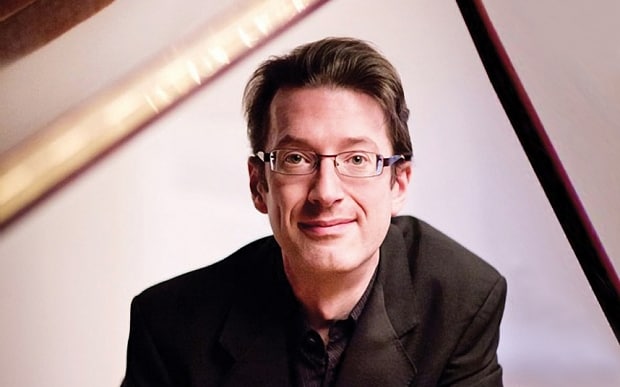


(photo: Jean-Baptiste Millot)

Who or what inspired you to take up the piano and pursue a career in music?

Ultimately my parents! However that isn’t quite as simple as it sounds: they were both professionally trained pianists, and I never remember a time when I wasn’t absorbing beautiful music at home from my mother’s fingers, but I didn’t really get to know my father till I was 20. Nevertheless he was in the background guiding my musical training, so I owe my main inspiration to both of them though at different times and in different ways.

Who or what were the most important influences on your musical life and career?

My fabulous teacher from 7 to 11 was Lamar Crowson. Without his thorough grounding I doubt if I would ever have become a pianist as I had a boyish rebellion at around 12 to 16 when I didn’t do any serious practice, at one point giving up playing completely. At that time non-classical pianists inspired me: McCoy Tyner, Thelonious Monk. I still love them.

Later on I was much inspired by some great string players, particularly Sandor Vegh, at Prussia Cove, who enormously influenced my thinking towards a more expressive, less literal and technical (and also less subjective) response. Also György Kurtág, perhaps the greatest musician I have ever encountered..

What have been the greatest challenges of your career so far?

I don’t think anything came close to preparing the UK premiere of the first six Ligeti Études. In their early days they were only printed as a facsimile of Ligeti’s manuscript and I would pore over a single bar for hours just trying to work out what I was supposed to play, let alone play it. The three Beethoven Sonata marathons I did were a challenge, but at least I knew the music already!

Which recordings are you most proud of?

Hmmm – none particularly! Some I can live with – the Balakirev Sonata and other pieces, Weber 2nd Sonata, some chamber music recordings and some of the contemporary two-piano recordings I did with Andrew Ball 20 years ago or more. When I hear, for instance, John Casken’s “Salamandra”, the two-piano piece he wrote for us, I wonder what became of this furiously energetic young man! Though I keep going and still have recording plans, including with my current duo with Mariko Brown.

Which particular works do you think you perform best?

I think that if I stopped to think of it I would neither play those well nor anything else! I try to approach each piece and each performance as if it’s the first time I’ve played it. Nevertheless there have been some recurrent themes and composers I seem to feel more at home with: Beethoven and Debussy – perhaps two very different sides of me.

How do you make your repertoire choices from season to season?

I try to play only music I love and feel I can say something to at a given moment. That can sometimes be a problem if a recital is booked a long time ahead though I usually find I can rekindle the love affair! I need enough variety, though sometimes reality puts a check on that – If you’re playing a Beethoven cycle you basically have to spend most of your time on Beethoven. Certain types of music become less interesting to me to play as I get older, for instance I don’t play much of the more abstract contemporary music any more. On the other hand I’m going to start playing Bach in my 70s.

Do you have a favourite concert venue to perform in and why?

A good concert leaves me on a high wherever it is. Having said which, I’ve only played a few times in the Albert Hall and it was fabulous. Just that unique, electric atmosphere.

Favourite pieces to perform?

Ravel G major Concerto. Oh for another chance to do that!

Who are your favourite musicians?

Fritz Kreisler. David Oistrakh. Arthur Rubinstein. Carlos Kleiber. Martha Argerich. Samson François. Yuja Wang.

What is your most memorable concert experience?

Playing in the garden of the British Ambassador’s residence in Riyadh with an air temperature of 36 degrees, and the Ambassador’s wife’s falcons solemnly listening.

What do you consider to be the most important ideas and concepts to impart to aspiring musicians?

Love, love, love. The more they love the music, and themselves playing it, the more they will want to communicate with their audiences, the more technique they will want to acquire (for the right reasons) and the more closely and accurately they will want to read the scores of these incredibly great musicians who have written their inexhaustible masterpieces for us.

Julian Jacobson celebrates his 70th birthday with a series of Sunday afternoon concerts at St John’s Smith Square, commencing on 22nd October. Full details and tickets here

One of Britain’s most creative and distinctive pianists, Julian Jacobson is acclaimed for the vitality, colour and insight he brings to his enormous repertoire ranging across all styles and periods.

Read more about Julian Jacobson

itin-14

Who or what inspired you to take up the piano, and pursue a career in music?

I don’t remember myself NOT playing piano.  As I was told by my parents (non-musicians but avid music lovers) I was drawn to the piano from a very young age. I was not that interested in toys – the piano was my toy. Pursuing a career in music must have been my first teacher’s idea: Natalia Litvinova was and has been a very important influence in my life (musical and not).  My conservatory professor, Lev Naumov, remains to this very day an inspiration and a driving force for my musical endeavors.

What have been the greatest challenges of your career so far?

Can’t put challenges on the scale. Everything becomes a challenge and a reward when done with utmost dedication.

Which performance/recordings are you most proud of?

I believe they are to come. There is a light at the end of the tunnel….

Which particular works do you think you play best?

I try to play works that I play best. 

How do you make your repertoire choices from season to season?

I choose whatever fascinates me hoping my audience doesn’t mind my whims.

Do you have a favourite concert venue to perform in and why?

There are many and they change. I suspect it has nothing to do with geography.

What is your most memorable concert experience?

Once I was scheduled to perform a concerto in Santiago, Chile. At the rehearsal ( fortunately not at the performance itself) I found out that the conductor and the orchestra were playing a different version of the piece. I had to change the concerto on the spot. Will never forget that.

As a musician, what is your definition of success?

I don’t have one. I just want to do my job well.

What do you consider to be the most important ideas and concepts to impart to aspiring musicians?

To be a musician is a privilege. 

Where would you like to be in 10 years’ time?

I hope I am still around in 10 years ( roviding the world is still there as well)

What is your idea of perfect happiness?

Would not be perfect happiness if I were able to explain it.

What is your most treasured possession?

I don’t treasure my possessions. 

What do you enjoy doing most?

I enjoy non-doing most

What is your present state of mind?

Ambivalent


Ilya Itin performs sonatas in D by Schubert and Rachmaninov on Saturday 7th October, part of the London Piano Festival at King’s Place. Further information here

ilyaitin.com


