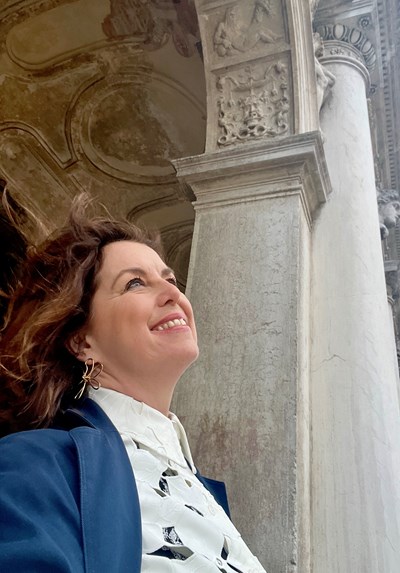
The penultimate weekend in March saw me in London for two exceptional concerts in particularly lovely settings. The experience was enhanced by the company of friends and a delicious meal with a wonderful view across Smithfield (former meat market, now the new site for the Museum of London) to St Paul’s cathedral.

A Season to Sing is a reimagining of Vivaldi’s evergreen The Four Seasons for mixed voices by British composer, vocalist and music director Joanna Forbes L’Estrange. A co-commissioning project between the composer, The Royal School of Church Music (RSCM) and over 50 choirs around the world, A Season to Sing was written to mark the 300th anniversary this year of Vivaldi’s The Four Seasons.

The London ‘launch concert’ took place on Saturday 22nd March at historic St Bartholomew-the-Great, a beautiful ancient church in the City of London. Luminosa Music, an exceptional amateur choir (who impressed with their pitch-perfect timing and exquisite, colourful sound) performed the music, the first half comprising choral pieces by Joanna, her husband Alexander L’Estrange, and works by Monteverdi and Thomas Morley, all with a seasonal theme. This set the scene nicely for the second half and A Season to Sing.

The Four Seasons is a perenially popular work, and this is is not the first time it has been ‘reimagined, Max Richter’s Recomposed, being the most famous example. But A Season to Sing is the first time this music has been reimagined for voices. As Joanna says in the concert programme notes, ‘...re-imagining in no way diminishes our respect for the original compositions. On the contrary it offers a new perspective….’ – this latter point being the most striking and magical thing about A Season to Sing.

Think you know The Four Seasons? Think again! Here, the orchestral version is transformed into a colourful extravaganza of sound which makes full use of the human voice (and other parts of the body) to bring Vivaldi’s seasons vividly to life – from whistled birdsong in Spring to “body percussion” to evoke the storm, a bagpipe’s drone and even some Swingle-style wordless ‘scat’ (Joanna was music director of The Swingle Singers for seven years, and the middle movement is dedicated to the group’s founder, Ward Swingle). New details from the original orchestration are revealed by the choir, such as interior lines and textures, and the entire piece feels as fresh as a spring shower. It’s full of affection too, and wit and warmth. It’s a wonderful tribute to this much-loved music.

The Four Seasons is the first piece of classical music I remember listening to as a child. I have very vivid memories of dancing around the room to the 3rd movement of Autumn

Joanna Forbes L’Estrange, composer

A Season to Sing is being performed around the world by the choirs who took part in the commissioning project (find details of all performances here). The score will be published by the Royal School of Church Music on 1st June (pre-order here).


Sunday afternoon and another concert at a lovely venue, this time the 1901 Arts Club, London’s most stylish and convivial small venue. This was a special concert to celebrate the 340th birthday of J S Bach and to launch American pianist Eleonor Bindman’s new album ABSOLUTE – her own transcriptions for piano of Bach’s Lute Suites BWV 996-998.

A lifelong love of J S Bach has led Eleonor Bindman to produce a number of important transcriptions for solo piano and piano duo of his music for other instruments, including the evergreen Cello Suites and the Brandenberg Concertos. In this latest addition to her catalogue, Eleonor has turned her attention to works originally composed for the lautenwerk or lautenwerck (lute-harpsichord), one of Bach’s favourite instruments, similar to the harpsichord, but with gut (or nylon today) rather than metal strings.

The small size of the music salon at the 1901 Arts Club lends itself to “haus konzert” style performances (such as Bach might have known) and the ambiance at this concert was warm and friendly.

Like Joanna’s reimagining of The Four Seasons, Eleonor sees transcriptions as a vehicle to “revive interest in original compositions”, shine a new light on the original work and “increase their popularity”. And just as in A Season to Sing, new details of dynamics, texture, counterpoint and more are revealed in this transcription for solo piano.

But for me the most satisfying aspect of Eleonor’s concert was her ability to bring so much colour and nuance to the music. Her range of sound was impressive, but never too much nor too little. Perfectly balanced to suit the small size of the venue, she brought both intimacy and grandeur (we can thank Bach for that!) to the music. I don’t think I have ever heard the Steinway at the 1901 played better!

The following day I met Eleonor for a most enjoyable, leisurely lunch, replete with much ‘piano chat’ and conversations about food.

ABSOLUTE is out now on the Orchid Classics label and on all major streaming platforms.

Ahead of the official launch of A Season To Sing, a reimagining of Vivaldi’s evergreen The Four Seasons for mixed voices and organ, composer Joanna Forbes L’Estrange offers insights into her compositional processes involved in rearranging this popular work for choir and explains why this piece is so appealing to her personally.

The work receives its London premiere on Saturday 22 March at St Bartholomew the Great in the City of London, perfomed by Luminosa Voices and organist Gavin Roberts. Info/book tickets here


Why Vivaldi’s The Four Seasons?

The Four Seasons is the first piece of classical music I remember listening to as a child. I have very vivid memories of dancing around the room to the 3rd movement of Autumn which is in 3/4 – my dad used The Four Seasons as a way of teaching me about 2/4, 3/4, 4/4 and 6/8 time signatures!

When I realised that 2025 will be the 300th anniversary of its publication I thought, “now’s the perfect time to make it possible for choirs to sing it!”

What is the appeal of this music for you?

One of the reasons that this particular work is so famous is because it’s programmatic – in other words, the music describes something specific – and was published with a programmatic title. Everyone, wherever they are in the world, can relate to the changing of the seasons and what makes each season different from the next. A piece called Violin Concerto in E major RV269 Op.8 No.1 has far less appeal to your average music-lover than a piece called Spring! Whereas Beethoven’s Piano Sonata No.14 in C# minor Op.27 No.2 wasn’t given the title ‘Moonlight Sonata’ until long after the composer’s death, The Four Seasons was published with that title. It was a genius move!

Vivaldi is known to have loved a series of paintings of Italian landscapes by his contemporary Marco Ricci, who was living in Venice at the same time, one of which we’ve used as the cover for the vocal score. The paintings inspired Vivaldi to write sonnets describing the seasons; the sonnets inspired the violin concertos and the violin concertos inspired me to write A Season to Sing. Perhaps A Season to Sing will inspire a choreographer to turn it into a ballet. Who knows?! This is the wonderful thing about art and artists – there are endless possibilities and inspiration comes from anywhere and everywhere.

How did you go about arranging the orchestral music for voices? Were there any particular challenges in this process, and what did you enjoy most about it?

The first stage was to study the score and work out which bits were singable. Last April, when I was just beginning to write A Season to Sing, I spent a few days in Venice to get into the zone. While I was there I attended a performance of The Four Seasons in Vivaldi’s church, sitting in the audience with the score on my lap, circling any bits which I knew would be good to sing. I’ve always approached choral composing very much from a singer’s perspective because it matters to me that everything I write feels nice to sing. With many of the movements the solo violin part became the right hand of the organ accompaniment while the choir parts were derived from the accompanying string lines of the Vivaldi. The slower movements (usually middle movements within each season) leant themselves more easily to being sung. Vivaldi’s melody-writing is absolutely sublime – sometimes I had to pinch myself to realise that they’d been written 300 years ago.

I decided early on that I wanted to keep all of the keys the same as in Vivaldi’s original. Sometimes, when you’re arranging instrumental music for voices, it makes sense to transpose into a different key, as was often the case when I was singing Bach in the Swingle Singers. I’m pleased that I chose to keep Vivaldi’s key structure because it helps my piece to retain more of the spirit of the original. Keys have certain colours and Vivaldi’s choice of keys fits perfectly with each season: the bright and joyful E major for Spring, the languid G minor for a hot and stormy summer and so on.

Tell us more about the texts you have chosen for A Season To Sing….

Sourcing the poems, hymn texts and Bible passages for each movement was an integral part of the process. It mattered to me that the words might sound as if they could have inspired the music, even though it was the other way round, of course! This meant matching their rhythms, rhyme schemes, phrase lengths and cadences to Vivaldi’s melodies whilst simultaneously enhancing his musical descriptions of different aspects of the seasons.

Vivaldi’s manuscript helpfully contains the Italian sonnets he wrote as the basis for his music. For the opening movement of Winter, I chose to adapt one of these sonnets, L’inverno, to create a soundscape. This is followed by the only wordless movement of the piece which I arranged in homage to Ward Swingle, the founder of The Swingle Singers, who became a close friend during my tenure as the group’s Musical Director. The remaining texts are from the Old Testament (Genesis, Exodus, Psalms, Song of Solomon and Zechariah), poems by two 19th-century English poets Emily Brontë and Eliza Cook, a hymn by Henry Alford and a Thomas Morley madrigal. It’s an eclectic mix into which I added the words of Ecclesiastes 3:1-8 (beginning ‘To every thing there is a season’) and set them in two movements which serve as bookends to the twelve Vivaldi movements.

In the final movement I’ve worked in a phrase from the Requiem Mass, Dona nobis pacem, (grant us peace) which helps to emphasise the ‘time of peace’ from the Ecclesiastes passage. Our world needs peace now more than ever.

What do you hope choirs/singers will enjoy in singing and performing this music?

My intention is for choirs to have a lot of fun with this piece, especially with the passages which are not so much “sung” as “performed”. For example, in SPRING there’s the birdsong chorus of whistlers and the nasal, bagpipe drone; in SUMMER there’s the call of the cuckoo and a storm created with body percussion; in AUTUMN, what were originally hunting horns are now a trumpet fanfare in praise of harvest; in WINTER the opening movement is half-sung/half-whispered to give the effect of the cold and the singers are required to shiver from time to time to maximise the effect!

As I always do when I’ve finished a new piece, I (together with my brilliant husband) have recorded every vocal line so that I can make sure that they all feel good to sing. Anything that feels awkward gets changed. So choirs can expect to have a lovely time learning and performing this piece. Nothing sits too high or too low and it’s deliberately on the easier side because I want all choirs to be able to sing it, from church choirs and chamber choirs to choral societies and community choruses and everything in between.

And what do you hope audiences will take away from the performances of A Season To Sing? I

imagine most people, even those who would profess to know nothing about classical music, have heard at least some parts of The Four Seasons before so I’m hoping that, as the performance unfolds, the audience will be thinking “ooh, I recognise that tune” from time to time. I’m also confident that by hearing a performance of A Season to Sing people might come to appreciate the genius of Vivaldi’s original concertos in a new way. Not only did he write great music but it is describing different aspects of the seasons – so clever!

Mostly I want audiences to feel joy when they hear this music. Performances should be visually as well as aurally entertaining and, because of the seasonal theme, they can happen at any time of the year. I love the idea that some concerts will be in the height of summer and others in the depths of winter! In 2025 there are performances happening all over the world. I’ll publish the list of dates and places as soon as it’s ready. I hope that everyone will be able to locate a performance happening near them and that all of the choirs who put on a concert will have a lovely, big audience of smiling faces.


A Season to Sing by Joanna Forbes L’Estrange is a choral re-imagining of Vivaldi’s The Four Seasons to mark its 300th anniversary in 2025.

Arranged for mixed voices and organ, A Season to Sing weaves into Vivaldi’s well-loved melodies with texts from poetry and the Bible on the subject of spring, summer, autumn and winter. The 40-minute work also includes a new setting by Forbes L’Estrange of Ecclesiastes 3.2 – To everything there is a season.

“…simply beautiful choral writing by someone who knows, from a singer’s perspective, how to compose music which every choir will want to sing.” – SIR JOHN RUTTER CBE, composer

A Season to Sing is a co-commissioning project with the Royal School of Church Music. The music is published by RSCM Publications and will be available from June 2025.

A Season to Sing events:

A Season to Come and Sing – a full day singing workshop, hosted by Joanna Forbes L’Estrange, followed by an informal concert. 15 March, St Thomas on the Bourne church, Farnham, Surrey. Full details/tickets

A Season to Sing – official launch concert. Saturday 22 March, St Bartholomew the Great, Smithfield, City of London. Full details/tickets