Guest post by Jill Timmons, DMA

These days, Creativity is trending as the new fashionable buzzword and answer to the many challenges that we face in midlife. Be creative and you will find happiness! It has even become a kind of “rebranding” tool for product marketing: our school, our company, our products are grounded in a commitment to Creativity. It leaves one wondering what they are talking about.

Creativity, however, is the unique imprint of our humanity. And from this personal expression of our very essence, we can discover most powerfully at midlife a way to recast and renew our potent purpose and meaning in life.

By midlife, most of us have had our share of disappointments, losses, or abysmal calamities, engendering a kind of liminal space—betwixt and between. Moreover, in meeting the challenge of this turbulent time, we may discover that metrics from an earlier period no longer serve us. We can be thrust into an ardent search for new meaning and purpose. It is through the discovery and application of our innate creative nature that we can recast our life journey.

As musicians know, one’s mode of creative expression is a deeply subjective choice, and one that can morph over time. There are, however, principles and processes that are embedded in most any given art form. For example, I launch a creative act with first experiencing desire, noticing what I am drawn to, and where my curiosity lies. Something within me creates a spark of attention. There is energy, illumination, and clarity as to what attracts me. I want to explore, develop, form, craft, or generate something new. I feel a certain intensity or passion in following this engagement. Consequently, I discover a rightness to what I am doing. I cannot not do it. As a musician, for example, I encounter moments of grace and ecstasy that may be in tandem with frustration, doubt, or discouragement. Preparing for a performance requires long hours of study and rehearsal. Then in that temporal moment of live performance, I must be fully present to my rigorous preparation. In wrestling with this creative process, I discover, nevertheless, that there can be flow to what I am doing. Even though the way can often be uncertain, I bear a deep awareness of inevitability as the course of events unfolds. These are the markers of an authentic integral creative act.

You might ask, how does this matter? It matters because Creativity requires an intrinsic perseverance, faith in the eventual outcome however it manifests, and tensile strength to sculpt and sustain an artistic vision and plan over an indeterminant period. Aren’t these the essential qualities for artfully navigating midlife and into the elder years, creating a potent all-in life?

Everyone has a creative impulse. On the other hand, in our noisy distracted world it can sometimes be difficult to simply hear our own thoughts. If you are seeking a new creative vision, one that can reveal renewed meaning and purpose to your life, my recommendation is to first start by carving out a personal retreat for at least a few days. In my experience, this requires digital celibacy. Spend time in nature, notice your surroundings, and if you feel inclined, walk to nowhere. What do you notice? Write freely about this, perhaps in a journal. What would you do if you didn’t have to earn a living? In the quiet of your retreat and in answering this question, you will undoubtedly find a new creative path, something that has piqued your excitement and curiosity. From there, you can build the edifice of a strategic action plan.

As an additional thought, a few words about purpose. We often hear about the importance of purpose in life. Certainly, purpose can give focus to how we choose to live. But purpose without deeply held meaning can become stale, dry to the touch. Unchecked it can be the genesis and breeding ground for “burnout.”

For example, let’s imagine for a moment the following scenario. For many years, as a pianist I taught and performed as a university professor and resident artist. That savoury work became my professional purpose. Nevertheless, I discovered that the meaning of that purpose shifted roughly every seven years. Invariably, I longed for some fresh creative path, one where I could be newly challenged and inspired. Inevitably, the consequence of this search was an infusion of new meaning. While I have remained in the music profession, the meaning of how and why I serve continues to evolve.

Lastly, harnessing your own brand of Creativity may also extend your life. Recently, researchers from the University College of London analysed survey data from a long-term study in the United Kingdom which included some 3,500 adults who ranged from very engaged in the arts to those who chose minimal involvement. Professor Daisy Fancourt reported the research team’s findings: “We found in this study that ‘arts engagement’ was related to 4% slower ageing rates, meaning people were about a year younger, biologically, if they were regularly engaged in the arts. This is actually the same reduction in biological ageing that we saw for physical activity,” she says. These findings are published in the journal Innovation in Ageing.

At midlife and into our elder years it is through harnessing the power of our own Creativity that we discover a way forward in answering the search for new meaning, purpose, and greater authenticity. In doing so, we can also enrich the lives of those around us. Consequently, that purposeful life then becomes our legacy—a gift to the collective.

Jill Timmon’s latest book Variations on Life after 50: A Field Guide to Harnessing the Power of Creativity, Purpose, and Legacy in Midlife is available now. Find out more


Jill Timmons is a leading international arts consultant
www.artsmentor.com

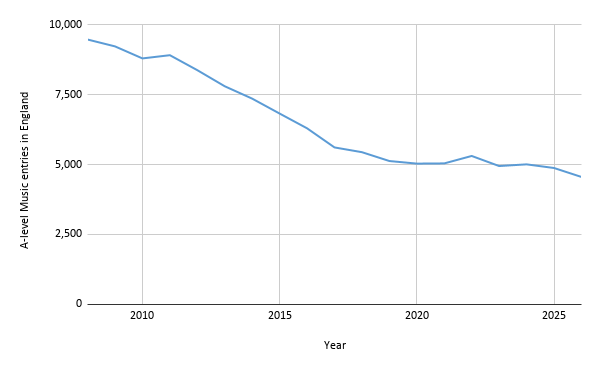
Big regrets: One in three adults wish they’d kept going with music, as A-level Music entries continue to fall

  • New research finds 34% of UK adults wish they had continued making or studying music when they were younger — rising to 45% among 25–34-year-olds
  • Final figures show 4,555 A-level Music entries in England in 2026, down 6.1% year on year and 51.9% since 2008
  • Just 3% wished they had kept going with subjects including law, engineering or accountancy

One in three UK adults — the equivalent of almost 19 million people — wish they had kept going with music when they were younger, according to new research released as A-level Music entries continue their long-term decline.

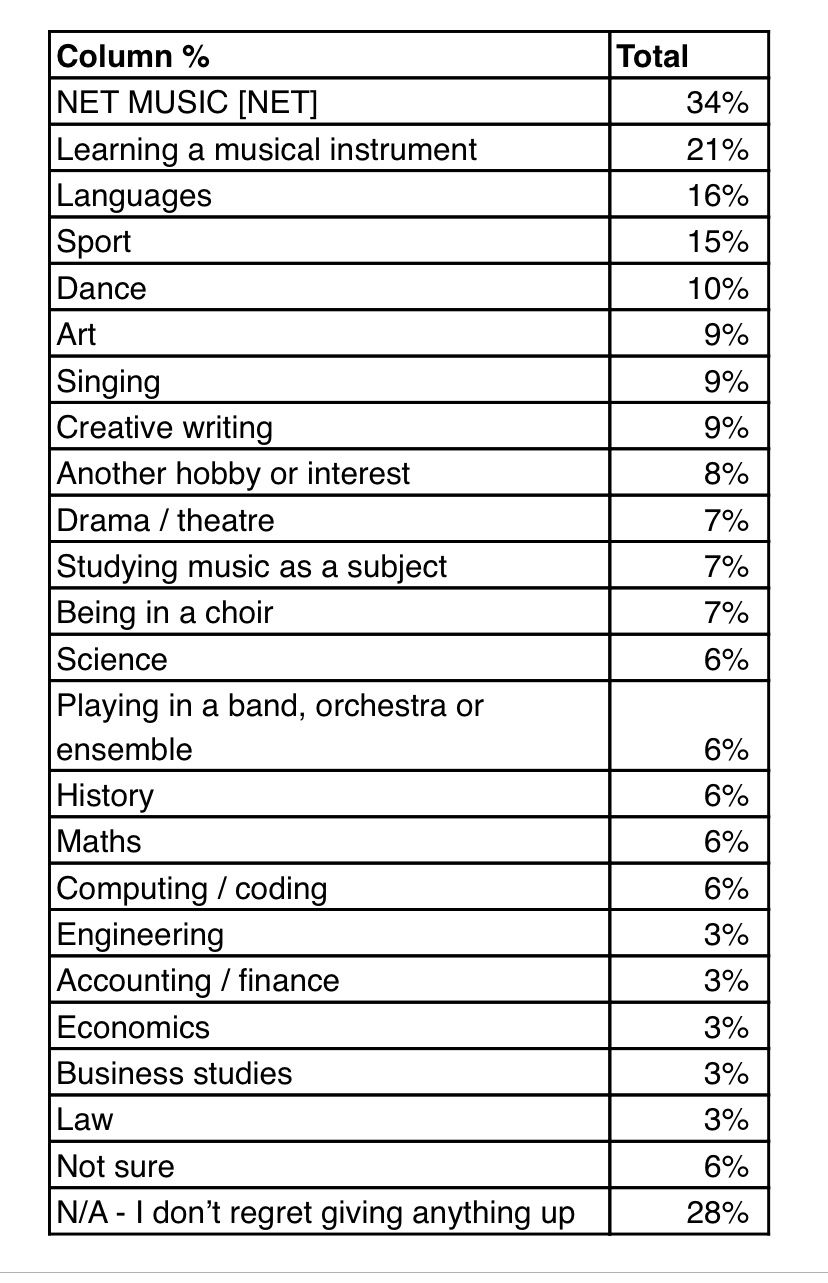
The nationally representative survey of 2,000 UK adults, commissioned by chamber orchestra London Concertante, and conducted by OnePoll, found that 34% said they wished they had continued with at least one form of music, whether learning an instrument, singing, studying music as a subject, being in a choir or playing in a band, orchestra or ensemble.

Respondents were asked: “What, if anything, do you most regret giving up when you were younger? Select all that apply.”

By contrast, just 3% said they wished they had kept going with engineering, accounting or finance, economics, business studies or law.

The findings come as final figures published today show just 4,555 entries for A-level Music in England in 2026, down 6.1% from 4,849 last year, even as A-level entries overall increased by 2.7%. Music entries have more than halved since 2008, when there were 9,465.

Among adults overall, 21% wished they had kept learning a musical instrument, while 9% wished they had kept singing, 7% studying music as a subject, 7% being in a choir and 6% playing in a band, orchestra or ensemble.

Nearly half of young adults already wish they’d kept going with music

The research suggested the feeling was particularly strong among younger adults. 43% of 18–24-year-olds and 45% of 25–34-year-olds said they wished they had kept going with some form of music.

Among 18–24-year-olds specifically, 14% said they wished they had continued studying music as a subject, twice the national average of 7%.

There were also significant regional differences. Londoners were the most likely to wish they had kept going with music, at 45%, followed by people in Scotland at 41%.

Chris Grist, Artistic Director of London Concertante, said: “These results show a huge contradiction in society. Music is increasingly undervalued in education, yet it is also the number one thing people look back and regret giving up. People really do value music — it holds an incredibly important place in their lives. For years, we’ve placed enormous emphasis on STEM subjects. Of course they matter, but so do the arts.

“The whole ecosystem of classical music — the players and singers on stage, everyone working behind the scenes, and the audiences who come to listen — is built on foundations that are partly laid down at school. We need brilliant teachers and schools that give young people the chance to discover music in the first place.

“The Government has promised change, but after years of decline, what matters is whether that ambition actually translates into more young people studying and making music. This is an existential issue for our industry, and we urge the new Prime Minister and his Government to treat it with the seriousness it deserves.

“But it doesn’t end when you leave school. We see thousands of adults coming to London Concertante concerts in their forties and fifties who have never been to a classical concert before. Our mission is to give people a route back in — through music they already know and love, performed by world-class musicians. Nothing beats hearing great music performed live.”

The Music NET comprises respondents selecting at least one of the following: learning a musical instrument; singing; studying music as a subject; being in a choir; or playing in a band, orchestra or ensemble. As respondents could select more than one answer, individual categories should not be added together.

A-level Music entries in England have more than halved since 2008

Final JCQ figures published on 13 August 2026 show 4,555 A-level Music entries in England, compared with 4,849 in 2025, a year-on-year decline of 6.1%. Across all subjects, A-level entries increased by 2.7% in 2026.

Music entries have fallen from 9,465 in 2008 to 4,555 in 2026 — a decline of 51.9%.

Source: Joint Council for Qualifications, A level by subject, age, sex and country, 2026 (Table 1); Ofqual, A-level outcomes in England historical data.

JCQ results: https://www.jcq.org.uk/exam-results/

Accessed 13 August 2026.

Population estimate

The around 19 million figure extrapolates the 34% survey result to the UK adult population using ONS population estimates.

Source: ONS, Population estimates for the UK, England, Wales, Scotland and Northern Ireland: https://www.ons.gov.uk/peoplepopulationandcommunity/populationandmigration/populationestimates

London Concertante tours extensively across the UK and Ireland, performing in cathedrals, churches and historic venues, with programmes built around music audiences want to hear. Its audience-led approach is designed to make classical music feel less like a closed world and more like something people can return to at any point in their lives.

Source: press release

life_cover_750x750_88985424452_enThis could be the best thing I’ve heard this year. A bold claim, I know, but listening to Igor Levit’s new recording Life (Sony Classical) literally stopped me in my tracks….

With four recordings already and glowing reviews wherever he plays, this latest offering – his first in three years – from German-Russian pianist Igor Levit was eagerly awaited. It’s very different from his previous recordings which have focussed on “big” serious works (the Diabelli and Goldberg Variations, Rzewski’s The People United Will Never Be Defeated, late Beethoven Sonatas). ‘Life’ is a classical concept album, a very personal existential reflection on life and death, prompted by the death of a close friend. Music has proven therapeutic benefits and Levit finds a way through his grief , though perhaps not a sense of closure, in a series of solemn, valedictory and deeply thoughtful works by Busoni, Bach/Busoni, Schumann, Rzewski, Wagner/Liszt and Bill Evans. There’s no flashiness here, no glittering runs or vertiginous virtuosity – that would be inappropriate. Instead we have a continuous meditative flow of music from Busoni’s Fantasie after J S Bach through the fleeting poignancy of Schumann’s Geister (‘Ghost’) Variations to Bill Evans’ Peace Piece, an unusual but entirely fitting work with which to close this wondrous recording.

Every note is considered, measured, poised but never mannered: there’s none of the pedantry other “intellectual” pianists tend towards in performance. This playing epitomises the maxim “through discipline comes freedom” – something I felt very strongly in Levit’s mesmerisingly intense concert of Beethoven’s last three sonatas at Wigmore hall last year. You could have cut the atmosphere – one of concentrated collective listening – with a knife, and Levit achieves the same palpable sense of presence, intimacy and profound communication on this recording. It’s as if you’re in the room with him, quietly observing, listening, almost without breathing, while he plays. He finds incredible delicacy in the quietest reaches of the dynamic range – technically hard to achieve and emotionally wrought – and the entire album has a compelling processional quality, felt most strongly (for me) in Liszt’s transcription of Wagner’s Solemn March to the Holy Grail from Parsifal, to which Levit brings immense control and a hushed, prayer-like quality to the magisterial architecture of this work.  The Fantasia and Fugue on the Chorale  ‘Ad nos, ad salutarum undum’,  the longest work on this 2-disc recording, is another glowing transcription, also by Liszt, demonstrating that music, like life, is subject to change. Isolde’s passionate Liebstod and Busoni’s poignant Berceuse pave the way for the final work on the recording.

Bill Evans’ ‘Peace Piece’ matches the solemnity and intensity of the rest of album but in its ostinato bass and delicate treble filigrees, so redolent of Chopin’s tender Berceuse, there is, finally, a sense of consolation. It’s beautifully played by Levit, as are all the pieces on this recording.

Highly recommended