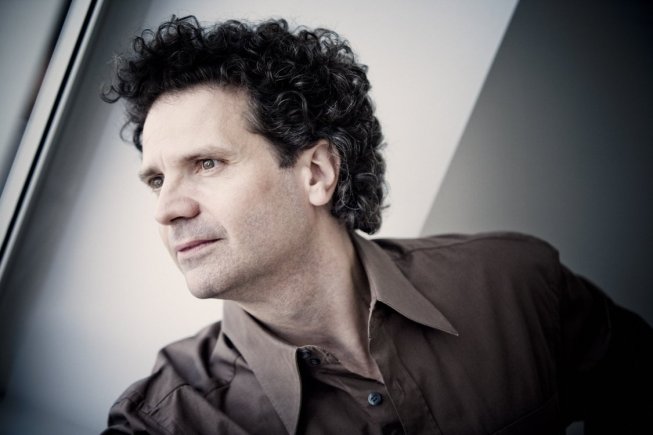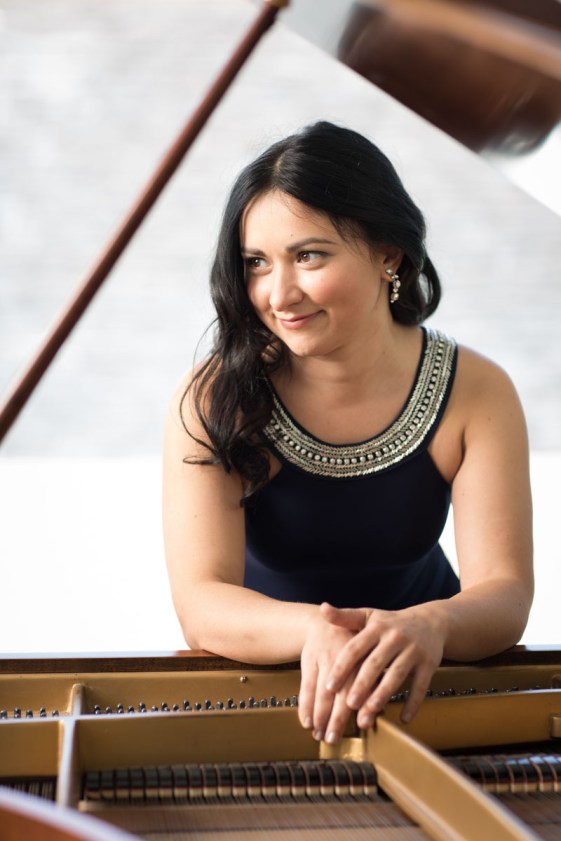
Dinara Klinton, London, April 2015

Who or what inspired you to take up the piano and pursue a career in music? Who or what were the most important influences on your musical life and career?

My passion for music probably started in my mother’s womb, as she is a piano teacher, and I must have heard her play at that stage. According to my family, the sound of the piano was what worked best to calm me down when I was a baby, and when I learned to stand I started playing non-stop – picking up whatever I heard around me and on TV. I remember the day when I was four and my mum brought me to the Special Music School in my hometown Kharkiv (which is similar to the Purcell and Menuhin schools in the UK). She didn’t want me to become a professional musician, as she has had to endure many difficulties herself, but she felt that I had “abilities” (“talent” was a prohibited word) and had desire for it. After half a year of lessons, I was playing works such as Bach’s Inventions and Mozart’s Sonata Facile. I didn’t feel it was anything difficult, but I remember working at it a lot. It is only now that I realise it was because I was a prodigy, but then it was strictly forbidden to say anything like that around me. Three years later I won 1st Prize at the Vladimir Krainev International Competition, and since then Krainev has played a very important role in my life, career and in the development of my taste and musicianship. He was an extraordinary teacher: listening to his “kids” (students or laureates and scholars of his Foundation) he could suggest one tiny thing, which would make the whole work shine. I have never been an official student of his, but I have played for him many times at masterclasses and before his scholars’ concerts. I have to mention that I have always been blessed to have the best teachers – from the very beginning, and I wouldn’t have achieved anything without them.

What have been the greatest challenges of your career so far?

I think it is believing in myself. Due to the nature of our work as musicians, those of us who have had to spend long hours practising from childhood are resigned to a certain level of solitude and hesitation. It makes us more sensible and responsive, but sometimes it is a disadvantage in this cruel world.

Which performances/recordings are you most proud of?  

There have been some performances I was quite pleased with, but I have never been satisfied. I’m quite happy with my latest CD recording of Liszt’s complete Transcendental Études. This was my dream project, and it was sponsored by the prestigious Benjamin Britten Fellowship at the Royal College of Music. I became the first ever recipient of this award, which is generously supported by the Philip Loubser Foundation.  I was also pleased with my performances in the Tchaikovsky and Chopin competitions last year.

Which particular works do you think you perform best?

I have been told that romantic music is my mother tongue. I agree, but would not limit it to that, as I genuinely enjoy and feel pretty much “at home” playing baroque, Mozart and Russian music.

How do you make your repertoire choices from season to season? 

There is a long list of pieces I have been wanting to learn for personal and educational reasons for a long time. And another list of those works I have been asked to play. So, these lines cross sometimes, but in general I’m lucky to be able to learn and perform a huge range of repertoire each season.

Do you have a favourite concert venue to perform in and why?

If I have to pick one, that would be the Great Hall of Moscow Conservatory. Rachmaninoff, Richter, Gilels, Horowitz, Rubinstein and many others worshiped by me from an early age played on this stage, and just this thought gives me an amazing feeling and inspiration. In general, the concert stage (no matter which one) is my favourite place in the world. It is the place I feel most comfortable, doing something I am living for. I am fortunate to be a City Music Foundation Artist who also help me secure great performing opportunities. 

Favourite pieces to perform? Listen to? 

Whichever pieces I perform become my favourite. I don’t think it’s possible to deal with any music without utter dedication to it. I really love listening to orchestral and vocal music: the principle qualities of which pianists should always be aiming for.

Who are your favourite musicians? 

The immortal composers. Among the pianists – I would mention a few giants from the older generation – Rachmaninoff, Horowitz, Gilels, Rubinstein.

What is your most memorable concert experience?

At the moment I would say my performance of Rachmaninoff’s 3rd Concerto with the Philharmonia Orchestra last year. During the rehearsal I was tempted to stop playing and just to listen how beautifully they “sing.” It is an unbelievable feeling to listen to a great orchestra and be on stage with them!

What do you consider to be the most important ideas and concepts to impart to aspiring musicians?

Music is connected to very hard work. The criteria that performances are judged by are very subtle and sometimes blurred. Our ultimate aim should be to create magic, which should leave the listeners’ souls with newly formed ideas plus a feeling of goodness and kindness. Also, to be knowledgeable about and prepare for other aspects of a career in music such as promotion, contracts and personal development, something which City Music Foundation have really helped me with.

Dinara Klinton’s new album Liszt’s Études d’exécution transcendante is now available on the Genuin Label. More details here.

City Music Foundation’s mission is to turn exceptional musical talent into professional success by equipping outstanding musicians at the outset of their careers with the tools, skills, experience and networks they need to pursue music as a viable and rewarding livelihood. 


Pianist Dinara Klinton was born in Ukraine and has recently completed the Artist Diploma in Performance course at the Royal College of Music. Dinara is the first recipient of the prestigious Benjamin Britten Fellowship, generously supported by the Philip Loubser Foundation. Prior to this she was awarded a Master of Performance degree with distinction at the RCM where she was under the tutelage of Dina Parakhina. Upon graduating from the Moscow Central Music School, where she studied with Valery Pyasetsky, she went on her Graduate Diploma with Honors at the Moscow State Conservatory, where she worked with Eliso Virsaladze. Since 2014 Dinara is the City Music Foundation artist.
Dinara has won many awards in prestigious international competitions, including Third prize at the BNDES International Piano Competition in Rio de Janeiro, Brazil (2014), Second Prize and Special prizes for the best performance of the Semi-final recital, Chopin’s composition and Paderewski works at the 9th International Paderewski Competition in Bydgoszcz, Poland (2013), Second Prize at the Ferruccio Busoni International Piano Competition in Bolzano, Italy (2007), Grand Prix at the Berne Interlaken Classics International Piano Competition (2010), Grand-Prix at the Vladimir Krainev International Competition for Young Pianists (2006), First Prize at the International Seiler Piano Competition (2003) and Second Prize at the Tchaikovsky International Competition for Young Musicians (2004) . She has also received the Diploma for the best semi-finalist at the XVII International Chopin Competition in Warsaw (2015) and Diploma of Outstanding Merit at the Hamamatsu International Piano Competition in Japan (2006).
Dinara has appeared at many international music festivals including the Rheingau Music Festival, International Festival of Piano “La Roque d’Antheron”, Aldeburgh Proms, Cheltenham festival. She has performed all over the globe in such venues as Royal Festival Hall, Cadogan Hall in London, Tchaikoivsky Concert hall in Moscow, Great hall of Moscow state Conservatory, Konzerthaus Berlin, Gewandhaus zu Leipzig, Warsaw Philharmonic, Tokyo Sumida Triphony Hall. She has also worked with many orchestras such as The Philharmonia Orchestra, Lucerne Symphony Orchestra and the St Petersburg Philharmonic Orchestra. Dinara’s playing has been broadcast on the radio and TV in Russia, Ukraine, Germany, Italy, France, USA, Canada, Brazil, Japan, UK (BBC2, BBC Radio3).
Dinara made her debut recording at the age of sixteen, with Delos Records, and the album Music of Chopin and Liszt. Her second album ‘Liszt Études d’exécution transcendante’ is available now.

www.dinaraklinton.com

Photo: Benjamin Ealovega


haefliger-andreas-065bmarco_borggreve5d
(Photo: Marco Borggreve)

Who or what inspired you to take up the piano, and pursue a career in music

I was born into a musical family. My father Ernst (a tenor) was the preeminent Evangelist (in the Bach Passions) of his time and also a wonderful Liedersinger.

Under these circumstances it is difficult to describe when the passion for music arose. It was simply always there and, maybe as the smell of leather permeates the childhood of the son of a shoemaker, the smell of music permeated mine.

My mother talked about me always being drawn to the piano – at three years of age I would walk over and start playing, my arms reaching up to the keyboard.

The conscious decision to pursue the career was thus more like an acceptance of the inevitable.

Who or what have been the most important influences on your musical career and life?

Again I must start with the earliest and biggest influence – my father.

From the earliest age I was immersed into going to operas, oratorios and lieder recitals. Wonderful musicians like Karl Richter, Erich Werba, Dietrich Fischer-Dieskau came to our house to make music and as soon as I was able to I had to accompany for pupils who came to the house for lessons. What better training could a child wish for.

In early adulthood my dreamy childhood fantasies were quickly adjusted to the reality of music-making through my studies at the Mozarteum in Salzburg with Hans Leygraf and then through my Juilliard studies with Herbert Stessin and the iconic William Masselos.

At age 17 the towering presence of Alfred Brendel came into my life and studies and dialogue continued for many years for which I am thankful to this day.

What have been the greatest challenges to your career so far?

The pianist’s life is one of constant growth.

As an interpreter you have to find just the right mix of ego and humility and this requires tremendous investment not just in the art of music, but also in the growth as a human being. Therefore challenges are omnipresent in your daily life as you walk through this growth.

Which performances/recordings are you most proud of?

I am still very pleased with my early recordings of Mozart, Schumann and Gubaidulina for Sony. Later I challenged myself with the Perspectives Recordings of which the Beethoven op 106 was a milestone of sorts. The human growth I talked about in the last question is audible however in the last recording of Schumann Fantasy and op 109- so may be I could say this one is the one that has reached an intermediate goal. My public perfomances have always been mirrored by the CDs so therefore I am also at a new level of expression in this medium.

Which particular works do you think you play best?

I do believe that my talent lies mostly in the interpretation of the central european repertoire. I also very much however enjoy commissioning new music from all over the world.

How do you make your repertoire choices from season to season?

I am a strong believer in the importance of programming. The piano recital offers to the pianist an opportunity to combine pieces  and lead the audience from work to work much as a curator would in a museum. In the past six seasons I have made the Beethoven Piano Sonatas the central part of this exhibition and I combine them with works that intuitively or intellectually  share or juxtapose ideas, keys or moods.

Do you have a favorite concert venue to perform in?

I love the famous halls in this world- each one has something particular and stunning to offer. All share the component of facilitating densely concentrated moments in time, thus making the creation of great art possible.

I also sense however that there will be evermore a branching away from these platforms of high culture  and that music in less formal settings will become more and more popular. In the best circumstances this can aid the art form tremendously as it will create an atmosphere of accessibility without watering down the content.

Favourite pieces to perform? Listen to?

I always enjoy the pieces that I am working on at the moment. In listening  I like to be surprised by repertoire I don’t know.

Who are your favorite musicians?

Edwin Fischer,  Wilhelm Kempf, Bruno Walter

Edwin Fischer once said that the perfect interpretation is to enliven a work without violating it. These three performers all shared this ability.

What is your most memorable concert experience

May be in an odd turnaround from my previous answer this still remains Leonard Bernstein with New York Philharmonic performing Mahler 2nd symphony. A wildly involved performance that was stirring to attend- oddly I am much less fond of the recording of this very concert.

What do you consider the most important ideas and concepts to impart to aspiring musicians?

Where does work begin and inspiration end?

We find ourselves in a very strange profession. Ultimately we are the flag bearers of a great achievement of human civilization. Ideally we go on stage in front of thousands of other human beings and transport them to never before experienced emotional heights. Years of study in matters both musical and philosophical have brought us to the point where we find ourselves capable of presenting phrases with such intensity and knowledge that they reach the listeners ear without distraction. Great art is made.

At the same time we live in an age of crippling competition and ability. Worldwide travel and immediate availability are a matter of course in a world where the other one will go and play if you don’t. Quick fix artistry is rampant in a selfie culture that looks to propagate the own achievement through any means possible. The music world is a confusing place.

At some point the student today has to make a decision to involve herself in the slow process of musical growth. At the same time modern aspects of musical performance cannot be ignored but must be incorporated in order for artistic intensity to be realized.

The young student must address this dichotomy early on in order to be able to successfully navigate the art form.


Coming from a rich tradition, the pianist Andreas Haefliger is: “consummately lyrical. Exhibitionism and pretence are antithetical to his musical personality”; he has “a vision of musical architecture second to none and a tender, profoundly cultivated sensibility, from which music flows unimpeded” ( International record review, September 2014). He has won many plaudits for his Beethoven Perspectivesrecitals on disc (Avie) and at major halls and festivals. He is also much sought-after as a chamber musician – past highlights include Mostly Mozart New York with the Takacs Quartet, and Salzburg Festival with Mathias Goerne. In 2014 he gave the premiere at the BBC Proms of a new concerto written for him by Chinese-American composer Zhou Long.

Haefliger was born into a distinguished Swiss musical family and grew up in Germany, going on to study at the Juilliard School in New York. He was quickly recognised as a pianist of the first rank, and engagements with major US orchestras followed swiftly – the New York Philharmonic, Cleveland Orchestra, Los Angeles Philharmonic, Boston Symphony, Pittsburgh, Chicago and the San Francisco Symphony Orchestras among them. In his native Europe too, Haefliger was invited to the great orchestras and festivals – such as the Royal Concertgebouw, Rotterdam Philharmonic, Munich Philharmonic, Budapest Festival Orchestra, Deutsche Symphonie-Orchester Berlin, Orchestre de Paris, London Symphony Orchestra and Vienna Symphony. He also established himself as a superb recitalist, making his New York debut in 1988, and has since performed regularly at major venues in Europe such as the Lucerne, Salzburg and Edinburgh Festivals and the Vienna Konzerthaus, as well as at major halls across North America and Asia.

Haefliger is a regular visitor to London’s Wigmore Hall, where he appears in December 2015 for the next instalment of his Perspectives series, in which he performs the complete piano works of Beethoven alongside works by other composers from Mozart to Ligeti. This series has formed the focus of Haefliger’s solo recital appearances and CD recordings in recent years. His latest chamber music project gathers friends Benjamin Schmid and Karen Gomyo (violins), Lise Berthaud (viola) and Christian Poltera (cello) for intensive rehearsal periods and concerts every year at the Louisiana Museum in Copenhagen, which the group will then take further afield. In spring 2016 he performs with his wife, the distinguished flautist Marina Piccinini, on an extensive tour of the USA.


Who or what inspired you to take up piano, and pursue a career in music?
I started with a local teacher, Art Richards, an amateur who loved music deeply. He gave me freedom to develop at my own pace, and in my own way. After a few years, I found that I could play more advanced repertoire, and it became self-motivating. I went on to study with Paul Strouse, who had been a pupil of Nadia Boulanger and Wanda Landowska. He demanded much more discipline and gave me a more well rounded musical education, preparing me for music school auditions.

Who or what have been the most important influences on your musical life and career?

My teachers, John Ogdon, Michel Block and Maria Curcio. Ursula Corning, a wonderful patron, sponsored my first recordings. Her support also enabled me to give my London debut recital.

What have been the greatest challenges of your career so far?

To balance practicing, teaching, performing and the promotional/admin side of the business.

Which performance/recordings are you most proud of?

I’m pleased with all the recordings I have released so far, but especially Scarlatti and Debussy.

Which particular works do you think you play best?

Anything that I feel I have a clear and personal vision of.

How do you make your repertoire choices from season to season?

I choose pieces to play based on trying to form balanced programmes, largely with core repertoire, circulating old, familiar works with pieces that are new and fresh for me.

Do you have a favourite concert venue to perform in and why?

In London it’s a toss up between Wigmore Hall, for its intimacy and history, and Kings Place, for its clear, detailed acoustics and fabulous design.

Favourite pieces to perform? Listen to?

I always enjoy programming Beethoven Sonatas. In each one there are awkward, angular passages, but his genius makes them works that are greater than they can be performed.

Who are your favourite musicians?

Anyone who plays with focus and integrity, pretty much in any genre.

What is your most memorable concert experience?

Playing Beethoven’s ‘Appassionata’ Sonata outdoors at the Holloway Arts Festival in London. The piano was amplified on a powerful PA system. As I tried to play quietly the sound technicians kept cranking the volume up. So when the sudden fortissimo passages came the dynamic was ear-splitting. I was told the piano could be heard three miles away.

What do you consider to be the most important ideas and concepts to impart to aspiring musicians?

Keep your musical standards high and concentrate.

What is your idea of perfect happiness?

Maintaining a steady 2 or 3 percent improvement every day.

Mark Swartzentruber performs music by Bach, Ravel and Schubert at Kings Place, London on Wednesday 2nd March. Further details here

Mark Swartzentruber has performed throughout Europe, the USA and East Asia. London appearances include solo recitals at the South Bank’s Queen Elizabeth Hall, Wigmore Hall, Kings Place and St John’s Smith Square. He has performed live on BBC Radio 3. He has also appeared on BBC Radio 4 and Classic FM.

Mark Swartzentruber studied under John Ogdon in the United States before moving to London to work with Maria Curcio, the eminent protégé of Artur Schnabel. A committed teacher and educator, he maintains a vibrant private practice. He is an external examiner and adjudicator for the Guildhall School of Music and was formerly a teacher at the Royal College of Music, Junior Department. He has given masterclasses and has adjudicated competitions in Britain, Ireland, the United States and Korea.

Swartzentruber’s début album, of Schubert Sonatas, was released by Sony to critical acclaim. Shortly afterwards he co-founded Solo Records, an independent label. His CDs, of Scarlatti, Haydn, Beethoven, Schumann and Debussy piano works, have all earned excellent reviews in the international music press.

As a broadcaster, Mark Swartzentruber appeared weekly on BBC Radio 3’s Sunday Morning programme, presenting historic recordings, as well as producing the show. He has also had music features commissioned by BBC Radio 3 and BBC Radio 4.

www.markswartzentruber.com


francoise

Who or what inspired you to take up the piano and pursue a career in music?

As a kid, my parents asked if I wanted to play an instrument. I loved the saxophone but teachers said I was too small for it so I turned to the piano instead. I was six and I loved it. At the age of 13, I eventually took saxophone lessons and have enjoyed playing it since but piano always stayed my main instrument. It was definitely chamber music experiences that made me decide to become a professional. The idea of sharing the music not only with an audience but also with other performers on stage was the most beautiful thing I could imagine.

Who or what were the most important influences on your musical life and career?

I’ll never forget as a kid listening to Murray Perahia playing Schubert on Sunday afternoons with my mother while eating chocolate, I realised then the power and beauty of classical music. I can easily say that the most important influences were the people I played with and still now every new musician I meet and perform with has an influence on me. I love discovering and sharing new ideas about music that will eventually change my own playing. From my very early chamber music experiences to my two groups formed as a student (Mercury Quartet and FranÇoise-Green piano duo) up until my current ensembles (NEC, Contrechamps, Nikel), every single person in those groups have challenged my playing and made me a better musician. And of course my teachers Paul Coker and Yonty Solomon that shared with me their knowledge and their passion for music. I also reserve a special place for the hungarian teacher and pianist Denes Varjon who opened a completely new world of understanding music for me.

What have been the greatest challenges of your career so far?

Hard to say, I’d like to think that every project is a challenge, and the ones that aren’t, I try to forget about them quite quickly. I love challenges so they become a pleasure. My most intense and draining experience may have been to embark on the complete performance of Beethoven’s symphonies for piano four hands with Robin Green, 5 concerts in 3 weeks, never have I worked that hard in my life. I also played recently ‘Opus Contra Naturam’ by Brian Ferneyhough, if you don’t know his music, people label him as a ‘new complexity’ composer, just have a look at his scores and you’ll understand the word challenge. Six months of six hours a day on one 15min long piece. It was so worth it though.

Which performance/recordings are you most proud of? 

Probably the Ferneyhough mentioned above, it was such a huge amount of work that I really became one with the piece. But I tend to love performances as they happen and the moment it is finished, I simply cannot wait for the next one, I don’t really like to think that one was better than the other, I simply hope that the next one will be even better.

Haven’t recorded many CDs but very proud of Mercury Acoustic, a free improvisation album with the Mercury Quartet, there was something very special in the studio and the quality of recording is unique. I also believe that the Bach, Schubert and Kurtag CD with the Françoise-Green piano duo (release planned for 2016) could be very special. We recorded music that was so dear to us and I hope people will hear this on the album.

Which particular works do you think you perform best?

Since a teenager, I have always loved performing new music, I feel like I understand the language of contemporary music and I love learning new pieces, especially if written for me or my groups. There are certain pieces that I have performed so many times like Messiaen’s Quartet for the End of Time or Schubert’s Fantasie in f minor that I know I can perform under any circumstances.

How do you make your repertoire choices from season to season?

I play with many new music groups that have an artistic director and decide the repertoire for me, like an orchestra, but the difference with an orchestra is that the repertoire is always new. It is so exciting, sometimes, I may not like certain choices as much as others but it’s the risk to take when we want to discover new things, and I definitely stick to that choice. If I discover a piece or a composer and fall in love with it, then I simply do everything in my power to programme it, and if there is nothing written for piano solo or my ensembles, then I commission.

Do you have a favourite concert venue to perform in and why?

Hard to say, it depends on the repertoire and the context. An audience can easily make a venue good or bad, and of course a great piano will change my perception of it. Yet I remember amazing gigs on bad piano just because the atmosphere and the audience was incredible.

Favourite pieces to perform? Listen to?

I have always had a special place for Luigi Nono’s …sofferte onde serene…, it is a piece for piano and electronics and the electronic part is made of recordings Nono did with Maurizio Pollini. There is so much poetry in this piece and you can really feel the connection and friendship between the composer and the pianist. When you perform it, it may look as if you are alone on stage but it is really a duo with the sound technician. Even though the electronic part is completely fixed, every performance feels so different. A masterwork.

Who are your favourite musicians?

All the people I have mentioned in the previous questions, all the people that forced me to think about music and be a better musician. Some are performers, some composers. I always have huge admiration for people that really brought a brand new way of understanding music, Glenn Gould is one of them. Not only his playing but his thinking and his entire body of work.

Recently I have found those kind of artists more in the pop/electronica world. There are so many geniuses that are breaking new barriers and changing the pre-conceptions of music, that’s what I love.

And of course also all the great story tellers, we should all learn from singers that could take the stage and tell you the most incredible stories. Belgium singer Jacques Brel for example is a real hero.

What is your most memorable concert experience?

As much as I love concerts and sharing music with audiences, I think my most memorable moments are often in rehearsals, when there isn’t so much pressure and you feel very free. I will never forget being in tears at the end of a play through of Beethoven 9th symphony with the piano duo, I had just realised for the first time how incredible this music was and simply couldn’t stop crying.

There are always wonderful moments shared with composers when a brand new piece finally comes to life for the first time, when you realise you’ve just created something together, those are my favourite moments.

What do you consider to be the most important ideas and concepts to impart to aspiring musicians?

Discover new things, always question yourself and learn from everyone around you. And never forget to tell stories. As a classical music interpreter, it can sometimes be a strange feeling to perform someone else’s music, so you have to feel like it’s your own story that you share with the audience.

Where would you like to be in 10 years’ time?

Somewhere new

What is your idea of perfect happiness?

Perfect happiness would be boring, happiness is about the journey towards something better. If it is perfect, where do you go?

What do you enjoy doing most?

Discovering new places

What is your present state of mind?

Tired – it was actually tough to answer all those questions…

Antoine Françoise is one half of the Françoise-Green Duo, who begin a residency at St John’s Smith Square, London on 21st January with the first in a series of concerts entitled The Viennese Salon.

After studying in Switzerland and United Kingdom with professors Paul Coker, Yonty Solomon, Andrew Ball, Ashley Wass (piano), Laurent Estoppey (saxophone) and Michael Oliva (composition), Antoine Françoise performs nowadays in Europe and further as a soloist, chamber musician, with ensembles and orchestras. At the term of his studies at the Royal College of Music in London, he was awarded the prestigious Tagore Gold Medal, for his outstanding talent and dedication to music. Antoine now is a professor of piano (contemporary specialism) at the RCM.

Fascinated by the chamber music of the 20th and 21st centuries, as well as all new expressions of modern music, Antoine is founding member of the Mercury Quartet and the Francoise-Green piano duo, 2011 winners of Concours Nicati (Switzerland). He is also principal pianist of Nouvel Ensemble Contemporain (NEC, Switzerland) and London Contemporary Orchestra. He also played with the London Sinfonietta, Ensemble Contrechamps, Philharmonia Orchestra and the London Philarmonic Orchestra. He played with conductors such as Diego Masson, Pierre-Alain Monot, Nicholas Collon or Vladimir Jurowski.

Antoine worked closely with composers such as Julian Anderson, Rebecca Saunders, Hans-Peter Kyburz (giving the uk premiere of his concerto) and Eric Gaudibert (who dedicated his last concerto GONG to him).

In the classical field, he has performed widely in Switzerland, France and the United Kingdom, including concerti by Grieg, Hindemith or Poulenc and is hugely in demand as an orchestral pianist and chamber musician.

www.francoise-green.com

Meet the Artist…..Robin Green