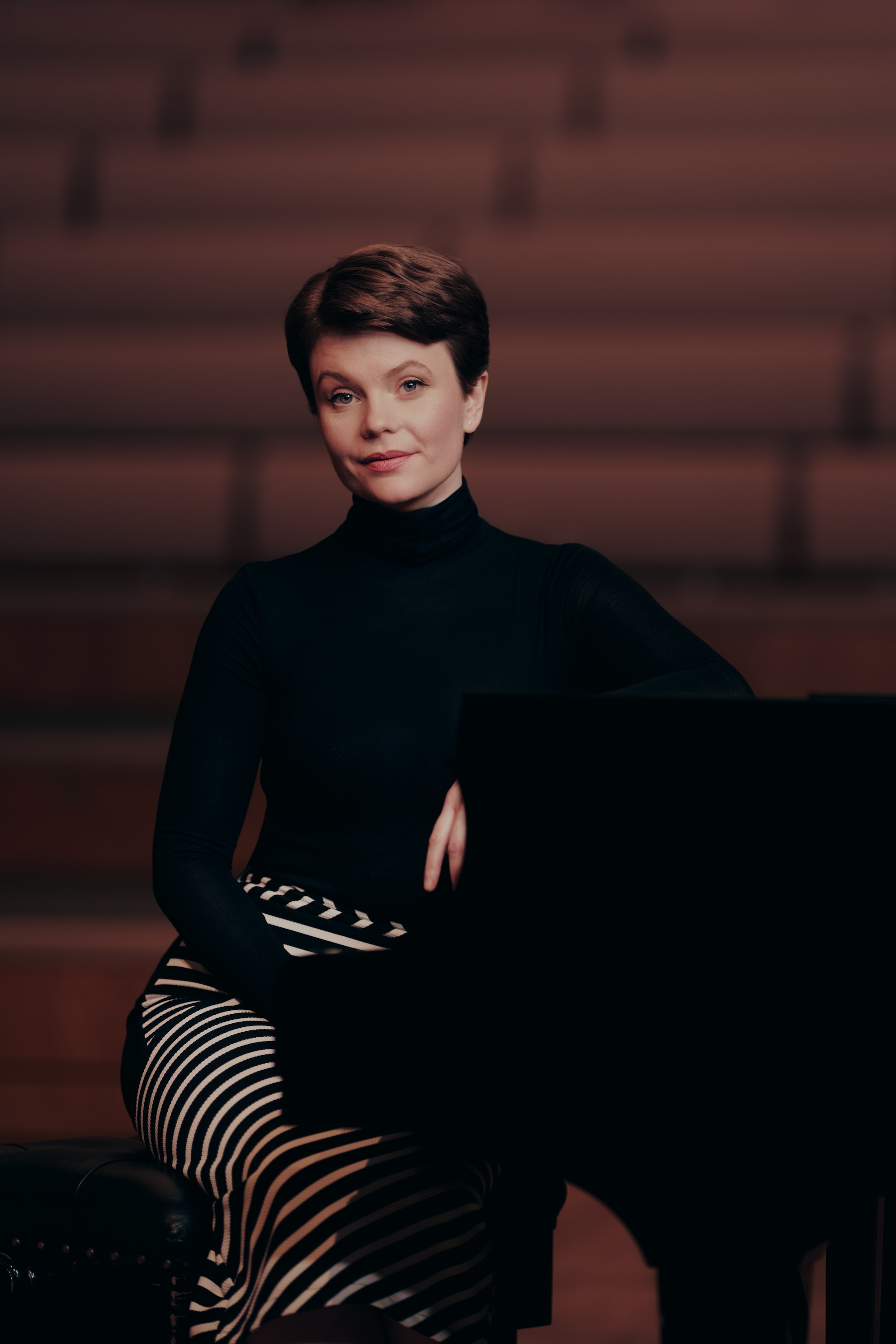
Since 2017, British pianist Clare Hammond has given 25 concerts in 8 prisons across the South-West of England. Here she describes her experience of performing in prisons and how music can inspire, console and heal.
Prisons can be daunting environments. A trek through long concrete corridors and heavy iron gates, negotiating lock after lock, to find a community of adults, trapped, bound together by adverse circumstance. Emotions run high yet are often impossible to express – shame, detachment, fear, denial. A sense of loss and frustration is palpable.
These environments are so distinct from our usual lives that the experience of visiting one for the first time is profoundly disorientating. Not only the physical environment, but the social hierarchy, is unfamiliar. I had never previously been so aware of a disparity of power, of the tension that a necessary hierarchy between staff and prisoners can produce. Words become charged and communication falters.
Unlikely as it may seem, music can provide a way to overcome some of these obstacles. I started to perform in prisons in 2017 as I was recovering from a severe and disorientating bout of postnatal depression. Not only had I been profoundly depressed for a year, but at times I had sensed my grasp on sanity weakening. This in itself was so alarming, and my obsessional focus on disaster and despair so wearing, that I decided to take drastic action. I needed to try something new, something challenging enough to distract me from my interior monologue.
I contacted a friend of my husband, a prison Chaplain, and asked if he might be willing to arrange a concert. I had no idea whether a recital of classical music would be of interest, but he accepted. A few weeks later, I found myself at Security, lugging my electronic piano behind me. After a thorough search, I was admitted and made my way to the Chapel. As I unspooled the extension cord, heard just how thin the piano sounded in the acoustic, and watched the rows of men file in, I wondered whether this had been a sensible decision.
I took a deep breath. Some listened expectantly while others were conspicuously indifferent. Two small pockets of young men were joking around, elbowing each other and sniggering. After a couple of virtuosic Chopin études, I decided to focus on the human stories behind the music, describing obstacles that the composer had faced and the way these emerge in their music. I described Schubert’s final illness, the isolation he experienced, and the beauty of the music he composed during that period. This was more powerful than I could have anticipated. The audience were completely still during his Impromptu in G flat major and, to this day, this remains one of my most moving concert experiences.
I have now given 25 recitals in 8 different prisons and still follow this format. I present, in turn, Robert Schumann’s battle with bipolar disorder, Beethoven’s contemplation of suicide in the Heiligenstadt Testament, or Hélène de Montgeroult’s imprisonment and sensational trial before the Committee of Public Safety, evading execution by the skin of her teeth. I programme tonal music with familiar melodies alongside more adventurous repertoire. Unsuk Chin’s phenomenally inventive Toccata, as ‘uneasy’ a listen as you could hope for, has become a surprise hit. To see the eyes of a young man light up in enthusiasm at his first encounter with hardcore contemporary music was not something I had anticipated. I donate copies of my discs, often of obscure repertoire, to the prison libraries and hear, months later, that a man who had never listened to classical music before has become a fan of Szymanowski.
From a personal perspective, these concerts have healed and grounded me. I have always been an anxious person, and suffered from debilitating guilt when I was ill with depression. Seeing the power music has to connect people, to console and inspire in such difficult environments, has taught me the value of my work. I now feel that I am making a real contribution and am much calmer as a result.
I believe firmly that everyone should have access to classical music, in all its forms. It broadens horizons, offering a glimpse of what life could be, what adventures are possible. Most importantly, though, it creates a visceral link between us – between those who hear a performance, those who play together in a band, or between a long-dead composer and the people their music inspires. Music is powerfully communicative, particularly in environments where words are too charged for comfort. It transcends our daily struggles and brings hope.
Acclaimed as a “pianist of extraordinary gifts” (Gramophone) and “immense power” (The Times), Clare Hammond is recognised for the virtuosity and authority of her performances.
In 2016, she won the Royal Philharmonic Society’s ‘Young Artist Award’ in recognition of outstanding achievement. Recent highlights include Grieg Piano Concerto with the City of Birmingham Symphony Orchestra, Moussa and Carwithen with the BBC Symphony Orchestra and BBC Concert Orchestra, Panufnik with the Warsaw Philharmonic Orchestra, and recitals at the Aldeburgh Festival, Palazzetto Bru Zane in Venice (broadcast on RAI 3), Husum Festival in Germany, and in Denmark and Norway with Henning Kraggerud.
When did I begin my love affair with the music of living composers? The moment I found Yvar Mikhashoff’s ‘Incitation to Desire’ CD of tango music for the piano. The smoky cover, the provocative title track – I was caught before I listened to a single piece. Ah, and what a collection! Tangos from multiple eras and in multiple styles. Tangos that spoke of something illicit, a smoky world of furtive late-night romance, smoky dance halls, and sensuality. These tangos represented a freedom I craved – freedom from the performance practice expectations of standard repertoire, and freedom from the years of insecurities and assumptions I brought to the music I’d been playing my whole life. Tangos broke the rules. I’d never danced a tango in my life, but I knew I needed to make music with the freedom I heard in these pieces.
I’d never worked on music by a living composer before I found this CD, but my love of this music was such that I set about tracking down the scores of my favourite pieces. Many of the tangos were unpublished, which meant I wrote to the composer to purchase a copy. Scott Pender’s tango, ‘Ms Jackson Dances for the World’ was one of these. After I received it, Scott and I kept corresponding. We became friends and have remained so for over a decade. And I loved his music – so much so that I eventually played, performed, and taught most of what he’s written for the piano. Ironically, although Chester Biscardi’s ‘Incitation to Desire’ was easier to find (it was published), I never felt I got inside it well enough to perform it publicly. It sat in my music collection, its provocative title and gorgeous writing teasing me with the promise of something I couldn’t quite grasp.
It took me over a decade to put ‘Incitation to Desire’ on a concert programme. I think this was because I needed to live more before I truly understood it. I needed to go tango dancing and feel the freedom and sensuality of the Argentine tango in my bones. I needed to perform and record Piazzolla tangos with my duo partner Molly Wheeler. And, on a deeper level, I needed to break a whole lot of rules. I needed to experience the judgment that comes from choosing to leave a marriage that had been on life-support for years. I needed to experience being swept off my feet by an unexpected grown-up romance that changed my entire life. In other words, I needed to know freedom before I could play it on the piano.
Because ‘Incitation to Desire’ is about sensuality and freedom. Much like the Argentine dance, it relies on the pianist’s ability to instinctively feel their way through the score. This piece begs to be played almost as an improvisation – just the same way that the Argentine tango is danced. It’s the pianist and the piano and the interplay of notes – sensuous, slinky, unapologetic. Chester Biscardi asks for a flexible interpretation of dynamics and tempi. I take this to mean that that this piece is best played from the senses, not the brain; instinct, not reason. In other words, you can’t play this music until you let yourself be seduced by it.
It was my No Dead Guys post about (and YouTube recording of) ‘Incitation to Desire’ that prompted Chester Biscardi to email and tell me how much he enjoyed my performance of it. That correspondence led to me learning ‘In Time’s Unfolding’ and ‘Companion Piece (for Morton Feldman)’, two pieces that, ironically, I still feel I had more of an innate understanding of than the tango that introduced me to Chester’s music. Best of all, Chet and I kept corresponding, and that correspondence blossomed into another friendship that I cherish.
I’ve never coached a student on ‘Incitation to Desire’; I’m not sure it can be done without introducing topics to a lesson that can get an instructor arrested. Furthermore, because it’s so improvisatory, the key to playing this piece well lies within each pianist’s personal experience. If they’ve lived it, they can play it. If not, no amount of musicianship or technique will bring this piece to life. I can, however, offer some general guidelines on how to navigate the score:
1) Don’t be in a hurry. This is slowly unfolding, sensuous music that can’t be forced by the pianist. All forward momentum must come from the sense that the power of the moment itself is what propels the music forward.
2) Don’t dig in too deeply on the scale passages. These are flourishes, the twirl of a tango skirt, a spin. They’re caresses, not demands.
3) Don’t start your accelerando too quickly at m. 29; you’ve got a very long way to do before you hit the end of it. This – like everything else in the piece – should feel inevitable and effortless.
4) Pay very close attention to the pedalling; it makes or breaks the piece.
5) If you’ve never danced the Argentine tango, watch some videos of it. This will explain the start/stop, slow/fast, gesture-driven nature of the score.
6) When you play it, drop all expectations of the piece, surrender to the music, and let it take you where it wants to go.
Sometimes the best way to find ourselves is to break a bunch of rules. Incitation to Desire gave me the permission I needed to follow my instincts rather than others’ expectations. It seduced me into a lifelong passion for the music of living composers. And even today, it reminds me to let moments and situation unfold naturally; it reminds me that the richest life (and my best playing) lies in releasing rigidity and entering the messy, beautiful, passionate dance of earthy, real life with my hands and heart wide open.
Rhonda (Ringering) Rizzo is a writer and a former performing and recording pianist. Her novel, The Waco Variations, was released in the summer of 2018, and her numerous articles have appeared in national and international music magazines, including Pianist Magazine, American Music Teacher, Clavier, Piano & Keyboard, and Flute Talk. A specialist in music that borrows from both classical and jazz traditions, Rizzo released four CDs, Made in America, Oregon Impressions: the Piano Music of Dave Deason, 2 to Tango: Music for Piano Duet, and A Spin on It.
She holds a BA from Walla Walla University and a MM from Boston University and is a passionate advocate of new music and living composers.
This site is free to access and ad-free, and takes many hours to research, write, and maintain. If you find joy and value in what I do, please consider making a donation to support the continuance of this site
Edna Stern’s latest release is a fascinating find. Beautifully performed, for sure, but those performances are led by an intriguing, impeccably realised idea.
The pieces on this disc are well-loved and oft-recorded: the first four ‘Impromptus’ (D899) and the ‘Moments Musicaux’ (D780). But Stern, following the courage of her convictions, has arrived at a new way of hearing them. Or perhaps, more accurately, a very old one.
The artist’s sleeve-notes explain the background at length, and if you buy this album, you’ll find they are an excellent read. So I will just try to summarise here. Broadly, Stern became disenchanted with modern digital recording – in particular, the facility to edit performances into ‘perfection’. To the non-expert listener, what can sound like a seamlessly executed rendition of a work is sometimes a painstakingly finessed collage from multiple takes. Flashes of divine inspiration that don’t conveniently occur within the same run-through are made to do so, after the fact.
This came to a head, Stern tells us, when working with a sound engineer who produced an edit that was stitched together to the point where she could barely recognise her own interpretation. For this project, then, each of the ten pieces is represented by a single, intact take. Of course, Stern recorded them several times in order to choose her favourite, but no artificial mix-and-match took place. She picked the versions she found the most interesting or appealing, if not necessarily the most accurate: the integrity and spirit of the performance outweighed the occasional stray note or tempo.
One of the reasons I enjoyed Stern’s booklet essay so much is the extremity of her position. While she acknowledges the value and skills of everyone involved, she calls that game-changing edit a ‘monster’, and likens the studio correction of mistakes to offering a performance from a robot over a human. It’s forcefully argued stuff.
And thought-provoking. Schubert-lovers who are tripping over Impromptu recordings – anyone with shelves (or hard-drives) full of versions of their favourite works: what are we looking for? I realise there’s an element for many of seeking an ideal version that matches the one in their head, of looking for the ‘best’… and I don’t envy critics who have to make these sorts of comparisons all the time. But what it’s really about, surely, is hearing the works you love ‘renewed’, enjoying the surprise and delight of seemingly infinite reinterpretations of the same music.
You could argue that, most of the time, these differences survive modern recording techniques. What must be Stern’s worst nightmare – correcting every error or deviation from the score so that every pianist’s Schubert CD comes out identical to all the others – hasn’t come to pass. But by removing the safety net, Stern has thrown down a gauntlet of sorts – will other classical musicians follow suit and subject their unvarnished playing to scrutiny?
I use the word ‘classical’ here deliberately. Pristine clarity may be the common goal in this genre, but over on the rock side of the fence, many acts have often wanted to go back to the source, in their search for authenticity. There’s the huge number of bands who went through the ‘Unplugged’ rite of passage in the 90s. There are producers like Steve Albini, who seems to carry out the intensive labour upfront, listening to his clients and finding exactly the right place for the microphones in the room – then documenting the resulting live sound, with staggering results. There’s the formidable roster of groups – perhaps most famously, the White Stripes – who have made records at London’s Toe Rag Studios, renowned for their totally analogue set-up.
There is a rock-snob trap here, of course: “when it’s me, it’s authenticity – when it’s you, it’s nostalgia”. But Stern is totally alive to this, seeking to recapture the sound of the recordings she loved most during her early development. Has she succeeded?
When you start ‘Schubert on tape’, you could be forgiven for thinking you’d just lowered the stylus on to vinyl, or pressed the clunky play button on a cassette player. You hear the room before the piano. Instead of a CD’s usual dead silence, you hear an ambient noise that I instantly want to describe as ‘warmth’: it’s not disruptive, there’s no hiss or clicking, just a hushed presence that replaces any potential dryness or sterility.
There’s no doubt about it. I was hit by two waves of entirely pleasurable nostalgia. One, true: my youth, playing records and tapes in my room. Two, false: the feeling evoked by Stern of being at a Schubertiade, hearing the composer perform his work in intimate, informal surroundings.
Because once the music starts, you are there in the room (especially if using a decent pair of headphones). You can hear some of the pedal work – towards the end of Impromptu No. 4, for example, there’s a passage where this almost becomes a percussion feature – and the rise and fall of the keys, even (I think) accompanied once or twice by the click of a fingernail. This sustained, audible ‘physicality’ really brings home the effort involved in a good performance and, in the salon of the imagination, makes you feel genuinely close to the player.
I think there is also a pleasing effect on the dynamics. I was reminded of something the rock writer David Hepworth said on a podcast, when discussing the merits of vinyl over CD – almost his instant response was: “The drums don’t hurt.” Analogue recording as evidenced here has a generosity of scope – I can hear that Stern is across every pp and ff, and all points between, but the sound never becomes a bang or a whimper – it’s all accommodated in the bandwidth.
We hear chiming, keening top notes and a gorgeous bass rumble – particularly in, say, Impromptu No. 2 or Moments Musicaux No. 2 – reminiscent of a fortepiano (I was interested to read that Stern also plays this instrument). The dexterity and sensitivity of Stern’s playing is still immaculately conveyed, shining through – while benefiting from – the tape’s ambience.
As a result, I think Stern’s particular strengths and this style of recording are perfectly aligned. A successful experiment, then – I look forward to seeing the research continue, and hearing which composer becomes its next subject.
Schubert on Tape is available on the Orchid Classics label
Adrian Ainsworth is, by day, a copywriter specialising in plain language communications about finance and benefits. However, he spends the rest of the time consuming as much music, live or recorded, as possible – then writing about it, often on Specs, his slightly erratic ‘cultural diary’ containing thought pieces, performance and exhibition write-ups, playlists, and even a spot of light photography. He has a particular interest in art song and opera… and a general interest in everything else.
An article in response to Andrew Eales’ excellent article Making Peace with your Inner Musician, which was in turn prompted by this quote from the Bhagavad Bita: “Better indeed is knowledge than mechanical practice…But better still is surrender of attachment to results, because there follows immediate peace”
I’ve already written about mechanical practice versus knowledge and clarity. But I find I am developing my thoughts on this even more with regard to some of my students. In his article Andrew Eales’ discusses having less of an attachment to and more of an appreciation of results and goals; to be kinder and more accepting of ourselves and our piano playing journey; and to find ways to enjoy our playing and what it gives both to ourselves and others. I agree with this wholeheartedly.
I read this quote from the Gita and understood it slightly differently; I interpreted it to mean that in letting go of attachments to goals we let go of those goals altogether; taking away ALL judgement about our playing (even with regards to right or wrong notes) and immersing ourselves in the moment; surely it is this that this leads to immediate peace? I’m not saying that there are not times and situations when results are useful and necessary (whether extrinsic or intrinsically motivated), but that there can be another option for pianists.
As COVID struck I noticed my teaching changed; I was more interested in my students being able to play music than any amount of right notes or technical achievements (hard to do the latter online anyway), so we found ourselves focussing on the sounds, using improvising and ear games. I have already written about how this can help with improvising so I won’t reiterate all those points here, other
than to say if a student can withhold judgement about their playing then they can make music, however little they know or practice; when unable to concentrate on notes on a page, many of my students found solace through the piano and kept playing through both lockdowns.
More recently though, one of my students had an injury and couldn’t play, but got fed up with this and wanted to just get her fingers on the keys, so we have been talking about moving away from any ‘result’ at all, trying instead to focus on being in the moment, and the process of actually playing, whatever that playing is (i.e. whether improvising or learning a piece), and relinquishing all judgement about whether it is good, or right, or even sounds ‘nice’ (there is plenty of published classical music, or jazz improvising, from highly respected musicians and composers, of which I don’t like the sound, so if they can produce such music, why can’t we?!). The student is not learning for either a concert or exam, so why get upset about the notes…? Radical! We can aim at the right notes (assuming we are learning a composed piece), but judge ourselves less, or not at all, for getting them wrong, and enjoy the process in any case.
The Alexander Technique talks about ‘end gaining’; the mistake we make in focusing on the end result rather than how we get there. Understood correctly this is a huge part of how the Alexander Technique can benefit a piano (or any other) student. I think it can go further than aiding our clarity and technical grasp of the music and take us to a place where we are in the moment and finding peace, whether it is in enjoying the physical nature of playing the piano (which is one of the things I myself love about the piano, whereas I didn’t like the particular physical demands of playing the flute, for instance) or getting absorbed in the moods we can evoke. Sometimes we might enjoy the former but not like the latter we produce but does it matter; if it is ephemeral then is has gone in a whisper but we have lived the moment with peace and pleasure.
If you want a left brain reason to do this then be reassured, letting go of all our preconceptions and ‘goals’ completely can produce much more freedom; from judgement, from tightness of technique, or from musical and physical rigidity, and lead one to being more comfortable at the keyboard from whence ‘traditional’
results and goals are more easily attained.
So along with Andrew’s suggestion to be kinder of and more appreciative of where we end up, I also encourage you to be more mindful of, and kinder to yourself, in the moment. Take away an interest in the results completely, and with it any judgement of how you get there or what you are doing. As I’ve said once before and which reflects Andrew’s own words, once we get out of the way, there is only the music, whether is it ours, or Mozart’s.
Alexandra Westcott, BA, FRISM, is a piano teacher and accompanist based in north London.
The Cross-Eyed Pianist is free to access and ad-free, and takes many hours every month to research, write, and maintain.
If you find joy and value in what I do, please consider making a donation to support the continuance of the site



 Adrian Ainsworth is, by day, a copywriter specialising in plain language communications about finance and benefits. However, he spends the rest of the time consuming as much music, live or recorded, as possible – then writing about it, often on



 The Cross-Eyed Pianist