Guest post by Dakota Gale. The latest article in Dakota’s series Notes from the Keyboard, aimed at adult pianists
I recently attended a piano performance, during which I spoke with a 92 year old woman sitting next to me. She’d played and taught piano for decades. When I mentioned that I take lessons online, her eyes widened. “ONLINE lessons? But…that is the most amazing thing!”
She’s not the only one surprised. “Wow, you take lessons online?” is a common response from most people, even after the nuclear proliferation of pandemic Zoom meetings.
Yep, ever since I began taking lessons in spring of 2021, I’ve done them online. My teacher, Antonio, is located in southern Brazil; I’m in the Pacific NW in the U.S, thousands of miles away. And it’s not just me; plenty of people do it, including:
Those looking for specific expertise (e.g. Chopin etudes from a professional)
Those being careful while going through chemo or with a disease affecting their immune system.
Those who travel a lot (tougher if you’re flying, obviously)
If you have a favoured, dear teacher, but one of you moves, going online allow you to continue lessons.
Me and Online Lessons
For me, initially I took online lessons because of two things: to save money and to avoid COVID.
Since then, I’ve seen additional benefits. For one, they’re much more time efficient. No travel across town! For parents, I imagine this would be a huge benefit since you’d avoid shuttling kids around. (Actually, one of my friend’s kids is taking lessons with Antonio.)
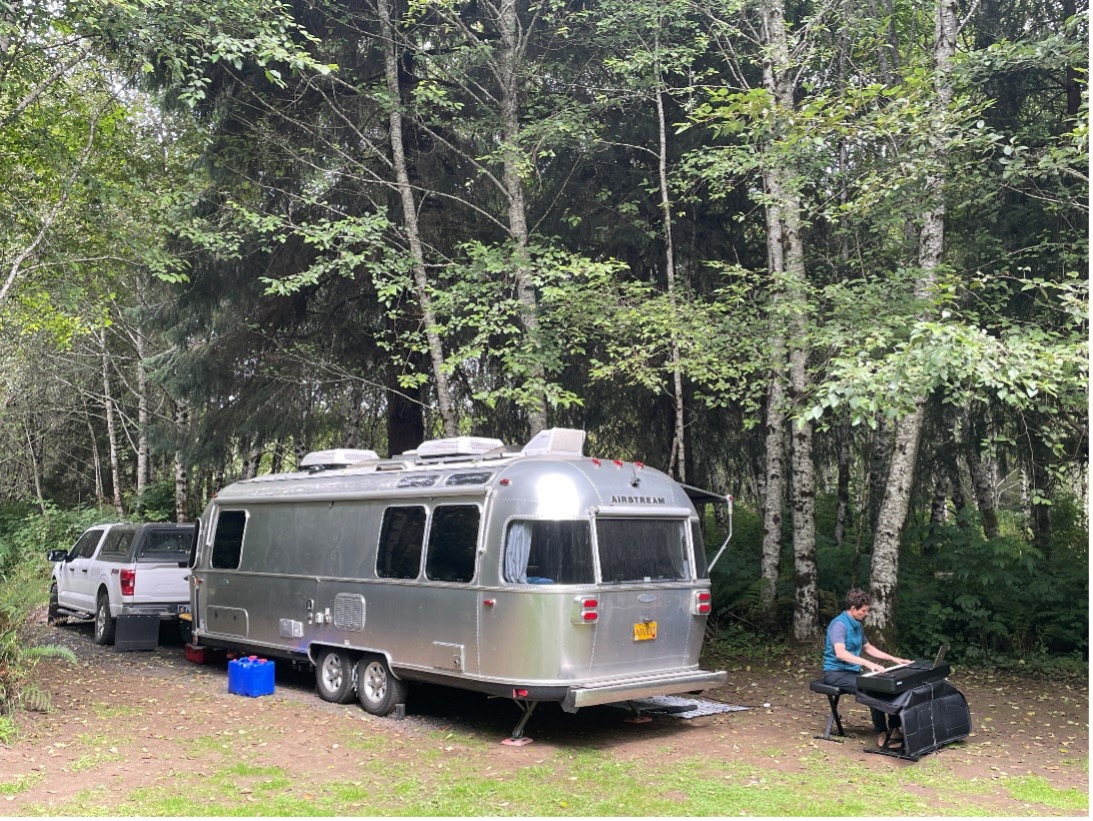
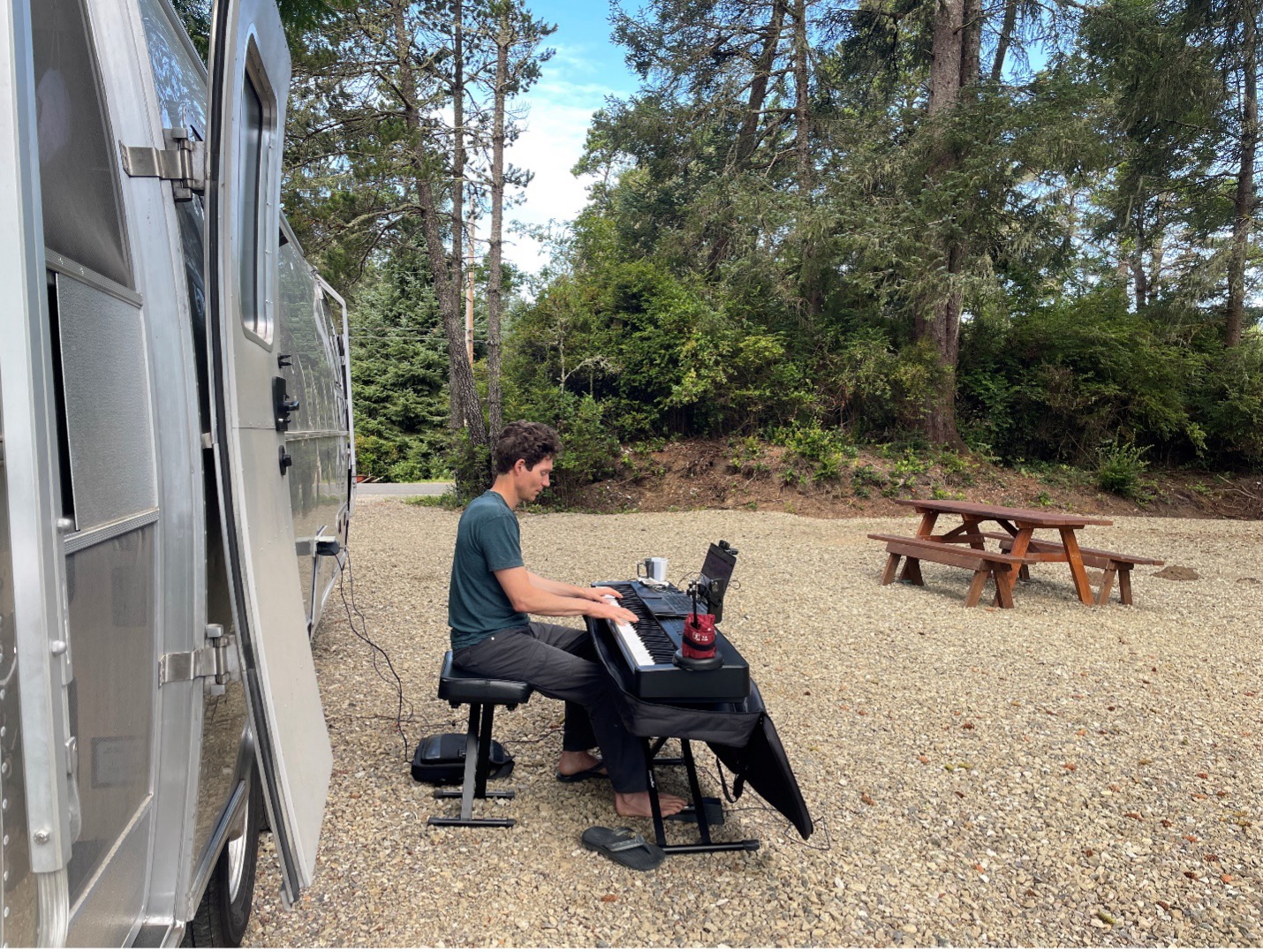
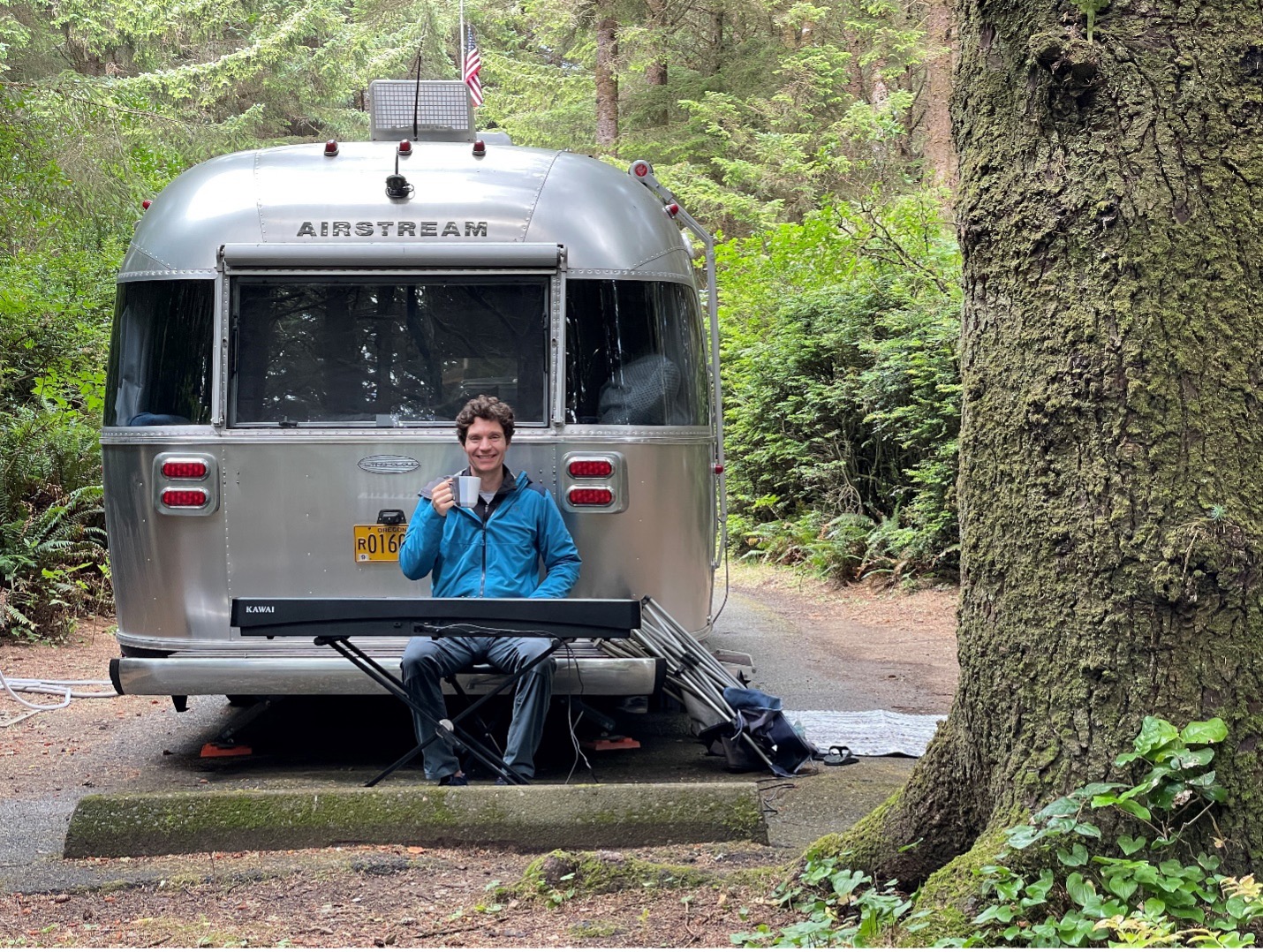
I travel fairly often and like to keep lessons going. In fact, I’m currently rolling around the Pacific NW with my wife for three months in a Airstream travel trailer. Between mountain bike rides, hikes, and hanging with friends, I’m both continuing to play consistently and still taking my weekly lesson. Courtesy of Starlink satellite internet and a digital Kawaii piano, I’m not skipping a beat.
When my teacher is on vacation, I’ve also taken lessons with professionals such as Grzegorz (Greg) Niemczuk, who I found on YouTube. You might be surprised how many YouTubers offer lessons (a friend takes lessons with the popular Heart of the Keys YouTuber.)
You know what makes piano better? Playing outside!
Beyond all those boring logistical things, Antonio being Brazilian brings a fun perspective to my experience. (I’ve learned a few choice phrases in Portuguese, for one!) I’ve also learned about (and love!) Brazilian music that I would otherwise not know, including tangos, the music of Tom Jobim and Ernesto Nazareth, and folk songs arranged for piano.
It inspired me to start a listening quest of different genres and international composers that has deepened my relationship to piano. Perhaps a local teacher would have provided that, but certainly it would have been different.
The nuts and bolts of online lessons
For those wondering how this is possible, allow me to describe the situation:
Antonio uses a Yamaha grand piano to teach. On it, he has four cameras for his face, top down on his hands, sideways on his hands, and another on his pedal. He even uses software that allows the camera to track his hands (AI magic!).
The sound quality is quite good–the nuances he can hear and comment on astonish me.
For my setup, I use a different system depending where I am. At home, it’s my computer with a webcam plus my phone on a stand looking straight down at my hands. While traveling, I just go with my phone on a small tripod set up to the side and occasionally my laptop in front of me. It works great.
The benefit of all this: the only time I’ve missed a piano lesson is when I’ve taken bikepacking trips. I challenge you to carry a full-size digital piano through the mountains…no thanks. A pianist needs to take a break from the keyboard SOMEtimes!
Resources:
To find an instructor, just type “piano lessons online” into any search engine. A few popular services: Superprof or Wyzant; a fellow traveler I met on this trip used Preply to find her ukelele instructor. (If you want to work with Antonio, just ping him on Whatsapp at +55 48 9181-9164.)
Following one of those wonderfully serendipitous encounters on the internet, I am delighted to present “Notes from the Keyboard”, a series of articles for adult amateur pianists, by Dakota Gale, chronicling his own experiences of learning the piano as an adult.
Four years ago, my wife surprised me with a digital piano for my birthday. I’d mentioned my desire to learn a few times and, ever the muse, she called my bluff.
I couldn’t read music. Finding middle C was a quest. I was a B-E-G-I-N-N-E-R.
And yet…she was right. At 38 years old, I tumbled rapturously into the world of piano.
Four years later, the honeymoon phase is over, and yet I remain motivated to play every day and am still loving the journey. (<–understatement: I’m head-over-heels for it.)
I even do stuff like learning to do portraits by drawing musicians! (My wife tells me that’s eccentric…)
I’m playing pieces by Chopin, Debussy, Beethoven, Liszt, and other famous composers that I thought were a decade off. Even facing the inevitable frustrations of piano study, I’m finding joy in piano every.single.day.
Learning piano transcends fun – I feel like I’ve unearthed a gift, a path to access some of the most beautiful music ever written. Accessing the pieces revealed a fountain of satisfaction that isn’t tied to money or achievement, a much-needed oasis of play as an adult.
In fact, I’ll often drop into a flow state for 30 minutes and be surprised when my timer goes off. Where else do we get that feeling once we’re done playing with Legos or mud pies?
You, mega-savvy adult reader, can do it too!
Adults CAN learn to play piano
I share my achievements not to brag (many pianists young and old far outshine my abilities), but to offer hope to adult learners. If you’re telling yourself, “Oh, I could never learn to play” or “I’m not musical” or “only kids can learn piano,” let me persuade you otherwise.
I’m shocked how many people tell me only children can learn. Well, kids are “naturals” at learning because:
They don’t over-complicate things, focusing on foundational blocks that are small and approachable. (Be it music, language, or other skills.)
Kids are able to practice more undistracted hours because an adult provides housing, food, and does their laundry. Their job is to be curious sponges; our Adult Role is often yawn-tastic Tuesdays, repeated.
Adults lack those luxuries. We put pressure on ourselves, try to play songs that are too hard for us, question if the time investment is worth it, and simply don’t have as much time to practice.
I’m an adult. (It snuck up on me.) On top of all the typical adult stuff, I have far too many hobbies. Sometimes friends do annoying things like interrupt my piano reverie to invite me to dinner or on bike rides. *sigh* The inconsiderate louts, I must practice!
And yet by carving out time each day to study piano, in a few months I reached a deeply satisfying level of proficiency that kept me coming back. After four years, I’m frankly astonished sometimes at what my fingers can do.
As a bonus, it’s beautiful for people to listen to (or so they pretend). A skill I’ll enjoy and develop for a lifetime, long after I’m done taking irresponsible risks on my mountain bike.
Beyond that, I’m fired up! I look forward to enjoying creating music the rest of my life and only wish I’d started earlier.
Dear reader, welcome to “Notes from the Keyboard: Adult Piano Chronicles” on The Cross-Eyed Pianist. This will be an ongoing series about my journey learning piano as an adult. I’ll share my journey (ups and downs!) and headaches with pieces and how I resolve them. I promise to absolutely not take myself too seriously—after all this is a hobby, not a vocation.
If you have ideas for topics you’d like to hear about from a dedicated amateur student of classical piano such as myself, please don’t hesitate to reach out. I’m looking forward to sharing this journey with you!
Dakota Gale
When he isn’t playing piano, Dakota Gale enjoys learning languages (especially Italian) and drawing. He also writes about reclaiming creativity as an adult and ditching tired personal paradigms in his newsletter, Traipsing About. He can often be spotted camping and exploring mountain bike trails around the Pacific Northwest.
This site is free to access and ad-free, and takes many hours to research, write, and maintain. If you find joy and value in what I do, why not
The Power of Bad Hits Musicians Straight After the Performance
When I came off stage, in my last performance, I had some familiar thoughts going through my head. The power of bad had control over me. A few questions, that pop up subconsciously. A focus on certain things, but nothing I am in control of. It is a weird feeling, almost like a day dream where you reflect quickly and brutally on the experience of that performance. When you speak to others, they are often doing the exact same thing! Some questions include:
“What did I do wrong?”
“What didn’t go well?”
“What did people think about me?”
“How silly did I look?”
Why is it that my mind doesn’t praise me straight away or doesn’t congratulate me on an amazing performance? Well, this is ‘The Power of Bad‘.
Sometimes, yes, things do not go our way in life or in music. We might know we have messed up and know we didn’t give our best and we have to deal with it. We have all been there and it is not a nice feeling. I normally just think about my family (who will love me regardless of anything) and also just very seriously tell myself to get back up, learn from it and move on.
However, even in those situations, it is important to reflect positively. Look for the light at the end of the tunnel. Wasitreallyasbadaswethought?
HowtoOvercomeThePowerofBadasaMusician?
As a musician and as a brass teacher, I often think about the idea that we get the whole picture. We feel, we think, we hear, we sense everything that is happening when we perform. But, what does the audience take from it? The audience do not feel the technical elements of playing the instrument, they never get the perspective from our point of view. As a brass player, I can internalise the sound I make. I can hear it inside and outside. This is an experience that no audience member or recording device is picking up.
As a result, we can be incredibly critical and negative towards ourselves when the actual picture being offered is viewed very differently by others. Audience members don’t focus on the bad, they want to be entertained and want to enjoy the show.
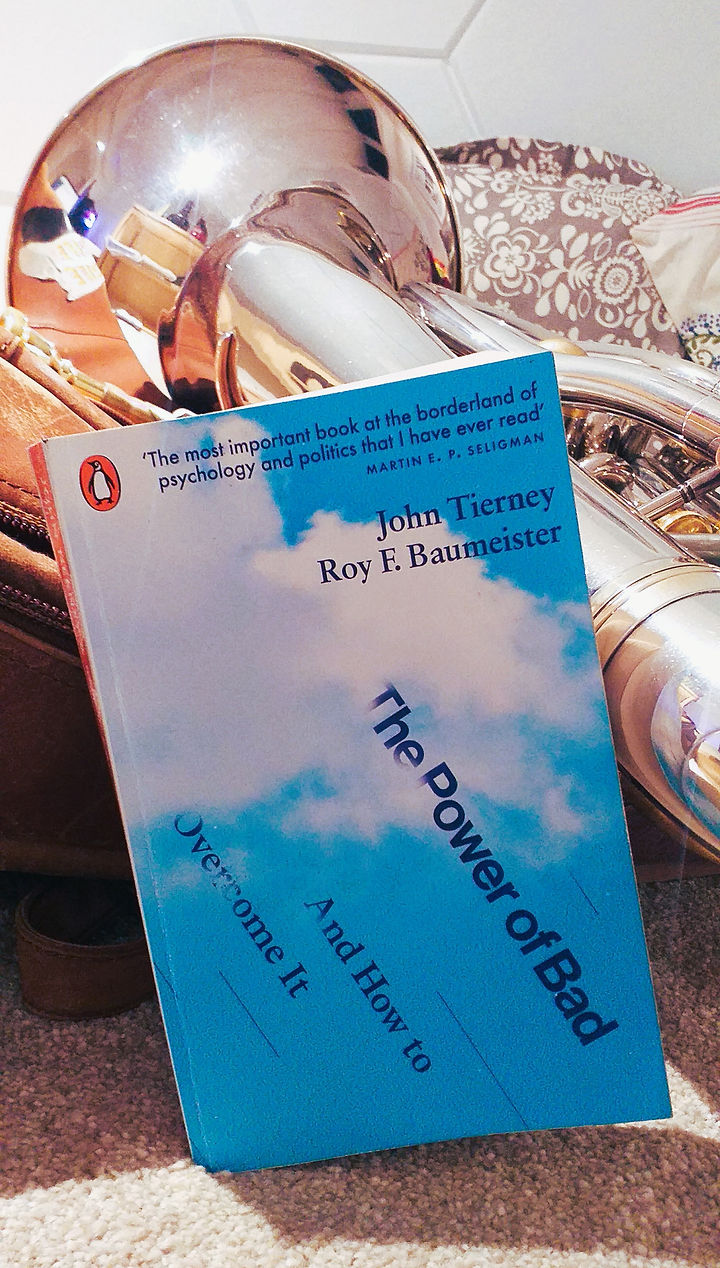
‘ThePowerofBad‘ elaborates on the fact that ‘bad‘ is stronger than ‘good‘, but if we know how to deal with it, we can make sure that ‘good‘ prevails. I am not going to give any spoilers for the book because it does contain some fantastic revelations and I highly recommend you read it if you want more help in this area. It is one of the best books on happiness you can find.
Use Positivity as a Musician to Overcome The Power of Bad
After my last performance, as I was driving home, I used the time to run through my own personal performance and tried hard to find as much good as possible. There were a few places in the performance where I had to play very quietly, they were all successful. There were a few places where I had to play very high, they were all successful. I had to get up and move around to sit in other places, I didn’t trip over anything or fall off the stage (I have fallen off a stage before! 🤣).
I found that this positive list would go on and on and actually it completely buried any negative thoughts that I initially had.
You have to find more good in your life, make the good / bad balance tip very strongly in the good, even if it is just from lots of small little good things. Get a grip of your thinking, steer it in a positive direction.
A few days after the performance, I had the opportunity to listen and watch the whole thing, because it had been filmed. Not one thing that I believed happened and was negative, was audible to my ears on the recording. There lies the power of bad, but my strategies from the moment I left the stage to the moment I watched the recording were positive, I overcame the bad with the good.
Grab a copy of the book and have a read; it will contribute to making you a better musician and more balanced person. It discusses other topics as well, like business, politics and psychology and is one of the best self help books I have read.
Good Preparation Beats The Power of Bad
Before the end, it is important to remember that good will not always just fall on you by chance. In order to be successful and in order to perform brilliantly as a musician, it requires belief and effort. It might be you come off stage, knowing you didn’t perform well, but also knowing that you had not worked very hard in advance. Preparation is key to success and if you want good things to happen in your life or in your performances, it is essential that you walk in the right direction. For more help with performance, check out my E-Book, The Inner Battle Between the Practice Room and the Stage.
These days we hear a lot about the allure of talent: gifted, extraordinary, special, something extra, blessed, graced, anointed, enviable. And as we know, the arts have been a particular repository for dazzling talent display.
Talent can be a kind of entry card. In music and dance we have such iconic artists as Arthur Rubinstein, Jascha Heifetz, Rudolf Nureyev, Margot Fonteyn, Taylor Swift, Fred Astaire, and the list goes on. There is a near religious fervour surrounding these folks who are perpetually confined to an archetypal pedestal – heroic figures living in a rarified alternate universe on Mount Olympus. To the lay person, it can seem almost magical that fame and fortune are readily available to those with exceptional talent. Often, there is a special entitlement afforded to these luminaries, and it may appear that with a bit of talent, we could all partake of these benefits. For some, there is the belief that talent alone should offer some measure of reward, a kind of requisite entitlement. Therein lies the shadow side of talent: acquiring something without the necessary earning of it.
As an artist, I stumble over the recognition of my own talent. To say that I am gifted strikes a difficult chord, so to speak. It feels like self-aggrandizement, ego inflation, and entitlement. Yet, if I don’t recognize my talent in an authentic and detached fashion, dare I say strategic, I would not be able to serve my gifts, perhaps my mission, and a sense of meaning and purpose to my life – making things better in the world through music. It’s a reminder, that the arts often contain paradox – two things can be true. I’m reminded of M. C. Escher’s lithographs where stairs simultaneously ascend and descend!
It is difficult to explain that talent and work go hand in hand. There can often be a disconnect (entitlement) between the temporal reality of musical study and the concrete requirements for what one may wish to achieve. As I regularly remind my students, there is no cramming for the concert, or for serious artistic growth. It’s a kind of marathon, and you wouldn’t just train for a few hours on Saturdays to take on those twenty-six miles!
Artists are individuals with varying skills and proclivities. While I might be a quick sight reader, it took me several months to learn J. S. Bach’s Goldberg Variations. Moreover, it wasn’t until I had performed it 6 times, that I really set to work! I had to marshal all my patience through this process, even with decades behind me as a professional pianist (perhaps some free-floating entitlement here!). These concepts are difficult to convey when entitlement is at play.
Add to this the fact that mostly our elementary and secondary education systems are now reduced to teaching to the test (reading and maths), and there is very little space in the curriculum for the arts, the creative process, and the fundamental human act of original thought. The notion of talent becomes a kind of bromide instead. Very little may be required to be considered talented. With that comes the risk of instant gratification, the dumbing down of quality and artistry, and a core understanding about what the arts require and what they can offer humanity.
Case in point: church music. This is by no means a declaration of any sort of religious affiliation. Consider, however, some of the greatest musical works from western European art music created by the likes of J. S. Bach, Mozart, Schubert, Bernstein (the Mass), Fauré, Poulenc, Elgar, and so forth. While there are still places where you can hear this exalted and compelling music, much of the American protestant church has withered into a kind of musical pablum: two chord changes with Jesus words. It doesn’t take much to master the ability to perform this music, nor does it require from the listener any level of artistic sophistication. It’s satisfying much in the same way as a bowl of Doritos. Oddly enough, many of the folks who deliver this music are often hailed as very talented.
For those of us who are educators, we can often encounter in our students that shadowy world of entitlement. It’s not just with the children we teach, but adult students as well. I recall one client who was a physician by profession. He had always wanted to play the piano at the advanced level, and so after reading Malcolm Gladwell’s edgy book, ‘Outliers: The Story of Success’, he asked me if after 10,000 hours of practice he could play one of the Chopin Ballades. Meanwhile, he was struggling with an early intermediate-level Haydn Sonata. Nonetheless, I lauded his efforts, and reminded him that the development of technic and musical capacity takes time – its own time, and that his responsibility would be to practice intelligently and regularly with a goodly amount based upon his goals, to follow my instruction, and to remember the long game. His sense of entitlement, however, overrode what I had hoped would be a gentle yet pointed reality check. He assumed that since he had weekly lessons, he was highly intelligent and disciplined, was committed to those 10,000 hours, and that in working with me he was entitled to have access to the advanced repertoire through some sort of short cut. Sadly, that sense of entitlement prevented him from serving his talent, of making a strategic plan in his practicing and study, honestly assessing his challenges along with his achievements, and trusting that together, he and I could move the cause forward. It would, however, require the long game as it does for most of us.
With young students, the struggle is more systemic. Parents are often driving their children to overload their schedules: A’s in everything, numerous sports, extra curriculars that might be the ticket to getting into Harvard or Oxford, and a schedule with every hour accounted for. Where is the time to daydream, to imagine, to create something original? Who will teach them the value and efficacy of this? Where is the education for the sublime, for beauty, for the inherent power of the arts to uplift humanity? How do they discover their own gifts, and more importantly how do they humbly serve music? How can they become inner directed, avoiding the distractions, the pressures to conform, and the seductions and misinformation that float around in the outer world?
Nurturing one’s talents takes time, commitment, appropriate education, inspiring and skilled mentors, confidence, patience, a keen work ethic, self-reflection, humility, and the long view. Moreover, one must acquire the ability to be ruthlessly honest about one’s work. What are my strengths? How can I build upon those? What led me to fluency in a performance? Conversely, what are the barriers to my progress? What blind spots do I have? Am I open to learning new things? Is my practice time allotment sufficient and effective for my goals? By the way, my definition of practicing is rehearsing solutions to musical and technical challenges. If you are not rehearsing solutions, what is it that you are drilling? Never mind those 10,000 hours! Can you measure yourself by what you strengthen in your own work? One can learn a great deal from mastering a new capacity! What is your artist vision and is it undergirded by a searingly honest and doable plan?
No matter how brilliant a mind, there will be a substantial, regular time commitment required if one is to develop artistry. For example, with musicians, the development of technic can take many years. I may dream of playing Beethoven’s Waldstein Sonata, but without the necessary technique, a grounding in historical performance practice, and a willingness to musically serve that style period, it will remain aspirational. No amount of will, talent, or entitlement will achieve that objective. Ask the artists at the top of the industry and they will regale you with stories of decades of practice, study, self-reflection, perseverance, sacrifice, challenges, luck, and yes, the long game.
So, in moving forward, how do we eschew entitlement in our own artistic work and that of our students? It may be that the way out is through. That Zen saying speaks volumes about the process required. In my own teaching, I have observed that when a student really wants to achieve something, they are apt to work for it if they can lift the veil of entitlement. It’s what I call concrete teaching. It’s a black and white approach (no pun intended) with weekly achievable goals, a constant check-in on reality, and that ruthless honestly. We ask our students as to how practicing is going? What is the quality of one’s practice time? Is it sufficient? Are we rehearsing solutions to musical and technical challenges? Are our musical goals congruent with our skills and time available? Needless to say, these points of practice apply equally to our own artistic work.
Moreover, all musical compositions have dues that one must pay in order to master fluency. It is relative to one’s skill and experience of course. The more experience you have, the more accurately you can assess the work ahead that is required. Back to the Goldberg Variations.
When I received an invitation to perform it, I had a year to prepare. I figured I could learn it in roughly three months with three to four hours of practice most days. I had other performances and professional tasks, but that time frame seemed appropriate. Wrong. It took me five months to learn it, during which time I had the flu, was preparing to move, and received a contract to write a book. Needless to say, I learned a great deal from that experience. Clearly, one’s musical skills and capacity are realized by the amount of time needed in order to learn a piece of music. This measurable and temporal reality may be your greatest weapon in combating entitlement: yours, or your students!
Speaking of students, the overarching concern that most music educators harbor is usually with sufficient and regular practice for their pupils. Moreover, that practice time must be informed, efficient, and consequential. As most of us know, many hours can be spent at the piano, even 10,000 hours, but there must be conscious awareness of how one is practicing. In those hours of practice, ideally, we become our own best teacher, and we train our students to embrace this concept as well. Mindless, disengaged drill at the piano does not engender mastery. One tool, however, can move the cause forward. If your student is motivated and is not under the spell of entitlement, they can greatly benefit from what I call a “mock practice session.” I periodically take an entire lesson time (usually one to two hours) and guide the student in what constitutes effective practicing. I am experientially teaching the student how to practice effectively and efficiently. This session is recorded for the student to review between lessons. Often, the student discovers that in a short period of time a great deal can be achieved in learning the score. Moreover, I remind students that they can continue this exciting path to mastery if they practice like they did in the lesson!
Ultimately, whatever way we approach the nurturing of talent, we need adequate time. This can be challenging in our cluttered and distracted world. I still struggle with this every now and then. There are, however, myriad solutions. Time management is a powerful tool, especially if you can review your schedule on a weekly basis. You are in charge, after all. As a side bar, I highly recommend Cal Newport’s groundbreaking book, ‘Digital Minimalism’. You will find a wealth of information, advice, and strategies to remain artfully engaged in your environment, but not possessed or distracted by the endless commotion from the digital world.
Lastly, I will leave you with several thoughts. My sense of music making is that it is 80 percent work and 20 percent talent. And moreover, the making of that music is not about me. I am merely the vessel. But without me, fully present, humbly prepared, and devoted to the composer and audience, that music remains on the page. It is indeed a sacred mission. In the final analysis, there is no entitlement, only devotion to the highest level our talent can take us. Music then becomes an act of service.
Jill Timmons is a leading performing arts consultant, serving individuals and nonprofits. As an international artist-educator, her work is sculpted by the ever-changing global market.The second edition of her book The Musician’s Journey is published by Oxford University Press.
The Cross-Eyed Pianist is free to access and ad-free, and takes many hours every month to research, write, and maintain.
If you find joy and value in what I do, please consider making a donation to support the continuance of the site



 Read more articles by Mark Glover and browse his website at




 The Cross-Eyed Pianist