Who or what inspired you to pursue a career in music and who or what have been the most important influences on your musical life and career?

It was at school that my love for the piano blossomed because I heard it every single day in the school assembly. Also, by chance my teacher in infant school happened to have a piano in her classroom, so the tinkling sound of it just occupied me and I loved to explore it and make sounds.

I had formal training as a Junior at the Royal Welsh College of Music and Drama in Cardiff with my teacher, who I still have, Alison Bowring, who took me back to the technical basics and posture, while also understanding what repertoire would suit me. Alison has been a major influence on my career so far from many difference perspectives.

I also did courses with an organisation called Musicians in Focus, a team who focused on visual impairment, which helped to develop me as a musician.

My greatest influences are listening to opera singers so the idea of singing with the piano is always reinforced. Another influence was being a participant on the North London Piano school every summer. The guest teachers really helped me understand about tone production through physical touch. I had never really experienced that sort of connection before, so that memory will stay with me forever. It made me not only improve as a pianist but gave me ways to connect through performance. Pianistically, I love the physical interaction between keyboard and the body becoming one – it’s an amazing experience.

What have been the greatest challenges of your career so far?

I was diagnosed with Asperger’s syndrome, an autism condition, which affects social and communication skills, so I have support assistance to help build my independence and confidence. I actually find my personal organisation to be more challenging than practising at the piano. I can feel anxious when plans change at the last minute, for example, when a train or flight that I am booked on is cancelled. Being totally blind also affects me when I have to travel for performances, as there is no time to become familiar with new locations and therefore I normally require assistance. Being a member of organisations like the Paraorchestra and RNS Moves, an inclusive ensemble based in Gateshead however, helps me to integrate and develop networks and connections with other disabled and non-disabled musicians.

Which performances/recordings are you most proud of?

Performing the Beethoven Choral Fantasia with the Royal Welsh College Chamber Orchestra and Chorus:

My final year recital for my Bachelor degree was very atmospheric and some people I knew from school also attended.

Performing at St. Martin-in-the-Fields in 2019 was thrilling as I was in an open and resonant space, so I had to adjust myself to both the instrument and the acoustic.

Performing the Scriabin concerto in East Dulwich with Michael Cobb conducting the Lambeth Symphony Orchestra. Unfortunately, I am only able to share the encore, an improvisation on some themes suggested by members of the audience.

Which particular works/composers do you think you perform best?

I have a soft spot for Beethoven’s music because both my grandmothers have developed deafness through ageing, especially my grandmother from Northern Ireland on my father’s side. The amazing thing about Beethoven’s music is that it always feels and sounds fresh, however many times you play the same pieces, especially when playing on different instruments and acoustics.

What do you do off stage that provides inspiration on stage?

I love browsing the internet about background of the pieces and always love looking at history and why repertoire was written for specific instruments of the time, especially when dealing with Baroque or Classical period music. Also, I have a grand piano at home that has a distinctive tone colour, which helps me to transfer intimacy across to my public performances. I find that exercise keeps me moving and agile, while breathing exercises or stretches help me to relax before I go on stage.

How do you make your repertoire choices from season to season?

For a recital programme, my teacher and I like to plan the pieces in advance that will complement each other. We always talk about the relationship between each piece regarding tempo and tonality, as well as realistic timelines for learning.

Do you have a favourite concert venue to perform in and why?

I particularly enjoy St. Martin-in-the-Fields as a venue because the acoustics are unlike any other, and it allows the pianist to draw into themselves so the audience can experience the incredible sound. It’s different to a drier acoustic when it sounds like you’re on the same level with the audience when you can hear every nuance. A cathedral is a celestial atmosphere to perform in, feeling like an out of world experience.

What do you feel needs to be done to grow classical music’s audiences?

I like the idea of pre-performance commentary by the artist involved to help make Classical music more accessible and interesting for younger generations. I also like the idea of museum tours (such as Victoria and Albert Museum in London) to explore the instruments for which music was originally written. This provides essential background as audiences are used to modern instruments as the norm.

What is your most memorable concert experience?

Performing in Japan as one of 90 international artists in the True Colours Festival 2022, organised by the Nippon Foundation and live-streamed around the world. The atmosphere was just incredible and I loved having my hair and makeup done for me so I could just sit back and relax. Also, I had never changed into other outfits between musical items, or played with a headset in a live performance. I loved the variety on offer and working with a range of other musicians.
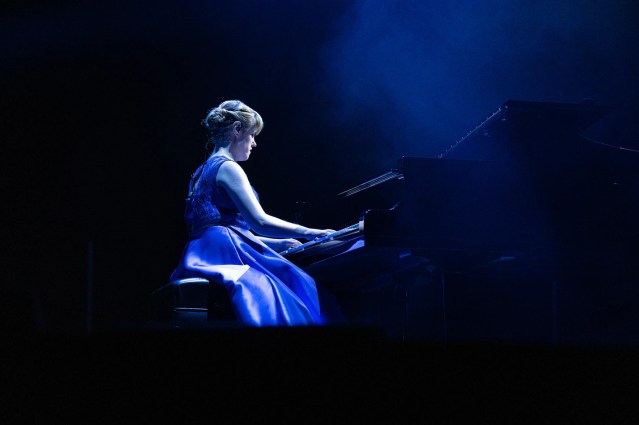
Rachel performing at the True Colours festival in Japan

As a musician, what is your definition of success?

Music is not about competition or who can play the best, it is about connecting and sharing with the audience and developing relationships as they can be vital for the future. Have the right support like a teacher who can understand the way you work, encourage and develop your musical journey.

What advice would you give to young/aspiring musicians?

Embrace every corner or avenue of your instrument from physicality/technique to exploring different music styles, so it becomes a part of you. For example, I love playing Jazz which I believe is interconnected with the classical composers that came before. Patience is always a virtue especially in practicing when you don’t get things right the first time. Keep positive and make the most of every opportunity.

On Saturday 27 May, Rachel Starritt gives a concert by candlelight at the inaugural Ludlow Piano Festival, created by impressionist, comedian and actor Alistair McGowan. Rachel will perform new works by three young composers, written especially for herm, as well as her own improvisations. Info/tickets: https://ludlowpianofestival.com/


Blind from birth, Rachel was born in Bridgend, South Wales in 1994. She has received formal training on the piano since 2006 with Alison Bowring and studied at the Royal Welsh College of Music and Drama (RWCMD) where she recently achieved a distinction in piano performance as a postgraduate student (MMus).

Rachel completed a six month Erasmus placement at the Conservatori Liceu in Barcelona under the tutelage of pianist Alba Ventura.

As a student at RWCMD, Rachel has enjoyed masterclasses with the Labèque Sisters, Stephen Osborne, Peter Jablonski, Angela Hewitt and Valentina Lisitsa. Additionally, she received guidance at the annual NLPS summer course at the Purcell school with renowned professors Dr Michael Schreider (Guildhall), Irina Osipova (Moscow), Irina Berkovich (Israel) and William Fong (RAM).

Rachel’s piano improvisation skills complement her love of jazz and she currently leads a jazz trio ‘The Rachel Starritt Trio’,  which appeared at the Brecon Jazz Festival in 2020 and 2021. At Chetham’s Piano Summer School she studied with Nikki Iles and Douglas Finch and has also received lessons with the renowned Welsh pianist and composer Huw Warren.

Read more

Image credit Daishiro Futakami

To coincide with the release of her new recording of Mozart Piano Sonatas Vols 2 and 3, I caught up with pianist Orli Shaham to find out more about her influences and inspirations and why one of her most treasured possessions features Snoopy the dog…..

Who or what inspired you to pursue a career in music and who or what have been the most important influences on your musical life and career?

It was my parents and my older brothers who inspired me to start music more than anybody else. My parents listened to a lot of music, and my older brothers were just enough older that they were beginning to be accomplished at instruments when I was coming into consciousness. I just really wanted to be part of that and be able to play with them and do the same sort of things that they were doing. That was very much the source of the initial inspiration. I also went to an untold number of conservatory concerts to listen to my brothers perform, and then also heard the 49 other pianists or violinists who were on the same program. That was hugely inspirational too.

A big part of my influences are the people in my life who also love music and who also play music. For me, that’s changed over time from being my elders to being my children and my students. I find them all incredibly inspiring.

Which performances/recordings are you most proud of?

Ultimately, it’s always the last project you just finished that you’re most proud of, because on some level you feel like it’s better than everything you’ve done before. I have certain highlights throughout my career that I think back on quite fondly. At the moment, I’m riding high on recording the complete Mozart sonatas. That was a monumental mountain to climb. I loved every minute of it, and I learned so much from doing it.

Which particular works/composers do you think you perform best?

I would say whatever I’m doing at the moment, which this year has included a lot of Mozart, and a lot of Clara Schumann and her compatriots. With any luck, we keep getting better at all of them – that’s the hope.

How do you make your repertoire choices from season to season?

That’s a really tough one because you have to choose repertoire quite far in advance. I have to project what I think I will feel like playing 18 months from today. Eighteen months is a long way to plan for your emotional state. These days, 18 minutes is a pretty long way.

I’m so lucky to be a pianist; I have so much repertoire to choose from. I have a list that I haven’t even begun to skim the surface of, of pieces that I would like to play. So I just go down that list based on what I think would work best next.

Do you have a favourite concert venue to perform in and why?

I have a favorite concert venue to record in, but I’ve never actually performed there. It’s Mechanics Hall in Worcester, Massachusetts. I love recording there because there’s something about the atmosphere of the building that makes me feel like it’s all about whatever I’m creating on stage (and also there’s an enormous painting of George Washington and the rear end of his horse looking down on me from high above the stage). The hall has an incredible sound. For pianists, performing or recording at a venue is intricately tied up with the venue’s piano. I really love the instrument at Mechanics Hall, as well as the technician who takes care of it. Any time I sit down at that keyboard, I’m inspired to experiment.

What is your most memorable concert experience?

That’s a very long list. One that I happen to be thinking about recently was with David Robertson and the St. Louis Symphony. I played John Adams’ Century Rolls in Carnegie Hall. The way schedules worked out, the composer couldn’t come to hear any of our performances before that; the first time he could come and hear it was at the Carnegie concert. I was only the second pianist to play that concerto at the time, and there was a great deal of nervous energy.

The orchestra did a magnificent job, and David was incredible. Everything worked, and it was fabulous. When John came on stage for his composer’s bow, he leaned in to me and said, “You got it, you really got it.” There’s really no better feeling as a performer, than for the composer to say, “You got it.” That’s what it’s all about.

I should add that I’m very much looking forward to playing John Adams’ second piano concerto, Why Must the Devil Have All the Good Tunes? in Finland next season, with the Finnish Radio Symphony Orchestra, and the self-same David Robertson conducting.

What have been the greatest challenges of your career so far?

Being a mother of infant twins was a big challenge. We’ve made it through to the other side – those twins are about to turn 15. Things are a lot a lot less intense than they were 15 years ago around this time. I think it’s true for many parents, certainly for a lot of mothers, that it’s tricky figuring out how to keep your commitment to music while also juggling a commitment to family, both of which are all-consuming.

What do you do off stage that provides inspiration on stage?

I do things that have to do with music, like teaching and listening to repertoire other than what I’m working on, which is very inspiring. I also specifically do things that don’t have to do with music. I’m inspired by books I am reading, or TV shows I am watching, or meditation or cooking, that really allow me to get inside my own head in a different way than when I’m getting inside a composer’s head.

As a musician, what is your definition of success?

The not so trite answer is that we musicians don’t have such a definition, because we never think that what we’re doing is good enough, so it can’t possibly be considered a success. Knowing that there will never be a feeling of complete and total success, I set very specific goals for myself, and if I can make those work for an entire performance, then I feel it’s been a success.

Those are often really small things. I had a shoulder injury a few years ago and one of the things that I’ve been working on is maintaining a certain level of muscle relaxation in my upper back, even in performance, from the beginning to the end. That’s no small feat. It has nothing to do with the actual music making, and it has everything to do with the actual music making. When I achieve that, I feel a huge sense of pride, because I know that’s something I wasn’t able to do before.

What advice would you give to young/aspiring musicians?

My biggest piece of advice is that whether other people give you the opportunities you’re hoping for is completely out of your control. But whether you feel that you are constantly improving is entirely in your control, and that way of approaching things will sustain you through the lulls and heartbreaks of a career.

What do you feel needs to be done to grow classical music’s audiences?

There are really two sides to that question. One, how do we get the next generation to understand that classical music is for them? That’s in part why I started Orli Shaham’s Bach Yard, to get to children at the ripe old age of three or four years old. The other side of it is making sure that what you’re presenting to the audience is relevant to their lives in some way. That may have to do with repertoire choices, it might have to do with venue choices, perhaps programme lengths, and the way that you introduce a programme to an audience and explain to them how it connects to them. It’s all about humanizing the musicians and the composers and making people feel that this is something that is actually designed for them and that they can partake of whether they’re three or 30 or 99 years old.

What’s the one thing in the music industry we’re not talking about which you think we should be?

It’s the question of what’s in it for them: What’s in it for your audience? What’s in it for the students? What are they going to get out of that and through their lives? What’s in it for a subscriber or a single ticket buyer? Why are we actually doing this? Because we in the industry get so caught up in the fact that we love it so much, we see what it’s doing for us that we forget to think about the perspective of the people we’re trying to offer it to.

What is your most treasured possession?

I have two favourite possessions. One of them is the Steinway B that’s been with me since 1997, 25 years. I don’t know how I would get it out of the apartment if there’s a fire.

My other favourite possession is the cartoon that Charles Schulz made for me in 1997 – also 25 years ago. It’s a one-panel strip where Schroeder is playing the Beethoven’s “Pathetique” sonata and the final bar line is missing, so the notes are all falling on the ground with their stems up. Poor Snoopy is trying to walk across the floor and the note stems are pricking his little feet, and he’s saying, “Ouch!”


Volumes 2 and 3 of Orli Shaham’s recording of the complete Mozart Piano Sonatas are available now on the Canary Classics label.


A consummate musician recognized for her grace, subtlety, and brilliance, the pianist Orli Shaham is hailed by critics on four continents. The New York Times called her a “brilliant pianist,” The Chicago Tribune referred to her as “a first-rate Mozartean,” and London’s Guardian said Ms. Shaham’s playing at the Proms was “perfection.”

Orli Shaham has performed with many of the major orchestras around the world, and has appeared in recital internationally, from Carnegie Hall to the Sydney Opera House. She is Artistic Director of Pacific Symphony’s chamber series Café Ludwig in California since 2007, and Artistic Director of the interactive children’s concert series, Orli Shaham’s Bach Yard, which she founded in 2010.

Read more


Image credit: Karjaka Studios


Who or what inspired you to pursue a career in music?

When I think back to the moment that led to me majoring in music, it’s funny that it wasn’t some Hollywood-style lightbulb thing—the way it happened was almost forgettable. I’d seriously played music my entire life, but I was also one of those obnoxiously accomplished kids who did everything and was proficient at every subject, so when it came time to do college applications I applied for programs in multiple fields. I ended up applying to and attending conservatory because my piano teacher stopped me after a performance and told me, seriously, that I couldn’t ever give up music. No one else had given me that kind of direction, so I took that bit of counsel and ran with it.

I figured I would follow music as far as it would take me; I promised myself that if there came a day where it no longer brought me joy and I’d wrung all the love that I could out of it, I would stop. That day hasn’t come yet.

Who or what have been the most important influences on your musical life and career?

When I was really little, I would watch Victor Borge on PBS, and I just adored everything about him; he made music so funny but he was also just a phenomenal musician. He was warm and silly and the silliness didn’t detract from the beauty of the music, and I think that was a really crucial thing for me to absorb at an early age, since classical music in general can take itself way too seriously. A lot of people get hung up on things like “greatness” and “nobility” and “transcendence” in classical music, and don’t get me wrong, those elements exist, but there’s also a lot of humor and irony and self-deprecation in music as well, and I think we do ourselves a disservice if we pretend the art form doesn’t contain all these very human things.

He was just a master of presenting music to audiences in a way that was really accessible and entertaining. When I was little I didn’t know much about music history or advanced theory, and I didn’t have to to enjoy Victor Borge’s performances. That’s something I keep in mind whenever I prepare performances, since I like to talk to the audience about the music; how do I teach them something about the music in a way that’s entertaining, where you don’t feel like you’re being lectured? I don’t get as slapsticky as Borge, and I’m nowhere near as funny as he is, but that accessible humor is something I always aim for.

There have been a lot of other influences in my life, of course, and I’ve been lucky to have amazing mentors in the field of music, but I think a lot of my guiding philosophy all goes back to Victor Borge.

What have been the greatest challenges of your career so far?

I’m really self-conscious about the fact that I’m not on the traditional track that pianists usually take. I didn’t do competitions when I was young because my teacher was very rightly concerned that competition culture would be really rough on me, since I was a pretty shy and sensitive kid. I didn’t go to a big-name conservatory, I haven’t won any major competitions or been picked up by a label or agency, and I’m not pursuing a career in academia. I’ve read biographies and memoirs and interviews by pianists I deeply admire where they actually, literally say, if you haven’t hit these traditional milestones by the time you’re eighteen, you need to give up, because you will never make it.

I know objectively I’m pretty good at playing the piano, but I still have trouble believing that anyone will want to listen to me. I also know that I’m not remotely the only person who feels this way, and that there are a lot of independent classical musicians out there who have overcome the same problems, but doing your own thing still feels very lonely sometimes.

Which performances/recordings are you most proud of?

I think my recording of Cécile Chaminade’s concert etude “Automne” (released in May) might be my favorite recording that I’ve made yet. I’m at a point where I feel like I’m constantly torn between wanting to sound like other people, following the rules that my teachers have drummed into me, and trying new things and finding my own voice. I feel like the Chaminade recording is, so far, the closest I’m come to playing something in a way that sounds really like me.

I’m sure in X number of years or after X number of recordings I’ll look back on it and go, oh my gosh, this is terrible, why did I make these musical decisions or play like this, but you gotta start somewhere.

Which particular works do you think you perform best?

I absolutely love playing Beethoven, Liszt, Chopin, etc. but I have this horrible anxiety whenever I perform their music, particularly the really famous pieces, because there are all these legendary recordings and performances that I feel like I have no chance of living up to them. And when you play that music, even if you have something really strong to say and have put your own stamp on it, you feel like everyone’s bringing their own different expectations to listening and you’re just set up to fail.

I think, personally, I perform best when it’s music that I love but that isn’t as well-known, because instead of trying to meet this invisible expectation, I’m coming from a place where I know it’s likely the audience doesn’t know what to expect and it’s on me to create something that makes it worth their while. Sometimes that’s lesser-known works by canonic composers, like Liszt’s “Les jeux d’eaux à la villa d’Este”—I just love performing that piece so much, it’s not what you’d expect but it’s such a crowd pleaser. And lately I’ve been adding music by traditionally underplayed women composers to my repertoire, and the amazing thing is that audiences love those works. I’ve had amazing responses to the Clara Schumann and Cécile Chaminade pieces I’ve played in concert, and oftentimes I’ll get feedback that people actually enjoy those pieces more than the famous stuff they’ve already heard a lot.

How do you make your repertoire choices from season to season?

My teacher usually recommends pieces—he has an uncanny way of picking unexpected crowd-pleasers for me—and I often go completely off-book and will learn other pieces when something really grabs me. The Louise Farrenc etude I recently released is one of those; I heard Konstanze Eickhorst’s recording of it, and was so utterly smitten that I dropped everything to learn it immediately, and then recorded it just a few months later.

I also pick my repertoire so I can have options putting together balanced programs that work for different audiences; I kind of think of a concert program as being like a really good meal, where you have a variety of flavors that all complement each other and take you on a journey.

Incorporating a 50/50 gender balance into my solo programs has also been a really interesting challenge, because when I’m presenting less-heard music to audiences, I have to think both about how certain pieces go together thematically as well as how it feels for the listener, going from something they know well to something that’s new, and vice versa. I also have to make sure

I’m not unintentionally reinforcing lazy stereotypes, like having a program where all the male composers ’works are really fast and agitated and all the female composers ’works are slow and lyrical. I know I’ve done my job when I’ve put a bunch of disparate stuff together and people say that they enjoyed the whole thing.

Do you have a favourite concert venue to perform in and why?

There’s a private house concert I do every year at the home of a dear friend with a wonderful Steinway grand; it’s just an incredibly lovely experience because she rustles up a whole audience of people who just really love classical music and enjoy listening to me talk about it and it doesn’t feel like a performance so much as a warm and nerdy afternoon. I wish I could share that kind of experience with the whole world, because it’s just so much fun.

What is your most memorable concert experience?

Ha, the first thing that comes to mind is that time I had a memory slip performing the Prokofiev Third Concerto with orchestra—I noodled around for a bit and somehow got out of it fine, but I still get panicky reliving it.

On further thought, I gave a lecture recital last year (2019) on Clara Schumann’s G Minor Piano Sonata, and I still feel all warm and happy remembering it, because the audience was so wonderful and engaged. It was put on by a nonprofit that does free community events, and the audience was primarily older classical music enthusiasts, who conventional wisdom says are typically the people least willing to listen to new stuff. But I just talked about how awesome Clara Schumann was, why her music isn’t as well known, and what makes her sonata so compelling; I can’t describe how amazing it feels to see a room full of people fully engaged and interested while you talk at them about something you really care about. And you can tell how engaged your audience is while you’re performing! Even if you can’t see them, there’s a certain energy you can feel. When I played I felt like that audience was with me the whole time, experiencing every phrase and going on that emotional journey. And afterwards we had a Q&A session, and they asked so many questions about Clara Schumann and the sonata, and a lot of them based their questions on what they heard in the performance. It felt like a culmination of why I love this art form so much.

As a musician, what is your definition of success?

When I was younger I equated fame with success and I just wanted to be, like, mega-famous. Now the idea of being recognized on the street is horrifying to me, and I feel a lot more wary about the idea of being treated as some kind of product or commodity. I also have my reservations about the very concept of celebrity, the idea that people might feel like they know you, even though they only know this small part of you that you’ve put on display. So my personal definition of success is a lot more nuanced now.

I think success is a state of being where you’re doing work you’re passionate about, where you feel like you’re being true to your own voice, and you have some audience who your work resonates with. I think, especially in classical music, a factor of success is also how much your work reaches people who aren’t already deep in the field. I feel really validated when people who say “I don’t know anything about classical music” tell me they really enjoyed a performance or a recording, or that I taught them something. Art has to keep finding bigger audiences in order to survive, so I think a truly successful artist is one who continues reaching those audiences.

What do you consider to be the most important ideas and concepts to impart to aspiring musicians?

I’ve learned so much from the past couple years of working that I feel like I could write a whole book of unsolicited advice. I think the first concept that aspiring musicians absolutely need to know is that classical music is not a meritocracy. You are not necessarily going to get anywhere purely based on your talent or even your work ethic, because like any other industry, connections are everything and in a chaotic world, luck can be everything. And it’s really unfortunate, but first-generation musicians are always going to have a much harder time making it than people from families who know the unspoken institutional rules of classical music. The flip side of that is that if you recognize that talent isn’t the only thing that matters, you can leverage your other skills and qualities. You don’t have to be the most talented musician in the room to be successful—there will always be people who are better than you are, but that doesn’t mean there’s no hope for you. You just have to figure out what you have to offer the world.

I think it’s also really critical to get rid of this expectation that if you’re a musician, your whole personality has to revolve around music. I think that’s part of why some young musicians get prematurely burnt out and jaded—I know people who got disenchanted with music in their teens and early twenties and ended up without any other identity to cling to, which is just really tragic. I really do think you should be a whole person outside of music, and it’s okay to be into non-classical music and non-music media and pop culture and whatever else floats your boat. The world is full of so many fascinating things for your brain to chew on, you know?

What is your present state of mind?

I’ve been really thrown—along with everyone else—by coronavirus. I’m very, very lucky to be able to shelter in place. But it’s shocking how uncertain everything is now, and how my routine and short-term plans have been totally upended. This is the time of year I usually do a whole slate of concerts, and that’s not happening. I was working on some really cool projects that were supposed to unfold next season; I’m not sure about the status of those projects anymore, due to arts org budgets imploding, gatherings being risky, etc. We’re all in this suspended state right now. Performing is such an important part of my life, but I don’t know when we’ll be able to have concerts in-person again. It’s very hard to visualize what a career in music looks like after this is all over.

In this state of limbo, it’s really hard to continue working day-to-day like everything is normal. I don’t do well when I don’t have immediate deadlines, so it’s really hard for me to practice like there are still performances on the horizon. On top of that all, I just feel so emotionally drained. I mean, people are literally dying right now, and the level of suffering is just breathtaking. Even if you’re safe and doing fine, you know way too many people who aren’t. It takes a lot of energy and brainpower to work on music—or anything, really—and it’s very exhausting just being a human being right now.

I’m just taking everything one day at a time and being nicer to myself—well, I’m trying, anyway. I still have to practice on a daily basis because physical things like stamina, control, flexibility, etc. evaporate if you don’t keep them up. I used to beat myself up for not practicing enough hours a day or not making enough progress, but now if I’m able to squeeze out one or two hours of meaningful work, I’m genuinely grateful.

(Interview date: 27 April 2020)


Sharon Su is a professional finger wiggler. While she hails* from a very sunny state (California), her work has taken her to concert halls, churches, ballrooms, and the occasional palace throughout the cloudier sections of the world, both as a solo and collaborative keyboard-masher. She has extensively performed pieces from the classical canon (sadly, that is “canon” with one “n” in the middle) as well as premiered a number of newly composed works, likely because the composers were in a hurry and couldn’t find a better pianist to perform their works for the first time. Her work has earned her recognition as an American artist and, most importantly, she has recently been hailed by her mother as being “pretty good at noise-making.”

Read more

Sharon Su play’s Clara Schumann’s Piano Concerto – more information

Louise Farrenc – Etude, Op 26/10


The Cross-Eyed Pianist is free to access and ad-free, and takes many hours every month to research, write and maintain. If you find joy and value in what I do, please consider making a donation to support the continuance of the site

Make A Donation

Who or what inspired you to take up the piano and pursue a career in music?

It was a long time coming. Though I had already played the piano for six years before entering the Curtis Institute of Music, it was the colleagues and friends I made there that really inspired me to see music as a way of life.

Who or what have been the most important influences on your musical life and career?

My teachers at Curtis and the Hannover Musikhochschule have shaped the way I see music. My family and friends give the life experiences I need to tell interesting stories. In an ever-changing environment, I’m grateful to have a stable network of people I can trust and count on for advice.

What have been the greatest challenges of your career so far?

There are many difficult things about being a concert pianist, whether its learning a particularly tricky piece, getting over a defeat at a competition, but these are so minor in the grand scheme of things. It’s an ongoing challenge to give your all every time you step out on stage. Even if you’re tired or fatigued, it’s a musician’s responsibility to inspire and bring memorable moments to audiences. But this is a challenge that I cherish.

Which performance/recordings are you most proud of? 

Certain concerts stick out in my memory. I had a wonderful experience performing a benefit concert for the Multiple Sclerosis society with Howard Griffiths and the Camerata Schweiz at the Tonhalle Maag. We performed the Beethoven violin concerto in the piano version and as an encore, Hallelujah, where the audience joined in the chorus. A moment of goosebumps, the good kind.

Which particular works do you think you play best?

I can’t answer such a question, but I have lots of music I love to perform. At the moment, I’m particularly interested in the Viennese classics of Haydn, Mozart and Beethoven.

How do you make your repertoire choices from season to season?

It’s a given that I only perform works I feel I have something special to express. I’m very open to learning different repertoire, and I gather a lot of inspirations through regular trips to different opera houses and symphonic concerts, something Germany abounds with. Finding a central work is important in each program, then it’s a question of finding matches and themes.

Do you have a favourite concert venue to perform in and why?

Hamburg Elbphilharmonie kleiner Saal is fantastic, not least because of its prestige. The pianos there, the acoustic and an enthusiastic audience are unique.

Who are your favourite musicians?

Cecilia Bartoli, Kristian Zimerman and Sviatoslav Richter.

What is your most memorable concert experience?

I performed in Beijing NCPA last year, and my three grandparents came, all over 90 years old. I was so proud and happy to share with them one of my favorite pieces, Chopin concerto No. 2.

As a musician, what is your definition of success?

Staying true to yourself and never wavering in your faith in music.

What do you consider to be the most important ideas and concepts to impart to aspiring musicians?

Live a full life, embrace multiple interests, because the more you know about the world, the more you can share.


Claire Huangci, the young American pianist of Chinese descent and 2018 Geza Anda Competition first prize and Mozart prize winner, has succeeded in establishing herself as a highly respected artist, captivating audiences with her “radiant virtuosity, artistic sensitivity, keen interactive sense and subtle auditory dramaturgy” (Salzburger Nachrichten). Her unusually diverse repertoire, in which she also takes up rarely performed works, is illustrative of her remarkable versatility.

Read more


