The second evening of concerts at Chetham’s featured musicians of the next generation and an established international concert artist.
The Ronald Stevenson Memorial recital is given in honour of one of the greatest composer-pianists of modern times, and was established in 2015 with generous funds donated by the Stevenson Society. Stevenson, who died in 2015, was a visitor to the Chetham’s Summer School. He wrote highly attractive, virtuosic and engaging music inspired by the landscape, heritage and culture of Scotland where he made his home. His large and varied post-Romantic oeuvre also includes music written for children, which is sophisticated and characterful.
In this concert, students from Chetham’s School of Music performed works by Stevenson, including his Scottish Folk Song Settings for Piano and the quirky Six Pensees sur des Preludes de Chopin, Stevenson’s clever combining of Preludes by Chopin to create miniatures which are witty and imaginative. It was wonderful to see young people, one as young as 9, performing with such poise and confidence. In addition, their individual sound and range of pianistic colours and moods was impressive, and this concert was both a celebration of Stevenson’s genius and these young musicians.
***
Leon McCawley’s concert was one of those occasions where the reviewer’s role is rendered largely redundant! What can I say about a performance of Mozart’s Piano Sonata K279 whose outer movements sparkled with wit and good humour, contrasting with an Andante of understated operatic drama and elegance? Or Richter’s favourite Schubert Sonata, the genial D894, performed with such taste, clarity and sensitivity that we never lost sight of the overall arc of this long sonata. So many little details – of melody, rhythm and harmony – were deftly managed to create a compelling and fluent musical narrative that was expansive yet also highly intimate. McCawley caught Schubert’s fleeting moods, his unexpected volte-faces (often signalled by “distant” harmonies or rests), with lyricism and grace.
The concert pianist cuts a romantic, almost mysterious image: alone on the stage with only a shiny black minotaur of a concert grand for company, the pianist exists in a place other than ours, elevated – both physically and metaphorically – before us. We invest special heroic qualities in the pianist, knowing that he/she must convey supreme mastery and complete oneness with the music by playing from memory. Pianists are like Himalayan adventurers, scaling the highest peaks without a safety net: Triumph or fail, they do so in the very public sphere of the concert hall.
A concert is not called a “performance” – and its participants “performers” – for nothing. Like an actor inhabiting a character created by a playwright, so the musician takes on a special role for the duration of the concert. Like actors, they also wear special clothes for the occasion, which further defines their role, and the occasion occurs in a special building, often in darkness or semi-darkness. Thus the concert becomes an experience outside the realm of daily existence – for audience and performer.
Every physical act you do when you’re on stage is part of the drama of the performance. Playing a concert is theater. It’s one of the reasons I think we should have a different costume for playing a concert, as opposed to listening to a concert. It doesn’t have to be tails, but I think we need to emphasize that this is something that’s not of the everyday.
– Stephen Hough, concert pianist (from an interview with Pacific Standard
Milton Court, London after a concert by America pianist Jeremy DenkThe mystique of the performance begins as the house lights dim, the unspoken signal to the audience to fall silent. A palpable sense of expectancy permeates the concert hall, and the shared adventure of the performance begins as soon as the pianist crosses the stage. The applause, the audience’s way of greeting the performer, and, in return, a bow, the performer’s way of acknowledging the audience. There is no enmity: for the next few hours we are, to quote British pianist Stephen Hough, “all friends”, sharing in the experience, our many differences forgotten for the duration of the concert.
The moments before the performance begins resembles nothing else. One has a sense of the awesome formality of the occasion, the responsibility, the knowledge that, once begun, a performance cannot be withdrawn. Silent, poised at the piano, at that moment the pianist has complete control over our reactions:
I sit down, and I don’t move a muscle. I create a sense of emptiness within myself, and in my head I count up to thirty, very slowly. This causes panic in the audience: ‘What’s happening? Is he ill?’. Then and only then I play the G [of Liszt’s Sonata]. In this way, the note sounds totally unexpected, but in an intentional way. Clearly, there’s a sort of theatricality about this, but the theatrical element seems to me very important in music. It’s essential if you want to create a feeling of unexpectedness….
The unexpected, the unforeseen – it’s this that creates an impression
– Sviatoslav Richter (from Sviatoslav Richter: Notebooks and Conversations by Bruno Monsaingeon)
The best performers (and I don’t necessarily mean the most famous or technically assured) are the ones who take us into their confidence, creating an unspoken mutual connection through music. They weave stories for us, create magic, transport us to another place and allow us to forget ourselves and the tedious minutiae of our daily lives.
The pianist’s mystique and the ritual of the concert create a unique connection in time and place between the performer, the music and the audience.
Today, when presenting classical music seems to be all about “accessibility”, the mystique of performance can be lost in the desire to “connect” with the audience “extra-musically”, so to speak, by talking to the audience, for example, to break down barriers. It’s great to enjoy classical music in a more relaxed setting; it’s interesting when the performers introduce the programme, discuss their particular connection to the music, or why they selected it. This can work especially well in smaller venues where the audience and performer are in close proximity. But talking to the audience pre-concert in a big hall is problematic without proper amplification, and the big venues almost naturally lend themselves to a more formal, mystical concert experience. And I think audiences like performers to actively create a sense of mystique – because we know we are mere mortals in the face of such superhuman ability.
The most startling thing can be meeting a concert pianist “off duty”, so to speak. Years ago, long before I started writing this blog, I interviewed a concert pianist at his fairly modest home in leafy suburbia. I have always been fascinated by pianists (still am, as this blog testifies!) and I had an overly romantic image of the “concert pianist” (this was some years before I took up the piano again and learnt how to be a performer myself, which gave me an understanding of what goes on on stage during a concert and the curious psychology of performance). The mystique was dispelled the moment the pianist answered in the door. I remember he was was wearing navy socks of the type one can buy in M&S, and his piano room was not some Lisztian salon, as I had imagined it might be, all crimson swags and a bust of the composer for inspiration, or an ascetic monkish cell, but a tidy “office” equipped with the tools of his trade – a grand piano and a career’s worth of scores neatly lining one wall. The virtuoso at home. This person had kids, and a friendly cat, a mortgage to pay and a car to service: in truth, he was disappointingly ordinary. I had imagined something, someone, more esoteric, and his very ordinariness was a shock – he regarded the fine art of creating beautiful music for others to enjoy as nothing more than something he did day to day, nine to five, just like any other job. In fact, most of the musicians I have met via this blog and my Meet the Artist series, and of course after concerts, are normal people – and they “normalise” the incredibly artistic and highly intellectual thing that they do on stage in order to function day to day and get their work (practising) done. Because for them, music is their job. But of course what marks them out is their ability to transform the normal into the beautiful, the transcendent, the magical……and if we want to preserve that mystique, maybe it is better we don’t meet our pianistic heroes and heroines.
…the further a performance must travel to reach the origin of the music, the more the artist demonstrates the measure of both his conscience and his genius
“The loneliness doesn’t worry me……I spend most of my life alone, even backstage…….I’m there completely alone. I like the time alone….”
Stephen Hough, speaking on BBC Radio 4’s Desert Island Discs
The pianist’s life is, by necessity, lonely. One of the main reasons pianists spend so much time alone is that we must practise more than other musicians because we have many more notes and symbols to decode, learn and upkeep. This prolonged solitary process may eventually result in a public performance, at which we exchange the loneliness of the practise room for the solitude of the concert platform.
Most of us do not choose the piano because we are loners – such decisions are usually based on our emotions, motor skills or the aural appeal of the instrument. For me, as a child – and an only child – the piano was a companion and a portal to a world of exploration, fantasy and storytelling. It remains a place to retreat to and time spent with the instrument and its literature can be therapeutic, rebalancing and uplifting. For many of us, being alone is the time when the sense of being at one with the instrument is strongest.
In addition, there is time alone spent listening to recordings – one’s own (for self-evaluation) and by others (for inspiration and ideas on interpretative possibilities, or purely for relaxation) – and time simply recovering from practising and refocusing in readiness for the next session. Many pianists tend to be loners – the career almost demands it and self-reliance is something one learns early on, as a musician – but that does not necessarily make pianists lonely or unsociable.
To me it’s always about connection – connecting with parts of myself, with the thoughts and feelings of the composer, and ultimately sharing with an audience. It’s travelling through time and space to experience other eras and cultures…..I can’t think of anything that makes me feel less lonely!
Stephen Marquiss, pianist & composer
The life of the concert soloist is a strange calling, yet many concert pianists accept the loneliness as part of the package, together with the other accessories of the trade. The concert pianist experiences a particular kind of solitude (as noted by Stephen Hough in the quote at the beginning of this article). The solitude of travelling alone – the monotony of airport lounges, the Sisyphean accumulation of airmiles, nights spent alone in faceless hotels. Dining alone, sleeping alone, breakfast alone, rising early to practise alone. And there is the concert itself: waiting backstage, alone, in the green room, and then the moment when you cross the stage, entirely alone….. The pianist Martha Argerich has described the “immense” space around the piano that has always made her feel alone on stage. But it is this aloneness, this separation, which the solo pianist exploits for the purpose of captivating and seducing the audience, drawing them into his or her own private world for the duration of the performance.
I suppose being an introvert in a ‘public performance’ profession has been my greatest challenge. It isn’t straightforward, of course – I seem to have a deep need to communicate music to an audience and get their reaction, and I love to be appreciated, but there are many other aspects of being ‘on show’ that don’t come naturally. I’m very interested in people, but I’m quite a private person and need lots of time to myself.
Susan Tomes, pianist and writer
The traditional positioning of the piano on stage, so that the pianist sits side on to the audience, heightens this sense of separation and aloneness. In a concert, the pianist must navigate a path between private, subjective feelings and public expression in a curious display of both isolation and exhibitionism. The power of performer, and performance, is this separateness from the mass of audience. Some performers may exploit this to create a sense of “us and them”, while others are adept at creating an intensity or intimacy of sound and gesture during which the audience may feel as if they have a private window onto the pianist’s unique world, in that moment.
Up there on the stage, one can feel more alone than anyone would ever care to be, yet it can make one better than one thinks possible because one’s ego is constantly being tested when one plays. To meet a Beethoven sonata head on, for example, it stops being about you – how fast you can play, how technically accomplished you are. Instead it is about getting beyond oneself, becoming ego-less, humble in the face of this great music, developing a sense of one-ness with the composer…..
After the performance, when the greeting of the audience and CD signing is over, the pianist may happily retreat to his or her solitary practise room or studio. Many of us long for this special solitude and actively relish the time spent practising alone.
The internet and social media has, for many of us, been a huge support in relieving feelings of loneliness and separation. Facebook, Twitter and other social media platforms enable us to connect with pianists and other musicians around the world, allowing us to preserve our solitude, while also engaging meaningfully with others when required.
An earlier version of this article appeared on the Pianodao blog
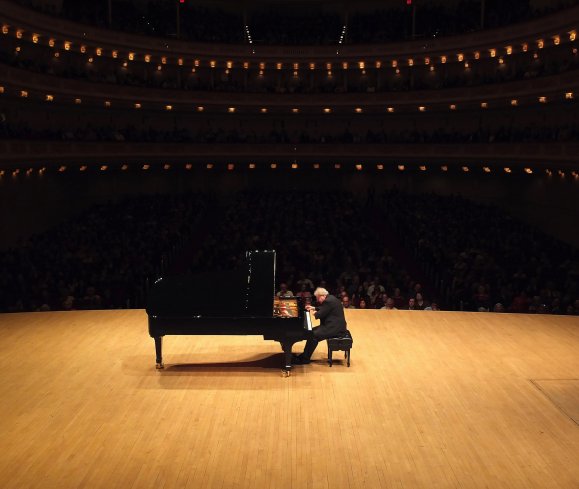
(Picture: Emmanuel Ax in recital at Carnegie Hall, photo by The New York Times)
Guest review by Patrick, a musicologist residing in the Midwest
Daniil Trifonov was annoyed. He walked out on stage with a pained expression, the cheery look of his youth victim of the trials, presumably, of a professional career. After two cursorily rude bows to the audience (which wrapped around the stage entirely), he jumped straight onto the bench, staring – grimacing – at the keys. Kinderszenen contained all of his trademark complexity of line and texture brought about by Trifonov’s utterly unique use of microdislocations – employed continuously throughout the whole set. This technique is the heart of his genius, allowing him to achieve extreme contrasts in texture, voicing, and phrasing of line. Can you think of any other pianist that developed the dislocation to such a degree? While it may seem like a product of his Russian education, is there another Russian pianist today that pursues the same innovation in performance technique? I doubt Trifonov learned in America either – I was certainly never allowed by my teacher to engage in such excesses. Neither can it be said that he is reviving some past performance practice – older Soviet pianists certainly employed dislocation to add emphasis to moments of arrival, but not in the pervasive manner employed here. Furthermore, the traditional type of dislocation – pressing the bass notes before the treble to create a sense of arrival – is decidedly not what one typically hears at a Trifonov concert. He must be taking a lesson from chamber music and vocal accompanying practice. After all, it is somewhat common among good accompanists to delay the bass arrivals until after the attack of the vocal notes fades into resonance. And this type of dislocation, with the bass (and also middle voices) delayed until after the treble, is what makes Trifonov’s artistry so special.
Back to the program: Kinderszenen was a feast to the ears of line and color. Dramatic passages were dispatched with great energy and aplomb. It must be said, however, that Trifonov’s typical lyricism seemed to be dulled this evening – perhaps a result of whatever annoyance was bothering him. The slower passages did not quite have that feeling of magical cessation of time, often miraculously whipped up by the pianist through an ingenious combination of tempo manipulation and textural contrasts. While these techniques were still very much present, there was the deadly feeling of impatience imposed over them. Notwithstanding, I cannot register a complaint, as what may have been lacking in the slower passages were more than made up for by the fire and drama brought to the climactic passages, especially as the recital progressed. The next piece, Schumann’s Toccata, testifies to Trifonov’s brilliance in program construction – after the lapidary miniatures of Kinderszenen, the audience was ready to be whipped into a frenzy, and the ploy worked – numerous people gave a standing ovation to the second piece on the program. The sound world of the Toccata (and of the Schumann in general) is very interesting. It seems to me that Trifonov has entered into a new phase of his career where he is exploring the mid-range of the piano. The Toccata was a great illustration of this, as the soprano and bass voices were hardly ever brought out in favor of a gritty voicing of the middle voice chords filling out the texture (another thing I would never have been allowed to do). This technique robs the Toccata of its flair as a dramatic showpiece with a thundering bass, but gives it a new lease on life by revealing its wacky side (I cannot help but now see a connection to Stravinsky’s Petrushka, occupying the place of finale in the other half of the program). As for the Kreisleriana, the masterwork of the first half, I can firmly declare that Trifonov is peerless in this work. No one other recording or performance that I have ever heard contains even half of his kaleidoscopic conception and range of texture, timbre, and tempo: my companion at the concert (a violinist herself) said that at several points she forgot that she was listening to the piano (an instrument she never took to that much) and instead thought there was a chamber ensemble on stage! Can you think of higher praise for a pianist than that?
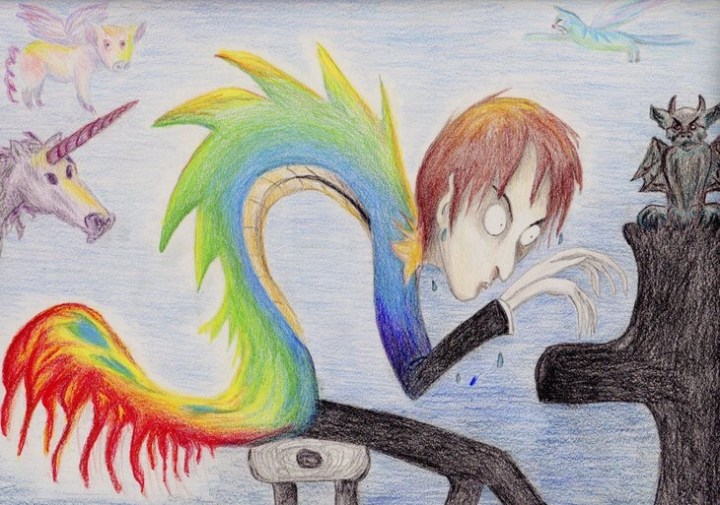
Cartoon of Trifonov by @pianistswkitten
After a massive standing ovation for the first half and the pause, Trifonov sprints back out the bench and dives into his selections from Shostakovich’s Preludes and Fugues. These selections were not chosen in their original order, but arranged for maximum effect – the creepily gorgeous opening prelude leads us through a luscious set of figural fragrances and fabrics before ending with a fugue containing a stormy finish. After this piece, the audience not only stood up to clap, but starting to yell bravos as well – something I have never heard before in the middle of a program – obscuring even the start of the Stravinsky! Even more so than the Schumann works, Shostakovich provided a canvas for Trifonov’s deeply original creativity – the range of sounds coming from the piano was tremendous, but equally matched by a phenomenal sense of dramatic pacing and climactic energy. The metaphor of Trifonov as a chamber ensemble with independent-minded players never seemed more apt. The final work on the program – Stravinsky’s Petrushka and the highlight of the concert – must be heard to be believed. No longer can Petrushka be considered an empty virtuoso vehicle, indeed so much life was added to it that many parts simply did not resemble what we are used to hearing. On top of all the qualities emphasized above (including some marvelously voiced chords and textures), it was Trifonov’s undeniable genius at rhythmic shaping that brought the piece to life. In short, the rhythms were so powerful, the syncopations so strong, the polyrhythms so present, that one could hardly avoid falling out of your seat – indeed Trifonov seemed perilously close falling off the bench has he was what could only be called dancing on the bench. And the music was dancing too, in every nook and cranny of the piece Stravinsky’s vision of the Russian countryside came to life. For the first time, that old wild smile began to appear on Trifonov’s face.
After tremendous applause that began before the piece even finished, the audience was treated to two encores (desperate attempts to garner a third through yelling at the pianist proved unsuccessful). The first was Nikolay Medtner’s Op. 38/8 “Alla Reminiscenza” played at a breakneck speed, building up to a tremendous flourish. Let it be known that I would graciously donate an arm and a leg to hear Trifonov perform the whole set. The second encore was a delightful piece by Prokofiev bringing the nearly 3-hour concert to a close. The concert showed once again that Trifonov is the premier recitalist of the age – it was only marred by a phone endlessly ringing during the Kreisleriana, which, after being supposedly shut off, went on to ring again exactly 30 seconds later.
Concert date: 26 March 2017, CSO Chicago
PROGRAM
Schumann – Kinderszenen
Schumann – Toccata, Op. 7
Schumann – Kreisleriana
Shostakovich – Selections from 24 Preludes and Fugues
Stravinsky – Three Movements from Petrushka
Medtner – Alla Reminiscenza from Forgotten Melodies [ENCORE]
The Cross-Eyed Pianist is free to access and ad-free, and takes many hours every month to research, write, and maintain.
If you find joy and value in what I do, please consider making a donation to support the continuance of the site






 The Cross-Eyed Pianist