Mozart wrote 18 piano sonatas and American pianist Orli Shaham has recorded all of them for the Canary Classics label, the final two volumes of the series being released in February this year. These sonatas have an enduring appeal, for players, both professional and amateur, and audiences alike.

For Orli Shaham the fascination with Mozart’s piano music began at an early age: this recording is the result of an exhilarating 40-year journey through the sonatas, getting to know them intimately, studying them deeply to appreciate their individual characters, and to understand the composer’s musical methods and motivations. “Was he trying out that piano? Was he writing for someone’s daughters? I want that something from every single one of them.” (Orli Shaham)

The recording was made in August 2019 and August 2020, at Mechanics Hall in Worcester, Massachusetts. The timing was deliberate to ensure consistent humidity in the hall: the result is a wonderful clarity and evenness of sound.

The piano sonatas reveal Mozart’s compositional genius in microcosm – from big orchestral gestures and brass fanfares to chamber music textures and eloquent operatic arias. Shaham pays great attention to the changing textures of Mozart’s writing but also his chiaroscuro – those remarkable emotional shifts from light to dark and back to light which occur in phrases or indeed a single bar. This is most evident in the slow movements where Shaham finds particular intimacy, poignancy and depth of expression – for example, as here in the Adagio from the sonata no. 2 in F Major, K.280:

There’s a delightful clarity too, in Shaham’s approach, with impeccable attention to details of dynamics, phrasing and articulation combined with tasteful use of pacing and rubato to create drama (take the opening movement of the sonata K.310, for example, where she takes time to appreciate the increasing operatic tension). There are moments of wondrous spaciousness, especially in the slow movements, where the contrasting hues of Mozart’s compositional palette are really brought to the fore.

I interviewed Orli Shaham to find out more about the pleasures and challenges of recording the complete Mozart piano sonatas

Congratulations on completing your recording of Mozart’s piano sonatas. What have been the particular challenges and pleasures of recording this cycle?

From a pianistic point of view, the greatest pleasure has been feeling Mozart’s hand at the keyboard and the way that he must have used his musculature, the technique. When you play all of these sonatas you feel like you know how it felt to be inside his hands and some of the brilliant ideas that he came up with of getting your fingers around the keyboard in virtuosic and delightful ways.

The complete sonatas run from his earliest maturity to quite late in his output. Therefore, the musical trajectory of how he put together notes, how he was thinking from a formal point of view, how he was thinking of the storytelling of a sonata and how the audience would be engaged throughout that whole time, that’s been a tremendous pleasure to learn from him.

The challenges are many. Mozart had a tremendous technique, so the sonatas are challenging to play because he was such a master of the keyboard and was so free to express himself in so many different ways. Internalizing what that is and getting to the place where I felt comfortable to convey as many of his intentions as possible, was certainly a wonderful challenge from the beginning.

There’s no question that part of the challenge of playing his sonatas is the fact that I’m playing them on a beautiful modern Steinway, which of course he didn’t have access to. While I love that, and it is a pleasure, the question of how do I make this as close to what I think he would have done if he were around in 2020 to record it is definitely challenging and something that I put a lot of thought into.

In terms of the recording sessions of the sonatas, we had a great challenge. Our first session was in August 2019. The world looked quite different when we recorded the second session in August 2020, during the first months of the Covid pandemic, and we came up against quite a lot of challenges. This was before any of the technologies were available for remote recording and remote engineering. We had to use 27 different apps and programs to make that second recording session possible.

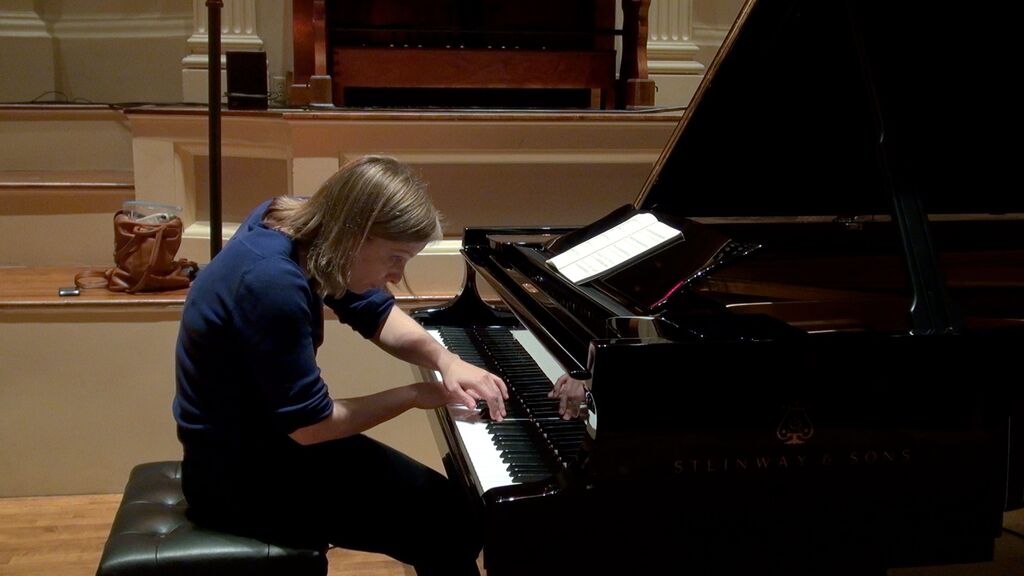
Orli Shaham in the recording studio

A particularly tough moment was when I had just finished playing the first movement of the C Minor Sonata, which is so emotional and such a moment of vulnerability for the performer. I played my heart out, and then there was radio silence from my wonderful producer Erica Brenner hundreds of miles away in Cleveland, because the internet service for the entire neighborhood had failed. Luckily, the audio was captured, and a few hours later, using a lot of workarounds, we were able to continue recording.

Schnabel said of the sonatas “too easy for children, and too difficult for artists”. What do you think he meant by this statement?

It’s a really interesting commentary. I’m not sure I entirely agree with “too easy,” but there are places in those sonatas where the writing is something that makes sense for a student to play because it’s so idiomatic for the keyboard. It will teach you how to use your hand correctly at the most basic level. But at the same time, he’s doing it with such grace and artistry and intelligence that there are layers and layers of meaning to unpack, even with the simplest phrase.

Why, in your opinion, do Mozart’s piano sonatas have an enduring popular appeal, with both artists and audiences?

They have an enduring popular appeal because Mozart had an enduring popular appeal in mind. I love that that’s so, so true. You see it in his letters. He writes to his father, “Don’t worry. I’m putting something in for the really super educated. I’m putting something in for the ones who really don’t know anything about music yet. I’m putting something in for the ones who want to play themselves but aren’t that good.” He thought about everybody and he tried from very early on to consciously put all of that into every sonata, into every work of music that he wrote, actually. I love that he was very mindful of his audience. Of course, that’s part of where he was in time. He was one of the first composers to try to get by without the benefit of somebody’s patronage, meaning he had to appeal to the audience.

Do you have a favourite sonata out of the entire cycle?

Yes. The one I’m playing at the moment.

Orli Shaham’s complete Mozart Piano Sonatas are available in 6 volumes on the Canary Classics label and via streaming

Photo credit Karjaka Studios

Guest post by Ingrid on the experience of studying with Dr Michael Low


Like many musicians, my journey started thanks to a fabulous piece I heard one day (and for sure so many more, but it has been a while so I can’t quite tell) that moved my heart and soul so deeply that I started daydreaming about it and about being able to do that same thing with the piano. I was maybe 10 or 13, but it took a while until I finally got to convince my parents to allow me to start learning the piano.

This led me to begin music lessons at the National Conservatoire here in Guatemala, and, as all music schools based on tradition, the curriculum included not only piano per se, but also Solfege, History, Tonal Harmony, and other subjects that are intended to nurture (and they actually do) your musical understanding and therefore your musical interpretation. A couple of years later I decided to pursue a music degree at university, and I obtained a Teacher’s Diploma in Music and a bachelor’s degree in music composition.

All of this gave me the tools to finally “play the piano”, which we normally say when we hear someone “play” that instrument. But little did I know that there is a huge dimension behind the mere study of any artistic discipline, that is sometimes overlooked and underestimated – that is, the Human Dimension, with all its intricacies and complexities.  

And why is it overlooked? Well, maybe because we usually assume that as artists (musicians, painters, writers…) that dimension is an obvious part of us, and even if that is true, no one ever prepares us for the setbacks and negative experiences that are inevitably part of the journey. As musicians we may suffer from stage fright, we may face abusive/authoritarian teachers, we may be immersed in a toxic competitive environment, we may be the target of intended mean critics, and none of that has to do with the subjects that we learn in during our studies, and that prepare us to become professional musicians – but it has a lot to do with who we are as human beings and how we practice our art.

These setbacks may lead us to reconsider our career path and that maybe we need a change. Some of us may decide to make a radical change, some of us may decide to make a small change. But all of this raises the question of how we can thrive when facing such difficult challenges.

I started searching for answers and began to read blogs where other musicians shared their own experiences in similar situations; blogs where teachers shared their thoughts on how to build a healthy technique and learning environment; blogs where authors shared their thoughts on creativity and how to foster it in your own practice; blogs that shared research based tips to better manage performance anxiety; and I found great resources in authors like Noa Kageyama, Forrest Kinney, William Westney, Graham Fitch, Penelope Roskell, Frances Wilson (The Cross-Eyed Pianist), Rhonda Rizzo, Zsolt Bognár and Michael Low.

In one of those blogs, I was particularly struck by an article that Dr. Michael Low shared where he talked about his own journey with the piano, performance anxiety and the tradition in music education. It really resonated with me, so I started following his work closely.

At some point we also started sharing our musical impressions through social media and video chat. I shared with him that I was re-studying the Brahms’ Intermezzo in A, op. 118 no. 2, and sent him a recording I made of the piece.  I remember he gave me some observations about it and his enthusiasm to work on it musically. I am not exaggerating when I say that this experience has been life changing.

I have to say I’d never had the chance to really discover and experiment with that (or any other) piece, nor I have had the chance to “think outside the box” musically speaking, because you are normally taught that there are “rules” that you must respect as interpreter, and sometimes even “fear”. There is nothing wrong with rules, but as an artist you can always trust your own criteria to use them; however, only an open-minded teacher and artist can help you discover that, and one of them is Dr. Michael Low.

It amazes me how spontaneously Dr. Low fosters that safe environment for experimentation, and how through funny examples and direct questions he challenges your own beliefs: be it about the piece or the composer or your own playing, always in a very kind and respectful manner, going beyond the surface and helping you to start thinking more as an artist than just a “piano player”. And the best part is that there are plenty of Eureka! moments, when you discover all the possibilities you have in your own hands, under his guidance.

And even if I have been in piano lessons before, there has always been a rush and a pressure to play a particular piece “perfectly”, not giving any space to really discover it (besides the obvious aspects of technique and analysis that are intrinsic to the music study), and to find one’s own voice as a musician and, most importantly, as artist. When there is too much noise outside, we get distracted from what we must look for on the inside.

After working all this time with Dr. Low and sharing interesting discussions about music, while also applying and following all of his very insightful advice in my own practice (both as teacher and as pianist), I have come to various conclusions that make me think about how we can thrive.

  • There is not just one answer, nor a right or wrong one, but there are some general thoughts that are worth always keeping in mind:
  • Music is a lifelong learning career/experience where one of our biggest enemies is the obsession with perfection
  • Kindness, in every aspect: with ourselves and with others, is a life changer as it creates wonders
  • Patience with our own artistic growth, as no path is the same as other and there is no one-size-fits-all solution for such big endeavor

As Vincent van Gogh wrote to his brother Théo, in a letter from May 1882, with relation to the meaning of being an artist:

“(…) Those words naturally imply always seeking without ever fully finding. It’s the exact opposite of saying ‘I know it already; I’ve already found it’. To the best of my knowledge, those words mean ‘I seek, I pursue, my heart is in it’.” 

This article is translated from the original Spanish, which you can read here:


Dr Michael Low is a pianist and teacher based in South Africa. If this article has piqued your interest in his work, why not come along to a masterclass at Coach House Pianos London showroom on Saturday 1 June to observe Dr Low teaching advanced amateur pianists in a variety of repertoire. The event is hosted by Frances Wilson AKA The Cross-Eyed Pianist.

Further details/tickets here

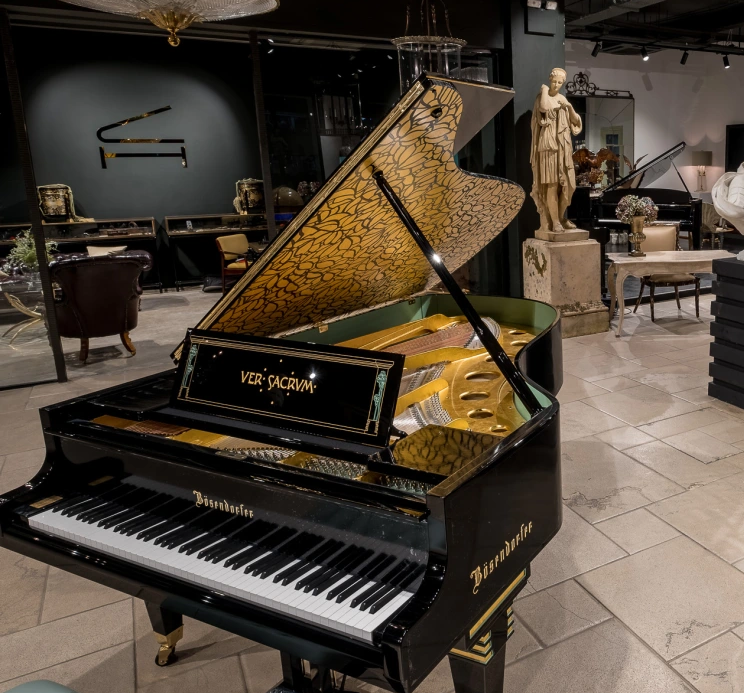
Coach House Pianos London Showroom