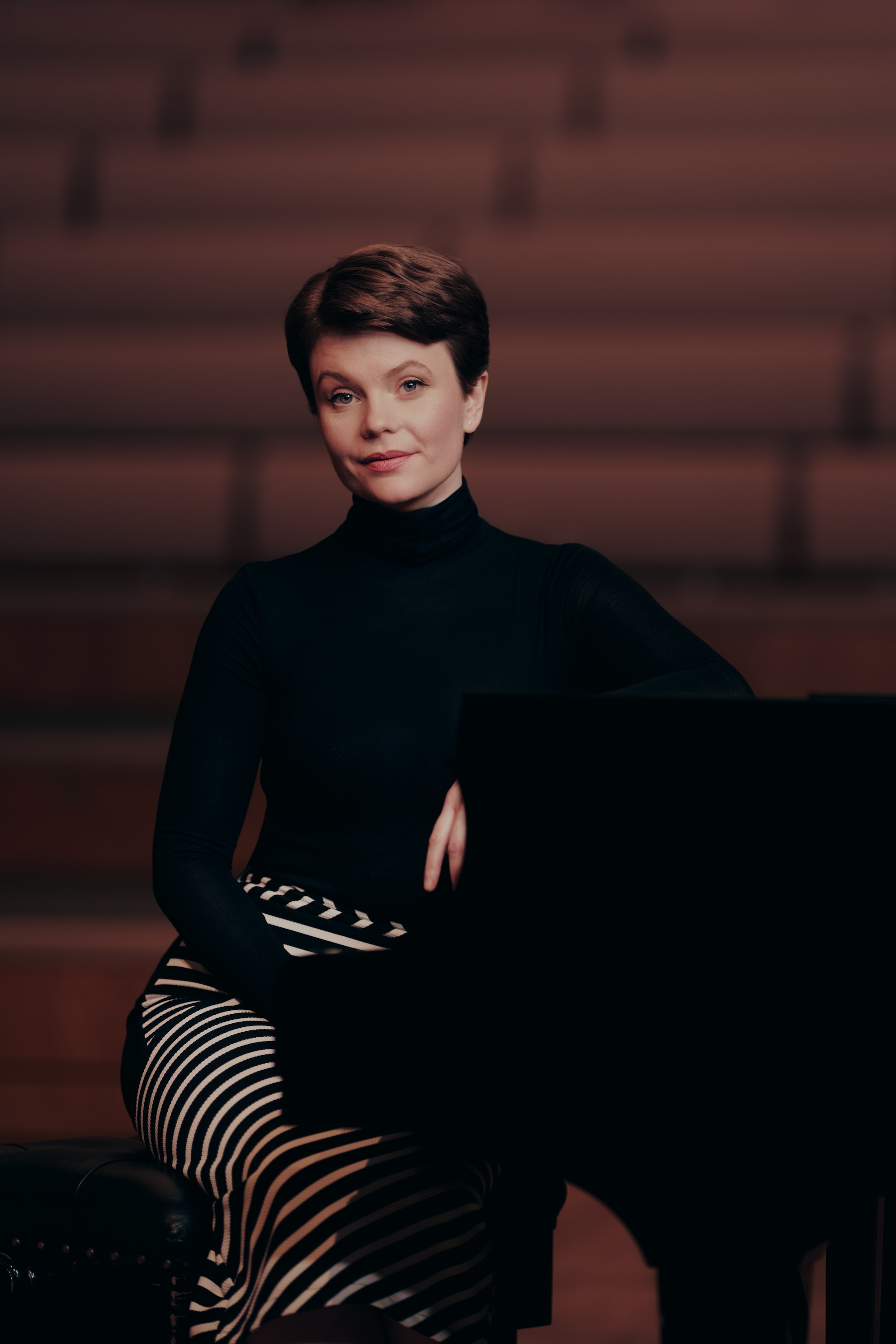
Guest post by Clare Hammond

Since 2017, British pianist Clare Hammond has given 25 concerts in 8 prisons across the South-West of England. Here she describes her experience of performing in prisons and how music can inspire, console and heal.


Prisons can be daunting environments. A trek through long concrete corridors and heavy iron gates, negotiating lock after lock, to find a community of adults, trapped, bound together by adverse circumstance. Emotions run high yet are often impossible to express – shame, detachment, fear, denial. A sense of loss and frustration is palpable.

These environments are so distinct from our usual lives that the experience of visiting one for the first time is profoundly disorientating. Not only the physical environment, but the social hierarchy, is unfamiliar. I had never previously been so aware of a disparity of power, of the tension that a necessary hierarchy between staff and prisoners can produce. Words become charged and communication falters.
Unlikely as it may seem, music can provide a way to overcome some of these obstacles. I started to perform in prisons in 2017 as I was recovering from a severe and disorientating bout of postnatal depression. Not only had I been profoundly depressed for a year, but at times I had sensed my grasp on sanity weakening. This in itself was so alarming, and my obsessional focus on disaster and despair so wearing, that I decided to take drastic action. I needed to try something new, something challenging enough to distract me from my interior monologue.
I contacted a friend of my husband, a prison Chaplain, and asked if he might be willing to arrange a concert. I had no idea whether a recital of classical music would be of interest, but he accepted. A few weeks later, I found myself at Security, lugging my electronic piano behind me. After a thorough search, I was admitted and made my way to the Chapel. As I unspooled the extension cord, heard just how thin the piano sounded in the acoustic, and watched the rows of men file in, I wondered whether this had been a sensible decision.
I took a deep breath. Some listened expectantly while others were conspicuously indifferent. Two small pockets of young men were joking around, elbowing each other and sniggering. After a couple of virtuosic Chopin études, I decided to focus on the human stories behind the music, describing obstacles that the composer had faced and the way these emerge in their music. I described Schubert’s final illness, the isolation he experienced, and the beauty of the music he composed during that period. This was more powerful than I could have anticipated. The audience were completely still during his Impromptu in G flat major and, to this day, this remains one of my most moving concert experiences.
I have now given 25 recitals in 8 different prisons and still follow this format. I present, in turn, Robert Schumann’s battle with bipolar disorder, Beethoven’s contemplation of suicide in the Heiligenstadt Testament, or Hélène de Montgeroult’s imprisonment and sensational trial before the Committee of Public Safety, evading execution by the skin of her teeth. I programme tonal music with familiar melodies alongside more adventurous repertoire. Unsuk Chin’s phenomenally inventive Toccata, as ‘uneasy’ a listen as you could hope for, has become a surprise hit. To see the eyes of a young man light up in enthusiasm at his first encounter with hardcore contemporary music was not something I had anticipated. I donate copies of my discs, often of obscure repertoire, to the prison libraries and hear, months later, that a man who had never listened to classical music before has become a fan of Szymanowski.
From a personal perspective, these concerts have healed and grounded me. I have always been an anxious person, and suffered from debilitating guilt when I was ill with depression. Seeing the power music has to connect people, to console and inspire in such difficult environments, has taught me the value of my work. I now feel that I am making a real contribution and am much calmer as a result.
I believe firmly that everyone should have access to classical music, in all its forms. It broadens horizons, offering a glimpse of what life could be, what adventures are possible. Most importantly, though, it creates a visceral link between us – between those who hear a performance, those who play together in a band, or between a long-dead composer and the people their music inspires. Music is powerfully communicative, particularly in environments where words are too charged for comfort. It transcends our daily struggles and brings hope.
If you would like to support music in prisons, please consider donating to the Irene Taylor TrustChanging Tunes or Koestler Arts.
Read Jailhouse Moose’s account of a prison concert given by Clare Hammond

Acclaimed as a “pianist of extraordinary gifts” (Gramophone) and “immense power” (The Times), Clare Hammond is recognised for the virtuosity and authority of her performances.

In 2016, she won the Royal Philharmonic Society’s ‘Young Artist Award’ in recognition of outstanding achievement. Recent highlights include Grieg Piano Concerto with the City of Birmingham Symphony Orchestra, Moussa and Carwithen with the BBC Symphony Orchestra and BBC Concert Orchestra, Panufnik with the Warsaw Philharmonic Orchestra, and recitals at the Aldeburgh Festival, Palazzetto Bru Zane in Venice (broadcast on RAI 3), Husum Festival in Germany, and in Denmark and Norway with Henning Kraggerud.

Read more


Conductor and festival director Tom Hammond thinks we should all bother with music. In this guest post, he explains why and previews this year’s Hertfordshire Festival of Music.
marchteal

I’m writing this less than two weeks before the opening of the 2019 Hertfordshire Festival of Music (HFoM), with the sweaty brow of the accidental concert promoter desperately hoping to see more tickets flying off the shelves.

We’ve programmed some fabulous music and musicians in this our fourth year: Fauré, Haydn, Schumann, Ravel, Mozart….with Steven Isserlis, Orchestra of the Swan, Anthony Marwood, Clare Hammond, the Carducci Quartet, to name only a few.

It’s not just classical music traditionally presented (although there’s some of that, and no apologies for it!) with two performances from the effervescent ZRI mashing Brahms with klezmer and gypsy styles plus their need live-to-film performance Adventures with Charlie Chaplin, an amazing jazz trio in a magical venue, and even a guided visit to Haydn’s summer holiday home when he was here in 1791. Plus three Featured Living Composers (Peter Fribbins, Alan Mills, James Francis Brown) and three major outreach projects involving more than 200 young people. Basically shed-loads of stuff, and really good stuff!

Since the Festival began – the initial germ of the idea coming to me back in 2015 – we’ve welcomed around 2,500 people to concerts in Hertford and Hertfordshire, given education and performance opportunities to around 500 younger people (schoolchildren as well as conservatoire level students) and raised something like £150,000 in external funds and Box Office revenue. Raising that sort of money for music is incredibly hard work as anyone who’s ever tried will know, taking hours of your life that could be spent doing vastly more enjoyable things….

The money that we’ve raised has gone directly into the music economy via paying our artists – about £75,000 on musician’s fees alone, and we pay at a decent rate –  plus all the other elements of the musical food chain, including commissions, hire of copyright materials, piano tuners, keyboard hire, sound and lighting equipment, etc., etc. Where that money certainly isn’t going is into my back pocket, nor that of my co-Artistic Director. We’ve also got a very hard-working board of trustees, because we’re now properly formalised as a charity, plus our FOH team who also do it for the love of music.

And why on earth would anyone do this?!

I have asked myself that question many times, not least as so many areas of running a Festival are things for which I’ve had absolutely no training, experience or aptitude and I’m already pretty busy with my main work as a conductor and producer. But, when I read my social media newsfeeds, or see classical music mentioned in the national media, it’s too often report after report about cuts in music education and how music is being marginalised. Or how to make it ‘relevant’. Or how it’s seen as for only posh people…. You don’t need me to go on because it’s jaw-clenchingly boring to do so, and moaning is too easy and the time could be better spent doing something about it.

What I and my colleagues at HFoM are trying to do, albeit in a nascent way which needs constant refinement, is simply put amazing music on in appropriate spaces that heighten the audience experience, plus open out opportunities for young people, and try to buck the above trend. As a colleague of mine once said to me, we are attempting to act as incubators of this amazing art form and when the day finally comes and politicians actually read the gazillions of studies that show how music helps people in so many ways and fund it again, someone can buy us all a pint.

Until then, if anyone fancies coming along and helping us continue beyond this year we have plenty of tickets left to sell. With only two exceptions, you can walk to all our performances in less than twenty minutes from train stations, all of which are well-served in and out of London. It will be light well into the evening, hopefully sunny and warm too. Tickets are not expensive, indeed some events are totally free, many offer £5 seats for anyone in full-time education, and they are in nice places with good pubs, restaurants and countryside nearby.

Hertfordshire Festival of Music runs from Thursday 13 to Sunday 23 June 2019. This year’s principal artist is cellist Steven Isserlis who will be giving masterclasses and performances during the festival. Full programme of events

Tom Hammond is co-Artistic Director of Hertfordshire Festival of Music, and a conductor and record producer.

www.hertsmusicfest.org.uk

Meet the Artist interview with Tom Hammond

A big screen adaptation of writer Alan Bennett’s celebrated memoir, directed by long-standing Bennett collaborator Nicholas Hytner.

The film tells the true story of the relationship between Alan Bennett and the singular Miss Shepherd, a woman of uncertain origins who ‘temporarily’ parked her van in Bennett’s London driveway and proceeded to live there for 15 years. Their unique story is funny, poignant and life-affirming. What begins as a begrudged favor becomes a relationship that will change both their lives. Bennett’s play has echoes of the story of Anne Naysmith, former concert pianist, who lived in a car in Chiswick after falling on hard times and being evicted from her home.

British pianist Clare Hammond will appear as the younger version of Dame Maggie Smith’s character, Miss Shepherd. Clare performs in a number of flashback scenes recreating a Proms concert in the 1930s, and enacts Miss Shepherd’s experiences as a novice nun some years later.

This slideshow requires JavaScript.

Clare’s recording of excerpts from Chopin’s Piano Concerto No. 1, with the BBC Concert Orchestra, is featured throughout the film. The slow movement of Chopin’s concerto and Clare’s performance of Schubert’s Impromptu in G flat major are included on the soundtrack alongside music specially composed for the film by George Fenton, due for release by Sony on the 6 November 2015.

Meet the Artist……Clare Hammond (interview)

Filmed on the street and in the house where Alan Bennett and Miss Shepherd lived all those years, acclaimed director Nicholas Hytner reunites with Bennett (‘The Madness of King George’, ‘The History Boys’) to bring this touching, poignant, and life-affirming story to the screen. The film is due for release in the UK on 13 November 2015.

Official trailer

Pianist Clare Hammond (photo credit © Angela Dove)

The Monday Platform at Wigmore Hall, presented by the Park Lane Group, showcased the impressive and varied talents of the Lawson Trio and pianist Clare Hammond.

This was an enjoyable programme which combined the elegant and witty classicism of Haydn with the intimate lyricism of Schubert, the mercurial passions of Schumann, Bach’s Italianate arabesques, and the earthy nationalism of Ginastera. The mix of ensemble and solo piano works made for an extremely satisfying concert experience.

Read my full review here