Who or what inspired you to take up composing, and pursue a career in music?

As a child my aunt was a pop singer, and released music; she also recorded my first song. My music teachers at school were supportive, and luckily Northamptonshire had a great music service when I was a child.

Who or what were the most significant influences on your musical life and career as a composer?

As a composer I have been lucky to have great female role models – Rhian Samuel, and Diedre Gribben briefly taught me at post-graduate and undergraduate levels.Sadie Harrison is a great mentor and teacher, an inspiring woman. I am also incredibly lucky to have worked with Kuljit Bhamra on his Tabla notation project. I was commissioned by Sound and Music to learn a new notation system for Tabla and compose new work for Kuljit, Anne Denholm and Joe Richards, mentored by Colin Riley. Most recently, the amazing soprano Gweneth Anne Rand is advising and mentoring me on composing for voice for my new work for Téte å Téte Festival in September 2020.

The music industry is tough and it is so important to have guidance and support. I have been lucky to be surrounded by strong female spirits throughout my life; even now my own grandmother has been teaching my son piano over Skype through lockdown. Her mother was a pianist (whom I never met), born in Greater Manchester, and studied in Vienna as a young girl. She married a lovely man from Lancashire who worked in the cotton mills and she ended up teaching and playing in the pubs of Oldham. My Grandma was keen to buy us a piano when I was little, so we got one from a pub in Wellingborough, where I grew up, and I began lessons as a child. Later I learnt cello, through the Northants Music Service at Junior School. I probably resonated with the cello after listening to the Bach Cello Suite’s, by Jaqueline Du Pré, on a tape cassette of my Mum’s that I think she was introduced to through contemporary dance. I grew up listening to a mixture of Bach, Dave Brubeck, Nina Simone, Carol King, The Specials, Madonna and Soul to Soul. Lisa Stansfield was my first proper concert at Sheffield City Hall with my Aunties, Mum and sister. As a young person I went to concerts at The Stables, a 40mins drive from where we lived, and performed in Youth Orchestra Concerts at The Derngate, Northampton. There was also a local Jazz night at a local pub which had some good players that my sister’s saxophone teacher let us know about, my Dad has always been really into Jazz and Blues and has been a huge influence on my listening. Latterly I became introduced to all kinds of music, North Indian Classical, Bartok, Shostakovich, Mahler, Saariaho, Cage, Oliveros, and all kinds of dance music, from electronica, drum and bass and Techno.

What have been the greatest challenges/frustrations of your career so far?

On leaving Newcastle University, I initially found it really difficult to find work, and was on The New Deal for Musicians. It was amazing as I got business advice and support from various professionals. I also got a Prince’s Trust grant to buy a computer as I had never owned one and then when I began working professionally as a cellist I had some guidance and awareness of the industry. A year later I was performing on The Mercury Music Prize (2000); perhaps without the chance to learn the ropes of being a self- employed musician I would not have had that opportunity. An RSI injury in my late 20s and early 30s was a real low point. My inspiring cello teacher at the time, Sue Lowe, built me back up again, emotionally and physically, which took several years. Luckily my composing career has been building slowly since then. My most recent career high was hearing my work for Tabla and String Quartet performed at the Royal Albert Memorial Museum in Exeter just before lockdown in March. The work was for amateur performers from the Devon Philharmonic with professional Tabla player Jon Sterx. The musicians were amazing – with very little rehearsal time they performed with such vitality and commitment.

What are the special challenges/pleasures of working on a commissioned piece?

The pleasures often outweigh the challenges; however since the Covid-19 lockdown I feel many musicians and artists in general are facing huge barriers to their livelihoods. Currently I am composing new work for Fenella Humphreys, and have contributed to her Caprice’s project, funded mostly by Kickstarter (see her website). It is thrilling when performers like Fenella agree to perform and record your music. Fenella has a Youtube channel which is enabling new work to be premiered to wider audiences, so moving on from the devastating lockdown challenges, people are really trying to overcome them through digital platforms, and I just hope people can continue to contribute to artists’ projects financially right now, as so many freelance artists have lost so much work and income.

What are the special challenges/pleasures of working with particular musicians, singers, ensembles and orchestras?

So much of my work, commissions and premieres have either been postponed or cancelled, and as an emerging composer, it is especially tough and heartbreaking. I only began composing again seriously after my son was born, so I am a bit of a late starter, and I just hope my energy and determination carries me though this unstable period. Some amazing opportunities have still managed to happen. I am currently working on a new Imaginary Opera project Song of Isis, Goddess of Love, for the Tête-à-Tête Festival 2020, which is a truly inspiring, inclusive and exciting festival to be part of. This wonderful opportunity is a lifeline as it is still going ahead in September, regardless of Covid restrictions. See the wonderful blog from Bill Bankes-Jones for more information. The practicalities of working on this are huge – devising and rehearsing new work with actor/singer Sèverine Howell-Meris over Zoom will be particularly unique to these times. I will be documenting this process online on the blog but really also hope to share our work in a real live format somehow.

Our performance date is, hopefully, 9 September 2020 (please follow us on @imaginaryopera or @laurareidmusic to find out when/if the performance will be going ahead live at The Cockpit Theatre, London). Again finances are tight, and Tête-à-Tête are fundraising for the festival on their website.

I am working with writer Chris Aziz, and animator Martha King to provide online content. I am hoping to include a virtual chorus, using singers and friends around the UK to participate in some capacity from their homes. Working with an all-female team is exciting, but as it is our first opera it is incredibly daunting at the same time. Networks such as Engender, run by producers at the Royal Opera House, are proving to be so important right now to get things to happen. Hearing leading figures like Gweneth Ann Rand and director Adele Thomas talk at the last meeting was inspiring and really encouraging.

Of which works are you most proud?

My commission for the Dorset Moon ‘Celestial Bodies’, performed to over 1,000 members of the public via headphones underneath Luc Jerram’s amazing Museum of the Moon.

How would you characterise your compositional language?

Eclectic, diverse, contemporary folktronica.

How do you work?

Sporadically. In the old days pre-covid, I had routines and time to think. But now it’s in odd moments when I am not doing childcare or home-schooling, mostly in the evenings since lockdown, although I am usually a morning person. I am really looking forward to, and feel incredibly lucky to be going to Made at The Red House, Aldeburgh, hosted by Wild Plum Arts, which will be an amazing opportunity to compose and think away from domestic responsibilities.

Who are your favourite musicians/composers?

My tastes are always evolving and changing. I currently love listening to Jill Scott, Tallis, and Bach. I really enjoyed listening to After Rain by Hildegard Westerkamp recently at the UK and Ireland soundscape conference in Sussex.

As a musician, what is your definition of success?

Happiness balanced with enjoying the process of composing and playing, and working on projects that inspire change and amplify narratives from the margins.

What do you consider to be the most important ideas and concepts to impart to aspiring musicians?

Keep a sense of your self and what feels right to you. Learn the rules, and then how to break them. Nothing matters very much, except staying sane and positive. We all face challenges so try and focus on what you can do rather than what you can’t.

What is your most treasured possession?

My cello J


Song of Isis. Goddess of Love, with music by Laura Reid, will be premiered by Tête-à-Tête on 9 September. Further information here


www.laurareid.co.uk

@laurareidmusic

@imaginaryopera

https://imaginaryopera.wordpress.com/

7372kArthur Sullivan, Haddon Hall

Following the critical success of ‘The Mountebanks’, John Andrews’ recording of Sullivan’s late opera ‘Haddon Hall’ with the BBC Concert Orchestra, BBC Singers  and a cast featuring Sarah Tynan and Henry Waddington was released at the weekend.

Further information and buy CD

Meet the Artist interview with John Andrews


img_5978En Pleine Lumière volume 1 – Sandra Mogensen, piano
This first album in the “en pleine lumière” project features 10 composers born in the mid-19th century, including Mel Bonis, Cecile Chaminade, Germaine Taillferre and Amy Beach.

Further information and buy CD

Meet the Artist interview with Sandra Mogensen


Guest article by William Howard

howardskempton_forwebsite
Howard Skempton

Howard Skempton is one of the UK’s most engaging and distinctive composers. Now in his seventies, he has produced a large and varied body of more than 300 works. Amongst these are over 100 pieces for solo piano, which he describes as the ‘central nervous system’ of his work. It is a treasure trove for both amateur and professional pianists, in which most of the pieces are very approachable from a technical point of view (in contrast to a great deal of contemporary piano music) whilst being at the same time hugely rewarding to explore and perform.

Almost all of Skempton’s piano pieces have been written for friends and colleagues or for special occasions. They are predominantly short, tonal and sparingly composed, with very few notes to the page. Many of them look very simple and are, in fact, quite easy to sight read, but, in my experience the only time these pieces are ever easy is when you are sight-reading them. As soon as you start practising them the challenge begins. Their apparent simplicity is deceptive, a conclusion reached in an excellent programme on BBC radio 3 recently called The Simple Truth, in which Tom Service explored the subject of ‘Simplicity in Music’. Commenting on one of Howard Skempton’s short piano pieces, he said “Simple, isn’t it…well, you try composing it!”. I would add “try playing it!”.

One of my favourites is Solitary Highland Song, which he wrote in 2017 for a collection of love songs for solo piano that I commissioned. When the piece first arrived, I immediately read it through and found it deeply moving. In fact, I couldn’t get it out of my head for days. It consists of a simple and haunting eight bar tune, repeated six times, each time slightly differently. The dynamics start at pp, progress to mp and return to pp. Nothing complicated here. And yet I remember practising the piece for hours and hours before I gave its first performance, and I still practise it a lot before a performance. Why? The simplest answer that I can give is that it takes time to really hear the music. Skempton’s musical language is so distilled and pared down that every note, chord and musical gesture must be perfectly calibrated. Quite apart from the question of mastering total control of touch and voicing, the performer must seek out the essential character of each piece by learning to be open to what is interesting within the music, rather than trying to make the music sound interesting. There are no short cuts in this process. Skempton deliberately gives only minimal performance instructions, so that performers are invited to participate in the music and develop their own awareness of subtle changes and shifting patterns. The more I play Solitary Highland Song, the more I become aware of the genius behind every choice the composer has made: the subtle changes of register, for example, or the distribution of notes in chords and unexpected changes of harmony and rhythm. For me the piece is an enduring delight, and, I think for others too, since it has recently achieved the wonderful landmark of being heard over a million times on streaming platforms.

An example of an even sparser piece would be the third of the Reflections, a collection of eleven pieces that Skempton wrote for me between 1999 and 2002. It consists of four two note chords, a ninth or tenth apart, which are repeated in a different order eight times. The only performance instructions given by the composer are that the chords should all be played approximately two seconds apart, ppp and pedalled throughout. Where is the challenge here? Well, for a start, it is not easy to sustain molto pianissimo playing with a consistent sound, even for just over a minute. The more you play the piece, the more your listening becomes tuned in to the slightest blemish, or bumped note. And the more you listen, the more you start to become aware of the harmonic resonance shifts in different ways as the order of the chords change. By the time I came to record this piece, my ears were highly sensitised to the point where the tiniest imbalance in a chord would sound like a catastrophe. But it became very clear in the recording sessions that what brings a performance to life for the composer are the tiny unexpected or unplanned things that happen and the way a performer responds to them. In his characteristically gentle and encouraging manner, Howard Skempton decided that what we might have called ‘blemishes’ should be referred to as ‘involuntary refinements’! For him, the most important thing is to keep the music alive at every moment rather than aim for clinical perfection.

I recommend this repertoire strongly to fellow pianists at every level of ability. You will find pieces that are hauntingly beautiful, others that are quirky and playful; they are always imaginative, beautifully crafted and unpredictable. As well as giving a huge amount of pleasure they can teach us a great deal about our relationship to the keyboard and about how we listen to ourselves. Having totally immersed myself in Skempton’s music recently, I find that all the other repertoire I am coming back to sounds new and refreshed to my ears.

Scores are easy to obtain. Oxford University Press have published three volumes of Skempton’s piano pieces, which are reasonably priced. Most recently Howard Skempton has taken on the challenge of writing 24 Preludes and Fugues, an intriguing cycle of miniatures covering all 24 major and minor keys, written last year and lasting barely 23 minutes. These will be published by OUP in the coming months.


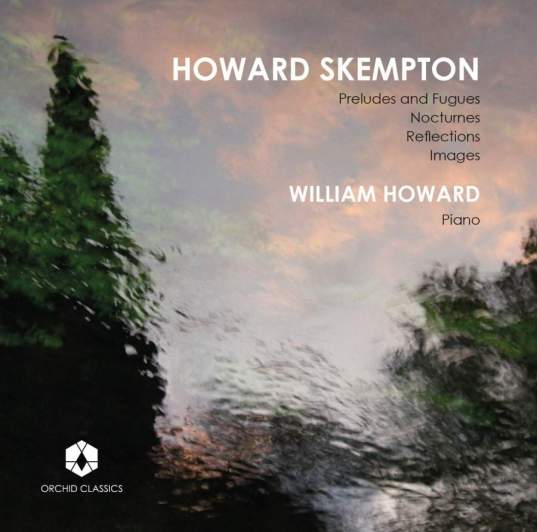
William Howard’s recording of Howard Skempton’s 24 Preludes and Fugues (2019), Nocturnes (1995), Reflections (1999-2002) and Images (1989) will be released on Orchid Classics (ORC100116) on 14th February. Pre-order here.:

Anyone who pre-orders the album can enter a prize draw to win one of five copies of Solitary Highland Song, signed by the composer. Please forward your order confirmation email to mail@williamhoward.co.uk before 14th February.

The album will be launched with a recital by William Howard at Kings Place on Wednesday 12th February at 7.30pm in which he will play works by Bach, Schubert and Howard Skempton. Tickets and further details here

Meet the Artist interview with William Howard

williamhoward.co.uk

orchidclassicsorc100116

Bernard Hughes

Who or what inspired you to take up composing, and pursue a career in music?

I started composing of my own accord at about the age of 8, without anyone particularly inspiring me or suggesting I do it. I just started writing things down on bits of manuscript paper lying around the house. I remember making up a key signature which combined sharps and flats and showing it to my father, who said there was no such key signature. I didn’t understand why that was, or why I wasn’t allowed to make up my own key signature. As to making a career from music, that was never intended. Most people who write music stop at some point, and I just never stopped.

Who or what were the most significant influences on your musical life and career as a composer?

I had an wonderful music teacher called Gwynne Lewis when I was about 10. He didn’t especially inspire me to compose, but he communicated a love of music and the joy of being involved in music and I carry that with me. I also learned a lot about commitment and integrity from the composer Param Vir. Apart from my teachers the inspiration above all has been Igor Stravinsky. I didn’t discover his music until the shockingly late age of 16 or 17, but once I heard the Rite of Spring I never looked back in my devotion to his music. First hearing the Symphony of Psalms was an unforgettable experience.

What have been the greatest challenges of your career so far?

As with all composers, the challenge is to have your music heard. In this I have been pretty lucky, but every composer wants more and higher profile performances and commissions.

What are the special challenges/pleasures of working on a commissioned piece?

Having a particular occasion or performed in mind can really help to shape a piece. When the requirements of the commission and you are aligned it is really fun: writing my narrator-and-orchestra piece ‘Not Now, Bernard’ was one such – I realised it was a story I loved to tell, and that the music could add to.

What are the special challenges/pleasures of working with particular musicians, singers, ensembles and orchestras?

I’ve been lucky to work quite often with the BBC Singers over many years, including on an album of my music released in 2016. The fun of writing for them is also the danger – they can sing anything and make it sound good, but if you push the boat out too far no one else will ever sing it.

How would you characterise your compositional language?

My musical language changes with each piece I write, so I don’t have a personal style as such – although I am sure there are recurring tricks if you look for them. Writing a piece is finding a solution to a problem, and when the initial restrictions vary, so does the end result. But when I write a piece like ‘Not Now, Bernard’, which is very tuneful and ‘accessible’, I don’t think of it as any less a ‘proper piece’ than my more avant-garde pieces – they are all aspects of my compositional voice.

As a composer, how do you work?

On a practical level I move between the keyboard, handwritten music notation and the computer. They each have their role within the process – although often first ideas come when I’m on my feet, either walking round my neighbourhood or in the shower. I like the handwritten element because you can trace your ideas back archaeologically if you change your mind. But I also love the opportunity the computer offers to check things like pacing, and complex harmony that is beyond my fingers.

Which works are you most proud of?

It would have to be the two large-scale pieces written for the BBC Singers. ‘The Death of Balder’ in particular, is an original conception – a ‘radio opera’ for choir on a Norse myth – and I am happy with how it turned out, after a great deal of uncertainty while composing it. I also had the opportunity to write an orchestral piece in 2012 called ‘Anaphora’ which again caused me a lot of grief in the creation but which I am in retrospect very proud of.

Who are your favourite musicians/composers?

As mentioned above, I am a huge Stravinsky fan, and always will be. Of contemporary composers, I really love Judith Weir’s music – she is also an extremely kind and generous person and it was a pleasure working with her on my album Not Now, Bernard and Other Stories, which features the premiere recording of her piece ‘Thread!’ alongside my own music. My current enthusiasm is for a French composer called Guillaume Connesson, who is very little known in this country but I think is brilliant and deserves much wider programming.

What is your most memorable concert experience?

I was lucky enough, as a child living in Berlin in the 1980s, to be taken to hear the Berlin Philharmonic a few times. The two occasions I particularly remember were hearing Mendelssohn’s Violin Concerto and – the first time I went – Mozart’s Piano Concerto no 21. I was about 10 and both completely blew me away, just the sound of the orchestra, and I still love both pieces. I also remember, at one of those concerts, the second half being a Shostakovich symphony, which I hated; Shostakovich symphonies still don’t do it for me.

What advice would you give to aspiring musicians and composers?

I think it is a responsibility of composers to listen widely, and to music that is not necessarily instantly amenable. I think too many people, young people in particular, are too narrow in their range of listening. In one sense there is no excuse for not listening widely – my excuse as a youngster was that it was difficult to access music, apart from Radio 3 and my local library’s cassette collection. But the flip side is that there is so much music available now that it can be difficult to wade through it all. But it is important for composers to have open ears.

Interview date: January 2020


www.bernardhughes.net
