Award-winning composer Thomas Hewitt Jones was one of the first people I interviewed for my Meet the Artist series, back in 2012. Here, he has updated his interview with further thoughts on his significant influences and inspirations, and why we should cherish and value the arts.
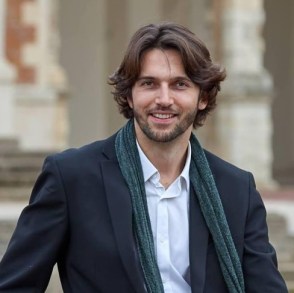

Thomas Hewitt Jones

Who or what are the most significant influences on your musical life and career as a composer?

Without a doubt, my paternal grandparents (both composers) were hugely significant influences on me, both musically and in terms of my career trajectory so far. My grandfather Tony was a great craftsman and studied with Nadia Boulanger; my granny Anita wrote educational music that is extremely accessible for young string players, yet is of consistently high quality. Both had studied harmony and composition techniques with the lovely man that was Bernard Rose while at Oxford (who told Tony in an early supervision “you’ll never get a girlfriend unless you cut off your beard”… anyway the next week Tony announced with a wry smile that he was engaged to Anita); however, over her lifetime Granny’s music did better commercially than Tony’s, who wrote entirely for himself (and often wrote choral music that was high quality, yet challenging to both listen to and perform). He once got offered a large amount of money to write music for a TV ad for a building company, and turned it down. I like to think that I have ended up with a mix of both approaches to composition, although I personally enjoy writing music for a wide audience which is nevertheless genuine, with…that ever-important word these days…integrity.

What have been the greatest challenges of your career so far?

I think that we live in a difficult time for composers who want to write music that has what I call ‘horizontal’ emotional narrative. There’s so much soundbitey ‘vertical’ contemporary classical music that is constructed like pop music, built around earworms and varying textures over a repetitive chord sequence rather than maintaining melodic, rhythmic and harmonic interest over time. Music can do so much more than just an earworm intended to get high numbers on Spotify.

On the other end of the artistic spectrum, I’ve got an amusing commercial music track called ‘Funny Song Cavendish’ that has gone mega-viral on TikTok (currently 2 billion streams, and countless celebrity videos as I write this). It is a lesser-discussed part of the music streaming arguments that are currently taking place, but newcomer music usage platforms such as TikTok present difficulties for composers and publishers because royalty streams are not always transparent until legislation is fought for in retrospect. I’ve actually recently been voted on the Ivors Academy Senate Committee for this year, and I’m going to be campaigning for this, and many other similar issues that will hopefully make issues of streaming rates more transparent for the composers of tomorrow. My overriding feeling is that composers in the year 2022 feel that they must write a certain type of music that will serve them well financially through the algorithms of streaming services, rather than being musically satisfying – rather than pushing artforms to a new and exciting place – which is, in my humble opinion, a sorry place to be.

What are the special challenges/pleasures of working on a commissioned piece?

It’s always an enjoyable challenge to write to a brief. As artists throughout time have invariably found, the difficult commissions are the ones where there is a clear cognitive dissonance during the creative process – if, for example, there are words a composer doesn’t particularly want to set, or a subject matter that doesn’t really interest him or her. The really great craftsmen can transcend these situations – but the arts at their best are an honest expression of humanity. A composer is invariably emotionally naked, and audiences aren’t stupid so they will realise pretty quickly if music isn’t authentic. I’ve been lucky not to have to deal with such situations, but in the arts there is nowhere to hide!

What are the special challenges/pleasures of working with particular musicians, singers, ensembles or orchestras?

I am incredibly lucky to have worked with some of the finest players around in recording sessions so far, many of whom have become friends as well as colleagues. The COVID lockdowns in 2019-21 were an interesting time because everyone was recording at home, but we managed to still make things work and release albums. As well as writing the music I very much enjoy the music production process as well, so these things came together during that time.

Of which works are you most proud?

I’m not sure that a composer can judge his or her work. Each piece of music you write is like a new offspring, but as soon as it has grown up and left home, it’s no longer yours. For this reason, I make a point of deleting files and throwing away copies of pieces of music that have had copyrights assigned and are published and out in the ether. If people email asking me for copies of pieces, I genuinely can’t help – and I occasionally hear things on the radio that I’ve forgotten I’ve written! As a writer, the thing you are working on is the only piece you are aware of.

How would you characterise your compositional language?

Approachable and mainstream, yet high quality and with integrity. That’s what I hope anyway, but it’s not for me to judge.

How do you work?

I have a lot of technology in my studio, and I love using it. That said, I believe that the key elements of music composition are exactly the same as they were in Bach’s time, that great melody and harmony (or interesting texture used in a way that is satisfying in narrative) are key to an emotional experience that makes great music.

It strikes me that today there are a lot of ‘noodlers’ who can’t look at a score and hear it in their head, and can’t compose away from their DAW [Digital Audio Workstation]. For me personally, that isn’t quite right. There is a place for every approach, and improvisation is incredibly important for all-round great musicianship. But for me, the first idea isn’t necessarily the best one, and while noodling might make for perfectly good underscore underneath an emotive speech in a film, it won’t break the mould as a standalone piece. (It might satisfy a mass radio streaming audience who are using music as background wallpaper though.) The creative process is full of contradictions so I always approach each project differently. As Stephen Sondheim so wisely said, ‘Content dictates form’.

As a musician, what is your definition of success?

A second performance. I think many of my peers would agree – if you ever meet a load of composers in a bar, they’ll either be chatting about the PRS, or about second performances.

What do you consider to be the most important ideas and concepts to impart to aspiring musicians?

This will sound facetious, but – like the human condition itself, the route into a musical career is also full of contradictions and there is honestly no set way to approach a career in music. I’m sure many would agree that it’s about hard work, luck, and being happy to be poor while you are building up a reputation in your early years. It took me 8 years after leaving university to make a successful living as a composer. Hopefully the horrendous swagger of entitlement of the generation above us (typified by the likes of certain members of our cabinet) will cause a reassessment of honesty, integrity and equal access for talented newcomers that will filter through to the arts as a whole. But that might be wishful thinking.

What do you feel needs to be done to grow classical music audiences?

I think that two ends of our industry have to meet in the middle, and everyone needs to be unjudgmental. I think ClassicFM has done such a huge amount for music appreciation in the general population, and I love its straight-to-the-point promotion of great melody. I also really enjoy listening to the Ligeti Piano Concerto. I think that great music needs to be given as much of an airing irrespective of commercial viability, background or composer’s gender.

Where would you like to be in 10 years’ time?

Last time I did this, I said I would like to be in a hut by the sea, with a wife and kids if I’m lucky. Well now I have a wife, Annalisa and two kids. Maybe next time I do this, I’ll have another kid, but hopefully not another wife!

What is your idea of perfect happiness?

Being with my wife and kids.

What is your most treasured possession?

My wife and kids.

What do you enjoy doing most?

Don’t ask.

What is your present state of mind?

I’ve got a huge amount of writing to do at the moment, on top of some mixing, so I’m extremely busy, but happy to be working on projects at the moment which are employing other musicians. Using live musicians is really important, and never more so than post-COVID. Software sampling is really great these days, but still nothing beats many musical brains working as one…


Thomas Hewitt Jones is an award-winning composer of contemporary classical and commercial music. Since winning the BBC Young Composer Competition in his teens, his music has been published by many of the major music publishers and is frequently heard in concert and on radio, TV and in the cinema.

Thomas’s diverse catalogue includes small instrumental, orchestral, choral and ballet works, and his large number of choral titles includes seasonal carols. ‘What Child is This?’ (OUP) has become a choral classic of recent years, garnering large numbers of performances each season. His music is regularly featured on Classic FM, including most recently ‘Christmas Party’ (his seasonal violin concerto, written and recorded for violinist Simon Hewitt Jones). In 2021, he released ‘Can you hear me?’, an acclaimed response to the COVID19 pandemic. 

Read more

Who or what inspired you to take up composing, and pursue a career in music?

I started playing the piano when I was very young – always by ear to begin with – and it wasn’t long before I started to pick out my own tunes on the keys. It felt very natural. I’d probably be horrified if I heard those stumblings now, but the seed was definitely sown. So it was always music from the get-go. I had some lucky breaks with television scoring soon after I left university, and it was then that I realized that I might be able to write music and pay the bills!

Who or what were the most significant influences on your musical life and career as a composer?

I was lucky enough to have a wonderful music teacher at school – the sort of chap who thought nothing of involving the entire school in an epic performance of Britten’s Noye’s Fludde. (I was in charge of the percussion section, and our trip to Woolworths to go through their entire mug collection for the ‘slung mugs’ raindrops is a lasting memory.) Without his encouragement I wouldn’t have gone to Cambridge – and, as is so often the case, I can trace the rest of my musical career from that wonderful springboard.

What have been the greatest challenges/frustrations of your career so far?

Even if you know it’s the only thing you want to do, starting out as a musician (or any creative artist) is, as we all know, really hard. It’s even more difficult now, especially given the times we’re living through. And to have those pressures, both creative and practical, while trying to stay true to your strengths and not compromise can be daunting. The greatest challenges so far – usually involving being some considerable distance outside my musical comfort zone – have nearly always produced new and inspiring ideas. The greatest frustrations? When you find yourself in a creative cul-de-sac (for any number of reasons) and you have to find a way out because there’s a deadline looming.

What are the special challenges/pleasures of working with particular musicians, singers, ensembles and orchestras?

I’ve been lucky enough to work with so many wonderful musicians and artists over the years, and when you’re able to write music knowing who’s going to play it or sing it, it can be inspirational. When you can tailor a piece or a solo or a whole musical landscape to someone’s personality – quirks and all – then that’s the challenge and the pleasure rolled into one! And collaborating with new colleagues, as I’ve been doing recently, starts that journey again.

Of which works are you most proud?

I’ve written quite a lot of music for youth ensembles, and seeing the fun and sense of accomplishment they give to children of all ages and from every walk of life is wonderful. It’s instant communication, and it’s very special.

How would you characterise your compositional language?

With each new commission I’m nearly always asked to come up with some “good tunes”, so that’s a bit of a giveaway. I’m not a particular fan of the ‘accessible’ description, but I’ve always written in a melodic, tonal style which, it seems, still resonates with a lot of people. I’m the first to admit that the style of my concert pieces owes a lot to my media work, and I’m not trying to create two different worlds. It’s a dramatic language that, for me, crosses over.

How do you work?

When I first started out everything was written at the piano. But, inevitably, the process now is initial sketches at the piano (with a trusty pencil) before going over to the computer and scoring from there – a familiar story for so many composers. When I worked a lot in television I treated the job as a 9 to 5 operation, almost literally. It was the only way to get so much music written in such a short space of time. Concert commissions are more forgiving, but I find I still need the pressure of a deadline. Adrenalin is a wonderful creative tool!

Who are your favourite musicians/composers?

There are so many that the list would go on forever. And tomorrow I’d probably give you a completely different list. Working with Lang Lang and Joshua Bell was extraordinary – their musicianship is awe-inspiring – and can I give a shout-out to my great-aunt, the pianist Dame Myra Hess? If you know some of the history of the National Gallery’s lunchtime concerts during the Second World War you will know what an extraordinary woman she was. Composers? All over the place – Elgar, Walton, Mahler, Fauré, John Williams, Tallis, Sondheim….

What do you feel needs to be done to grow and maintain classical music’s audiences?

It goes without saying that the question has a poignancy today that we couldn’t imagine a year ago. To get back to where we were would be a major achievement, and embracing the new audience who have turned to ‘classical’ music as a source of comfort during these unprecedented times is hugely important.

As a composer, what is your definition of success?

If you can start with a blank page (or computer screen) and create music that connects with a listener on any level, whether for a few moments or a lifetime, that’s success.

The Way of Light – The Music of Nigel Hess is released on 5 February on the Orchid Classics Label
Nigel Hess has had considerable success in the film and television world (Campion, Maigret, Wycliffe, Dangerfield, Hetty Wainthropp Investigates, Badger and Ladies in Lavender). This new album concentrates on music he wrote for the concert hall.

Composer Sally Beamish has received an OBE (Order of the British Empire) in the 2020 Queen’s Birthday Honours, for services to music. Here she shares some insights into her influences and inspirations, the pleasure of working on commissioned pieces, and how talking to audiences can help explain the creative processes involved in making music.


Who or what inspired you to take up composing, and pursue a career in music?

My mother, a professional violinist, taught me to read and write notes when I was four – before learning to read and write letters. As soon as I grasped the relationship between the dots on the staves and the sound from her violin, I began to create my own music. It is something I still recognise in myself – the compulsion to ‘do it myself’ – to make, to draw, to write stories.

I don’t think I ever doubted that I would be a musician, and I was lucky that the professional musicians in my family were all female, so there didn’t seem to be any problem with that. My father’s sisters were both musicians, as was my paternal grandmother – though she had been discouraged from a professional career.

However, none of them composed, and I was not aware of any woman who did, apart from Clara Schumann, whom I adopted as my role model from an early age – even though I didn’t have the opportunity to hear much of her music. It was enough for me that she existed.

But, like her, I didn’t consider composition as a possible career, and decided to study viola to achieve a level whereby I could support myself, in order to be able to compose.

Who or what were the most significant influences on your musical life and career as a composer?

My mother and paternal grandmother were hugely important. Granny would play piano duets with me, teaching me to sight-read by refusing to wait for me, or slow down, when we played piano duets together. I had to keep going, even if it meant playing one of two notes per bar.

We gave many family concerts – my brother is an excellent trumpeter, and my father was a good amateur flautist and singer. Only my mother and I were shy about singing. Everyone else was happy to perform lieder, show songs and parlour duets, and I was the house accompanist.

Later, as a violin/viola student at the RNCM, I found myself in demand as accompanist and chamber pianist in lessons and master classes, and was able to learn first hand about the instruments I didn’t play myself.

But maybe the biggest influence was my father’s record collection. He worked for Phillips, and was often responsible for taking first-edit records home to check for faults. They were in brown paper sleeves: Ravel’s La Valse, Prokoviev’s Classical Symphony, Schubert’s piano trios. Through his collection I discovered Malcolm Arnold’s Tam O’Shanter, Walton’s viola concerto, and the classics – such as Dvorak’s New World Symphony. Arnold and Walton, in particular, had a profound affect on my orchestration and musical language.

When I was 15, a friend introduced me to Lennox Berkeley, and he became a mentor – encouraging me by telling me that I was ‘a composer, and must not forget it’.

What have been the greatest challenges of your career so far?

During my time studying viola at the RNCM I was quite often asked to write for friends, and also for my teachers – writing a violin sonata for Bronislaw Gimpel and a viola piece for Atar Arad. Several pieces were performed by students who went on to have solo careers. I gained confidence through these opportunities, and applied to study composition as a post-graduate at several institutions. I was turned down for all of them, one of them citing my tonal language as a barrier. This was a blow, and it was hard to keep my confidence. In those days, it simply wasn’t acceptable to write tonally, but I was baffled by the sounds I was hearing from the well respected composers of the time. Looking back, I’m glad I didn’t have to try and fit in with something that was alien to me, when I was still developing my own voice.

Later, as a viola player in London, I played a great deal of contemporary music, often with the composers conducting, and I became more comfortable with different languages to my own.

Many of these composers were extremely generous with their time and advice, and this was my period of study – with Oliver Knussen, Nigel Osborne, John Woolrich, Luciano Berio, Peter Mawell Davies and others, who kindly agreed to look at my scores.

What are the special challenges/pleasures of working on a commissioned piece?

I love the boundaries that come with a commission. I love having the scoring, length, and sometimes an extra-musical theme set out, so that I have parameters to work within. And it is always inspiring to listen to the players I’m writing for – to imagine the occasion of the premiere, and what I would like to hear them playing. I even, in a way, love the deadline – because it takes away a lot of the agonising. Like playing Sheep May Safely Graze with my granny, I just have to keep going. As the deadline approaches, there’s no time to look over my shoulder and wonder if it’s ‘any good’, or what people will say/think.

What are the special challenges/pleasures of working with particular musicians, singers, ensembles and orchestras?

Each musician brings something individual, and the alchemy between composer and performer is very important to me. Often a performer has their own idea of what the piece might be about, or of filling a particular gap in the repertoire – for instance Håkan Hardenberger, who wanted a lyrical trumpet concerto, and Evelyn Glennie, who asked for marimba plus ‘handbag-sized’ percussion; and Robert Cohen, who wanted a cello concerto to draw on his family roots in Poland and South Africa. These are the things that immediately start making sounds in my mind. My three piano concertos were all written within a year, and the inspirational starting points suggested by the three soloists (Ronald Brautigam, Martin Roscoe and Jonathan Biss) made it possible to find a fresh world for each work. The Cairngorm Mountains. The whirlpool at Corrievreckan. Beethoven’s first concerto/the 2016 US election…

Of which works are you most proud?

In 1993, violinist Anthony Marwood asked me to write him a concerto. I knew his playing well – having played for several years with him in the Raphael Ensemble. He sent me Remarque’s book ‘All Quiet on the Western Front’. I had never read it, but as soon as I did, I knew what he meant about it being a fantastic starting point for a concerto. The violinist as the protagonist – the lone soldier, pitted against the horrors and futility of war. It chimed in with my own pacifist convictions, and I think produced one of my strongest works. I was still very inexperienced at writing for orchestra, but almost for that reason, was bold and sometimes rash in my instrumental choices, which makes the work one of my most daring for orchestra.

The concerto Seavaigers is one of the few pieces I decided to write and then looked for performance opportunities. I knew I wanted to write for Scottish harpist Catriona McKay and Shetland fiddler Chris Stout, and to put them together with the Scottish Ensemble. The solo parts are mostly notated, but the idea was that Catriona and Chris took them off the page in their own direction, so their recorded version is in places quite different from what I originally wrote. The piece can be performed by non-improvising soloists, and even by soloists on different instruments – which have included nyckelharpa, accordion and recorder – but I loved that original conception of the piece, with the soloists responding freely and spontaneously to my music by extending, ornamenting and expanding.

How would you characterise your compositional language?

I find myself speaking different languages, and sometimes become quite a different composer for different projects. My music is very often informed by other genres – for instance jazz, and folk music. Increasingly, I let go of any anxiety about being ‘original’, and try to think of how I can use musical language and idiom to express the broadest range of emotion and ideas.

How do you work?

When I first started composing full-time, I was limited by the 4 hours a day that I had child care, and this worked extremely well. Once I no longer had this limitation, I struggled for years to regain that self-discipline. In 2013, a friend recommended the Pomodoro Technique. I have used it ever since – planning eight 25-minute composing sessions per day. One advantage is that I know when I have finished for the day! Another is that I never have the excuse of it not being worth starting, thinking I have too little time. One pomodoro can be crossed off the list in a spare half hour.

I work straight into Sibelius software, having made notes and planned a structure. Sometimes I start drafting the programme note before writing any notes at all. Now that I’m playing the viola again I do occasionally try out ideas, and I have a keyboard next to me which is useful.

But I tend to start by listening in silence, and waiting. Sometimes 25 minutes is simply a silent preparation. Showing up at my desk is vitally important.

Who are your favourite musicians/composers?

The folk musicians who’ve inspired me, such as Chris Stout, Catriona Mckay, and Donald Grant (member of the Elias Quartet, for whom I wrote a folk inspired fiddle part in Reed Stanzas). The American saxophonist Branford Marsalis, who I met in 2016, has become very important to my work and inspiration, and I’ve written several classical pieces for him, while planning a jazz collaboration which we hope will come to fruition in the next 10 years or so..! Composers I return to again and again are Knussen, Turnage, Bartok and Gubaidulina.

As a musician, what is your definition of success?

Communication. If I can express something through a score, via performers, to an audience. If someone in that audience is changed, moved or affirmed in some way by hearing the music.

What do you consider to be the most important ideas and concepts to impart to aspiring musicians?

I think it’s important for composers to be in touch with performing. Whether they sing, conduct, or play an instrument, they should be aware of how it feels to be onstage, and to be the direct transmitter of sound and emotion.

What do you feel needs to be done to grow and maintain classical music’s audiences?

It’s important to share the creative process – to talk to audiences. The pre-concert talk is good up to a point, but it tends to be talking to the converted. Much better for the composer to come onstage just before the new work, and talk about their process, their inspirations – preferably with examples. It is very difficult for a listener to assimilate a work on one hearing, and therefore to get something from it beyond a vague impression. This applies to the historical repertoire too, and in fact I think the language of the classical canon is very hard to identify with, if it is outside your experience. All the more reason to break down the 4th wall and chat to the audience, being careful not to use exclusive language (such as pizzicato, fugue, sonata form etc etc).

What is your idea of perfect happiness?

Collaborating on joint projects. My work with choreographers David Bintley and David Nixon on full-length ballets was transformative, and when I met my husband, a playwright, in 2016, I realised this was the way I wanted to continue to work. He is very often a ‘dramaturg’ in my work, suggesting stories, structures and dramatic trajectory. Our discussions are my idea of perfect happiness.

And being with my family!

What is your most treasured possession?

The viola made for me by my daughter in 2014. Having had a beloved instrument stolen in 1989, and then to have sold all my instruments in 1995 because I decided I simply didn’t have time to play any more, this viola has brought me back to a communion with performers, and reminded me what an important part of my life it is to perform.


Sally Beamish was born in London. She studied viola at the RNCM with Patrick Ireland, and in Detmold with Bruno Giuranna, and was a founder member of the Raphael Ensemble. She also performed regularly with the Academy of St Martin-in-the-Fields and the London Sinfonietta, and was principal viola in the London Mozart Players and Scottish Chamber Orchestra.

She moved from London to Scotland in 1990 to develop her career as a composer. Her music embraces many influences: particularly jazz and Scottish traditional music.

She has recently moved to Brighton, and is married to writer Peter Thomson. She still performs regularly as violist, pianist and narrator.

Read more

Sally Beamish to receive OBE – article in The Strad magazine

Photo credit: Ashley Coombes

Who or what inspired you to take up composing, and pursue a career in music? 

They always say that you don’t choose music as a way of life, it chooses you. From when I was about six years old I remember endlessly doodling  at the family piano, generally making up my own pieces rather than  learning how to play what was put before me by my piano teacher. I  couldn’t write down what I was making up until a few years later, but the impulse to compose something of my own was always there. I was fortunate to go to a school where music was an important part of the curriculum, I sang in the school choir, and by the time I was in my  teens I was showing up my little compositional efforts to our director of music Edward Chapman, who was always encouraging and never tried to  steer me into any particular style or genre. I was immensely enriched by  a friendship that developed between me and John Tavener, who was a year  ahead of me in school and streets ahead of me in compositional  technique and sophistication. It wasn’t until he left to go on to the Royal Academy of Music and I went to Cambridge that I came out from  under his shadow, but I owe him a great debt for the encouragement he gave and the example he offered. There was never any doubt that he would  become a professional composer, but I had no thought of that happening  to me, and in fact I was advised by my headmaster to go for an academic career (not in music), advice I’m very glad I didn’t take. 

Who or what were the most significant influences on your musical life and career as a composer? 

This really follows on from my previous answer, and I’ll confine myself to  those I have known personally; I could give you a long list of composers  and other musicians from the past who have inspired me. My kindly college at Cambridge allowed me to do a music degree, even though I had applied to study modern languages, and I was fortunate again: I was assigned Patrick Gowers as a composition teacher, who was a considerably  gifted composer now remembered mainly for his atmospheric and finely-crafted music for a TV serialisation of Sherlock Holmes which ran  for many years, but who was open to all sorts of music (he was a very  good jazz pianist) and who let me go my own way. Also at Cambridge I met  and got to know Sir David Willcocks, the renowned director of King’s  College Choir who believed in my compositional talent and took me under  his wing. It was thanks to him that my first little compositions (a  group of Christmas carols!) were published, and this led to my  association with Oxford University Press which has lasted for a very  long time. David continued to champion my work, and he remained a mentor  and friend to me for the rest of his life. I could list many other key  figures who have offered me opportunities, encouragement and support, I  have been so fortunate: no one I respect has ever told me ‘look, you’re  no good, retrain for another profession’. 

What have been the greatest challenges/frustrations of your career so far?  

The greatest challenge is to keep yourself fresh, not repeat yourself too  much, and find a balance between exercising the skills you know you’ve  already got and learning new ones. Finding the will power and stamina to write when you’re tired and busy with other work is hard. Every day of my life I’m shamed by the quantity and quality of music that so many composers have succeeded in writing when there are only twenty-four hours in a day. I’m not prolific, but then I divide my energies: composition is the compulsion, I guess, but conducting is the pleasure, and being among musicians, sometimes in the role of recording producer,  is a great joy and privilege. My only frustration is that I don’t get  more done. 

What are the special challenges/pleasures of working on a commissioned piece? 

It’s many years since I’ve undertaken commissioned work. In the 1980s I contracted a debilitating illness, ME (also known as post-viral fatigue syndrome), and, like malaria, it cycles on and off so you have good weeks and bad weeks. When you accept a commission there is a binding obligation to deliver on time, and I had to accept that I might not always be able to do that, so I stopped. After about seven years I made a  full recovery, but did not by then want to go back to what had become a  treadmill, so I continued in a pattern that I have stuck with ever since: from time to time I respond to invitations and suggestions from  the outside world, but then I also work on my own projects. I’m less  productive than in the years I was doing commissions, but I’m less  stressed. The challenge with a commission is to come up with something  that fits the required specification, the pleasure is to be told that it  does fit and that you have actually surpassed expectations. 

What are the special challenges/pleasures of working with particular musicians, singers, ensembles and orchestras? 

It always helps if you have the sound of a particular artist or ensemble in your head as you write: you’re writing specially for them. I always try to find out as much as I can in advance about who I’m writing for.  If it’s a group I’m thoroughly familiar with – King’s College Choir in the radiant acoustic of its chapel – I’m half way there before I start.  It’s a poor composer who can’t craft a piece well for its intended  performers. The problems can start when other groups, perhaps not as skilled as those you have written for, have difficulty and think your  music is unreasonably hard, or maybe they just don’t get it. 

Of which works are you most proud? 

That would be like admiring yourself in the mirror. I don’t think about my past work except when I find myself conducting it. I just want the next  piece I write to be the best yet. 

How would you characterise your compositional language? 

Eclectic. Conservative. Accessible. But I hope recognisable as my own. 

How do you work? 

Hard, but not as hard as I used to. 

Who are your favourite musicians/composers? 

Too many to list. There’s no reputable musician/composer from whom you can’t learn something. If I dislike what I’m hearing, I tend to blame myself.  

As a musician, what is your definition of success? 

To have achieved at least part of what you set out to do. 

What do you consider to be the most important ideas and concepts to impart to aspiring musicians? 

Be very, very good at what you do if you possibly can. Work harder and more perseveringly than anyone round you. Prepare thoroughly. If you are a performer, try to be true to the composer’s vision; if you are a composer, be true to yourself. If you have a spark of something, it will communicate, regardless of style. 

Where would you like to be in 10 years’ time? 

Still on this earth and working. 

What is your idea of perfect happiness? 

Being too busy to think about it. 

What is your most treasured possession? 

I don’t rate possessions. 

What do you enjoy doing most? 

Enjoying a meal with family and friends after a concert or recording has gone well. 

What is your present state of mind? 

Immersed in my current projects.


John Rutter was born in London in 1945 and studied music at Clare  College, Cambridge. His compositions embrace choral, orchestral, and  instrumental music, and he has co-edited various choral anthologies  including four Carols for Choirs volumes with Sir David Willcocks and the Oxford Choral Classics  series. From 1975-9 he was Director of Music at Clare College, and in  1981 formed his own choir, the Cambridge Singers, as a professional  chamber choir primarily dedicated to recording. 

Rutter’s choral works, including his Requiem and Gloria, are frequently performed around the world. In 2003 Mass of the Children, a major work for adult and children’s choir, soloists, and orchestra,  was premiered in New York’s Carnegie Hall conducted by the composer.

johnrutter.com