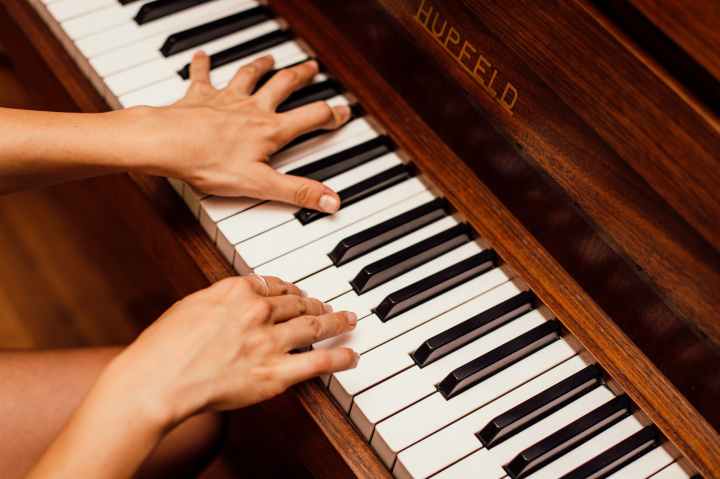
Guest post by Dakota Gale, the latest article in his series aimed at amateur adult pianists


I clearly remember the first time I rode Tyler’s, a popular bike trail near me. I walked some rocky uphill ramps, awkwardly landed jumps, and generally hacked my way down it like a noob.

I still had a hell of a fine time.

These days, I’ve ridden Tyler’s dozens of times and know every major feature. I fly down that sucker.

But is Tyler’s more fun, exciting or fulfilling now versus my first time? 

In general, is there a way to develop appreciation and deeper comprehension rather than boredom for a repeated experience?

Travel to the same places. Hobbies we’ve done for years. Meals we’ve made for a decade.

Or piano pieces!

Navigating the creative gamut

Like a new bike trail, the first time I play a piano piece my brain scrabbles to survive, jamming the notes into my brain. I’m walking super rocky sections and scoping out switchbacks, one measure and phrase at a time.

Take Schubert’s Serenade, a song I’ve always loved that I started playing. In my initial efforts, I pushed through the technical challenges of the piece and could “play” it. Then I tabled it for a month, letting the music sink into my synapses. Cue round two, with more nuance and expression…and yet I was barely getting started.

Bridging that gap between what I CAN do and what I WANT to do is the hardest part. With any new piece, I listen to recordings and think, “yup, do that, fingers!” Then I sit down and create some monotone pabulum akin to playing bongo drums with wet laundry. *sigh*

The gap between my expectations and my abilities is frustrating sometimes. Like some truculent kid, I want to play it like a pro, now now now!

After I turn my pre-frontal cortex back on, I can (usually) reframe things. Because truly, I find this so motivating: I’m going to grow not just with new pieces, but enjoy a deep satisfaction revisiting piano works for the rest of my life. Something fresh to discover, to experience.

And dang it, I AM making progress. Even if I’m no master, there’s magic in the journey and daily satisfaction in the learning. I don’t need to be pro to have fun. (Maybe it’s more fun not worrying about earning a living with it?)

Plus, pushing myself on challenging songs pushes me to greater heights on those I already play. It’s the same thing that happens when I ride technical trails on my bike. I may not slip effortlessly through the toughest moves, but that difficulty makes other trails feel even more cruisier in comparison.

Unlike during piano pieces, sometimes I pause mid-climb on a bike to eat…

As piano, as life

I love how this mindset so easily translates to other endeavors or pastimes. We’re different people when we revisit a city or national park, reread a book, or play an old song. Depth, additional context, a slower pace…it all modifies the experience and likely results in a deeper appreciation.

With all this in mind, I’m continuing to actively push myself to share not-perfect work like my beginner drawings and music recordings. (Sharing my writing on my blog starting a decade ago was an early effort in that arena.) 

It’s tough because I want the work to be better, to make insane progress overnight. Sometimes I shake my head at how hard it is to take what’s in my brain and put it on paper or piano.

Whatever. There’s a reason every book on creativity decries perfectionism and Ira Glass from This American Life talks about “The Gap,” that space between what we envision and what appears in reality. I’ll probably always find blemishes and wish-it-were-different aspects of ANYthing I create.

The good news? It creates constant motivation to keep improving, growing, seeking.

That’s a beautiful thing.

As for Schubert’s Serenade? Maybe it’s not perfect, but I’m looking forward to a lifetime of it evolving beneath my fingers.

And if I get frustrated, I can always go rip down Tyler’s on my mountain bike.


When he isn’t playing piano, Dakota Gale enjoys exploring the great outdoors, learning languages and drawing. He also writes about reclaiming creativity as an adult and ditching tired personal paradigms in his newsletter, Traipsing About. He can often be spotted camping and exploring mountain bike trails around the Pacific Northwest.

Watching Masterchef The Professionals, a series to which I am rather addicted (mainly because my son is a professional chef), I have noticed a certain expression from chef Marcus Wareing during the preliminary Skills Test section of the competition.

In this round, contestants’ culinary skills and nous are tested with a set of technical challenges, most of which should be second-nature to any well-trained chef – filleting fish, shucking oysters, boning out a joint of meat, making meringue or hollandaise sauce, for example. For some, this is a daunting round where weaknesses are exposed or nerves get the better of the contestant. For others, it proves their mettle and demonstrates that not only have they been properly trained (and keep their skills well-honed), but also that they are able to adapt their skillset and intuitive culinary common sense to an unfamiliar recipe or set of ingredients. When a chef succeeds in this, Marcus Wareing will often say, with an approving nod, “Chef’s head“.

So I’m coining the expression ‘Pianist’s Head’ to apply to those situations when we might encounter music which is unfamiliar or outside our comfort zone, which might at first appear daunting, challenging or even almost impossible, but which, with some consideration, drawing on our musical knowledge, experience and intuition – our Pianist’s Head – is achievable. Having a good Pianist’s Head upon your shoulders will stand you in good stead for successful sight-reading and the ability to learn music more quickly.

No repertoire is ever learnt in isolation – or at least it shouldn’t be – and everything is connected. Musical skills, just like culinary skills, once learnt and practiced, can and should be applied to different situations. No learning should ever be done in a vacuum: a single piece of music is not just that one piece, it is a path to other pieces via accrued technical proficiency, musical knowledge and artistry. Early students and less advanced pianists often see the pieces they are learning in terms of stand alone works which have little or no relevance to other music they are working on, or are going to learn. This is also particularly true of scales, arpeggios and other technical exercises which may be studied in isolation instead of appreciating their relevance not just in understanding keys and key relationships, but also in actual pieces of music. This was something I was not taught when having piano lessons as a child, and it’s the fault of the teacher, not the student, if the usefulness and relevance of such technical work is not highlighted.

Chopin knew this: it is said that he studied Bach’s Well-Tempered Clavier every day, appreciating the music’s relevance to his own musical development, his composing and his teaching. If you can successfully manage Bach’s ornamentation, for example, your Pianist’s Head should allow you to cope with Chopin’s trills and fioriture.

Your Pianist’s Head skills will develop the more time you spend with varied repertoire and your willingness to take an open-minded, lateral thinking approach to learning and playing music to an point where these skills become intuitive and you won’t even know you’re applying them!

To develop and maintain your Pianist’s Head, approach each new/unfamiliar piece of music with the thought, “what do I know already and how can I apply experience from other repertoire to this piece?“. For example, if you’ve encountered a similar passage or technical challenge elsewhere you’ll know how to approach it this time.

Understand and appreciate the composer’s particular stylistic characteristics, idioms, soundworld, and quirks. This can be developed not only through playing other music by the same composer but also by listening and studying scores away from the instrument. And as your Pianist’s Head develops, you’ll find yourself making intuitive decisions about how to approach repertoire based on sound technical knowledge and musical insight.


Support The Cross-Eyed Pianist

This site is free to access and ad-free, and takes many hours to research, write, and maintain. If you find joy and value in what I do, why not


Photo by Juan Pablo Serrano Arenas on Pexels.com
 

Guest post by Dakota Gale, the latest article in his series aimed at adult amateur pianists


Not gonna lie: I had no idea what to write for this month’s Notes from the Keyboard.

Why? Well, honestly, for a lot of December and much of January, my enthusiasm for piano was lower than a gopher’s interest in sunbathing. 

Not that I wasn’t still playing consistently. I was, if less each day. I just didn’t feel that spark, the deep joy that I usually get from sitting down and banging on lovingly caressing the black and white keys.

Spoiler alert: I’m feeling much better now, back in the piano groove.

What changed?

Simple: my repertoire.

At the beginning of December, before a 6-week winter break from lessons, my teacher recommended – ok, convinced me – that it was time to learn a fugue. Specifically, Bach’s Cm Fugue from the Well-Tempered Clavier

I’d managed to mostly avoid Bach’s work, if only because I’m hard-headed and bring my own pieces to my teacher for study. (He does choose pieces for me, just not that often. The recent Beethoven sonata I wrote about, for one.)

Anyway, The F**kin’ Fugue. Out of the gate, I enjoyed it. Finding the theme, the left and right hand conversation, the different voicing. I dug the intellectual challenge.

Then… I stagnated with it. But I wanted to play it and knew it was good for my hand independence, among other things. My future piano self would be so.damn.grateful. I must persevere!

I’ve done this before, but (wisely) realized when I needed to back off and just enjoy myself. This time, I pushed too long and started skipping my morning piano session, only sitting down for a lackluster few minutes in the evening.

We all know what happens when you push the day’s exercise or homework or piano to the evening. Quality suffers and dogs yowl forlornly at the sky, that’s what!

For me, the former for sure happened, and I’m quite sure our elderly cat eyed me with disdain a few times too. That was enough: I realized I was in a slump and clawed my way out of the piano slump. 

You know what I did instead of the dang fugue? I went back to the repertoire I love. Chopin. Alexis Ffrench. I retackled a samba version of Happy Birthday. I even played the much-maligned LUDOVICO EINAUDI! (I’ve written about him before.)

My energy changed overnight. Revisiting older works and fun, lighter new pieces reinvigorated me. And it drove home a big reminder:

I’m an amateur. I’m doing this FOR FUN. I don’t have to learn anything on a deadline. That means it can be – should be – fun. 

We pianists know it’s a lonely pursuit filled with hours of solitude. It’s necessary to enjoy the scales, the sightreading practice, and the brain-melt of a new piece. Otherwise, this hobby isn’t happening. That’s like aspiring to run marathons, but hating the morning 5-mile jaunt!

And so I end this post, dear reader, with a reminder. If you find your interest flagging in piano (or any hobby), ask yourself “How could I make this more fun?” 

Perhaps it’s as simple as switching repertoire, or maybe it’s setting up a digital piano outside to mix things up. Playing with other people. Taking a break from the keys to strum a guitar? 

For me, the primary goal is enjoyment, personal fulfillment and being able to play Happy Birthday (samba version!) for a good friend. If I feel like digging a hole and chucking my piano deep into it, then I’m doing something wrong.

Now I just need to remember that next time I’m wrestling for too long with a difficult piece. For now, my love affair with piano continues.


Dakota Gale

When he isn’t playing piano, Dakota Gale enjoys exploring the great outdoors, learning languages and drawing. He also writes about reclaiming creativity as an adult and ditching tired personal paradigms in his newsletter, Traipsing About. He can often be spotted camping and exploring mountain bike trails around the Pacific Northwest.

Read more articles in his Notes from the Keyboard series here

Guest post by Dakota Gale, part of his Notes from the Keyboard series for adult amateur pianists


Back in 1970, when my mom was 18, she composed the first section of the only piece of piano music she’s ever written.

Perhaps inspired by copious amounts of listening to Debussy and Satie, the music just poured from her fingers one day when she sat down at her piano.

At the time, she was in college in Madison, WI and in love with Robert, her first serious boyfriend. The piece starts off sweetly, brightly, a happy time in her life. The happiness shines from the first notes.

She’d taken piano lessons when she was younger, but never studied composition. She never wrote down the music, but it lodged in her hands and head.

Like mother, like son. (A drawing of mine.)

My mom graduated from college a couple of years after she wrote the first section. She and Robert planned to head to Santa Fe together and get married, but first he needed to work in construction for a bit to earn money for the move.

My mom headed south ahead of him to get situated in Santa Fe and start job hunting. A month, two months passed, but Robert didn’t show up. She wrote him letters, no response. Had he changed his mind, broken up with her?

Finally, a letter arrived. But not from Robert—from his mother. 

He’d died in a construction accident. 

Devastated, her world spun around and plans shattered, soon afterwards my mom wrote the second part of her composition. It’s a faster, darker section, an outpouring of grief after a sudden key change.

Years passed. My mom got a teacher’s certification, moved to Idaho, lived in a tipi and taught art. 

Then she went to a national ceramics convention and met a bearded artist from California. A romance followed and they got married and moved to a defunct commune outside Chico. 

Little Dakota popped out into the world not long after.

42 years later during a snowy walk in Bend.

Around this time, she composed the third section of music for her piece. It’s sweet, my mom in love again. The innocence and freshness of it is apparent. Cheery, fast and impetuous, full of expectations. 

Who knows, maybe it flowed from her fingers while she was pregnant with me? She can’t remember the exact timeline.

Regardless, I recall her playing it occasionally when I was younger. After years away from the piano, she could perform it beautifully at any moment.

When I started learning piano, I wanted to learn the piece, but there wasn’t sheet music… Until this past week, that is! 

On a rainy afternoon during her recent visit, we worked through the chords together and I explained the harmonies and sudden key changes that she’d chosen. She’d never learned music theory and didn’t know which chords she’d picked or why—all the music came straight from The Muse.

Sorting out the piece. Check out the stained glass in the background that my mom made for us—lady of many talents!

The only things missing were a final chord or two, so we played around with options before landing on something she liked. After some work, I fully transcribed the piece to sheet music—a first for me.

And so I’d like to present In Search of Lost Time by my mom. If you’re a pianist, you can download a PDF of the sheet music via Dropbox and play it! (Please forgive any newbie sheet music notation mistakes.)

Here’s a recording of my mom playing her piece, 54 years after the initial idea bubbled up from her consciousness:

The end of a special project together.


Dakota Gale

When he isn’t playing piano, Dakota Gale enjoys learning languages (especially Italian) and drawing. He also writes about reclaiming creativity as an adult and ditching tired personal paradigms in his newsletter, Traipsing About.

He can often be spotted camping and exploring mountain bike trails around the Pacific Northwest.