January 2025 will mark the 3rd anniversary of the Oxford Piano Weekends, and the thirteenth weekend. I can hardly believe that what started on the back of an envelope in late 2021, has developed into such a fixture in the piano course market that pianists return again and again.
We started in 2021 with the legacy of Covid and all the social and musical anxiety that came with that. It was essential to find a way of getting people to know each other quickly so I devised a mini workshop to be held before supper on the first evening, in which people get into pairs to chat about a particular musical and performing issue. Within a short space of time, the conversations are animated, social anxiety disappears and people feel relaxed and comfortable. By the time we start the evening session, a united and supportive group has already established itself.
It can’t be underestimated how important this group bonding is. A good number of pianists who come on the Oxford Piano Weekends struggle with performance anxiety and physical tension, and feeling emotionally safe within the group is essential to move through these issues.
I used to have crippling performance anxiety and now I really enjoy performing, something that would have been previously unimaginable. The weekends have helped me immeasurably.
Right from the start, Oxford Piano Weekends have had a wonderfully diverse pool of advanced and committed pianists taking part: bankers, medics, piano teachers, lawyers, choir directors, pianists returning after many years, battered and bruised pianists from a legacy of harsh teaching, students preparing for final recitals and many, many more. Pianists come from all over the UK, as far afield as Dublin, Finland, Malta and most recently, Canada.
The weekend is a chance to reflect deeply on your playing with expert guidance to take away and improve your practice.
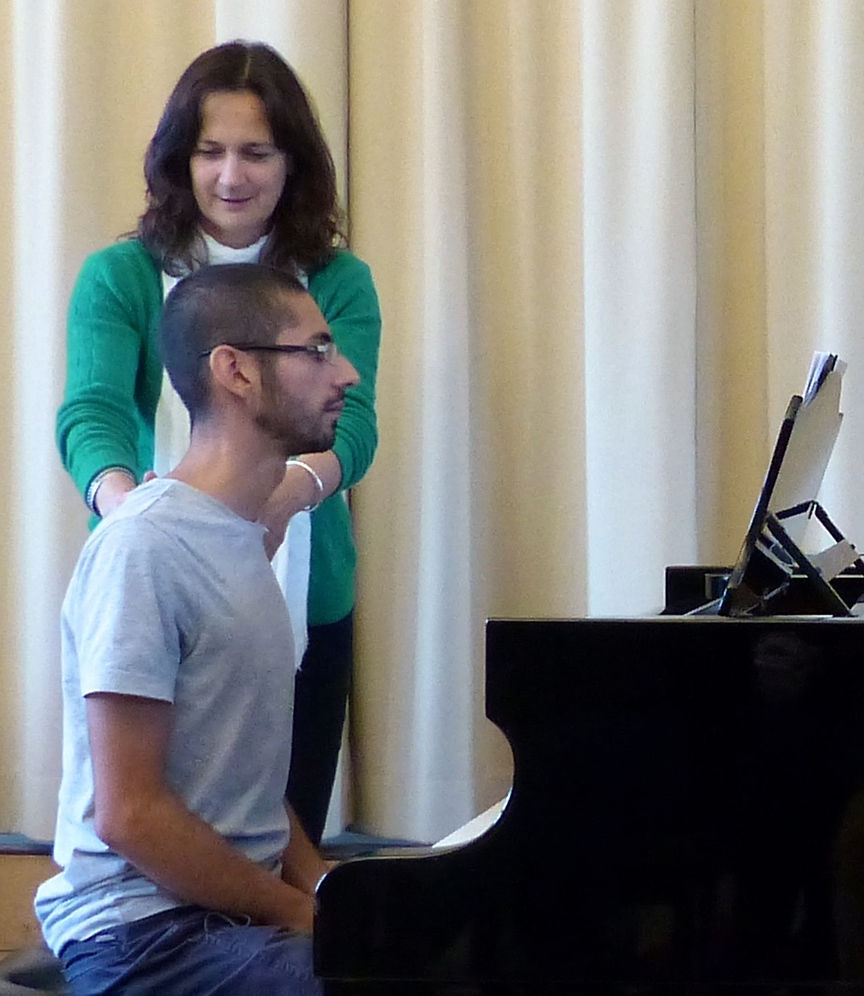
On any one Oxford Piano Weekend, the numbers are kept deliberately low with six or seven as the ideal. Each pianist has twenty minutes teaching within the group, in rotation over the weekend, and it’s extraordinary how much can be packed into that short time. I listen to each pianist to see what they need, and then make sure that my response is valuable not just for the pianist themselves, but also for the group. Participants learn so much from watching and listening to each other, seeing their own challenges reflected in other pianists and then observing that pianist transform in front of their eyes.
A truly wonderful weekend. Charlotte is so caring, and teaches with such empathy, understanding & musical knowledge and expertise.
And what’s more important than the meal times? Homemade, tasty, nutritious food with free flowing wine in the evenings, the now-famous homemade flapjacks for coffee breaks, all provide a wonderful back drop for lively, stimulating conversations among like-minded people. They truly are full and rich weekends, and I, for one, come away at the end of each one feeling exhilarated and all ready to go for the next one.
Guest post by Ingridon the experience of studying with Dr Michael Low
Like many musicians, my journey started thanks to a fabulous piece I heard one day (and for sure so many more, but it has been a while so I can’t quite tell) that moved my heart and soul so deeply that I started daydreaming about it and about being able to do that same thing with the piano. I was maybe 10 or 13, but it took a while until I finally got to convince my parents to allow me to start learning the piano.
This led me to begin music lessons at the National Conservatoire here in Guatemala, and, as all music schools based on tradition, the curriculum included not only piano per se, but also Solfege, History, Tonal Harmony, and other subjects that are intended to nurture (and they actually do) your musical understanding and therefore your musical interpretation. A couple of years later I decided to pursue a music degree at university, and I obtained a Teacher’s Diploma in Music and a bachelor’s degree in music composition.
All of this gave me the tools to finally “play the piano”, which we normally say when we hear someone “play” that instrument. But little did I know that there is a huge dimension behind the mere study of any artistic discipline, that is sometimes overlooked and underestimated – that is, the Human Dimension, with all its intricacies and complexities.
And why is it overlooked? Well, maybe because we usually assume that as artists (musicians, painters, writers…) that dimension is an obvious part of us, and even if that is true, no one ever prepares us for the setbacks and negative experiences that are inevitably part of the journey. As musicians we may suffer from stage fright, we may face abusive/authoritarian teachers, we may be immersed in a toxic competitive environment, we may be the target of intended mean critics, and none of that has to do with the subjects that we learn in during our studies, and that prepare us to become professional musicians – but it has a lot to do with who we are as human beings and how we practice our art.
These setbacks may lead us to reconsider our career path and that maybe we need a change. Some of us may decide to make a radical change, some of us may decide to make a small change. But all of this raises the question of how we can thrive when facing such difficult challenges.
I started searching for answers and began to read blogs where other musicians shared their own experiences in similar situations; blogs where teachers shared their thoughts on how to build a healthy technique and learning environment; blogs where authors shared their thoughts on creativity and how to foster it in your own practice; blogs that shared research based tips to better manage performance anxiety; and I found great resources in authors like Noa Kageyama, Forrest Kinney, William Westney, Graham Fitch, Penelope Roskell, Frances Wilson (The Cross-Eyed Pianist), Rhonda Rizzo, Zsolt Bognár and Michael Low.
In one of those blogs, I was particularly struck by an article that Dr. Michael Low shared where he talked about his own journey with the piano, performance anxiety and the tradition in music education. It really resonated with me, so I started following his work closely.
At some point we also started sharing our musical impressions through social media and video chat. I shared with him that I was re-studying the Brahms’ Intermezzo in A, op. 118 no. 2, and sent him a recording I made of the piece. I remember he gave me some observations about it and his enthusiasm to work on it musically. I am not exaggerating when I say that this experience has been life changing.
I have to say I’d never had the chance to really discover and experiment with that (or any other) piece, nor I have had the chance to “think outside the box” musically speaking, because you are normally taught that there are “rules” that you must respect as interpreter, and sometimes even “fear”. There is nothing wrong with rules, but as an artist you can always trust your own criteria to use them; however, only an open-minded teacher and artist can help you discover that, and one of them is Dr. Michael Low.
It amazes me how spontaneously Dr. Low fosters that safe environment for experimentation, and how through funny examples and direct questions he challenges your own beliefs: be it about the piece or the composer or your own playing, always in a very kind and respectful manner, going beyond the surface and helping you to start thinking more as an artist than just a “piano player”. And the best part is that there are plenty of Eureka! moments, when you discover all the possibilities you have in your own hands, under his guidance.
And even if I have been in piano lessons before, there has always been a rush and a pressure to play a particular piece “perfectly”, not giving any space to really discover it (besides the obvious aspects of technique and analysis that are intrinsic to the music study), and to find one’s own voice as a musician and, most importantly, as artist. When there is too much noise outside, we get distracted from what we must look for on the inside.
After working all this time with Dr. Low and sharing interesting discussions about music, while also applying and following all of his very insightful advice in my own practice (both as teacher and as pianist), I have come to various conclusions that make me think about how we can thrive.
There is not just one answer, nor a right or wrong one, but there are some general thoughts that are worth always keeping in mind:
Music is a lifelong learning career/experience where one of our biggest enemies is the obsession with perfection
Kindness, in every aspect: with ourselves and with others, is a life changer as it creates wonders
Patience with our own artistic growth, as no path is the same as other and there is no one-size-fits-all solution for such big endeavor
As Vincent van Gogh wrote to his brother Théo, in a letter from May 1882, with relation to the meaning of being an artist:
“(…) Those words naturally imply always seeking without ever fully finding. It’s the exact opposite of saying ‘I know it already; I’ve already found it’. To the best of my knowledge, those words mean ‘I seek, I pursue, my heart is in it’.”
This article is translated from the original Spanish, which you can read here:
Dr Michael Low is a pianist and teacher based in South Africa. If this article has piqued your interest in his work, why not come along to a masterclass at Coach House Pianos London showroom on Saturday 1 June to observe Dr Low teaching advanced amateur pianists in a variety of repertoire. The event is hosted by Frances Wilson AKA The Cross-Eyed Pianist.
I have written before about how some repertoire is considered “off limits” to amateur pianists, and should remain the preserve of the professional. I think what such an attitude demonstrates is how the “core canon” of piano repertoire is held in high regard, almost to the point of zealotry, and that certain pieces should remain on their exalted pedestals, accessible only of a chosen few.
My view has always been that the music is there for the many not the few, that it was written to be played, whether you are a world-famous professional musician or a “Sunday pianist” who enjoys playing in the privacy of your own home. We forget that many of the pieces which now regularly grace concert programmes around the world were intended for a more intimate salon or domestic setting – music to be played for friends and amongst friends, or at home.
One piece which seems to reside on the Mount Olympus of piano repertoire is Bach’s Goldberg Variations. Revered by musicians, students, critics, teachers, academics and audiences, the Goldbergs represent music of highest order of complexity, invention, technical challenge, expression and – if one is playing the entire set – stamina
One of the foremost reasons for the Goldberg Variations’ esteemed reputation is the sheer technical and artistic mastery the work demands of the pianist. Comprising an intricate series of 30 variations upon a simple bass line, this music presents a seemingly formidable challenge to even the most accomplished pianist. Each variation presents its own unique set of technical hurdles, from rapid hand crossings to intricate ornamentation and virtuosic passages. In addition, the Goldberg Variations are celebrated for their intellectual depth, requiring an understanding of counterpoint, harmony, and structure. Then there is the emotional and expressive depth of this music: each variation is infused with a distinct character and mood. From playful, witty and cheerful to melancholic and introspective, the variations traverse a wide emotional spectrum.
Of course these aspects are true of many other pieces, not just those by Bach, but the piano sonatas of Haydn, Mozart, Beethoven and Schubert, for example; Chopin’s Nocturnes; Brahms’ Intermezzi, and much, much more. These are universal aspects which make music interesting and engaging, challenging and satisfying.
While the amateur pianist may not be able to tackle the entire Goldberg Variations, individual variations are within reach of the intermediate to early advanced player: the Aria, and Variations 1, 2, 4, 7, 13, 18, 19, 21 and 25 – and all can be played and enjoyed as stand-alone pieces. (The Aria appears in the 2024 Trinity College London Grade 8 piano syllabus, thus bringing this wonderful music to students of all ages, and, perhaps, encouraging further exploration of Bach’s mighty achievement.)
As a starting point for tackling some of the Goldberg Variations, it is worth exploring some of Bach’s other keyboard music, both as a player and a listener. For example, the two- and three-part inventions are a useful lesson in his use of counterpoint; while the 48 Preludes and Fugues demonstrate a wide range of moods and colours. Within the suites, there are movements which recall the Aria of the Goldbergs (for example, the Sarabande from the fifth French Suite). In addition, all of Bach’s keyboard music offers insight into his invention and imagination, his harmonic language and his use of ornamentation to enhance the melodic line.
Learning the Goldberg Variations, whether in its entirety or single variations, is an absorbing, long-term endeavour for any pianist. Be patient and embrace the journey, but never ever believe that as an amateur pianist, you shouldn’t be playing this glorious music! There will be moments of frustration, but perseverance will lead to growth as a pianist, a sense of personal achievement, and a deeper understanding of Bach’s wonderful music.
This site is free to access and ad-free, and takes many hours to research, write, and maintain. If you find joy and value in what I do, why not
Are you an advanced pianist wanting to move through performance nerves in a safe, supportive group? Do you want play with greater physical freedom and practise more efficiently with an empathetic and experienced teacher? If so, you may enjoy an Oxford Piano Weekend. There are some places left for Friday June 23rd – Sunday June 25th 2023 and Friday October 6th – Sunday October 8th 2023. For more details and to book, go to: https://www.charlottetomlinson.com/oxford-piano-weekends
Pianist and teacher Charlotte Tomlinson introduces her Oxford Piano Weekends:
In these last rather strange couple of years of isolation and restrictions, it feels as if music and performing has become more important than ever. The desire to learn in person along with other musicians has also taken on an extra special meaning.
Pre-2020, I had spent many years in my roles as piano teacher and performance coach, giving presentations and masterclasses for conservatoires, universities, festivals and orchestras around the world, but when the cancellations started as they did for so many musicians, I found myself thinking about what I could offer from home. After all, we were all so used to working from home. At the same time, I had a number of requests from piano students for me to run my own course.
I have been teaching and coaching one-to-one in my own studio at the bottom of the garden with its lovely Steinway for around thirteen years and had already run some one-day workshops there. And from 2000-2008, I ran my own chamber music course at the Purcell School. But it was these requests from pianists that got me thinking: could I run a piano weekend from my own house and studio? I realised that I did have the space for a small group both in my kitchen and studio, and that perhaps there might be a gap in the piano course market for a weekend of teaching in a small, supportive group within a home environment.
“Many thanks for all your warmth and total acceptance of where we’re all at. Your ‘can do’ approach is so positive and encouraging. You have the ability to ‘see’ the individual.”
So, in January 2022, Oxford Piano Weekends was officially born. The first weekend was intense, fun and stimulating. There were seven pianists and the eclectic mix of scientists, medics, writers and sport coaches along with professional pianists, made for dynamic masterclasses and some wonderful discussions at mealtimes.
“The weekend works on so many levels, musically and socially, and I thoroughly recommend it. It is so encouraging to spend time with other people who are both talented and supportive.”
Providing fresh homemade, nutritious and tasty food (with free-flowing wine in the evenings!) is important to me. I want everyone to feel nourished and refreshed for the learning part of the weekend.
“The food was excellent – all thought through and prepared with care and love!”
It was such a delight to have my house and studio full of people, that after it had all finished, I wondered why I had never thought about running this type of course before. I am now planning a number of weekends and booking has already started for the next two.
Charlotte Tomlinson is an internationally renowned pianist, piano teacher and Performance Coach. She taught piano at the Purcell School for eleven years, the University of Hong Kong and HK Academy for Performing Arts and has worked with pianists in masterclasses at the Royal Conservatoire of Scotland, Royal Birmingham Conservatoire and International Piano Academy, Konz, Germany among others. She has a thriving piano teaching practice in Oxford where she teaches students from the University of Oxford, post-graduates from the London music colleges along with international piano students who come to Oxford to study with her. She gave a presentation on the Psychology of Performance and Competition at the Leeds International Piano Competition 2018 and has been invited to work with laureates of the Sydney International Piano Competition.
The Cross-Eyed Pianist is free to access and ad-free, and takes many hours every month to research, write, and maintain.
If you find joy and value in what I do, please consider making a donation to support the continuance of the site

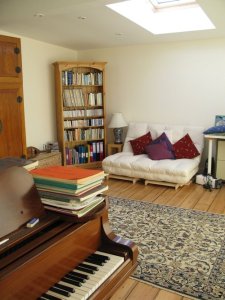 I have been teaching and coaching one-to-one in my own studio at the bottom of the garden with its lovely Steinway for around thirteen years and had already run some one-day workshops there. And from 2000-2008, I ran my own chamber music course at the Purcell School. But it was these requests from pianists that got me thinking: could I run a piano weekend from my own house and studio? I realised that I did have the space for a small group both in my kitchen and studio, and that perhaps there might be a gap in the piano course market for a weekend of teaching in a small, supportive group within a home environment.



 The Cross-Eyed Pianist