Last weekend I ran a masterclass for members of the Hitchin Piano Club who are taught by a teaching friend of mine. It was the first time I’d taught adults in this format and I found the experience hugely enjoyable and stimulating – and I think the participants did too. In addition to one-to-one coaching while the others observed, we covered warm up exercises away from the piano, managing performance anxiety and finished the day with a listening game in which participants were asked to try to identify nationality, period and style of a selection of pieces chosen from Spotify. The day ended with me giving my friend a brief lesson, which was interesting for both of us and an important test of mutual respect and trust.

The commonest issue with adult amateur pianists tends to be performance anxiety – by which I don’t mean the fear of playing in an actual concert, but simply playing in front of other people. This anxiety has its roots in a number of places, including negative musical experiences in childhood and the simple, and entirely understandable, fear of making mistakes and feeling a fool in front of one’s peers. Whenever I discuss performance anxiety with any student, I stress that such feelings of anxiety are normal, natural and common – even amongst top-class professional musicians. Until fairly recently, performance anxiety – like injury – was not discussed amongst professionals. It was considered taboo to mention it for fear of admitting to a weakness, but recent projects such as Charlotte Tomlinson’s Beyond Stage Fright and interviews with leading musicians who have revealed their own anxieties and how they deal with them, has led to greater openness. Personally, I find a state of acceptance about the symptoms of performance anxiety, coupled with solid preparation of one’s music, can lead to greater confidence in performance, whether this involves playing in someone’s living room on a Sunday afternoon, as at our Piano Day, or in a formal concert.

The participants in Sunday’s piano day had not been taught in a masterclass format before and I tried to ensure that even while I was giving individual coaching, everyone found something useful in what I was saying and doing with the other student. In fact, the masterclass format can be one of the most useful and inspiring ways of being taught – one can learn a great deal by listening and observing, and I encouraged the others to comment on one another’s playing, including differences in sound and touch. We covered a number of technical aspects, such as rotary motion and lateral arm movement to help certain players release tension in their hands and arms, and to help them achieve the kind of sound they envisaged.

My main aim when teaching is to help students to achieve the sound and emotional content they desire in their music and to enable them to play with colour, expression and confidence. To achieve this, I use visualisation techniques in my teaching, asking students to explain what they like about the music they are playing, to describe the character of the music and ascribe a narrative or mental picture to it to help them create a vivid portrayal in their playing. Technique, such as a cantabile legato or particular type of staccato, gives us the tools to create timbre, mood and emotional impact in music, and technique must always be seen as something with a clear musical purpose. Combine solid technique with imagination and the rather elusive “artistic vision”, and one can create wonderful music, and play with confidence and authority.

It was a thoroughly enjoyable and very stimulating day and a pleasure to work with a group of such engaged and receptive students.

Repertoire played:

Mozart – Fantasy in D minor, K.397

Philip Glass – Metamorphosis 3

Beethoven – Sonata in F minor, Opus 2, No. 2 & Sonata in D, Opus 10, No. 3


Further reading

Masterclasses without tears

More than hobbyists – the world of amateur pianism


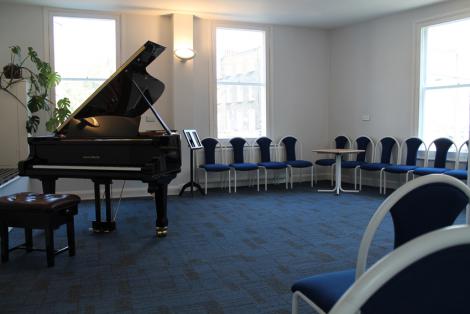
I was delighted to rejoin the London Piano Meetup Group (a friendly and supportive group for adult amateur pianists in London which I co-founded in 2013) for the March performance event. We met in the airy upstairs studio at Peregrine’s Pianos where we had the opportunity to play a medium-sized August Förster grand piano (one of the many attractions of the group is the chance to play different pianos). There was, as usual, a varied range of repertoire from Scarlatti to contemporary British composer Cheryl Frances-Hoad, with some impressive and enjoyable Chopin, Debussy, Rachmaninov, Bach, Howells, Liszt, Mayerl and even a drop of “cocktail jazz” (‘A Nightingale Sang in Berkeley Square’). Afterwards, we repaired to The Clerk and Well pub for a jolly lunch and lively piano chat.

newroom3medium-470x314
Upstairs studio at Peregrine’s Pianos

The original motivation for forming the group remains very strong – to provide a supportive and relaxed environment for adult pianists to meet, play for one another, share repertoire and socialise. I’ve made some very good friends via the group, as have others, and it was very nice to reconnect with old friends and make new ones too. The popularity of the group – and others like it – is an indication of how many pianists there are in and around London who enjoy the opportunity to meet and explore new or familiar repertoire. The chance to exchange ideas about practising, taking exams, performing, teachers and teaching, courses, concerts and more is also very important, and many people use the informal performance opportunities as a place to run repertoire by a friendly audience ahead of an exam, diploma, competition or festival performance.

Being sympathetic towards nervous players is a crucial component in creating a “safe place” where nervous or inexperienced players can perform without fear of criticism or negative comments: everyone’s performance receives warm applause and appreciation.

For further information about the London Piano Meetup Group or to join the mailing list to be kept informed about upcoming events, please email londonpianomeetup@gmail.com or find the group on Facebook

Related content

Courses and Summer Schools for Adult Amateur Pianists


Final of GPP/LPE adult amateur piano competition, adjudicated by Leslie Howard. Saturday 27 June 2015, All Saints Church, West Dulwich

If anyone needed proof of passion for the piano amongst adults look no further than the final of an amateur competition which took place last weekend in south-east London. A joint collaboration between specialist piano restorer and retailer Grand Passion Pianos and London Piano Events (formerly London Piano Meetup Group), the final brought together seven pianists whose playing demonstrated a high level of technical facility, artistry, musical understanding and committment. The first round (YouTube submissions) presented the judges with the unenviable task of selecting eight people to go through to the final.

The competition final was adjudicated by acclaimed international concert pianist Leslie Howard. The finalists had to cope with a church acoustic (great for the audience, but tricky to judge for those at the piano) and little or no time to warm up, and they all rose to the challenge with poise and confidence (any nerves were well disguised!). At the end of the competition, Leslie made some helpful and encouraging general comments, and everyone left with a sheet of more detailed comments on their individual performances.

The results of the competition were as follows:

Winner – David Griffiths

Mazurka op 17 no 4 – Chopin
Etude pour les arpeges composes – Debussy
Etude-Tableaux op 39 no 5 – Rachmaninov

Second place – Michael Cheung

Sonata in A-flat, Op. 110 (1st movt) Beethoven
Widmung – Schumann arr. Liszt
Prelude in G minor, Op. 23 no. 5 – S Rachmaninov

Third place – Claudia Lazarus

Litaney – Schubert arr. Liszt
Mädchens Klage – Schubert arr. Liszt
In Dahomey (“Cakewalk Smasher”) – Grainger

The Raymond Banning Trophy was presented to the winner by Lorraine Womack-Banning, whose late husband Raymond Banning was a concert pianist, professor of piano at Trinity College of Music, London and a keen supporter of amateur pianism.

Download the full programme here

This slideshow requires JavaScript.

It may appear counter-intuitive to say that social networking, that most distracting and potentially time-wasting of modern-day preoccupations, could possibly assist in one’s piano practise. Allow me to illustrate this with an anecdote. A while ago, a renowned British concert pianist posted on Facebook that he was having trouble with a tricky passage in a work by Schumann and asked if anyone could suggest a more intelligent/efficient/comfortable fingering scheme. There followed a stream of replies, many of which offered alternative fingering schemes, while others took the conversation off on interesting by-ways and tangents. A few days later, the same pianist posted that, thanks to the comments, he had found a better fingering for the passage. This is an excellent example of “the wisdom of crowds in action” (to quote from another FB colleague of mine) and demonstrates how social media can, truly, assist in your practising.

When I first started this blog five years ago, I wasn’t very active on social media networks: in fact, the blog was the only “social media platform” I regularly engaged with. I started the blog as a way of recording my thoughts about the music I was listening to, enjoying in concerts and studying. I found it helpful to write down ideas about what I was practising – to think about it away from the piano allowed my thoughts to crystallise. As the blog became more well known, interesting discussions developed out of these posts, as people left comments or contacted me for advice about music or technical issues they were struggling with. When I took the decision to study for my first performance diploma, I charted my progress in a series of blog posts. After the diploma was completed and passed, a colleague wrote that I had been “brave” to have been “so public” in my attempt, and that  my efforts were inspiring and “liberating for so many people” (i.e. other adult amateur piansists). I was flattered that someone thought my writing and musical activities could offer support to others who were considering or actively engaged in a similar musical path to mine. In fact, in addition to writing my own blog posts about my diploma progress, I read and followed many other blogs on music and pianism which provided crucial support, especially in the final months leading up to the diploma recitals. Interacting, via comments and on Twitter, with the authors of these blogs made me feel supported and encouraged. Playing the piano is a lonely occupation (though I enjoy the loneliness) and I didn’t see my teacher that frequently for lessons. When we did meet, there was far too much work to be done on the actual music to spend time musing over more esoteric issues of, for example, interpretation, the psychology of performance and managing performance anxiety, stagecraft and presentation, and all the other myriad aspects which go into producing a slick, well-prepared and engaging musical performance. In short, my interactions with people on social networks made me feel less alone in my task.

A few days ago, I tweeted a picture of the final bars of Schubert’s Piano Sonata in A, D959, which I am working on at present. This is a long-term project, but my tweet was to celebrate the fact that I had, finally, after 7 months work, learnt the entire sonata. (By which I mean, it is “in the fingers”, but is by no means finessed – that hard work begins now, and for the next half year, or more.) A number of people responded to the picture with words of congratulation and encouragement, while others expressed their liking for this sonata or offered links to their favourite performers and performances of the work. As is often the way with social media, an interesting discussion ensued, all of which, for me, feeds into my continuous circle of practise, study, discussion, interaction, teaching, listening, concert-going, and more.

Across the social networks, by which I mean the most widely-used platforms of Facebook and Twitter, there is a plethora of musicians, music teachers and musically-inclined people who regularly post about the music they are enjoying as a listener/concert-goer or studying and practising as a performer and/or teacher or enthusiastic amateur. In addition to people’s personal timelines, there are groups and forums where like-minded people can get together to bounce ideas around, often providing invaluable support, advice and solidarity for those of us who might be “stuck” in a musical impasse. Sometimes someone might flag up difficulties they are having with a particular section of a piece, or ask for suggestions for new repertoire for themselves or their students, or post a recording they have made for others to critique. Sometimes we just have a collective grumble about how difficult it all is! And often Facebook and Twitter simply provide a pleasant antidote to the enjoyable hardship of trying to refine Schubert’s “heavenly length” or get to grips with a knotty section of a Bach fugue.

On a more practical level, Twitter in particular is the place where you will daily find a wealth of links to blogs, articles, videos and other material which can assist in your piano practise – from the simplest “how to do it” videos to academic writing offering detailed critical analysis and commentary on specific works. Sifting through this material can be daunting, but both Twitter and Facebook have functions which allow you to “favourite” or save links to read later.

Here are some comments from people with whom I am connected on social networks about the usefulness of these platforms to the musician and music teacher:

I have learned FAR more useful teaching ideas and techniques from Facebook groups than I did by studying for a teaching diploma!

it really helps me as practising can be lonely and it’s nice to have piano chat during breaks

Facebook has helped me considerably (and less so Twitter) both to research piano-related information and has helped me hugely with practice through the support of specialised Groups, and of pianist friends on my News flux. Even my face-to-face teacher (not a lover of the social network society) has noticed!

For me it’s solidarity!!! Knowing that I’m not the only one having problems.

We can find solutions to more than just fingering issues. Plus lots of varying opinions. Without it we’d be at risk of only teaching in the way we were taught!

I think one of the most important aspects of social media is solidarity – it’s so good to be able to share problems, find that others are experiencing the same etc. I think that has a huge influence on our own well-being as musicians.

I think there is an almost unlimited amount we can learn from each other, and social networking helps build those connections both online and (hopefully) in the real world too

Selected resources

Practising the Piano (Twitter @PractisingPiano)

The Musician’s Way (Twitter @klickstein)

Piano Addict blog (Twitter @pianoaddictblog)

Stephen Hough’s blog (Twitter @houghough)

Pianist magazine (Twitter @pianistmagazine)

Musical Orbit (Twitter @musicalrbiter)

Piano Network UK (Facebook group)

Professionalism in Piano Teaching UK (Facebook group)

London Piano Events (formerly the London Piano Meetup Group)

The Bulletproof Musician