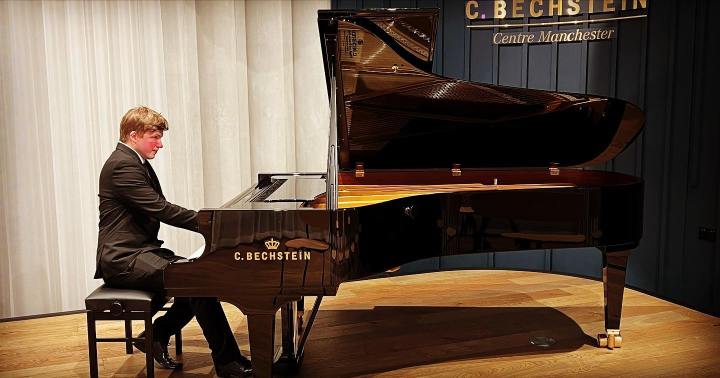
This new release from Slovenian pianist Adriana Magdovski pairs César Franck’s mighty Prelude, Chorale & Fugue with a piano sonata by leading Slovenian composer Tomaž Svete (b. 1956), which is dedicated to Magdovski.

Although composed just over 100 years apart, there are clear musical, textural and thematic connections between the two works; for example, the Svete includes a Passaccaglia, Corale and Fugue, and the Svete Sonata, although unmistakably modernist in its harmonic language, opens with a fantasy-like movement which mirrors the improvisatory atmosphere of the Prelude of the Franck. Magdoskvi handles both deftly: in the Franck, she achieves a wonderful sense of spontaneity in the Prelude, with its shimmering opening arpeggios, balanced by a masterful command of the material. Tastefully-judged rubato is complemented by precise articulation and a range of dynamic colour to bring drama and sensuality to this opening movement.

The Choral opens with a graceful seriousness, the “chorale” theme elegantly presented. The rolling arpeggiated chords which embellish the theme are masterfully played. One has a true sense of the grandeur of this music in Magdovski’s hands, as she allows the music to build in stature throughout the movement. Her attention to detail is impressive, as is her appreciation of the music’s architecture. This is particularly apparent in the Fugue which is virtuosic yet thoughtful. Overall, a very accomplished and authoritative account.

The Svete Sonata provides an interesting, more linear contrast to the voluptuous, polyphonic textures of the Franck, yet shares much of the same seriousness. Magdovski proves to be equally at home in this repertoire as in the Franck. With graceful phrasing, sensitively nuanced dynamics and a clear sense of the music’s structural and emotional narrative, this is an impressive companion to the Franck.

Scrolling through Twitter, as I do far too often each day, this concert poster caught my eye:

It’s striking, isn’t it? Not just the bright colours and simple design, but the choice of image which instantly says “summer” – appropriately, for a summer concert.

It’s also not a typical classical music image. There are no people in penguin suits, or conductors with wild hair, or women in evening gowns – indeed, none of those tired, cliched images all too often still associated with classical music. It’s immediately eye-catching, it contains the information you need, and the choice of the ice lollies instead of a more “classic” (as it were!) image might just attract people who might not normally choose to go to a classical music concert.

Working in the publicity and promotional realm of classical music, I am struck more often than not by how poor a lot of concert promotional material is – including by the big/important venues and promoters. It is a fact almost universally acknowledged these days that we live in a visual age; for advertising and marketing material – whether physical posters or flyers – or digital assets for online promotion, the choice and quality of images is pretty crucial. Yet time and time again I see poor quality, or simply bad, images, and, worse, in appropriate and/or illegible typefaces.

Today one doesn’t necessarily need to hire a graphic designer to create decent promotional materials. Easy-to-use design programmes like Canva offer templates and a wealth of images and other elements to help you create quality flyers, posters and social media posts, which are set to the correct dimensions for specific platforms, e.g. Twitter or Instagram (this ensures no chopped off heads or misaligned text etc).

In addition to high-quality images, choice of typeface is also important. Florid scripts may look pretty or artistic, but think about how they translate to a flyer or poster. Are they easy to read? Largely, no. Another pleasing aspect of the ice lolly poster above is the clean typeface (something like Helvetica or Arial, I think). Note how a different weight (bold) of the same typeface is used to highlight the composers’ names. The final aspect which receives a big thumbs up from me for this poster is its simplicity: it contains the crucial information (though it could perhaps do with a website link and note of ticket prices).

That oft-quoted three-word phrase from architect and designer Mies van der Rohe (“less is more”) is as applicable to furniture design as it is to concert promotional materials. Too often I see posters and other materials which contain far too many words. Give your potential audience enough What Where and When information and trust them to do the rest by visiting the relevant website or calling the box office. There’s no need to tell them everything about that forthcoming concert…..

D major is unquestionably one of the “bright” keys – perhaps the brightest, and, allegedly, for Mozart the “happiest” key (he wrote three piano concertos in D major and four piano sonatas, including the sonata for two pianos KV 448). It’s heroic and triumphant, the key of joyous fanfares, majesty and optimism.

Mozart – Sonata for Two Pianos KV 448

This finely-crafted sonata epitomises the pure classical structure and is an uplifting and virtuosic work to play and to hear. The joyous first movement opens like an operatic overture, replete with timpani and trumpets while the middle Andante has a single aria-like melody shared between the two instruments. The finale is an ebullient rondo which feels like a piano concerto without orchestra.

Chopin – Prelude in D, Op 38 & Mazurka in D Major, Op 33, No. 2

Chopin composed most of his Opus 28 preludes prior to the winter of 1838-39, when he joined his lover, George Sand, on the island of Majorca. The Prelude in D Major, the fifth of the set of 24, packs a lot into a miniature which lasts a mere half a minute. It’s scored in continuous semiquavers which glitter with all the positivity which the key of D major suggests.

The Mazurka in D major opens with a happy main theme, embellished with ornaments. The off-beat rhythms, characteristic of the Polish folk dance on which Chopin based his Mazurkas, is clear in the accompaniment.

Beethoven – Piano Sonata No. 15 in D major ‘Pastoral’

The nickname ‘Pastoral’ was given to this piano sonata by a London publisher, suggesting perhaps nature and the countryside or the calm simplicity of this sonata in contrast to the one which precedes it (the ‘Moonlight’ with its unsettling opening movement and restless finale). The first movement of the Sonata in D major opens with a low D pedal point in the bass, which suggests a bagpipe drone and is associated with country scenes. This pedal point is heard again in the Andante which opens with a foreboding minor-key theme before a cheerful, skipping dance in the middle to lighten the mood. A brief, playful Scherzo follows, while the finale is firmly rooted in D major, whose lilting opening recalls the pedal point of the first movement. According to Beethoven’s pupil Czerny, this was one of the composer’s favourite sonatas and one which he never tired of playing.

Rachmaninoff – Prelude in D, Op 23 No. 4

This Prelude rather contradicts the main characteristics of the key of D major. It begins with a calm, flowing melody and accompaniment, a song without words, almost Schumann-esque in character, but grows increasingly more dramatic in its middle section, with several minor-key modulations and ecstatic episodes.

Guest post by Rhonda Rizzo

When did I begin my love affair with the music of living composers? The moment I found Yvar Mikhashoff’s ‘Incitation to Desire’ CD of tango music for the piano. The smoky cover, the provocative title track – I was caught before I listened to a single piece. Ah, and what a collection! Tangos from multiple eras and in multiple styles. Tangos that spoke of something illicit, a smoky world of furtive late-night romance, smoky dance halls, and sensuality. These tangos represented a freedom I craved – freedom from the performance practice expectations of standard repertoire, and freedom from the years of insecurities and assumptions I brought to the music I’d been playing my whole life. Tangos broke the rules. I’d never danced a tango in my life, but I knew I needed to make music with the freedom I heard in these pieces.

I’d never worked on music by a living composer before I found this CD, but my love of this music was such that I set about tracking down the scores of my favourite pieces. Many of the tangos were unpublished, which meant I wrote to the composer to purchase a copy. Scott Pender’s tango, ‘Ms Jackson Dances for the World’ was one of these. After I received it, Scott and I kept corresponding. We became friends and have remained so for over a decade. And I loved his music – so much so that I eventually played, performed, and taught most of what he’s written for the piano. Ironically, although Chester Biscardi’s ‘Incitation to Desire’ was easier to find (it was published), I never felt I got inside it well enough to perform it publicly. It sat in my music collection, its provocative title and gorgeous writing teasing me with the promise of something I couldn’t quite grasp.

It took me over a decade to put ‘Incitation to Desire’ on a concert programme. I think this was because I needed to live more before I truly understood it. I needed to go tango dancing and feel the freedom and sensuality of the Argentine tango in my bones. I needed to perform and record Piazzolla tangos with my duo partner Molly Wheeler. And, on a deeper level, I needed to break a whole lot of rules. I needed to experience the judgment that comes from choosing to leave a marriage that had been on life-support for years. I needed to experience being swept off my feet by an unexpected grown-up romance that changed my entire life. In other words, I needed to know freedom before I could play it on the piano.

Because ‘Incitation to Desire’ is about sensuality and freedom. Much like the Argentine dance, it relies on the pianist’s ability to instinctively feel their way through the score. This piece begs to be played almost as an improvisation – just the same way that the Argentine tango is danced. It’s the pianist and the piano and the interplay of notes – sensuous, slinky, unapologetic. Chester Biscardi asks for a flexible interpretation of dynamics and tempi. I take this to mean that that this piece is best played from the senses, not the brain; instinct, not reason. In other words, you can’t play this music until you let yourself be seduced by it.

It was my No Dead Guys post about (and YouTube recording of) ‘Incitation to Desire’ that prompted Chester Biscardi to email and tell me how much he enjoyed my performance of it. That correspondence led to me learning ‘In Time’s Unfolding’ and ‘Companion Piece (for Morton Feldman)’, two pieces that, ironically, I still feel I had more of an innate understanding of than the tango that introduced me to Chester’s music. Best of all, Chet and I kept corresponding, and that correspondence blossomed into another friendship that I cherish.

I’ve never coached a student on ‘Incitation to Desire’; I’m not sure it can be done without introducing topics to a lesson that can get an instructor arrested. Furthermore, because it’s so improvisatory, the key to playing this piece well lies within each pianist’s personal experience. If they’ve lived it, they can play it. If not, no amount of musicianship or technique will bring this piece to life. I can, however, offer some general guidelines on how to navigate the score:

1) Don’t be in a hurry. This is slowly unfolding, sensuous music that can’t be forced by the pianist. All forward momentum must come from the sense that the power of the moment itself is what propels the music forward.

2) Don’t dig in too deeply on the scale passages. These are flourishes, the twirl of a tango skirt, a spin. They’re caresses, not demands.

3) Don’t start your accelerando too quickly at m. 29; you’ve got a very long way to do before you hit the end of it. This – like everything else in the piece – should feel inevitable and effortless.

4) Pay very close attention to the pedalling; it makes or breaks the piece.

5) If you’ve never danced the Argentine tango, watch some videos of it. This will explain the start/stop, slow/fast, gesture-driven nature of the score.

6) When you play it, drop all expectations of the piece, surrender to the music, and let it take you where it wants to go.

Sometimes the best way to find ourselves is to break a bunch of rules. Incitation to Desire gave me the permission I needed to follow my instincts rather than others’ expectations. It seduced me into a lifelong passion for the music of living composers. And even today, it reminds me to let moments and situation unfold naturally; it reminds me that the richest life (and my best playing) lies in releasing rigidity and entering the messy, beautiful, passionate dance of earthy, real life with my hands and heart wide open.


Rhonda (Ringering) Rizzo is a writer and a former performing and recording pianist. Her novel, The Waco Variations, was released in the summer of 2018, and her numerous articles have appeared in national and international music magazines, including Pianist Magazine, American Music Teacher, Clavier, Piano & Keyboard, and Flute Talk. A specialist in music that borrows from both classical and jazz traditions, Rizzo released four CDs, Made in America, Oregon Impressions: the Piano Music of Dave Deason, 2 to Tango: Music for Piano Duet, and A Spin on It.

She holds a BA from Walla Walla University and a MM from Boston University and is a passionate advocate of new music and living composers.

Find out more

Chester Biscardi, composer


This site is free to access and ad-free, and takes many hours to research, write, and maintain. If you find joy and value in what I do, please consider making a donation to support the continuance of this site

Make A Donation