Are there pieces that are simply too challenging for non-professionals to even attempt?
Guest post by Caroline Wright
There are those who believe that, yes, there are indeed pieces that amateurs should leave well alone. Hugely technically challenging pieces – of which there are many in the piano repertoire – should be respected by those who cannot hope to do them justice. We should all be aware of our limits, and leave the tough stuff to those who can handle it!
I think most musicians probably disagree with this position. Personally I don’t think any repertoire should be off-limits,to anyone. We all need to be aware of our level and personal limitations, but that’s true of professionals and amateurs alike. Many individuals have physical limitations that mean they will never be able to play certain pieces, but that has no effect on their ability to play other repertoire – for example, having small hands is a curse for pianists who wish to play Brahms, Rachmaninoff and Ravel, but may actually bean asset in Bach, Scarlatti and Mozart. Finding and expressing the beauty of a piece of music can be both a challenge and a joy for anyone, irrespective of it’s technical demands.
I cannot think of a better way of respecting the music of great composers than by dedicating many hours to playing and memorising it. Listening to recordings and live concerts given by great performers is wonderful too, of course, but undoubtedly a more passive way to experience music than playing it and internalising it yourself. Learning the music, to such a level that you can see the score in the mind’s eye and listen along without the need for external sound, is surely a greater mark of respect than playing it note-perfect in every performance?
In reality, the boundary between amateurs and professional musicians is blurred. Many amateurs are highly skilled, qualified musicians, and many professionals rarely perform in public. At the end of the day, any musician (particularly soloists!) must decide what repertoire they are happy to play in concert in front of strangers, versus that which they prefer to play for their own enjoyment, in the safety of their own home. And here, I believe, is where the most stark difference occurs between amateurs – literally ‘lovers’ of music – and professional performers who must make a living from music. Those of us who have the (dubious!) ‘luxury’ of earning a living outside of performing can afford never to play to a fee-paying public, if we so desire. We may play to friends and family, students and colleagues, or simply to ourselves, without having to conquer performance anxiety and the very real possibility of making fools of ourselves on stage. This choice should certainly not act as a barrier to playing particular repertoire. Professional performers, on the other hand, must make a living from performing and accept that anything less than a polished performance is unlikely to help their career progression or recording sales.
As an amateur pianist, there is no doubt that there are many pieces that I will never be able to play well enough even for my own satisfaction (and wouldn’t dare inflict on anyone else!), and others that I believe I play well enough both for myself and others to enjoy. There’s a balance that I find hard to strike between painstakingly learning more challenging repertoire and playing technically easier repertoire to a higher musical level. The guidance of a teacher to steer any unwary students towards repertoire that they will find challenging yet satisfying is crucial. But no music should be off-limits and, regardless of one’s ability, it is a privilege to be able to study some of the greatest works that have ever been created by the human mind.
Caroline Wright is a musician (MMus, LTCL) and scientist (MSci, PhD). Her compositions have a diverse range of influences, from classical and contemporary to blues and jazz, film and folk, dance and electronica.
I admit I was prepared to hate this series on Channel 4 (and, full disclosure, I was interviewed for the programme by someone from the production company last summer). It was made by the same production company which brought us The Great British Bake Off, another series which I have come to loathe, and was billed as “Bake Off for amateur pianists”. Oh dear.
The basic premise of the series was to showcase the pianistic talents of ordinary people through their performances on street pianos at railway stations in London, Leeds, Glasgow and Birmingham. Unbeknownst to these amateur pianists, their performances were being watched by “the world’s greatest pianist” Lang Lang and one-hit wonder singer-songwriter Mika. The series is presented by Claudia Winkelman.
The programme makers wanted us to believe that these performances were completely spontaneous, but in fact the participants had to go through an audition process and were then selected for the programmes. Also, the instrument on which they played was not the usual rather beat up, out of tune street piano of the type which this article rather rudely describes, but a rather nice Boston upright from Steinway’s ‘diffusion range’.
However, none of this matters in the least because it quickly became evident that the real joy and power of this programme lay in the people, their back stories, and of course their music. Just as in Bake Off, the participants were a mixed bunch, from the young to the very old. There were some really heart-warming moments, such as a 92 year old man who played the piano to communicate with his wife who had dementia, or the young man who had found comfort in music, following the suicide of his father.
During each episode, a young professional pianist friend of mine would message me to rail at the lack of “proper classical music”, and while I too had hoped for more Chopin or a drop of Mozart, it was evident that this series was about people and their connection with the music they played, and why the piano was so meaningful or special for them.
A number of the participants had taken up the piano during the covid lockdowns as a way to fill the excruciating sameness of those long, dull days. Others had been playing all their life. Some were self-taught. But all found joy, fulfilment and personal achievement in playing, regardless of the genre of music or their ability.
In episode two we met Lucy, a blind girl with severe learning disabilities but with a remarkable natural aptitude for the piano. Her performance of Chopin’s B-flat minor Nocturne was beautifully fluent, subtly phrased and elegantly shaped. Actually, it was simply astonishing. It held the audience at Leeds station utterly spellbound, and it was quite evident that Lang Lang was genuinely moved by her performance, along with the many others who watched her playing. She was supported by her teacher Daniel, who works with a charity called The Amber Trust, which provides musical opportunities for blind and partially-sighted children, and children with more complex needs.
The final episode of the series was a special concert in which the “winners” (although this wasn’t really a competition – and certainly nothing like any talent show presented by the likes of Simon Cowell) performed at London’s Royal Festival Hall. Once again, Lucy’s extraordinary talent shone through, this time in a mesmerising performance of one of Debussy’s Arabesques. But all the performers played with commitment and emotion, which really transmitted to the audience. At the end of the concert, Lucy was awarded star player (in a lovely, low-key way) and then Lang Lang and Mika made a special announcement: each player was to be gifted an acoustic piano.
The four finalists at the Royal Festival Hall with Lang Lang, Mika and Claudia Winkelman.
Reactions on social media are a testament to the appeal and power of music, as people were genuinely moved, amazed and intrigued by all the performers in this series. The more relaxed, spontaneous way of presenting music, on a street piano, will, I’m sure, remind people that music is for everyone and one need not enter a formal concert venue to experience the wonder. And if this series inspires people to take up or return to the piano, or for young (and old) piano students to find renewed enthusiasm in their practising, then it has served an important purpose. Finally, this show must surely raise the profile of the piano, and music in general, at a time when classical music in particular is under attack – and that has to be A Good Thing.
As the various performers demonstrated, through an incredibly eclectic range of music and ability, it’s not about winning; it’s about doing something that you love and finding fulfilment, comfort, self-improvement, and above all pleasure in what you do.
The Piano on Channel 4 is inspiring, joyous, uplifting, poignant, moving and life-affirming. Do seek it out on All4.
Fellow blogger, Thoroughly Good, has posted a helpful article full of useful information, contact details and draft texts for you to express your concern about the proposed demise of BBC Singers, and cuts to funding of other BBC classical musicians/orchestras.
If you care about classical music in the UK, please consider writing to your MP and/or the BBC.
Before I discuss some of the points made in that article, I would like to clarify the following:
● The intention of my response is not to point fingers as to who or what is right or wrong. All of us are entitled to our own opinion and the purpose of this article is to provide an alternate viewpoint.
● All of us are unique individuals, what works for one person (musically and otherwise) might not necessarily resonate with another. In an ideal world, we will learn to respect someone else’s opinion without the need to resort to some form of online slur of abuse. However, the world we live in is far from ideal.
● Everything in the article is based on my own experience as a human being, educator, musician and a pianist.
I must applaud the author of the article for being so articulate and standing up for what she believes in. The music industry and the world of piano teaching will always be indebted to teachers with Lorraine’s passion.
I agree that some form of panel or administrative board (notice I stopped short of calling them ‘third-party’ interlopers) might be useful not only to regulate the quality of piano teachers, but also to provide general information and guideline to aspiring piano teachers as to what good teaching might be. Ultimately, this does not guarantee that everyone who is examined and passed by the board will end up as good teachers (as Lorraine rightly pointed out later in her article). It is all very well being able to convince a panel of examiners or judges that you have the credentials to be a good teacher, but applying what you have studied in real life is an artform in itself, and one which takes a lifetime to perfect. I also see the benefit of CPD (Continuous Professional Development) for piano teachers, but I must admit that the best teachers that I know have often been musically curious (in a healthy way) and always considered themselves as students of the arts. In general, it is my opinion that being a good teacher has less to do with the qualification and more to do with being a relatable human being, as teaching is the transference of knowledge from one individual to another (and very often from one generation to another). Ultimately, teaching is a spiritual exercise which requires patience, empathy, integrity, dedication, and sometimes even humour – in short, all the qualities that make one a honourable human being. Though it may sound obvious, we often take it for granted that some form of qualification is the minimum requirement for all professions. Bad teaching is often attributed to teachers having little, or at times no qualifications or formal training, whereas an excellent student is often the product of certain highly qualified individuals.
While Lorraine asserts that, in her experience, the majority of poor students have been taught by unqualified teachers, I would like to suggest that there are many other reasons why a piano student might not have as solid of a musical foundation as one would like, some of which I will try and address below.
Firstly, no teacher is ever entire responsible for how a student develops, as I strongly believe that there also has to be a sense of accountability on the student’s part. As much as I enjoy the 1984 film Karate Kid, I have come to find Mr Miyagi’s famous line ‘No such thing [as a] bad student, only [a] bad teacher’ a little simplistic. This is because I pay all of my students the compliment of being responsible for their own decisions (musical or otherwise). Take a common musical occurrence: if (for whatever reason) you left your sheet music at home instead of bringing it to your lesson, then it is no fault of your parents. And if we are preparing for an external exam or performance, there will be musical consequences should you choose not to practise your scales and technical work properly. A teacher can do their best to help, facilitate, teach, even go as far as practicing with a student, but at the end of the day we cannot play for them. I recall meeting an excellent Singaporean piano teacher during my travels who told me that she was ‘embarrassed beyond words’ because one of her students had taken a rather spontaneous opportunity to play for a very famous piano teacher when she was on holiday in China. I might have read the situation incorrectly, but in this instance the teacher clearly felt that all her students are a reflection of her teaching and personal credentials. When I reassured this teacher that she is not ultimately responsible for everything her student plays, and given the circumstances it was very understandable, she looked at me as though I was speaking Wookie! As excellent as some piano teachers are, I sometimes wonder if their dedication and commitment (particularly in Asia) have more to do with the preservation of their own self-image and reputation. This makes sense from a business point of view, especially when you are making a living in a results-driven culture.
Secondly, I believe that the gaps in all our musical development often have more to do with the lack of interest (or even laziness) on the student’s part rather than lack of effort by the teacher. A sweeping statement perhaps, but I count my lucky piano stars that I was fortunate to have studied with some of the most sought-after piano teachers in the business. As different as all my teachers were, they were unanimous in believing that unless I studied more Bach and work on my sight-reading, I would never reach the musical heights of my fantasies. I sometimes wonder if things would have turned out differently if I had at that stage come across Maria Tipo’s recording of Bach’s Goldberg Variations or Grigory Sokolov’s performances of Rameau and Couperin … Unfortunately, I was young, hot-headed, and lacked any sort of emotional or musical patience. Why play contrapuntal music when I aspire to perform works with eight-note chords on every single beat of the bar? What I failed to notice was that contrapuntal musical lines exist within almost all chordal textures. And who needed sight-reading when I was able to learn new repertoire just as quickly through obsessive practising? I was wrong of course, and it was only years later when I become a teacher that I started addressing these musical gaps. To this day, I have never felt that the talented but wildly undisciplined Michael Low of twenty years ago was a reflection of any of my teachers.
Ultimately, it is up to the student what they want to get out of their piano lessons. As a teacher, would you turn down the lucrative proposition if a potential client offers to double or even triple your fees, only to let you know that they have absolutely no interest in learning how to read music notation? The same client’s ultimate aim is to play a few soundtracks from iconic Hollywood movies or well-known pop songs when hosting elaborate dinner parties. As a teacher, do you take on such a student in the hope that, while this is far from a ‘proper’ or ‘ideal’ way of teaching the piano, maybe the student will change their mind somewhere down the line and recognise the importance of reading music notation? Such an occurrence might be rare, but it is not entirely impossible, and I have experienced it. Or do you simply refuse to entertain such profanity? The situation becomes even more complicated when there is a new teacher trying to build their reputation. Does the new teacher turn down this very profitable musical venture and run the risk of losing out on future clients of the same social status? I cannot speak for everyone else, but when I started teaching I took on anyone who wanted to learn how to play the piano, partly for financial reasons, but most of all because I believe that I have to work hard in forging my musical reputation. I did everything (within reason) to assist my students when it comes to note-learning, even to the extent of spoon-feeding them. Looking back, I probably should have considered a less strenuous methodology when it comes to reading musical notation, but that was an important part of my journey as a music educator, and I certainly do not think any less of myself for the musical decisions that I have taken.
Imagine going to bed with a blanket long enough only to cover three quarters of your body. If your pull the blanket over your chest, then your feet will be exposed; and when you cover the lower part of your body, your chest will be cold. Any student and piano teacher worth their musical salt will tell you that managing time is one of the most challenging factors during weekly lessons. In other words, one can never have enough of it. If you spend all your lesson working on technical studies and repertoire, you run the risk of neglecting other aspects of the student’s musical development such as sight-reading and aural. By spending a substantial time on the latter, you will find it hard to delve into the details and the emotional subtleties of musical interpretation. And because of this, I would argue that there will inevitably be gaps in any student’s musical and pianistic developments. It is very difficult for any teacher to address all the musical weaknesses in a student. Sometimes the teacher just isn’t experienced enough, but most of the time this is a logistical issue. By the same token, most teachers are not so bad that they cannot address any of the more glaring issues in a student’s playing.
I have never been keen to give my new students a ‘check list’ of things we need to do to improve their playing as I find that in doing so only creates tension and bad feelings especially when the student (for whatever reasons) feels attached and loyal to their previous teacher – I am speaking from experience as I have been on the receiving end of such a treatment during my student days. Rather find out what was done and what hasn’t been done so well and build on this. Just like any musical performance, if you look hard enough, you will always be able to find interpretive discrepancies. It is up to the individual how they move forward from here.
Again, this may be another unpopular opinion, but studying with highly qualified or sought-after teachers doesn’t necessarily mean that you will have all your musical and pianistic questions answered. This might sound like a simplistic statement, but highly qualified (and famous) teachers often have the musical gravitas to attract more advanced students. This of course makes complete sense – you are not going to study with one of the professors who teaches in a music conservatoire if you are just interested in playing Grade 3 level (nothing wrong with that of course, as all musical and pianistic goals are personal), and, conversely, you don’t seek help from a primary school piano teacher if you are studying the entire Liszt Transcendental Etudes (again, this is a generalisation – and perhaps a little tongue-in-cheek – because I have come across excellent piano teachers who have yet to have the opportunity to showcase their teaching credential at a tertiary institute). The dilemma lies at the highest level of teaching, where prestigious music schools are more interested in having famous performers than actual teachers on their teaching roster. I knew of a brilliant young pianist who won a scholarship to study with one of the twentieth century’s most prolific pianists in London, only to have a handful of lessons due to his teacher’s own personal commitments. And I am sure all of us are familiar with the story of Martha Argerich, who recalled only having four lessons (in eighteen months) when studying with Arturo Benedetti Michelangeli. Michelangeli asserted that he taught Argerich ‘in silence, and away from the piano.’
I would like to leave you with the following scene from John Avildsen’s 1984 film The Karate Kid. I am sure many of you are just as familiar with the movie’s plotline as I am: the teenage Daniel LaRusso and his mother Lucille move to Los Angeles and live in the same apartment block as the Japanese immigrant Mr Miyagi, who accepts Daniel as a karate student when he becomes the victim of bullying. What follows is a mentor/student relationship that encompasses not only, karate but life itself, as in the following exchange:
Miyagi (to Daniel): You remember lesson about balance?
Daniel (nods somewhat hesitantly): Yeah.
Miyagi: Lesson not just karate only. Lesson for whole life. Whole life have a balance, everything be better. Understand?
As piano teachers, it is our duty to teach our students the mechanics of how to play the instrument along with the basic of music such as rhythm, note-reading, musical notation, as well as interpretation and music appreciation. However, as much as we want all our students to succeed and become international prize-winners, it is worth remembering that, ultimately, every student is different and some are more interested than others. At the end of the day, it is not the teacher who does the playing or performing in practical exams. Just as it is left to Daniel LaRusso to find the balance in his life that ultimately propels him to become the karate champion, our students will ultimately have to walk through the musical door that we open for them, and that will be enough.
Michael Low, March 2023
Listen to Michael Low’s podcast with The Cross-Eyed Pianist
The Cross-Eyed Pianist is free to access and ad-free, and takes many hours every month to research, write, and maintain.
If you find joy and value in what I do, please consider making a donation to support the continuance of the site

 There are those who believe that, yes, there are indeed pieces that amateurs should leave well alone. Hugely technically challenging pieces – of which there are many in the piano repertoire – should be respected by those who cannot hope to do them justice. We should all be aware of our limits, and leave the tough stuff to those who can handle it!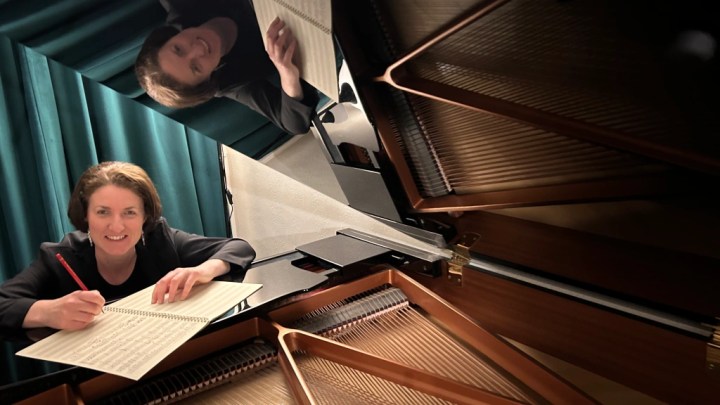






 The Cross-Eyed Pianist