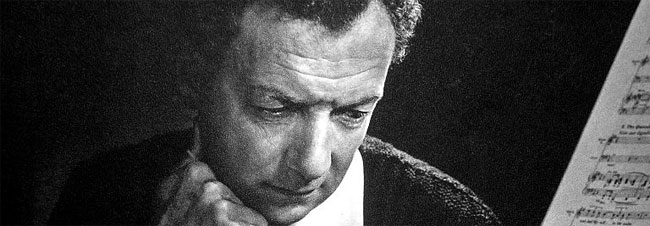
A number of artists who have participated in my Meet the Artist series are involved in concerts and events to mark the centenary of the birth of Benjamin Britten. In a series of occasional posts, I will be highlighting these concerts while allowing readers the opportunity to revisit some of the Meet the Artist interviews.
Britten at 100 – Kings Place, London: Thursday 7th – Saturday 9th February 2013
British pianist John Reid is presenting his first concert series in London at King’s Place as part of the celebrations for the centenary of the birth of Benjamin Britten.
Fellow-pianist Andrew Matthews-Owen and John have gathered together a wonderful group of performers to celebrate the life and work of Benjamin Britten, through his music, works by his contemporaries (composers, librettists and visual artists), the repertoire which he championed as founder and director of the Aldeburgh Festival, as well as through commissions by Simon Holt, Jonathan Dove and Martin Suckling.
Other performers include Nicky Spence, Nicholas Mulroy, Joby Burgess, Claire Booth, Andrew Radley, Oliver Coates, Richard Watkins and Christine Croshaw.
Saver ticket: Only £9.50! Your seats will be the best available left 1 hour before the performance. Book early as seats are allocated based on first come, first served.
Russian pianist Yevgeny Sudbin treated the Wigmore lunchtime audience to a feast of virtuosity in a programme of works by Scarlatti, Chopin, Liszt, Scriabin and Saint-Saens.
Hot on the heels of the publication of his book ‘Play It Again’, Guardian editor and keen amateur pianist Alan Rusbridger and publisher, Jonathan Cape, are organising a competition for amateur pianists to showcase their talents to the world.
If you have what it takes to play Chopin’s ‘Ballade No.1’, submit a video of your performance to YouTube, to be in with a chance of winning:
A trip to London
A piano masterclass
A chance to meet Alan Rusbridger
A tour of the Guardian offices
A year’s subscription to BBC Music Magazine
Judges:
Alan Rusbridger (Editor of the Guardian)
Oliver Condy (Editor of BBC Music Magazine)
Andrew Clements (Guardian Music Critic)
Erica Worth (Editor of The Pianist)
Lucy Parham (Concert Pianist)
Alex Bowler (Editor at Jonathan Cape)
Pianists of all standards and levels of experience welcome
DEADLINE FOR ENTRY: March 8th 2013
Further information, entry form and full terms & conditions here
Check out the Play It Again website for piano and Ballade-related content, including interviews, video clips, articles on the brain and music, and much more
Having a lovely time in my first piano lessons (but usually improvising when I was supposed to be practising), and nudging my mum off the piano stool so that I could take my turn. Also, listening to my father’s collection of jazz recordings – pianists such as Thelonius Monk, Oscar Peterson, Dave Brubeck and Jacques Loussier: in fact, it was while sitting on stage right next to Loussier at one of his ‘Play Bach’ concerts at Bristol’s Colston Hall that I first woke up to the possibility of Classical music and jazz functioning plausibly together. Not too long after that, I had my own opportunity to play on that same piano as part of Fairfield Grammar School’s annual concerts, put together by the ever-energetic Bob Latham (whom incidentally I still rub shoulders with from time to time – we both adjudicate music festivals). I’ll never forget the feeling of smallness on that vast stage, surrounded by a sea of faces, nor the uproarious sound of the applause; it all seemed rather improbable to me at the time. At roughly the same time I appeared on a BBC TV piano competition as semi-finalist, and vividly remember having to improvise live on the programme in front of Sir David Willcocks in response to a video of a fire station amid full action-stations…
Who or what inspired you to start teaching?
Teaching the piano, for me, seemed an inevitable adjunct to playing. I ‘fell into’ teaching I suppose, initially taking on an occasional youngster for a few quid while I was a first year student at college, and then getting rather more serious about it a little later on, with the taking of teaching diplomas and so on. I’ve always felt that teaching and playing are flip-sides of the same coin, and indeed that the crossover points are sometimes so hazy that it can be difficult to know who is gaining the most from the experience. I certainly never considered piano teaching to be a second-best option.
We all know that teachers regularly learn from their pupils (there’s nothing new in that, of course), and yet it strikes me that this is a crucial part of keeping going as a teacher. We hear constantly about how important our pupils are – well of course they are – but so is the mental health of their teachers! It’s worth bearing in mind that if teachers are insufficiently nourished by their daily experience, they may become jaded, semi-functioning box-tickers with one eye on the clock; not a recipe for happy piano lessons. Resisting this is easier said than done of course, and I have known of a number of perfectly good piano teachers who were simply not able to withstand the tide of fatigue and frustration that their jobs entailed. This is a real shame, and yet we shouldn’t be too quick to judge teachers who cave in under the strain of what is a tremendously tiring and responsible job.
Who were your most memorable/significant teachers?
I’ve been really blessed. Mrs Dean (I now realise that I never actually knew her first name), then Gwyn Pritchard – both as a boy in my hometown of Bristol – followed by Geoffrey Buckley, Philip Martin and Richard McMahon. I was given composition lessons by Richard Roderick-Jones and Andrew Downes and was fortunate enough to play in quite a number of masterclasses too, with John Ogdon, Peter Donohoe, John Lill and many more. Peter Johnson was my PhD supervisor at the Birmingham Conservatoire – he is a terrifically resourceful academic who never ran dry of suggestions or alternative ways of thinking about things; I owe him a great deal.
Who or what are the most important influences on your teaching?
Well, inevitably all of the above people! Interestingly, my interactions with concert pianists quickly revealed to me that they operate quite differently, prioritise differently and hence directed me differently. To my thinking, the biggest challenge, from the perspective of a fragile music college student, is coming to terms with seemingly conflicting views. At first, it can all bubble up like a melting pot in one’s head, and one can end up feeling utterly rudderless and confused – until, that is, one wakes up to the startlingly obvious reality that one has to take one’s own view when it comes to matter of performance, and that often all one is really grappling with is a difference in emphasis.
Most memorable/significant teaching experiences?
I suppose there are many individuals whom I feel I have been able to support along the way, and a number of these are ‘out there’ today, operating very comfortably within the music profession, as performers, teachers etc, even the odd rock star. It seems a bit ridiculous to single people out really, but I’ve often thought it remarkable that the very first piano lesson I ever gave as Assistant Director of Music at Taunton School in Somerset (arriving straight from a fairly harrowing PGCE course, I might add, where crowd-management seemed all too prevalent a feature), was to a lad who would turn out to be the most accomplished musician to come my way in sixteen years of teaching there. Each lesson was, in reality, a trawl through the great piano concertos – we’d hack our way through Rach. 3, the Grieg, anything I happened to have a copy of to hand, and his sight-reading was at least as good as mine, even then. (He is now much in demand internationally as a freelance organist and writer). School teaching was a very enriching experience for me, on the whole, and I certainly feel I learned a lot about aspects of music I’d never really come into contact with before, such as choral music and music technology. I also had the chance to do bits of conducting from time to time and to gain experience playing nearly all of the brass instruments that were lying about ownerless in the music school. During this time I was lucky enough to have both a head of department and a headmaster who were willing to let me off the leash, as it were, to perform all over the place and indeed to undertake research for my PhD, which involved day-release to Birmingham over a period of four years. Running concurrently with my school career, I did a fair amount of lecturing up and down the country, but notably at Dillington House and then at Jackdaws in Somerset; I feel an especial connection with Jackdaws to this day, generally running a couple of courses each year – notably a popular Summer School for Pianists. Jackdaws serves as a constant reminder to me that the learning process never stops, either for me or for the endless stream of people (many of a ‘certain’ age), who can amaze me with what they are doing at the piano. Incidentally, if you’ve not yet experienced Jackdaws, I’d suggest there’s a hole in your life that you’d better set about fixing straight away; it’s not necessarily because of the standard of playing (though there are some excellent players who attend the courses), more the level of human being.
At the same time, it’s good to remember that sometimes progress is measured in inches, not miles. Success for one person might constitute a complete disaster for the next, so ultimately the only person worth comparing yourself with is you. That way, you keep nudging your way forward, at whatever rate you are capable of, mindful of the fact that any distance travelled down the road of progress is better than none (even if it happens to be a tad less impressive than people half your age). I say this because I can call to mind a number of ex pupils who were less than remarkable as younger players, but who found their legs later, and it is so gratifying to learn that something you said or did as a teacher helped to bring about a eureka moment, maybe decades later. The dedication angle usually turns out to be absolutely crucial to succeeding in music – in my view diligence is at least as important as natural ‘talent’ (and let’s face it, could you ever find two people who could agree what talent actually is?)
What are the most exciting/challenging aspects of teaching adults?
Adults are not big children (and therefore, it goes without saying, children are not small adults). To treat either as such is to misunderstand them, and it’s only a short step from here to underestimating them, patronising them and losing sight of what playing the piano actually means for them: experiencing enjoyment and fulfilment. In 95% of cases our adult pupils hanker after personal enrichment and a sense of engagement with something tactile and beautiful – and all of this is perfectly achievable without becoming a serial devourer of grades, diplomas or other gongs (helpful though these can undeniably be, though in a relatively small number of cases in my opinion).
Adults tend to talk rather a lot in lessons, I’ve noticed! This used to bother me – after all, surely it’s taking money under false pretences if much of the time is not spent ‘on the job’…then, one day quite a few years ago, it came to me in a flash…we all need different things from our piano lessons. Confidence-building can take many forms, and we don’t all need bolstering to the same extent or in quite the same way. I no longer feel guilty about having a cup of tea and a chat during a lesson…
Adults often lack an awareness of where they are at, both technically and musically, especially if they are not working under the auspices of a regular teacher; hence, they might turn up wearing a beaming smile, brandishing hopelessly unrealistic volumes of late Beethoven Sonatas, or whatever, and within two bars of stumbling about, I know this will end in tears, particularly if the student in question has already committed him/herself to an exam of some kind for which they are wholly unsuited. Related to this, is that I find adults frequently don’t seem to know what they don’t know, if you see what I mean, and hence, left to their own devices, they fixate on unreachable goals such as attaining a higher diploma, a qualification which is really designed to meet the needs of aspiring professionals, not amateurs. I’m all for working towards something a little way off, but in extreme cases only the most strong-willed teacher can succeed in imposing a restraining order.
Nevertheless, while the risks may sometimes be greater with adults, arguably the gains can be greater also. After all, unlike many children, adults know what their lessons are costing them in time, money, conflicting family pressures and so on, and hence in many cases it matters more to them. The adult learner is often a ‘returner’ – I can’t help noticing that the world seems to be full of grade 3 pianists who ‘gave up’ thirty-odd years ago. Things change, and life can overtake us, causing us to bid a reluctant farewell to the piano for a while, and yet thankfully, most people cherish the prospect of coming back to playing some day when the children are married off, they can afford a decent instrument and they rediscover that elusive bit of ‘quality time’. It can be terrifically rewarding as a teacher to help returners, but it certainly helps if they bring a measure of realism and common sense to their approach and are prepared to be guided.
What do you expect from your students?
I suspect I’m rather untypical. As an examiner and trainer for ABRSM you might imagine that I spend much of my time ‘selling’ the Board’s wares…actually, I’ve always been a little slack in this area, to be frank. I generally wait for students to mention exams, and then I respond in the way I feel is right, but rarely do I initiate such discussion. I’ve known parents to be a little problematic if they carry with them personal ‘baggage’ (such as wanting their child to have the opportunities they didn’t, etc.) and this might mean that the teacher feels cajoled into entertaining the next exam before the time is ripe. I suppose I expect students to take their playing seriously, not to waste my time (or their own), and to aim to make the most of their attributes, be they great or small. In return, I try to be a cheerful motivator and to have a positive influence on the course they have chosen to undertake.
What are your views on exams, festivals and competitions?
Interestingly, I notice that the question deliberately groups together exams, festivals and competitions as if they all amount to virtually the same thing. To my mind they are all very different; festivals may well be the right way to go for musicians who are more interested in participation than direct attainment, or for the musician who simply can’t get to grips with all of the supporting tests that are expected for the various grade syllabi. Here too though, teachers and parents all too often get the wrong end of the stick, and the poor child is frogmarched onto the stage, quivering like a jelly, with little hope of acquitting him/herself positively. I have adjudicated dozens of festivals up and down the country, and although overall I do feel they have an important basis for helping amateurs to evolve, I privately worry about the impact on the more fragile contestants who end up proving to themselves what they’d suspected was true along; a real pity. Following on from my comments in relation to the previous question, I feel that exams can play an important role, but only when all of the circumstances are right; they’re a double-edged sword. I deplore the sausage-machine approach (the minute grade 3 has been achieved, a spanking new copy of the grade 4 pieces is magically prised out, like a rabbit from a hat, with no time for consolidation, reflection, fun…).
Competitions are a rather different ballgame – these are for your more go-getter types who have probably already shown considerable aptitude in grades and/or festivals, and are now looking for something with a bit more ‘edge’ to keep them on their toes. But, with every winner there will be, by necessity, a whole bunch who did not win (or are ‘working towards’, to borrow a more politically correct term). Teachers ought to guard against exposing their pupils to less than positive experiences, and they should be continually guarded to the less than helpful influence parents can unwittingly bring to the situation. Whereas few parents would attempt to influence the strategy of, say, an A level maths teacher, some feel qualified to steer the piano teacher down avenues they’d rather not go, resulting in a less than happy outcome. All of this adds to the teacher’s lot, I’m afraid; ultimately, it’s about maintaining diplomacy and compassion, while keeping the pupil at the heart of it all.
What do you consider to be the most important concepts to impart to beginning students, and to advanced students?
For beginners, I feel lessons ought to be about helping them to fall in love with the sound of the piano – its vast range of effects, colours, idioms and styles. For this reason, I am a fan of demonstrating a lot in lessons – it’s not really showing off, so much as showing the instrument in the best possible light, to help them to recognise good playing when they hear it and to want to move towards that in their own playing. I’m not too fussed about introducing notation, not for quite a bit longer into the process than is seen as conventional. I believe that learning to read music is, especially for younger beginners, a big, unnecessary distraction that could easily wait until it is properly needed – in other words, I advocate the learning of notation on a strictly ‘need to know’ basis. After all, learning to play and learning to read are two quite separate things, notwithstanding the collision course that eventually occurs once they are properly up and running. I’d draw the line at an overly Suzuki approach however – the minute reading music shows the potential to become more of a help than a hindrance, it ought to find its way into the teaching. After all, we learn to speak years before we learn to write, and we learn to enjoy food years before we learn how to follow a recipe, so what’s the big rush with learning to read music?
With advanced students, I reckon there is generally still too much emphasis on whizzy-fingered playing. Technique is relatively easy to teach, in the scheme of things, and so teachers may be tempted to place undue emphasis on it, even when it ought to be clear there are more important musical issues still to resolve. My maxim is: come to an understanding of what you wish to achieve musically, and only then get to work on the technical procedures needed to make these achievable. The ‘notes-per-minute’ card can become a distraction from what I call ‘grown up’ piano playing, by which I mean things like chord-voicing (how many pianists, even at diploma level, know what that is?) and acquiring an understanding of what makes the music ‘tick’. There seems to be a prevailing confusion that pianists play, composers compose and analysts analyse, but I believe this to be too simplistic and ultimately somewhat limiting. A pianist who is really able to get to the soul of a piece has, perhaps instinctively, come pretty close to feeling what the composer felt when s/he wrote it. There has to be a measure of structural awareness therefore underpinning the playing, even if there is a shortfall in the ability to articulate it. It annoys me when people derive pleasure from referring to certain jazz pianists as non-readers, as though this in some way absolves them of the need to acquire high-level reading/analytical skills. (Besides, although Oscar Peterson didn’t read music, he understood it more profoundly than most).
Furthermore, only rarely do advanced students seem to be the ‘complete’ musician. Your average grade eight pianist wouldn’t be capable of playing a simple Christmas carol by ear in the key of B major without several minutes grappling and swearing, which I think means we as teachers must be overlooking this type of skill in favour of a more one-dimensional approach. I wish, too, that advanced players were more regularly encouraged by their teachers to measure their accomplishments in relation to the quality of what they are producing, rather than the self-evident complexity of the dots scattered over the paper. If a teacher were to suggest to a teenage boy that, despite having already gained his grade seven he might consider performing a grade five piece in public, I suspect a typical reaction would be that this is some kind of insult to his manliness, or at any rate, an inferred retrograde step. Surely, advanced players are so because they bring a heightened musical intelligence, stylistic awareness and flexibility of technique to their playing, and this should at all costs not be confused with being able to race through a piece at top speed with hurdles tumbling at every stride.
What are your thoughts on the link between performance and teaching?
I’m guessing you are asking whether it is possible to teach the art of performance? If so – yes! (…and no…). I reckon it’s the case that teachers can only hope to tease out what is already there to be brought out. By the same token, you can’t make a silk purse out of a sow’s ear. Having said that, I once had a pupil who gained a distinction in her grade 8 piano exam (mind you, it took her over a year to prepare the pieces) and only by applying every single nuance, tenuto, pedal effect that I handed to her on a plate. Left to her own devices, she demonstrated an alarming incapacity for artistry, but because she was bright, an attentive observer and a hard worker, she acquitted herself very well in the exam, and I remember feeling that she deserved her success. (I can’t help feeling, however, that if I’d handed her three similar pieces and put her on a desert island for another year without any help, she would revert to type: a grade 8 pianist going on grade 5).
With pupils on the cusp of giving recitals in public, I spend quite a bit of time on ‘owning the moment’, i.e. how long to wait before taking the first bow, how to create the right atmosphere before the first note is played, how fast to walk on and off the stage, etc. The theatrical element is, after all, an integral part of what goes into creating an impression with an audience, and even with very polished players it all needs properly tackling until it begins to feel natural. I also spend quite a bit of time working on memorising, programme building, developing sufficient stamina and generally getting to grips with the finer details that go into making a memorable performance.
Who are your favourite pianists/pianist-teachers and why?
Among my favourite pianists would have to be Ivo Pogorelich, Murray Perahia and Howard Shelley. All three place artistry and finesse high up the agenda, but (certainly in the case of Pogorelich) in rather different ways. Technical aspects are so thoroughly embedded into their playing that one barely notices things like notes, just the larger musical gestures that add up to a persuasive personal account. I generally dislike players who possess an overly heavy foot (no names!) – after all, we play the piano with our fingers, not our feet, and that the sustain pedal is as likely to contaminate the sound as to assist it (ditto vibrato for singers, incidentally – and, rather like chilli powder, a little goes a long way). I also find it difficult to enjoy piano playing when it seems overly encumbered by exaggerated body movements in order to justify a massive rubato, especially when, in a recording, the visual element is no longer there to help us understand what on earth is happening.
Mark Tanner will be teaching at the following summer schools in 2013:
Chetham’s International Summer School for Pianists: 20th-26th August
Mark Tanner was born in Bristol in 1963. His first tentative solo appearance at Bristol’s Colston Hall, aptly described as “intrepid” by the Bristol Evening Post, came at the tender age of 13, and shortly after he appeared on BBC TV, playing Liszt. Studying piano with Philip Martin, Richard McMahon and Geoffrey Buckley, Mark gained his PhD from the Birmingham Conservatoire; he was awarded their honorary degree in 2009. He has appeared in many of Britain’s most celebrated recital halls, including five consecutive appearances at Wigmore Hall, the Purcell Room and St John’s Smith Square in London, as well as a number of prominent educational establishments including the universities of Oxford, Cambridge, London, Edinburgh, Aberdeen, RWCMD, Birmingham Conservatoire and Chethams International Summer School for Pianists. With duo partner Allan Schiller, Mark appeared at St George’s Bristol as part of the Mozart 250 celebrations; he has appeared there on many other occasions besides. He is a popular recitalist onboard cruise liners around the globe, including the entire Cunard, P&O and SAGA fleets, having now given several hundred recitals at sea, many of which have been with flautist partner Gillian Poznansky; the duo’s recording of music by Graham Lynch was chosen as an ‘Outstanding’ disc of the month in International Record Review and is broadcast regularly on BBC Radio 3. Together they have premiered several important new works at Wigmore Hall and elsewhere, with recent recitals at festivals in Spain and Denmark. Mark has broadcast several premières live on BBC Radio 3, and his many recordings have attracted consistently high critical acclaim. Of his York Bowen double-disc, Bryce Morrison wrote:
“Tanner’s performances are magnificent. Most pianists would give an arm and a leg, or at least a finger, to achieve his sumptuous sonority and seamless legato…such enviable breadth and poetic commitment.” GRAMOPHONE
Mark has contributed hundreds of reviews and articles for International Record Review, Classical Music, Musical Opinion, International Piano and Piano Professional. He has also published scholarly articles in the USA and UK, including 19th Century Music and the Liszt Society Journal, and edited several contemporary scores for Peters Edition and Europa Edition. For Spartan Press he has published thirty albums of original music and a piano-friendly edition of the Fitzwilliam Virginal Book in a much lauded new graded series. As a trainer and international examiner of grades and diplomas for ABRSM, Mark has undertaken tours to all five continents; he adjudicates festivals for the British and International Federation of Festivals and on three occasions judged the EPTA Piano Competition; he has given numerous lectures on a diverse range of subjects, as well as masterclasses in the UK, Europe and mainland China.
For sixteen years Mark was Assistant Director of Music at Taunton School in Somerset; he has now been active in music education for some 30 years and is currently a visiting lecturer of piano and composition at University College, Falmouth. He also enjoys preparing students for diplomas, college entry and recitals from his homes in Cornwall and Somerset. He is a Fellow of the Royal Society of Arts, a member of Mensa, and his first novel, Life on Mars? A Catinel’s Chance was published by Llama Press; with it he undertook a successful book-signing tour of Waterstone’s stores.
The Cross-Eyed Pianist is free to access and ad-free, and takes many hours every month to research, write, and maintain.
If you find joy and value in what I do, please consider making a donation to support the continuance of the site







 The Cross-Eyed Pianist