Who or what inspired you to take up the piano and make it your career?

We got a piano in our house when I was about 6 because it had belonged to my grandfather but he developed arthritis and so didn’t play any more. After that, it was quite hard to get me to stop playing it.

Who or what are the most important influences on your playing?

The music I play and my teachers Sulamita Aronovsky and Denis Matthews, also the pianists listed below I suppose.

What have been the greatest challenges of your career so far?

Following the conductor Chris Austin when recording Morgan Hayes’ Slippage for piano and ensemble – there are loads of time signature changes, and fortunately he was very clear and patient with me; memorising Albeniz’s Iberia, playing Sorabji’s 7-hour Sequentia cyclica, playing all of Scriabin’s sonatas in one concert (I did that a few times) …

What are the particular challenges/excitements of working with an orchestra/ensemble?

Making sure the conductor doesn’t go to fast and gives me plenty of space to shape phrases

Which recordings are you most proud of?

The first ever CD of music by Alexander Goldenweiser who taught my teacher … some pieces called Dainas by Latvian composer Jānis Mediņš, a disc of music by Felix Blumenfeld, and the live recordings from the Husum Festival (proof that I occasionally actually play OK concerts)

Do you have a favourite concert venue?

In the UK I like the Jacqueline du Pré Music Building in Oxford quite a lot. Recently I turned up in Elizavetgrad in central Ukraine to play Szymanowski (he was born very near there) and got to play on a really nice new and big Bechstein (perfect for this music) in an excellent hall … a nice surprise.

Who are your favourite musicians?

Richter, Delarocha, Feinberg (Samuil), Bolet, Sofronitsky, Petri, Yudina, Enescu

What is your most memorable concert experience?

There are a few: first concerts in Moscow Conservatoire, Helsinki Opera House, NYC Kaufman, Montpellier Festival Radio France … and the small places like the Neuhaus Museum in Kirovograd, the Čiurlionis House in Druskininkai where the audience sits in the garden, Goldenweiser’s flat in Moscow on Tverskaya where there were a scary number of pianists in the audience … playing Elgar in the Philarmonia in Kyiv.

What is your favourite music to play? To listen to?

Often it’s Russian music of the early 20th century – I like listening to orchestral music, especially if I’ve been playing the piano all day long, but have quite broad taste that includes lots of jazz, soul and Brazilian music as well.

What do you consider to be the most important ideas and concepts to impart to aspiring musicians/students?

Be curious, listen hard and stick to your guns.

What are you working on at the moment?

Radulescu 2nd Sonata, Aperghis A Tombeau ouvert, Rachmaninoff 3rd Concerto, Alkan Concerto for solo piano

Where would you like to be in 10 years’ time?

At home with my family

What is your idea of perfect happiness?

Walking in the mountains with my wife and son

What do you enjoy doing most?

Cooking for my family, walking and sleeping

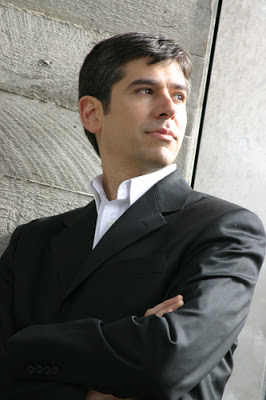
Jonathan Powell is a pianist and composer. After studies with Denis Matthews and Sulamita Aronovsky, he established an international career as a soloist, his programmes ranging from standard Classical and Romantic repertoire to contemporary and little-known 20th century works. He has performed widely in Europe, as well as in Russia and the US; he has also appeared on national radio of many countries and recorded about 20 CDs.

Over the last decade, concert work has taken him to New York, the Musica Nova Festival in Helsinki, the Festival Radio France et Montpellier, Festival de Chaillol (Hautes-Alpes France), the Raritäten der Klaviermusik am Schloss vor Husum, the Reggello Festival (Italy), Vredenburg Muziekcentrum in Utrecht, De Toonzaal in ‘S Hertogenbosch, Gigant in Apeldoorn, and concerts in the Conservatoire and Russian Academy of Music in Moscow, and the Sheremetevsky Palace (St Petersburg), in the Altes Rathaus, Vienna (at the invitation of the Joseph Marx Society) and in masterclass and concert tours of Denmark. In the UK, his concerts have taken him to venues ranging from the Royal Festival Hall to university departments and local town halls.

He has recently appeared in many concert halls in Eastern Europe: since October 2010 he has undertook tours in Slovakia, the Czech Republic (including a residency at the Janacek Academy in Brno), Ukraine, Russia and Lithuania, performing repertoire ranging from John Field and Chopin, to contemporary music.

Powell has worked with many of today’s most prominent composers such as Ambrosini, Finnissy and Staud. As well as giving UK premières of pieces by Sciarrino, Feldman and Salonen, he has commissioned many new works.

Powell is a self-taught composer – he has recorded several of his own works for BBC broadcasts and has received performances by the London Sinfonietta, the Arditti Quartet, Valdine Anderson, Sarah Leonard, Darragh Morgan and Nicolas Hodges among others. His articles on many aspects of Russian music appear in the New Grove Dictionary of Music; his articles have been published by International Piano and the Finnish musicological journal Musiikki-lehti. He recently contributed to a book on the pianist-composer Samuil Feinberg, and co-edited the publication Rimsky-Korsakov and his Heritage.

When I was in the final throes of preparation for my ATCL Diploma in December 2011, my piano teacher gave me some very useful advice. “Try and remember what excited you about the pieces in the first place and what you like about them”. (Here’s what I wrote about the previous programme.) When one is preparing for a big exam, competition or recital/recital series, and one has been living with and working on the same repertoire for a long time (nearly 18 months in the case of some of my pieces), there is a terrible danger of growing bored with the music, or overworking it to such a degree that it starts to go stale. My students find it hard to grasp the concept of “over-practising”, which suggests to me that none of them do enough practising in the first place (!), though a couple have complained of this issue in recent weeks, with their exams coming up very soon. When one goes into the recital room on exam or concert day, it is important to have something extra to give, to add an edge to the pieces and to make them appear fresh, created anew for the audience or adjudicator.

When I was playing to a friend/colleague on Friday, I recalled over and over again, when we were discussing the pieces, why I like each and every one of them, and why, after such a long period getting to know them and immersing myself in their individual characters and intricacies, I still love them.

Bach – Concerto in D minor after Marcello BWV974

I’ve always loved Bach, from the time when I first encountered his music as a young piano student in the Two- and Three-Part Inventions, through the “48” to the Partitas for keyboard and Concerti for solo keyboard.  I was immediately struck by the beautiful serenity of the slow movement of this concerto, bookended by the upright and rhetorical opening movement and the joyous (despite its minor key) dancing Presto final movement. This has been a satisfying and absorbing piece to learn, and the one with which I always begin my practising, almost without fail. I love the way Bach retains some of the orchestral elements of the original concerto by Marcello, particularly in the first movement, and combines these with aspects – ornamentation, texture – which demonstrate the possibilities, both technically and emotionally, of the harpsichord (or piano).  I have written more extensively about this Concerto in a separate post).

Takemitsu – Rain Tree Sketch II

I wanted to include some 20th century music in my programme, for the sake of contrast, and I originally started learning one of Messiaen’s Preludes (the ‘Chant d’extase dans un paysage triste’/Song of Ecstasy in a Sad Landscape), but realised it would be a very long and challenging learning process. When I first heard the Rain Tree Sketches, I fell in love with the Debussyan and Messaienic references, the musical colours and meditative soundscape. I will learn the first Rain Tree Sketch in the near future. More about Takemitsu here.

Mozart – Rondo in A minor K 511

I first came across this late piano work in a concert given by Robert Levin with the OAE in 2007. I love its plaintive melancholy and the way it presents, in microcosm, almost every aspect of Mozart’s music from grand operatic statements and beautiful arias to string quartet articulation and Baroque references. I have been learning this work, on and off, for five years, and each time I come back to it, I find more things in it. It is one of the most difficult pieces I have ever learnt – not the notes which are relatively straightforward, but the shaping and the profound emotional content of this music.

Liszt – Sonetto 104 del Petrarca

I learnt the ‘Sonetto 123’ for my ATCL. It was my first serious foray into Liszt’s music, and I am so glad I took the plunge to start exploring his piano music. The three ‘Petrarch Sonnets’ come from the second year of the Années del pèlerinage (more here), and this is the most virtuosic and dramatic of the three. I felt it was important to have one big romantic work in the programme and I decided to steer clear of the obvious pieces, such as one of Chopin’s Ballades. I love the sweeping romanticism of this piece, its rapid changes of mood, and striking harmonic shifts.

Rachmaninov – Études-Tableaux in E flat and G minor, Op 33

I had never seriously learnt any Rachmaninov until I picked up these pieces. I had an idea that Rachmaninov’s Études were easier than Chopin’s (I was wrong!), and I felt it was better, once again, to steer clear of the more obvious choices such as two of Chopin’s Études, or the Opus 39 Études-Tableaux, which are more well known.. I like the Slavic flavour of these works, in particular the open fifths in the arpeggiated figure in the moody, elegaic G minor Étude-Tableau. (I have written more extensively on these pieces – here)

I played my Licentiate Diploma programme through to a pianist colleague/friend last week and received some very useful and positive feedback on my performance (the first time my playing has been described as “authoritative” and “convincing”, something I’ve striven very hard for since I embarked on this whole Diploma pèlerinage).

With four weeks to go until the exam, much of what I need to do now is simply “housekeeping”, finessing and tidying, and making sure all cadenzas and other fiddly places are absolutely secure. It was helpful to have a different, critical set of ears on my pieces as this has enabled me to refocus my practising. The only piece which still requires some serious attention is the E flat Étude-Tableau (Rachmaninov) but between us we devised a strategy, and I think it will be all right come exam day. Curiously, in my last Diploma, the piece which I felt was least secure (the Schubert E flat Impromptu, D899) was the one I did best with. Such is life…..!

This week I will have another rehearsal with the page turner, ahead of my concert for the NPL Musical Society. This will be the “dress rehearsal”, for both of us.

My friend’s grand piano made everything sound lovely, and I’m pretty pleased with the recording. You can hear what I feel is the best stuff on my SoundCloud:

Last weekend I had the great pleasure of attending and performing in a student concert organised by pianist and piano teacher Helen Burford. It’s always interesting to hear the students of another teacher perform, and is a great way of exploring new repertoire and celebrating the pleasures of playing the piano.

Held in the Quaker Friends Meeting House, a simple eighteenth-century building nestled in the heart of Brighton’s famous Lanes, with a medium-sized Yamaha grand piano and a good acoustic, the concert was informal while showcasing some very talented pianists, both children and adults. I was particularly impressed by one young man, Sam, who played one of his own compositions, a minimalist-inspired piece which contained echoes of John Adams’ ‘China Gates’, and the subtly shifting harmonies of Philip Glass. Later, Sam played a piece by Turina (‘Conchita Reve’ – ABRSM Grade 7), which was atmospheric and sensuous. I also enjoyed performances by some of the younger players, including JoJo, who played ‘Island in the Sea’, the waves lapping at the shoreline suggested by glissandi. Saskia’s ‘Gnossienne No. 1’ by Satie was measured and elegant, while Charlotte gave a very committed and convincing performance of Grieg’s Nocturne, Op 54, No. 4.

It is always a pleasure to hear my friend and colleague Helen play, not least because her choice of repertoire is often unusual and unexpected, and always beautifully played. She closed the concert with the contrasting ‘Three Improvisations’ by Chick Corea.

I was honoured to be billed as “special guest performer”, and it was very good to have the opportunity to put some of my Diploma repertoire before a friendly audience. Afterwards, we retired to a wine bar called 10 Green Bottles, which seemed a perfect way to end a really lovely afternoon of piano music.

Helen is performing in the Brighton Festival Fringe on Sunday 5th May in a programme featuring works by Bach, Messiaen, Ginastera and Corea. Further information here

www.helenburford.com