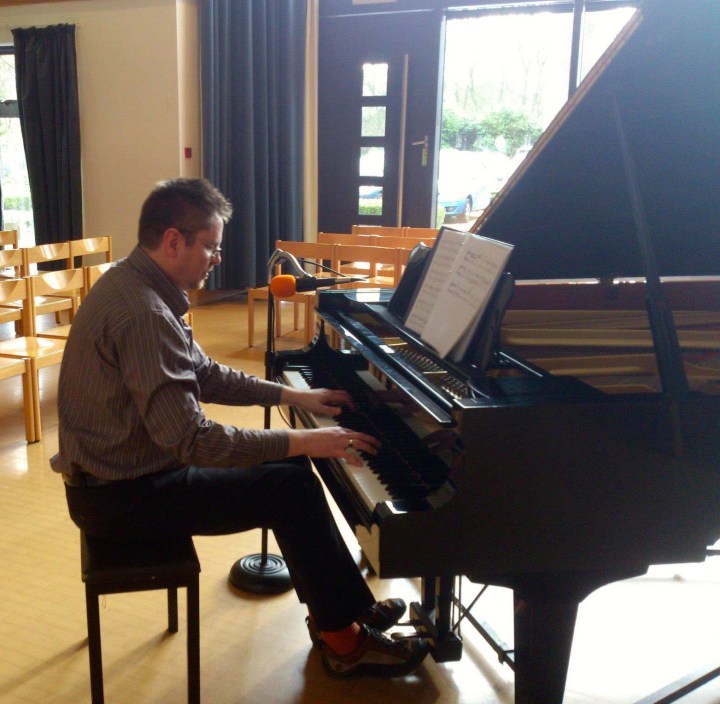
What is your first memory of the piano?
I was seven years old. My older sister was taking lessons. I had double-pneumonia, and was recovering in bed. I remember hearing her playing and wishing I could learn too.
Who or what inspired you to start teaching?
A friend of mine was a classroom music teacher. He asked me to give lessons to one of his sixth form students, who had self-taught up to about grade six, but with major flaws in his playing. I was working for EMI Classics and commuting to London – which I hated. So I gave the student an evening lesson, and fairly instantly knew that I had found my vocation.
Who were your most memorable/significant teachers?
I was lucky to have several outstanding teachers. My first teacher was quite scary, and had a reputation for shouting at students, but having made a decision that I wanted to grow up to be a great musician I was happy to take my chances with her. In fact she was always tender and encouraging with me, although she did periodically wander off to another part of the house to shout at her husband! When I told her I liked Grieg, she said that when I grew up I would prefer Sibelius. When I said I had enjoyed hearing Bizet’s ‘Carmen’, she announced that in a few years time I would like Wagner. I think she recognised that I was musically inquisitive and deliberately goaded me, but she knew exactly what she was doing and before long my musical taste grew in many new directions. When I was eleven I won a music scholarship to boarding school, and as a parting gift she gave me a copy of ‘The Fitzwilliam Virginal Book’, an unusual present for sure. That seed lay dormant for many years, but remains one of my favourite possessions in terms of sentimental value.
Many years later I was studying for my music degree at Birmingham University. David Ponsford was assigned to teach me the harpsichord, and he had a very profound influence on me. Of all my teachers he is the one I feel most indebted to, and following on from those lessons I chose to specialise and study the Early Music course at the RCM, where I learnt with Robert Woolley.
My final piano teacher was Joseph Weingarten, the Hungarian concert pianist. He had studied with Dohnanyi at the Franz Liszt Academy in Budapest before coming to the UK in 1934. There was a clear sense that he was connected to this incredible heritage, that his teaching was authoritative, and yet he was so supportive and gently encouraging. He had a perfect balance there, which I can only attempt to emulate!
Who or what are the most important influences on your teaching?
The biggest influence is actually my love for the music itself, and all it communicates. And by that I include music from a wide range of traditions, not just classical. When I hear great music I am just inspired, and want to share it with others, so that informs my teaching from one day to the next. For me, music is an incredible journey of discovery – and my students are also on their own journey, so it’s a privilege to share that and play a part.
My wife Louise works in child and adolescent psychiatry, and it would be remiss of me to ignore the huge influence this also has on my teaching ethos. Her insight into the issues that affect the lives and mental wellbeing of children and families in contemporary society inevitably has a massive impact on my own approach to people.
Most memorable/significant teaching experiences?
Working for the local authority Music Service in schools in the 1990s was formative and very significant, forcing me to think carefully about my understanding of music education. Although a pianist, most of my work at that time was teaching electronic keyboards in a group context. The ensemble programme that I created took me down a very exciting creative route that I wouldn’t otherwise have experienced, and led to a lot of opportunities both here in the UK and in the USA.
What are the most exciting/challenging aspects of teaching adults?
Adults have more understanding of the journey they are on as musicians, and they know what music they like and what they don’t like. So that is a different type of challenge to teaching a child, who might be more open to new experiences. Because my teaching is driven by my own love for music, it’s important that the student’s interests and tastes coincide to some extent with mine. But often I have found that a student’s enthusiasm for a composer or style has fed back into my own interest, and that’s a real joy too – another discovery that feeds my enthusiasm as a teacher.
What do you expect from your students?
Respect. If a person doesn’t respect me – both as a musician and as a human being – then I can’t teach them.
What do you consider to be the most important concepts to impart to beginning students, and to advanced students?
There are the three essentials that underpin all playing: literacy, musicianship and technique. They need to be developed in tandem, and it’s the same whether a player is a beginner or more advanced. And again, the most important thing of all is to develop a proper LOVE for the music. We must be careful not to trivialise music or pretend it has to always be “fun”, but it must never be dull either.
The big enemy (as always!) is tension. I believe that the way to overcome that is to use physical movement away from the piano, and I have developed specific exercises based on Qigong forms and theory, which are proving very effective. Once a player is more relaxed, their musicality and creativity finds better freedom to be expressed.
What are your views on exams, festivals and competitions?
Exams can be great if used as a celebration of achievement, provided we don’t let them dictate the way we teach, or neglect creativity. Most of my students take selected ABRSM Grades, with positive experiences and fantastic results. I use ABRSM because I like the professionalism of their service, the positivism and consistency of the examiners, and the superb published resources.
My students do not compete in festivals. Growing up, I won virtually every competition I ever took part in, but I didn’t enjoy a single one of them. In fact they turned performing into something I dreaded, although I didn’t upset my teachers by admitting that to them at the time!
These days of course we have a much better understanding of the direct link between the public criticism of players and their performance anxiety. The welfare of our students is more important than upholding any tradition, however well intended, and as music teachers we can have a powerful role in remoulding and recasting our performance culture for the better.
What are your thoughts on the link between performance and teaching?
While we are all individuals with different strengths, I believe it is really important for performers to also teach, and for teachers to also perform.
I also believe that all musicians should try to compose and/or improvise. I see creating, performing and teaching as the three key areas of musical activity.
How do you approach the issue of performance anxiety/tension?
Performance anxiety primarily feeds off three things: the fear of failure, of looking silly, and of being compared critically with others. So we have to cut off this toxic food supply. Firstly, we minimise the fear of failure by ensuring students are well prepared, realistically confident, and focussed on enjoying the music they play. Secondly, we can ease their fear of looking silly by diminishing the formality and ritual associated with classical performance. And thirdly we can move away from the practice of having an adjudicator publicly evaluating and comparing performers, and in so doing establish a more positive context for both public performance and private, constructive feedback.
So long as we remember that music is an art form, not a competitive sport, performers and audience alike can all come away from concerts feeling entertained and enriched. Having performed in popular music settings as well as classical, I know the positive feelings that a good concert should engender, but sometimes it appears to me as if the classical world is deliberately trying to eschew enjoyment!
Once we have this basic understanding that performing music should be a celebration, we can start to look at how we approach a performance in terms of our preparation, how to deal with natural nerves and the effects of adrenalin in our system, breathing and stretching exercises, mental control, diet, and so on. This is again an area where I personally believe that Qigong can offer a genuine breakthrough.
ANDREW EALES is a pianist, teacher and educational consultant based in Milton Keynes UK.
His ‘Keyquest’ tuition books for electronic keyboard have sold many thousands of copies in the UK and overseas, and he has contributed to several other publications as composer and author.
To find out more please visit www.keyquestmusic.com
Andrew is also the founder of the online community The Piano Cloud, which brings together creative pianists from around the world. www.thepianocloud.com
Andrew’s next publication, ‘Piano Qigong’, is planned for Spring 2015.






 The Cross-Eyed Pianist