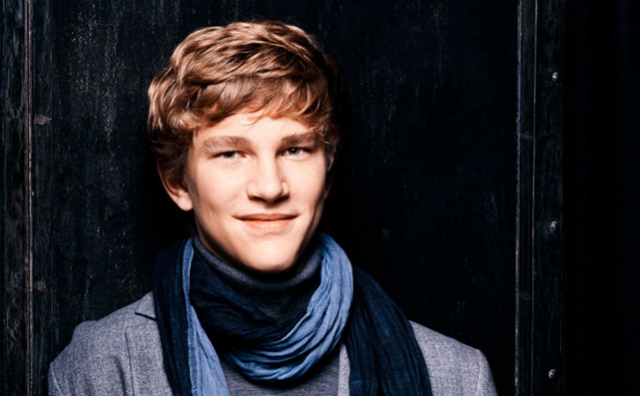
Philip Glass

As a string player who can make a claim to only the most rudimentary pianistic ability (accompanying On the Dodgems in a pupil’s ABRSM preparatory test really did make me go cross-eyed), I embarked on this Pianist’s Alphabet entry on Philip Glass with the fitting trepidation of the interloper.

Why do I want to write about Philip Glass’s piano music? The answer is envy. There are many marvellous tricks that we string players can execute – vibrato, portamento, flying staccato – but one thing that is harder for us is the motoric or raindrop ostinato which is so integral to Philip Glass’s music. We can try, in pieces like Arvo Pärt’s Fratres, but various physical impediments stand in the way of pellucid purity, the bow being the major one; therefore, in Pärt’s Spiegel im Spiegel, we are far better suited to the long notes, which can be made expressive with different bow pressure, or judicious vibrato No doubt there are also many difficulties inherent in Glass’s piano music, which require the same attention to the voicing and spinning out of its long harmonic lines as a piece of Bach, but the results are marvellous: mesmeric, crystalline, resonant, and eloquent, despite the ‘limitations’ Glass places on his musical palette.

Like many people – I assume – I first became properly acquainted with Glass’s music through film scores (specifically The Hours and Notes on a Scandal) and when I came to know more of his music, I began to wonder how it was that his minimalism possessed such rhetorical power. I also wondered why so many people, hearing similar styles of music, by composers less aesthetically adept than Glass would tut ‘Sounds like Philip Glass’ with a dismissive, mirthless laugh.

In Tristian Evans’s Music, Multimedia, and Postminimalism (Ashgate: 2015), the author’s more positive and open-minded analyses explore why Glass’s music possesses such infinite adaptability, moving between the spheres of absolute music and ‘film music’ with ease – an ease which, as Edward Strickland writes in New Grove, has led to Glass becoming ‘one of the most commercially successful, and critically reviled, composers of his generation.’ You can read an example of such criticism by Justin Davidson, in the New York magazine. However, the ways that Davidson, amongst others, censures Glass, are precisely the reasons why I like his piano music: Glass is famous for his musical intertextuality (mainly quotations of his own ideas) and references to other music. In his Etude No. 2, there’s a clear referential link to the first Prelude of Bach’s Well-Tempered Clavier, and it is pursuing the twisted paths of motivic reference – through the repetition that Davidson finds so distasteful – that I love.

Finally, performance. As an encore to Mozart’s Concerto for Two Pianos in E-flat at the 2015 Proms, the Labèque sisters played the fourth of Glass’s Four Movements for Two Pianos. Witnessing the intricacy of their interaction, the delicacy required to balance the musical texture, and extract its essential melodic trajectory, was a masterclass in communicative, rhapsodic piano playing.

Corrina Connor

More than a quarter of a century ago a family of piano enthusiasts in Swansea had a simple dream – to establish a local specialist business for pianists looking for something truly special. It all started in an unassuming 250 year old coach house with fantastic local historical charm with room for just 23 pianos. However, for the aptly-named Coach House Pianos, it was the perfect place to starting building a business that was set up to give pianists simply the best instruments for a variety of different players.

It’s clear to see that the company has always focussed on nothing less than excellence – from Steinway to Zimmerman and Yamaha to Bechstein. By building its reputation over the course of over twenty years, Coach House have housed everything from brand new Kawai baby grands to genuinely antique, century-old Steinways.

coach-house-bannerEvery pianist will agree that when it comes to meticulously crafted handmade pianos, like Steinways and Yamaha’s, that there’s an air of uniqueness and almost personality around each individual instrument. They all carry a story; develop their own sounds; create their own tonal qualities and offer an experience that’s different for each pianist.

That’s always been the dream of the family behind Coach House pianos, which is why their appointment as an official Steinway & Sons stockist was so important to the company.

Not only was it vital from a business perspective but it gives validity to what they do and what they offer players; pianists know that these instruments are more than just ‘buying a product’ but help start a journey towards unique musical experiences.


“Today, little has changed, apart from the size of our establishment!”

Fast forward to 2015 and the firm prides itself on being the UK’s largest stockist of new and used Steinways – irrefutably revered instruments that most pianists would consider themselves honoured to even play. The company was forced to move its premises from the small converted coach house into something more practical and fitting of the illustrious international Steinway name.

Now sitting in a purpose-built two storey showroom, Coach House Pianos has transformed the premises into somewhere that Steinways feel more at home. Marble floors, crystal chandeliers and the perfect acoustic environment house literally hundreds of pianos.

“Today, little has changed apart from the size of our establishment,” say the company. “Same family, […] same standard of service!”

www.coachhousepianos.co.uk/
This is a sponsored post

As a footnote to this article, I can attest to the high-quality service of Coach House Pianos. The company kindly loaned us, free of charge, a beautiful Steinway Model D for the Concert for Hannah Lindfield in September.

Frances M Lynch is a soprano and artistic director of Minerva Scientifica, an evolving music-theatre programme reflecting the work of British Women Scientists through the music of British Women Composers. Here she introduces the project and explains the inspirations and challenges of working with a diverse range of composers and music

Tell us more about Minerva Scientifica…..

With an emphasis on the context within which women have operated in science, the project sets out to explore the links between women scientists in history and the present day and to find innovative and exciting ways of igniting interest in science, particularly among young women, through the medium of arresting and powerful music-theatre.

We have already worked with Judith Bingham who created a work for solo voice and stones about the palaeontologist Mary Anning, and with Karen Wimhurst who created a piece for bass clarinet & solo voice about entomologist MiriamRothschild. We are just finishing our project at King’s College London with Kate Whitley, Cheryl Frances-Hoad, Lynne Plowman and Shirley Thompson who together have created a series of variations on the theme of Rosalind Franklin which we’ve called The Franklin Effect  for acapella Vocal Quartet. They each worked in direct and deep collaboration with four scientists from King’s –  Professor Elizabeth Kuipers (Psychology), Dr Claire Sharpe (Renal Sciences), Professor Mairi Sakellariadou (Physics), Professor Ellen Solomon (Genetics).

It will receive its World Premiere on October 22nd, at 6.30pm as part of the Arts & Humanities Festival 2015 – Fabrication (St David’s Room (2nd Floor), King’s Building, Strand, King’s College London, WC2R 2LS)

More details here – http://www.electricvoicetheatre.co.uk/?page_id=1291.

It’s free to come along but booking is essential https://minervascientifica.eventbrite.co.uk

We have been working with schools in Islington on this project – recording the voices of the children talking and singing about women scientists – this will be used in the premiere. Next term we will go on to work with the Life Sciences Museum at King’s – running a pilot project of workshops with schools connecting creativity, DNA and the Museums exhibits…. and of course touring the programme to other centres in the UK.

We will be doing 3 more performances this month too – ‘Minerva Scientifica – Ada Lovelace’ – at the Science Museum as part of their Lates series on October 28th  – with a world premiere by Cheryl Frances-Hoad, and we will be joined by science historian Patricia Fara  – door opens at  6.45pm.

We are developing two new projects – one on mathematics at Cambridge University and one on memory at Newcastle University. Lots happening on these at the moment – and touring dates to come too….

What was the inspiration behind the project? 

Women, science and music. In combination they are immense. I had long thought about the parallels between women working in science and music (mainly because of personal connections) – and being involved in the world of technology as an artist, I was acutely aware of the male dominance in that area as well as the struggle for many women composers to be accepted generally. I have worked with many women on productions and projects of many kinds and with few exceptions, found their way of working  generous , insightful, open and holistic. I see, particularly in the world of medicine, but elsewhere in science, that this kind of approach is much needed – but as in music, women struggle particularly to break that famous glass ceiling. (Not sure why its called a glass ceiling unless its toughened, unbreakable glass that is!)

What have been the pleasures and challenges of working with such a diverse range of composers and musicians? 

So far we have undertaken 3 separate projects: the first 2 with individual composers being fairly straight forward. The most recent one – inspired by Rosalind Franklin, x-ray crystallographer whose photo 51 was the key to unlocking the mystery of the structure of DNA – involves 4 composers, 4 scientists and 4 singers, and a few more besides.

All of the projects have been a great pleasure for all of us. The Franklin work has been particularly rewarding, bringing together a diverse group of people to create work with a sense of unity, in intense collaboration with the scientists. It was daunting at first, but once we got to know each other I think we felt that we never wanted it to end (it does however on Oct 22nd with the premiere!)

What do you hope audiences will gain from the project? 

Gain is a strange word in the English language – to my ear it has too many financial connotations to be a useful way of describing what audiences (and artists) experience together. We hope, and have already experienced that audiences are fascinated by the stories and the science of these women – going away and learning more about them; they are often awakened to the importance of women composers, again paying more attention to them afterwards. However, the most important thing for me as an artist – besides their engagement and enthusiasm for the subject – is that they enjoy the music – which, being so diverse, means that everyone finds something for themselves to take away.

Frances M Lynch

Who or what inspired you to pursue a career in music? 

I’m Scottish: everyone inspired me to be a musician – from my Granda and his stories and songs, my relatives and their daft party pieces, my Dad singing, my sisters playing instruments, my school giving us compulsory music tests at the age of 5 and thrusting a violin in my hand, an amazing nun who wrote music for the church and taught us to sing complex music, the music I heard everywhere, the list is pretty endless. As to pursuing a career, that was never, and is not now, in my mind. I am simply singing and pursuing ideas with other artists and creatives, and scientists and more, those of many hues, and folk sometimes remember to pay me for it….

Who or what were the most important influences on your musical life and career?  

Many teachers, a nun who composed her own music and taught us to sing plainchant, the music of many great composers starting with my mad conducting of Rossini’s ‘Thieving Magpie’ (a stress busting activity for any teenager), folk music, Michael Mara, Judith Weir, Elton John, Yes, Maxwell Davies, Hildegard von Bingen, almost all the live music I’ve seen and characters on stage who fascinate and inspire….

What have been the greatest challenges of your career so far?  

Working out how things work in the whole business of the contemporary music community when I first started, making myself into a producer, working out how to work well with people and bring out the best in them and myself, raising funds, many many impossible scores to learn, staying afloat when all around are sinking….the challenges never end.

Who are your favourite musicians?  

This is an impossible question. I’ve been lucky enough to experience a vast array of extraordinary players and singers – its hard to single them out really. Basically I am usually in love with the performers in the last event I experienced – when its fabulous of course – which it often is, whether it’s professional, amateur, rock, classical, folk, avant garde…….. We are so lucky to have such a wealth of music here.

What is your most memorable concert experience?  

I’ve had so many its hard to choose…but I’ll never forget singing a Requiem for Lockerbie by Karen Wimhurst with so many of the relatives in Greyfriars Kirk. It was humbling that so many came when it must have been so difficult for them. Words fail me as to how to describe the emotions so present in the church – it was a charged atmosphere in so many ways, and one I will never forget.

What do you consider to be the most important ideas and concepts to impart to aspiring musicians? 

In music – Listening, openness, compromise, Listening, fearlessness, a spirit of adventure, Listening

In professional life – persistence, fearlessness, compromise, listening, openness, meeting people,  don’t be afraid to ask for help, say YES and worry about it afterwards….
Frances Lynch’s biography

Prize Winners at the Royal Overseas League competition and the Schubert International Duo Competition, the Françoise-Green piano duo presents The Viennese Salon – an exciting five-concert residency at London’s St John’s Smith Square dedicated to Vienna’s musical landscape, from the intimate salons of the late 18th century to the private society concerts of the 1900’s.

The duo will perform the complete Mozart piano sonatas for piano duet, a selection of four hands masterworks by Schubert, together with arrangements of the key orchestral pieces of the Second Viennese School: Schoenberg’s two Chamber Symphonies, the orchestral interludes from Berg’s Wozzeck, a new arrangement of the Lulu Suite, as well as Zemlinsky’s epic arrangement of Mahler’s sixth symphony.

To complete this residency, each concert will feature a new addition to the repertoire by young composers Vlad Maistorovici, Christian Elliott, Colin Alexander, Christian Mason and Alissa Firsova.

Full details of the concert series here

Meet the Artist….Robin Green (interview)