image1

Who or what inspired you to pursue a career in music?  

My Mum and Dad. They gave me the opportunity to have piano lessons and I’ve never looked back. A few years later they encouraged me to learn more instruments so I chose the clarinet and harp initially, but my Mum said no to the harp because it was too big, so I chose the marginally smaller cello as an alternative. I was enrolled in dance lessons from the age of 4 so learnt to love performance from a young age. I loved to put on shows with my cousins for our parents and grandparents. I took this to another level when I forced my sister and a friend to perform a rendition of a track from the show Starlight Express whilst on roller skates in a school assembly. My piano teacher and music teacher encouraged me to pursue performance and composition. To be honest I never imagined doing anything other than music so I think I have always been pursuing a career in music without actually realising it.

Who or what have been the most important influences on your musical life and career? 

I’ve never really had one or two important influences. More a continual building collection. Daily I’ll be influenced by many different things whether that be a piece of music, a painting, photograph, philosophical article or an approach someone takes on life. I’m a very reflective person so can be influenced by the simplest of things like watching a bird splash about in a puddle. I’m driven by the belief that there is only one life we live in our current form. Therefore we should either be striving to achieve a goal or, at the very least, enjoy what we are doing. Not everyone has this choice so we shouldn’t take it for granted.

What have been the greatest challenges of your career so far? 

The first thing I think of is staring at a blank page when I know I need to compose a piece for a deadline. But this is a daily challenge. The greatest challenge of my career though is probably getting people to listen to my work when there are so many other artists work they could also be listening to.

Which performance/recordings are you most proud of?  

There are two pieces I composed for a pitch for an advert. There are also some cues from a film score that I’m particularly proud of because of their emotive drive. The type of music which makes your hair stand on end.

Favourite pieces to listen to?  

This changes weekly, even daily. Today I’m really enjoying Beautiful Lie by Hans Zimmer and Junkie XL

Who are your favourite musicians? 

There are too many too name. My favourite musicians are ones whose music has elements which will intrigue me and which I have an uncontrollable urge to immediately analyse. Whose music is utterly captivating to listen to because of all the different compositional elements. To name just a small number would be Alexandre Desplat, Danny Elfman, Johann Johannson, Max Richter, Clint Mansell, Kronos Quartet, Goldmund, Nils Frahm, The Glitch Mob…there really are too many from so many different styles.

What is your most memorable concert experience? 

Unfortunately I have a very poor memory so I expect there have been many. However, there are a few I still talk about. One was when Muse performed at SWSX many years ago before they were as big as they are now. They were absolutely incredible. The type of musicians where you can tell they breath music. For the same reason, Jill Scott and Mumford and Sons were also extremely memorable. But more recently, I’ve seen a few film score composers in concert who have been absolutely wonderful. Namely Danny Elfman and Hans Zimmer. I came away more in awe than when I went in. There are a number of theatre productions that have literally left me speechless as well.

What do you consider to be the most important ideas and concepts to impart to aspiring musicians? 

Explore concepts you feel uncomfortable with. Face your weaknesses. Learn to take a step back from your work and hear it from a different perspective. Don’t ignore your gut instinct. Learn to accept and see criticism as constructive feedback but also be confident in your own mind and opinion where necessary.

Where would you like to be in 10 years’ time?  

To still be making a living out of composing music.

What is your idea of perfect happiness? 

Working from a studio that looks out to the ocean.

Aleah Morrison-Basu’s first narrative piano and electronics album ‘Evolving Reflections’ is released on 8th July 2016. 

Aleah is a London-based composer working out of her studio in central London. Always enthusiastically looking for new and interesting collaborations with musicians, composers, Film, TV and Theatre directors as a composer, arranger, orchestrator, music supervisor and co-composer. 

Distinctive melodies, emotive scores. Nominated for 2015 MAS Award for Best Original Score for Feature Film and Best Original Score for Short Film. Music composer for feature films, TV series, short films, TVC’s, branding films, interactive theatre. 

Aleah has composed scores for a number of award-winning short films and recently co-composed her first feature film, released in September 2015 in UK, USA and Canada. 

Also, has been composing scores for a number of TV documentary series, currently working on her third score.

Clients include BBC, HBO, Head, Adidas, Kia, Hyundai, Wilko, Three mobile, America’s Cup, Philip Stein, The American Heart Foundation, McVities, Georgia Tech, Harvard amongst many others. 

While composing, arranging, orchestrating and music supervising for Zelig Sound, Aleah is continuing her passion for collaborations in other creative art forms working as a freelance composer and arranger for film/ TV/ and theatre directors.
www.aleahmorrison.com

album_coverLucas Debargue: Scarlatti, Chopin, Liszt Ravel (Sony)
Escape all the noise and fall out of Brexit and the Conservative Party leadership wrangling with this exquisite debut disc by Lucas Debargue, the young French pianist who came fourth in the prestigious Tchaikovsky International Piano Competition in 2015.

Weightless elegant Scarlatti opens this album which was recorded live at the Salle Cortot in Paris, Debargue’s first concert in his hometown after the competition. His sense of pacing, evident in the Scarlatti sonatas, really comes to the fore in his reading of Chopin’s Fourth Ballade, where he balances delicacy and poetry with drama to create a performance which is both intimate and expansive. The real impact comes when he holds the music in suspense: it feels natural and unpretentious. His performance of Gaspard de la Nuit, the work for which he received much enthusiastic acclaim during the competition, is equally impressive. His clarity of touch and tone combined with that wondrous pacing brings a silky sensuality to ‘Ondine”s watery arabesques while ‘Scarbo’ is less grotesque, more puckish and playful, though no less dark for it. In between these movements, ‘Le Gibet’ is seven minutes of restrained desolation. His Liszt is a proper waltz instead of the headlong frenzy some pianists give to this work. The Grieg is like an encore, a calming salve after Liszt’s twirling rhyhms. The Schubert is as intimate as you like, as if Debargue is playing just for you – and playful too, reminding us that Schubert was a composer of dances and Ländler. And in a neat piece of programming the album closes with Debargue’s variation on the Scarlatti Sonata in A which opens the album.

At the Tchaikovsky Competition, the Moscow Music Critics Association awarded him their prize for “the pianist whose incredible gift, artistic vision and creative freedom have impressed the critics as well as the audience”, and his debut disc demonstrates these attributes in spades.

Highly recommended.

Lucas Debargue’s performances at the Tchaikovsky Competition are still available to view on the Medici TV site

If you would like to contribute a review to ‘If You Listen to One Thing This Week….’ please contact me here

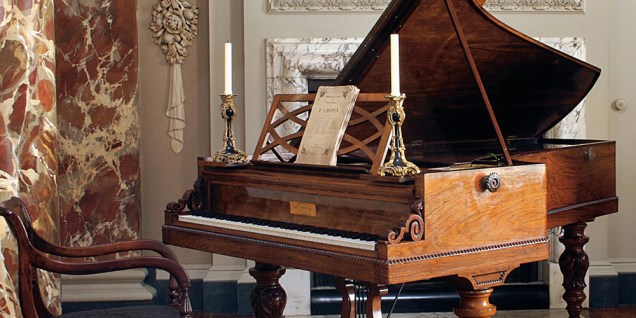
Some years ago I heard two performances of Chopin’s Piano Sonata No. 3 in the same day: the first was on an 1848 Pleyel from the Cobbe Collection at Hatchlands, a piano said to have been used by Chopin when he visited England in 1848. The second was at the Royal Festival Hall on a modern concert Steinway model D. It was almost as if I’d heard two completely different pieces of music. If I had to pick one performance, I would probably say I enjoyed the concert at Hatchlands more – the setting which harked back to Chopin’s Parisian salon and the culture of concerts amongst friends, and the more limited dynamic range of the instrument (without loss of pianistic colour), which seemed appropriate for the music. The performance on the modern Steinway seemed more seamless, the sound somehow “smoothed out”.

33_chopin_pleyelb
Chopin’s ‘own’ grand piano (photo: The Cobbe Collection, Hatchlands)

A few months ago I interviewed an international concert pianist who spoke of the difficulties of playing Chopin’s Piano Concertos with a modern orchestra, on a modern piano. “There’s a simplicity/naturalness/delicacy [in this music] which is bordering on impossible on a modern piano. You have to over-articulate and then it doesn’t feel like Chopin. It becomes “Panzer Chopin”. It shouldn’t be forceful. Very often today the pianos are voiced quite aggressively so that they carry to the back of the hall over the orchestra.”

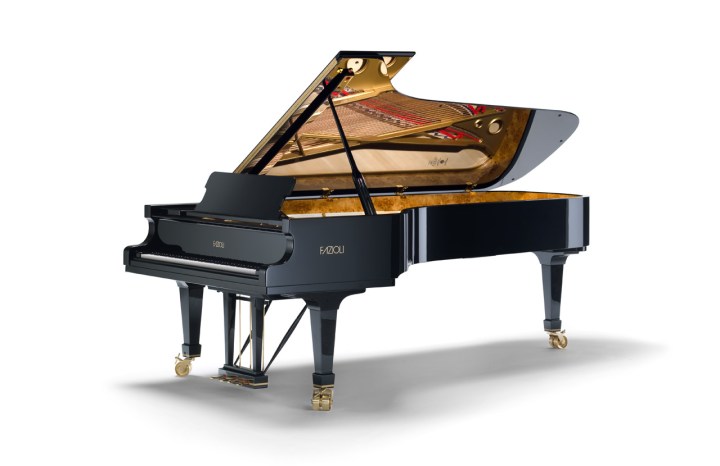
Pianos are now bigger and louder than ever: the invention of the iron frame in the 1820s and the introduction of steel wire strings allowed manufacturers to create much stronger and therefore bigger and noisier pianos. Designed to project in the biggest venues, the largest grand pianos are now over 3 metres in length (the standard Steinway Model D – still the most popular piano in modern concert halls – is 2.74 metres) and modern manufacturing techniques and materials give these instruments immense power. In addition, contemporary taste and trends, in part driven by the wide availability of very high-quality recordings, mean that modern pianos are often voiced in such a way that the sound is very bright, particularly in the upper register.

f308-01
Fazioli F308 model (3.08 metres long)


I have been lucky enough to play  Schubert and Chopin-era fortepianos and pianos (including the aforementioned 1848 Pleyel), an instructive experience for it tells one a great deal about the possibilities – and limitations – afforded by the instruments of the day and the kind of soundworld these composers might have known. I’m no period instrument crusader (nor do I buy into the theory that hearing music on period instruments allows us to “hear it as the composers heard it” because that is impossible, and changes in piano technique, performance practice etc influence the way pianists produce sound), but I do think it is important to understand that an 1826 Graf fortepiano, such as Schubert would have known and played, or a early twentieth-century Bechstein (such as the one I own), does not sound like a modern piano, and we should carry this appreciation into our playing and the sounds we strive to make. (It is reported by those who heard Chopin perform that he never played louder than mezzo-forte, even if he had written forte in the score.). Not all fortes are equal (nor all pianissimos for that matter!), and a forte or fortissimo in Schubert should not be played with the same volume as the equivalent dynamics in Rachmaninov or Stravinsky, for example. Schubert’s dynamics tend to be introspective and intimate, and his fortes generally lack the declamatory nature of Beethoven’s or Rachmaninov’s.

An appreciation of “psychological dynamics” is also important: dynamics should be nuanced to suit the genre, period, mood, key and character of the music. The word “dynamics” does not simply mean “loud or quiet”, and a whole host of adjectives and metaphors can be applied to suggest a particular sound and mood – vibrant, angry, energetic, lethargic, distant, lonely…. I have noticed a tendency amongst certain performers, who shall remain nameless, to offer very literal interpretations of dynamics. Add to this a very large grand piano in a medium-sized venue such as Wigmore Hall and one can feel as if one is being constantly hit over the head with sound, even in the back row of the hall where I usually sit. For someone who suffers from intermittent tinnitus as I do, this can be quite uncomfortable, verging on painful. It also feels “unmusical” to me.

And here is another issue concerning the sound of the modern piano – performers need to make adjustments to their sound according to the size of the venue. At a piano meetup event I attended last winter at a very small salon-style venue, a number of players pushed the fortes and fortissimos in their pieces as if they were playing to a full house at Carnegie Hall, quite inappropriate for the size of the venue. Earlier this year I gave a concert in a colleague’s home on a 1960s Steinway D. Fearful that my fortes might be too great for the size of the room, I considered playing with the piano’s lid on half-stick, but the instrument was so beautifully set up that it was not necessary. (I should add that this was a piano with a rather special heritage: it used to belong to the Hallé Orchestra under Sir John Barbirolli and has been played by such piano greats as Richter, Gilels, Barenboim and Ashkenazy.)

A skilled pianist playing a properly set up modern piano can adjust his or her sound according to venue, acoustic, genre of music. Thus, a pianist such as Richard Goode, whom I heard in Schubert’s last three piano sonatas recently, can bring a richness to the fortes and fortissimos without a loss of beauty of tone. His sound was warm and orchestral, rather than simply loud. Equally, in the piano and pianissimo passages he created an incredible sense of intimacy which seemed to shrink the Royal Festival Hall to the size of Schubert’s salon. Such skillful, controlled and sensitively nuanced playing is of course the result of many years of experience, an understanding of each composer’s distinct soundworld, and the ability to judge the volume of sound one is going to make before the finger reaches the key.

Paul Badura Skoda plays Schubert (on an 1826 Graf fortepiano, a 1923 Bösendorfer and a modern Steinway)

Chopin’s ‘own’ grand piano at the Cobbe Collection


Who or what inspired you to take up composing, and pursue a career in music?

I was obsessed with music as a teenager so I never really considered any other career. At that age I was very dedicated to my instrument and so chose to do a degree in music performance. However, by the end of it I had realised that it is the creative side of music that engages me more than performing.

Who or what were the most significant influences on your musical life and career as a composer?

The first person that comes to mind is Christopher Fox. He was a tutor of mine while I was doing my MMus. He encouraged me to focus on the music that I enjoyed and not worry about musical trends and what other musicians were doing. As my career has developed I have found myself becoming increasingly interested in small ensembles/solo instruments and sparse, understated music and this has been reflected in my compositions. I love delicate piano music so I really enjoy the work of the Impressionists. I also have a soft spot for the music of the film composer Thomas Newman. Shostakovich’s string quartets are particular favourites of mine but I have to be in the right mood to listen to them! The minimal textures he created with pedals have certainly influenced my own work. Of course there are endless composers I like but these are the ones that first come to mind. Lastly, I would say my father; he is a painter. Being someone who has worked in a creative industry, he has been able to give me some invaluable advice over the years.

What have been the greatest challenges of your career so far?

Although occasionally inspiration strikes and I write a piece without too much effort, the vast majority of the time it takes a great deal of hard work. I would say the greatest challenge I have faced as a composer has been sticking at pieces when my creativity is at a low point. It is very frustrating when, after spending weeks struggling to develop a small musical idea, I decide to scrap 90% of it and take the remaining 10% in a completely different direction. Many times I have found that leaving the piece for a few months can help, but there have been some ideas that have been an uphill struggle all the way. Of course, it is worth it when they are finally finished.

What are the special challenges/pleasures of working on a commissioned piece?

I have done commissions where the brief has been extremely specific and it has taken many re-writes before I was able to even understand what the person who commissioned it wanted. This can be even more challenging when the individual doesn’t know what they want and the only feedback they give involves vague unmusical descriptions and a lot of hand waving. However, I have also had some really enjoyable experiences with commissions where I have been asked to combine several very different genres and have been able to do so successfully. French, flamenco, military jazz, anyone?

What are the special challenges/pleasures of working with particular musicians, singers, ensembles and orchestras?

There are several musicians I work with who have a very particular sound. It is always a pleasure bringing a piece to them knowing that their input will not only make it sound as good as possible, but will also give me new insight into my own music.

Which works are you most proud of?

There are a few compositions on my new album of which I am particularly proud. My album celebrates the music of Erik Satie 150 years after his birth. My piece ‘Sea-Bird’ was inspired by Satie’s uncle; an eccentric man who had a profound influence on the composer as a child. Both Satie and his uncle were known to have had bad tempers, swift mood swings and a childlike innocence and I think I captured this very successfully. Although a simple piece, I am also particularly pleased with ‘Knossienne No.1’ as it came out exactly as I hoped it would. I would also say ‘A Walk to Le Chat Noir on a Snowy Day’ as I am pleased with my use of quartal harmony.

Who are your favourite musicians/composers?

As well as the musicians I mentioned in question 2, I would also say Arvo Pärt, Charles Ives, John Tavener, Morton Feldman, Michael Nyman, Saint-Saëns, Prokofiev, Messiaen, Holst … all sorts really. There are also some non-classical artists whose music I enjoy; I love the music of blues musicians such as Stevie Ray Vaughan, Albert King, Tommy Emmanuel and BB King. I’m still discovering new music all the time; I have only just been introduced to the music of Stephen Montague.

What is your most memorable concert experience?

That really is impossible to answer as I remember different concerts for different reasons. I have seen orchestras play at The Royal Albert Hall and been blown away by their power and the atmosphere of the venue. Likewise, I remember seeing the Borodin Quartet at the Southbank Centre and being very impressed by the delicacy of their playing and the intimacy of the experience. However, I have also seen many weird and wonderful performances that were memorable for other reasons. One of the most memorable performances I have seen in recent years was a comedy act called ‘Mr. B The Gentleman Rhymer’. Although not ‘high art’, I have to say it was very funny and very memorable!

What do you consider to be the most important ideas and concepts to impart to aspiring musicians?

When you decide to be a professional musician it is because you want to do something you love. However, it is important that aspiring musicians learn early on in their careers that they will probably have to do some performing/composing/teaching that they’d rather not do in order to pay their bills. It is a bitter pill to swallow, but the earlier it’s done the better.

Where would you like to be in 10 years’ time?

I would like to be in a home that I own. I am a member of Generation Rent and I have to say that I am becoming increasingly concerned with the housing situation in London. It is starting to feel like a pipedream!