Managing the practise of a selection of pieces, as one needs to when preparing for a performance diploma, can be problematic and at times frustrating.

I find juggling four works at the same time so tricky. If I leave one aside for a while, even only a week, it seems to fall apart!

For my Associate performance diploma I had 7 works in the programme and for the Licentiate 8 (I treated the Bach keyboard concerto as 3 works from the point of view of practising). All the pieces had their own particular difficulties, knotty sections which needed focused practise. Ensuring that everything was practised regularly and systematically became a feat of time-management, as my practise diary attests, with each day’s work minutely mapped. One of the most important things I took away from the experience of preparing for my Diplomas was understanding how to practise deeply and thoughtfully.

  • If you have limited time to practise, learn to be super-efficient. If it helps, map your practise time in advance and keep notes of progress in a notebook. These notes should include 1) what you plan to achieve at each practise session and 2) what you actually achieved. The notes you make after the practise session should offer food for thought and consideration at the next practise session. However, allow your practise plan to be flexible – there will be days when you can’t practise, or don’t feel like practising, and I believe it is important to be kind to oneself on those situations, rather than beat oneself up for not practising. Rigid schedules can be unrealistic and dismotivating.
  • You don’t have to do all your practising in one chunk (and bear in mind that after about 45 minutes, one’s attention is waning and it’s time for a break, if only five minutes to do some stretches and make a cup of tea). Taking breaks during practise time helps to keep one focussed and engaged and ensures practising is productive and mindful, rather than mindless “note-bashing”.
  • Learn how to dissect the pieces to spotlight which areas need the most attention. Take out technically challenging sections and “quarantine” them so that they get super-focused work. And don’t just quarantine sections once: build quarantining into your regular practise routine and return to those problem areas regular to ensure noticeable improvement.
  • Break the pieces down into manageable sections and work on those areas which are most challenging (technically, artistically or pianistically) first while your mind is still fresh and alert. Start anywhere in the piece, work on a section, and then backtrack and do an earlier section before knitting those sections back together.
  • With a multi-piece programme, try to have the works on a rotation, so that you start with a different work (or movement if playing a sonata or multi-movement work) at each practise session rather than spending a week, say, working on a single piece.
  • Even when you feel a piece is well-known and finessed, spend some time doing slow practise, memory work, separate hands practise etc. Be alert to details in the score – dynamics, articulation, tempo etc: even, and especially, when a piece is well-known we can become complacent about such details and overlook them.
  • Schedule regular play-throughs of entire pieces, and (about 3 months prior to the diploma date) the entire programme, even if some works are not fully learned/finessed. This allows you to appreciate the overall structure and narrative of both individual works and the entire programme, and helps to build stamina.
  • Practise away from the piano is useful too. Spend time reading the scores and listening to recordings – not to imitate what you hear but to get ideas and inspiration. Go to a concert where some of your repertoire is being performed and in addition to listening, look at the kind of gestures and body language the pianist uses and how he/she presents the programme (all useful pointers for stage craft and presentation skills, on which one is judged in a performance diploma).
  • When we’ve been working on the same pieces for a long time, we can lose sight of what we like about them as we get bogged down in the minutiae of learning. It’s worth remembering what excited you about the pieces in the first place, why you chose them and what you like about them (I ask my students to make brief notes about each of their exam pieces, and I did the same for my Associate programme).
  • Above all, enjoy your music and retain a positive outlook throughout your practising.

Further reading

The 20-Minute Practice Session – article on Graham Fitch’s blog

I offer specialist support for people preparing for performance diplomas, including advice on planning a programme, writing programme notes, stagecraft and managing performance anxiety – further details here
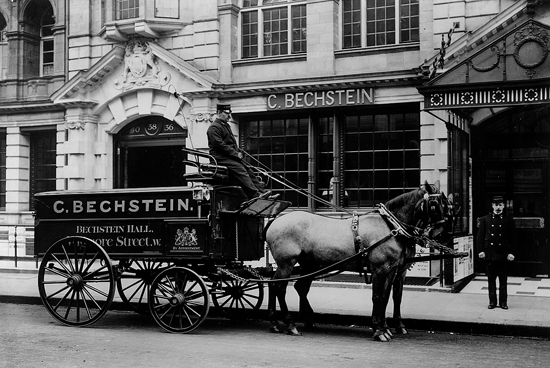
For one night only, audiences at the Wigmore Hall were treated to a glimpse of the hall’s origins, in those pre-First World War days when it was Bechstein Hall and home to the German piano maker C. Bechstein’s London showroom.

bechstein-hall

When Bechstein Hall opened in 1901, Bechstein was Europe’s leading piano maker (it produced 5000 pianos in 1901),  its instruments preferred by most pianists outside America, where Steinway predominated. The Bechstein piano company built similar concert halls in Paris and St Petersburg to showcase its instruments and the leading performers and singers of the day. With its special barrel roof “shoebox” design, beloved of many musicians, the hall still boasts a fine acoustic, while its small size (its capacity is c600 seats) makes it the perfect place to enjoy intimate chamber and piano recitals.

At the beginning of the twentieth century Bechstein Hall on London’s Wigmore Street was promoted as the best of places for intimate music making, and boasted unrivaled comfort and facilities for patrons and artists with its elegant green room up a short flight of stairs behind the stage (so that singers did not arrive on stage breathless). At the time of its opening, concert life and leisure in general in London were enjoying something of a revolution. Theatres and music halls were opening across the west end, a wide public was being introduced to the experience of shopping for pleasure in the new “department stores” (Selfridges is a mere 10 minute walk, at the most, from Wigmore Street), and with cheap and efficient public transport, it was easy for people to enjoy these delights in the centre of the metropolis. A new breed of international concert promoters, agents and impresarios, such as Robert Newman, who with conductor Henry Wood founded the world-famous Proms, were dedicated to organising high-quality recitals, and Bechstein Hall alone scheduled two hundred concerts a year.

During the First World War, it became increasingly difficult for Bechstein Hall to trade viably. Strong anti-German sentiments and the passing of the Trading with the Enemy Amendment Act 1916 led to the hall’s closure in June 1916, and all property including the concert hall and the showrooms was seized and summarily closed. The hall was sold at auction to Debenhams, was rechristened Wigmore Hall and opened under its new name in 1917. Today Wigmore Hall enjoys an international reputation for high-quality music in an elegant and intimate setting.

To give the modern audience a flavour of those halcyon pre-war days of concertising in London, the French pianist Pierre-Laurent Aimard gave a concert on an 1899 Bechstein grand piano, a piano which may well have been sold out of the Bechstein piano showroom next door to the hall on Wigmore Street.  The concert, which included music by composers active at the time when the Bechstein piano company was at the height of its powers, was preceded by a talk with Pierre-Laurent Aimard, Peter Salisbury, a leading piano technician who restored the piano, and composer Julian Anderson, whose work ‘Sensation’, written for Pierre-Laurent, had its London premiere at the concert.

As Pierre-Laurent Aimard explained, the event was the culmination of a long-held dream: to present a concert of the kind of repertoire and composers – and instrument – contemporary with the hall when it first opened. Peter Salisbury talked about the difficulties of preparing a piano for a specific hall, for each space has its own distinct acoustic and the piano must be adjusted and voiced to suit venue, performer and repertoire. When the 1899 Bechstein was brought into Wigmore Hall, Peter noted how closely instrument and venue suited each other, evidence that Bechstein built concert halls to showcase their instruments at their best – and vice versa!

Prior to the First War, piano design and manufacture was still evolving, and each make had its own distinct sound and character. Bechsteins of this period are notable for their special resonance and projection, which result from their manufacturing process. Pierre-Laurent commented on the piano’s uniquely rich palette of colour and tones, combined with great clarity. Every note seems to have “many overtones”, resulting in an orchestral sound which is rich but not cloying.

For composer Julian Anderson, the Bechstein piano has a special place in his life: his own piano is a 1913 Bechstein, passed on to him from his father, and is the instrument on which he composes. He admitted a “great affection for the Bechstein tone”, and that it has a range of colour which “encourages metaphor” and makes it easier to imagine other sounds or instruments when composing.

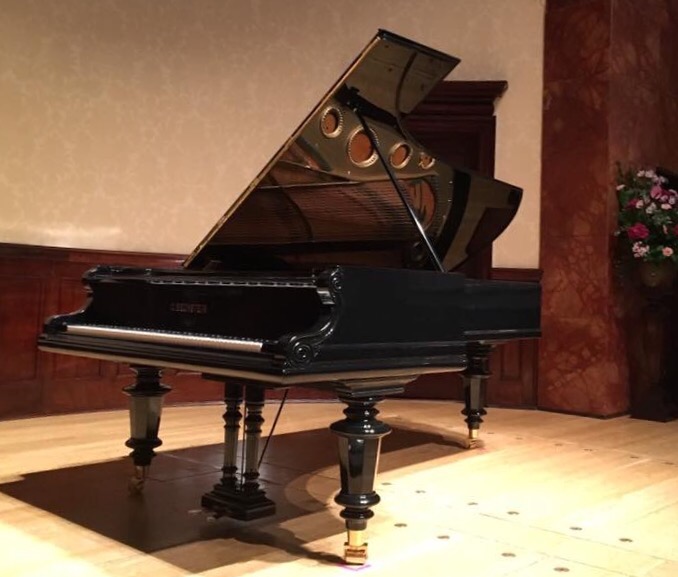
The 1899 Bechstein has been restored by Peter Salisbury and retains the original soundboard and bridge. A new mechanical action was fitted to provide technical accuracy, with new hammers voiced according to Bechstein’s original sound concert. An attractive instrument with a polished black case with scrolled details, the piano has turned legs and a fan-shaped music desk. The instrument is 275 cms (9 foot)long, with 88 notes (not all pianos were at that time – my Bechstein has 85 keys), and it took 3 months to rebuild it fully. For Peter the piano represents “a portal to the past, a lost era of tonal distinction”.

Peter Salisbury’s 1899 Bechstein concert grand on the stage at a Wigmore Hall

After 1910, piano design and manufacture became standardised across makes, and today most concert pianos (most commonly Steinway) have a consistency of sound and touch which enables performers to move fairly effortlessly between a piano in a Tokyo concert hall and one in London or New York. Concert pianos have also grown bigger to project into larger halls, and in the 10 years that I’ve been going t concerts regularly, I’ve noticed the sound of these pianos is, generally, much brighter and often quite strident.

As the owner of a 1913 Bechstein model A, I was very curious to hear this slightly older piano in a concert setting in an acoustic for which it was built. The programme included music by Liszt (the first version of Harmonies poétiques et religieuses), Scriabin and Debussy (both of whom owned Bechstein pianos), Julian Anderson (b.1967)!and Nikoly Obukhov, a colouristic Russian composer whose music bridges the Russian and French compositional traditions of the first decade of the twentieth century. The first half of the concert proceeded without interruption for applause (something with several audience members near me seemed to find quite “difficult”, though I enjoyed the flow of music from one composer to another). From the first notes of the Liszt, I felt I was hearing my own piano in concert – those distinct resonances and layers of colour which drew me to my instrument when I first played it in my tuner’s workshop were made more explicit in Pierre-Laurent’s hands. A surprisingly deep bass resonance, but clear and bell-like, without the chocolatey Sachertorte richness of a Bosendorfer, and a remarkable sustain with unexpected harmonics evident in the sound decay. In the Scriabin pieces, the piano’s multi-faceted sound came to the fore, responding perfectly to Scriabin’s sensual textures with harmonies superimposed on different registers and layered overtones.

The selection of Debussy’s Études was particularly fascinating. Here Pierre-Laurent balanced clarity with tonal sensitivity and the studies burst into to life with delightful shifting colours. The sweet lucid treble was wonderful, so different to the rather strident treble sound one finds in modern instruments, and there were further opportunities to enjoy this sound in the works by Julian Anderson and Nikolay Obukhov. Despite the piano’s resonance and sustain, there was no sense of the sound being too big or overly domineering (again an issue, for me at least, with modern concert grands in medium-sized or small venues). For me, the highlights of the evening, aside from the opportunity to hear this period piano in concert, were the works Debussy and Obukhov – had I not seen the programme, I would have thought the latter was post-Vingt Regards Messiaen, yet this was music written prior to the Russian Revolution, avant-garde and way ahead of its time.

67741286_mandatory_3340468b
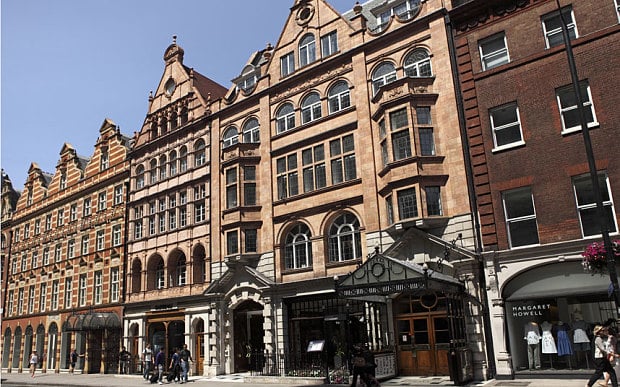
Wigmore Hall today (photo: The Telegraph)

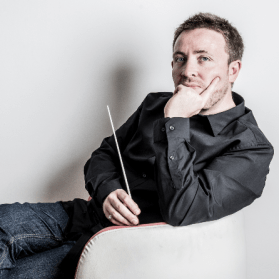
5f3e69_e385f87332164cdbbb4075d6aa12adf3Guest post by conductor and artistic director Tom Hammond

Two of my ambitions as a conductor are to maximise communication within ensembles (sounds simple, but isn’t), and to make concerto soloists feel like they are being accompanied by their own musical shadow.

If I can see the eyes, face, bows and fingers of the soloist I and the orchestra are accompanying, I can go with breath, speed of bow, a nod of a head or other subtle physical gesture… but when it’s a piano concerto, this is often impossible.

Nine times out of ten there’s no chance to see the fingers on the keyboard, I’m not close enough to hear inbreaths (which not every pianist makes audibly anyway) and if I try to lock on to eyes for an extra mode of communication – I can lose the connection with the orchestra. Basically – it’s all behind me!

In a recent performance of ‘Rhapsody in Blue’ I even had the acoustic challenge of a piano that was (on the biggest stick) projecting beautifully into the hall, but away from my ears and couldn’t necessarily hear every note. Quite scary when picking up ends of cadenzas, I can tell you….

My solution is often simply not to even try more than a little eye contact for starts and ends of movements, and then rely totally on my ears. That’s sometimes harder than it might sound, as piano concerti often contain the trickiest technical moments for conducting; bringing in a tutti or a solo instrument off the back of a cascade of rapid notes when, with a string concerto for example, you can also use visual contact as well as aural. Moments in the Rachmaninov Paganini Variations and indeed ‘Rhapsody in Blue’ can really sort the men and women from the boys and girls in conducting terms…

All this led to me wondering how pianists feel about working with orchestras and conductors, and what factors might help make a performance comfortable at the very least, and something special at best. Two pianists I am accompanying in the coming weeks – Stephen Hough and Alissa Firsova – took time out of their hectic schedules to answer a few questions.


May0031407 Stephen Hough for DT ArtStephen Hough

What worries you most before a new concerto project? Is it the instrument, the orchestra, the conductor or the piece of music?
I never worry about the instrument until I see it. But with a new piece there is the uncertainty of how it will actually sound (or rather feel) in that first rehearsal. No amount of preparation prepares you for the oboe or horn or violas coming at you from that particular angle on stage. And because a collaboration with a conductor is like a blind date well … when the mask comes off who knows what to expect!
Have you ever found the ‘perfect’ position on stage for being able to communicate with a conductor during performance? How much is eye contact desirable?
I normally have a good view of the conductor’s buttocks which doesn’t help much … No, but seriously I don’t need eye to eye contact but out of the corner of my eye I’m taking in body language all the time and at certain crucial moments THE STICK!

How much rehearsal time do you like to have?
As much as we need is nice, but not more. I don’t like thrashing the details out until everyone’s exhausted. A little spontaneity is essential. But with certain pieces decisions have to be made, especially with the great works, the Brahms and Beethoven concertos for example.

Which concerti would you like to direct from the keyboard, but have never had the chance?
I’d be curious to try the two Brahms sometime, if only to decide that it didn’t work.


5f3e69_d3be6bedc9d64af0897015aab598ebdcmv2-1Alissa Firsova

What worries you most before a new concerto project? Is it the instrument, the orchestra, the conductor or the piece of music?
“Worry” is not a feeling that comes to mind when embarking on a new concerto project, but rather “excitement”, “curiosity”, “joy” and “gratitude” for the opportunity to take on a challenge and join forces with the conductor and orchestra to explore a remarkable piece of music. However out of the 4, the greatest achievement and dedicated work lies in the process of learning the piece and trying to master it to the best possible ability. Then when meeting the conductor and orchestra for the first time, it becomes a celebration. A bit like a process of making a cake: taking good care of all the ingredients, cooking it at the right temperature and for the right amount time, and then, eating it – the party begins! What I love about musical interpretation is that it is endless. It is so interesting to be able to get to know a new conductor and their personality and see what their ideas are about the piece, when there is a chance to play though sections and explore different ideas, this is gold-dust. I think it’s always important to have an open approach, to try new things, to be flexible in being able to adapt to a different acoustic or instrument or time of day.

Have you ever found the ‘perfect’ position on stage for being able to communicate with a conductor during performance? How much is eye contact desirable?
I think it is ideal to have the opportunity for eye-contact, for those few “magic moments”. Other than that, the most important thing is the listening. When that is completely in sync and focus with everyone, then we might as well be blind-folded. But sometimes it’s nice to be able to communicate visually, to bring that other dimension and to respond to each other. I’ve always felt at home having the orchestra around me. It gives a great support and warmth, a feeling of being all in it together, and the conductor marries the soloist with the orchestra. The priceless moments are those spontaneous ones during the concert, where everyone suddenly takes time or creates a new nuance that didn’t happen in the rehearsals. Thats when you know total ‘oneness’ has been reached.

How much rehearsal time do you like to have?
Even though ideally one would like to have as much rehearsal time as possible, in order to keep trying different things and perfecting corners as well as getting used to the overall structure and pacing of the piece, it’s also important to leave room for the spontaneity and freshness for the concert. I like to have one rehearsal before the day of the concert, and one on the day, an extra rehearsal could be a bonus.

Which concerti would you like to direct from the keyboard, but have never had the chance?
 Mozart Piano Concertos No. 21 in C and No. 27 in B flat
Tom Hammond conducts piano concerti by Beethoven and Brahms, with Stephen Hough and Alissa Firsova respectively, on 18th March and 6th May. Full details here

Top of the list of competitors is twenty-year-old British pianist Martin James Bartlett. Winner of BBC Young Musician of the Year in 2014, Martin now studies at the Royal College of Music.  

Martin James Bartlett

FORT WORTH, Texas, March 7, 2017—The Cliburn announces today the 30 competitors selected to participate in the Fifteenth Van Cliburn International Piano Competition, taking place May 25–June 10, 2017, at Bass Performance Hall in Fort Worth, Texas, USA.

Two hundred and ninety pianists submitted applications to participate in the 2017 Cliburn Competition, and 141 auditioned live in front of a five-member screening jury in London, Hannover, Budapest, Moscow, Seoul, New York, and Fort Worth in January and February 2017. 

After an exhilarating and quite thorough process, I am extremely happy with the 30 pianists who will come to the Cliburn Competition in Fort Worth this May. They are engaging and skilled, and—most important—will inspire and move you,” said Jacques Marquis, Cliburn president and CEO.

The 2017 Cliburn competitors hail from all over the world, representing 16 nations: Russia (6), South Korea (5), the United States (4), Canada* (3), Italy (2), Algeria*, Austria, China, Croatia, Germany, Hong Kong, Japan, Poland, Romania, Taiwan, and the United Kingdom (*one competitor has dual Algerian/Canadian citizenship, and both nations are counted here). There are 21 men and 9 women, and the competitors range in age from 18 to 30.

2017 CLIBURN COMPETITORS

Ages are as of June 10, 2017, the final day of the Competition.

Martin James Bartlett, United Kingdom, age 20

Sergey Belyavskiy, Russia, 23
Alina Bercu, Romania, 27

Kenneth Broberg, United States, 23

Luigi Carroccia, Italy, 25

Han Chen, Taiwan, 25

Rachel Cheung, Hong Kong, 25

Yury Favorin, Russia, 30

Madoka Fukami, Japan, 28

Mehdi Ghazi, Algeria/Canada, 28

Caterina Grewe, Germany, 29

Daniel Hsu, United States, 19

Alyosha Jurinic, Croatia, 28

Nikolay Khozyainov, Russia, 24

Dasol Kim, South Korea, 28

Honggi Kim, South Korea, 25

Su Yeon Kim, South Korea, 23

Julia Kociuban, Poland, 25

Rachel Kudo, United States, 30

EunAe Lee, South Korea, 29

Ilya Maximov, Russia, 30

Sun-A Park, United States, 29

Leonardo Pierdomenico, Italy, 24

Philipp Scheucher, Austria, 24

Ilya Shmukler, Russia, 22

Yutong Sun, China, 21 

Yekwon Sunwoo, South Korea, 28

Georgy Tchaidze, Russia, 29

Tristan Teo, Canada, 20

Tony Yike Yang, Canada, 18

ABOUT THE FIFTEENTH VAN CLIBURN INTERNATIONAL PIANO COMPETITION

Established in 1962, the quadrennial Van Cliburn International Piano Competition is widely recognized as “one of the world’s highest-visibility classical-music contests” (The Dallas Morning News) and remains committed to its original ideals of supporting and launching the careers of young pianists, ages 18–30. 

[source: press release]

(Picture: BBC)