I don’t usually write about very personal things on this blog – except when they directly relate to my piano playing or music – but this morning we had to take the very difficult decision to have our beautiful Burmese cat Freddy put to sleep. Saying goodbye to a much-loved animal companion is never easy. Freddy had enjoyed a very long and happy life, but in the last few weeks he had become increasingly frail, could hardly stand and eventually stopped eating, and it was clear he was nearing the end of his life. As pet owners, we usually know when it is the right time to do the most humane thing (what a pity we are not at liberty to do the same to our human loved ones in similar circumstances…..). In his youth Freddy was a great wanderer, a fearless fighter and a slayer of squirrels, but he was also very companionable and he loved the company of humans.

My piano students, especially when they were young kids, loved Freddy and my other cat Poppy (who died in 2009), and Freddy would frequently “join in” with piano lessons, either by yowling loudly (he had a very distinctive miaow, a feature of his breed) while a child was playing or by jumping up on the piano, or sitting on the piano stool next to a student. Sometimes he would leap onto the keyboard and parade up and down – “Ooh look, he’s playing his scales!” the surprised and delighted student would exclaim. Once, when a pianist friend came to lunch, Freddy leapt onto the keyboard interrupting our conversation with what I claimed was “Stockhausen”. “That’s amazing!” my friend declared, rushing into my piano room to witness my cat playing “plinky plonky music”.

I’ve always lived with cats, and I’ve owned five cats (including three Burmese) during the course of my nearly 30 year-marriage. Cats strike me as good companions for pianists –  I know many pianist friends and colleagues who have cats. We both crave and often actively seek solitude and quiet, and a cat is an undemanding companion, unlike a dog who seeks attention and, rather like a toddler, cannot be left to its own devices for long. Cats are independent (something which non-cat people regard as a negative trait) and come and go as they please. Freddy would often wander into my piano room and sit under the piano, or join me on the piano bench, leaning gently against me as I played.

He will be much missed, as are all our cats, but I have a feeling we will not be without a cat for too long…..

Guest post by Benjamin Tassie

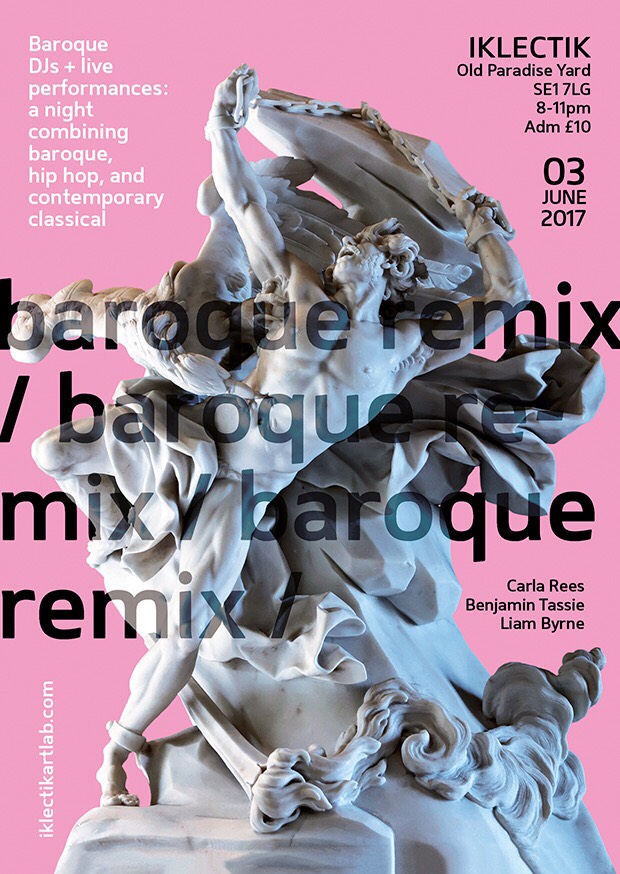
On June 3rd IKLECTIK’s performance space, bar and garden will exist between two worlds: that of the baroque dance parties of the 17th and 18th centuries, and the musical world of 21st-century London. The sound of the baroque flute and bass viol, the music of Byrd or Bach, will mix with music from across the centuries for Baroque Remix, the first full-scale incarnation of this new classical club night. Baroque DJs will ‘live remix’ baroque music, sampling Lauryn Hill or 2Pac alongside Pergolesi or Purcell. Combining the best of baroque, hip hop, R&B, and contemporary classical music, Baroque remix will reimagine baroque music with drum loops or through the synth-bach arrangements of Wendy Carlos (‘A Clockwork Orange’ soundtrack).

The evening will feature live sets from period instrumentalists Carla Rees (baroque flute) and Liam Byrne (viola da gamba) playing a mixture of old music and new, showcasing the diversity of these historic instruments. World class performances will present baroque music alongside pop arrangements and works by contemporary classical composers, in a series of small sets throughout the night that reframe these instruments for today’s new-music scene.

Previously performed at nights for the V&A (part of a museum late, opening the new Europe 1600-1815 galleries) and Royal Palaces (for ‘Queen James’, part of #PalacePride at Banqueting House), Baroque Remix on June 3rd will be the first full-scale club night, with IKLECTIK’s bar and garden the perfect informal setting for a night of unique and innovative music making.

Venue Details

IKLECTIK

Old Paradise Yard, SE1 7LG

www.iklectikartlab.com

Nearest Tube: Lambeth North / Westminster

Date and Time

03.06.2017 – 8-11pm

Tickets £10

Book tickets

IMG_4218

dsc9240
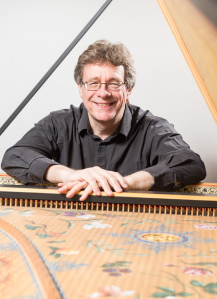
John Irving, fortepianist

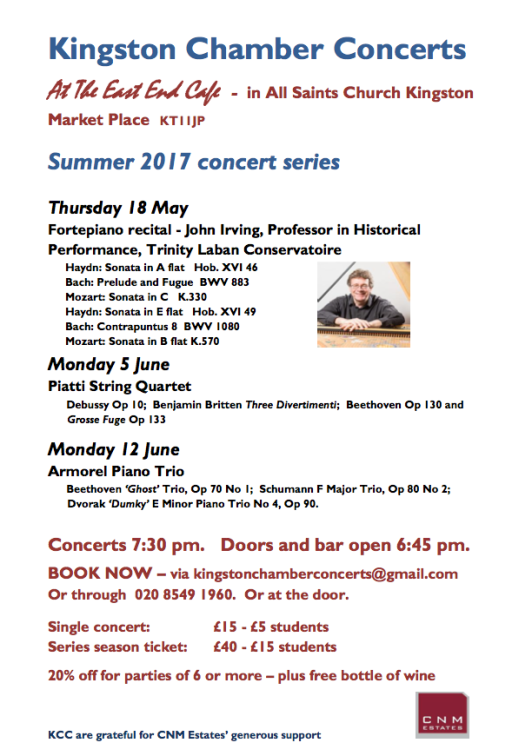
A new chamber music series launches in Kingston-upon-Thames on Thursday 18 May at All Saints Church, Kingston Marketplace.

The opening concert features keyboard music by Haydn, Bach and Mozart performed on a replica fortepiano very like the type of instrument Haydn and Mozart would have known and played. The concert is given by John Irving, Professor of Historical Performance at Trinity-Laban Conservatoire in Greenwich.

Future concerts in the series include the Piatti String Quartet in music by Debussy, Britten and Beethoven, and the Armorel Piano Trio, who will perform Beethoven’s ‘Ghost’ Trio together with works by Schumann and Dvorak.

The concerts will have a relaxed format, with audience seated salon style around small tables to create a convivial atmosphere and as a reminder that chamber music was written to be enjoyed in this way.

Tickets cost £15 (students £5) for a single concert or £40 for the whole series.

Further information and booking via kingstonchamberconcerts@gmail.com / tel. 020 8549 1960

Venue: All Saints Church, Kingston Marketplace, Kingston-upon-Thames KT1 1JP

Who or what inspired you to take up the horn and pursue a career in music?

I started to play the cello at five years old as both my parents were professional string players and it seemed like the right thing to do. When I was six years old, I was diagnosed with the lung condition Bronchiectasis and this led to the decision that maybe taking up a brass instrument (with the added element of deep breathing!) would be a great way to strengthen my lungs. From there it was a case of playing in various orchestras, ensembles and listening to famous horn players which made me realise that pursuing a career in music was definitely the way forward for me.

Who or what have been the most important influences on your musical life and career?

My teacher at the Royal College of Music Junior Department, Sue Dent, was absolutely incredible for me in terms of developing as a musician both with and without the instrument. I studied with her for almost eight years before my idol, Radek Baborak, of whom I had listened to almost every recording and watched every YouTube video of, invited me to study with him in Berlin at the Barenboim-Said Academy. Aside from horn players, I was always very interested in the artistry of Rostropovich and listening to recordings made at a time before it was possible to edit them to perfection. This raw energy is something I really admire.

What have been the greatest challenges of your career so far?

I think an on-going challenge and a challenge I will have for the rest of my career is to convince first the management and organisational side to music, then the wonderful audiences that the horn should be held in high regard as a solo instrument!

Which performance/recordings are you most proud of?

Performing in the Brass Category Final of the BBC Young Musician Competition for me was the single most enjoyable musical experience of my life. I had dreamt about being on that stage for years and had really prepared every single note of my programme as well as physically possible. To be rewarded with such an incredible response from both the live audience and then the people watching at home was just amazing.

Which particular works do you think you play best?

I think when it comes to very technically difficult and abstract contemporary music, I really enjoy taking the time to figure out the puzzle and think that it is an area of music where I feel most at ease performing.

How do you make your repertoire choices from season to season?

As a young soloist, I tend to accept any invitation I get to play and more often than not, promoters already have a piece or programme in mind. Now and then it is possible to make requests and here I try and add concertos that people very rarely play and are most likely unknown to the audience.

Do you have a favourite concert venue to perform in and why?

I recently played in the KKL Concert Hall in Lucerne, Switzerland and before even stepping foot inside the unbelievable hall, had fallen in love with the town.

Favourite pieces to perform? Listen to?

One of my favourite pieces to perform is the Franz Strauss Nocturne for Horn and Piano. It is really quite cheesy but so satisfying to play and allows you to really express yourself to the audience. To listen to…will always be the Goldberg Variations by J.S Bach.

Who are your favourite musicians?

I have many favourite musicians both dead and alive! I think my teacher, Radek Baborak, is quite an extraordinary musician as is Daniel Barenboim and I am also fascinated by the wonderful percussionist Martin Grubinger.

What is your most memorable concert experience?

My debut at the Royal Albert Hall with the English Festival Orchestra was by far, for me, the most special concert I have ever been involved with. To walk out to a completely sold out RAH, with sound coming from all sides was just incredible. And then to see the audience’s faces light up with the Rondo of the third movement from Mozart’s 4th Horn Concerto was really special.

What do you consider to be the most important ideas and concepts to impart to aspiring musicians?

I think that something that is quite seriously overlooked in aspiring musicians and certainly something I overlooked is the simple fact that people should be in music and study music to enjoy it. The profession is too difficult anyway so at least enjoy making the music!

Where would you like to be in 10 years’ time?

Easier said than done but I would love to be in a position where I was performing concertos with orchestras all over the world!


Nominated by the Barbican as an ECHO Rising Star, during the 2021/22 season Ben gives recitals at major concert halls including the Concertgebouw, Musikverein, Elbphilharmonie and Köln Philharmonie, including an especially commissioned new work by Mark Simpson. 

Read more