
Who or what inspired you to take up the piano and pursue a career in music?
I suppose it was initially the fact that my father’s enjoyed playing a little jazz piano as a hobby, and as a toddler I couldn’t resist hitting the keys, rather too often for my Grandmother’s liking. It was this that meant I started having formal piano lessons, and it has grown from there. It was, however a long time until I thought that I might be able to play professionally. I think in the end it comes down to the fact that I love music and having the opportunity to share it, and there came a point where I just couldn’t conceive of doing anything else.
Who or what were the most important influences on your musical life and career?
I have benefited very early on in my life from wonderfully committed teachers who cared about my personal development as well as my musical one. They gave me a through technical grounding, but they also showed me that technique is about freeing yourself to be able to communicate musically.
What have been the greatest challenges of your career so far?
I think for any young pianist currently it is quite tough, there are so many exceptional musicians that it’s hard not to wonder sometimes whether you have something distinctive to bring. And balance is always something that’s hard to achieve – especially when navigating your early career. I hugely enjoy teaching and working with young musicians, and being able to share with them, but also take part in competitions, as well as performing. I have in the past struggled a great deal with nerves and perhaps for me that will be a lifetime process, but it is something that I have very actively worked on in the past few years, and am gradually overcoming.
Which performance/recordings are you most proud of?
I think the performances I am most proud of aren’t necessarily the ones in the most prestigious venues, but the ones where I feel a real connection with the audience. That can happen not just in a big concert hall, but sometimes when you play to children or people who don’t often attend classical music concerts, they aren’t constrained by learned behaviour. They experience music in a very immediate way. In terms of recordings, I have just been in the studio, recording my first CD project, in partnership with Kawai and German label Acousence, of pieces which are linked to folk music and the Danube – it was wonderful to have the opportunity to make the recording, and I am so excited for it to be released later in the year.
Which particular works do you think you play best?
It’s really hard to choose a favourite, when so much depends on the occasion, the audience and the mood. I feel a particular affinity with Mozart: the phrases are so natural, and I think as far as one can argue that classical music is somehow universal, then Mozart is the embodiment of this. But I also love the richness of the great Romantic repertoire, the sheer inventiveness of Prokofiev, and of course nearly all pianists want to explore the depths of Beethoven’s piano writing.
How do you make your repertoire choices from season to season?
I’m not yet in a position where I make all the choices! Often I get offered a concert with particular repertoire in mind, so that’s always an excellent justification for broadening my repertoire. Otherwise I try to create interesting programmes which have overarching themes, or celebrate a particular composer, and I try to balance familiar repertoire with other pieces which may be fresh to the audience.
Do you have a favourite concert venue to perform in and why?
As a pianist I am always going to be thrilled if a venue has a great piano, as pianists have to try and adapt themselves to the temperament and qualities of the piano they find, rather than being able to bring a familiar instrument with them. But I don’t think it’s the building that makes a concert. It’s the audience, so it doesn’t matter if it’s an ornate concert hall, although they are obviously wonderful, or a more alternative and intimate setting. I’ve never played outdoors as an adult, so that’s one I hope to try one day!
Favourite pieces to perform? Listen to?
It’s so hard to choose but the Mozart concertos, some Liszt and Prokofiev would have to be included. I also enjoy listening to music I can’t play myself: Opera, symphonic repertoire and jazz being my favourites.
Who are your favourite musicians?
I believe there’s a wealth of inspiration to be found in the recordings of the old piano masters. I am personally most drawn to Gilels and Lipatti. The sincerity and depth of their performances is rarely matched. Also, we are very blessed to be able to experience live the performances of legendary musicians such as Argerich, Lupu and Barenboim. Away from the world of piano, my favourite musician is probably soprano Cecilia Bartoli. She sings so beautifully, and I find her art inspirational for my piano playing.
What is your most memorable concert experience?
I was a small boy when Gerhard Oppitz came to give a recital in Bucharest. I remember it was all sold out, but I managed to squeeze in the auditorium thanks to the kind ticket lady who let me in. I sat on the fire-escape stairs, but I will never forget the impact his rendition of the Beethoven Diabelli Variations had on me. It was music-making beyond any rational understanding.
What do you consider to be the most important ideas and concepts to impart to aspiring musicians?
I think that hard work and dedication can never be underestimated. But if you keep practicing and listening and being open to ideas you will always improve. Music is an art not a science, and so people will always have different ideas of what things should sound like, but this doesn’t have to be reductive. You have to be led by a desire to communicate, so educate yourself as broadly as you can, read literature, go to the theatre, as well as practise.
What is your idea of perfect happiness?
Being on a remote island, with my wife and dogs, an amazing picnic, some wonderful recordings – and a boat to go back to the mainland on at the end of the day.
Born in Bucharest, Romania, Florian Mitrea’s early passion for the piano led him to a scholarship to study at the Royal Academy of Music in London.
In 2016 Florian was joint winner of the Verona International Piano Competition and was awarded second prize in the major biennial James Mottram International Piano Competition at the Royal Northern College of Music in Manchester, UK. This followed success in 2015 when he was a finalist (fourth prize and chamber music award) at the Hamamatsu Piano Competition and earlier was awarded second prizes at both the Santa Cecilia Competition in Porto, and the Premio Città di Imola at the Imola Academy. In 2014 Florian won third prize and the Classical Concerto Prize at the ARD International Competition in Munich, and first prize at Lagny-sur-Marne. Previous prizes include first prizes at the Panmusica 2010 Vienna International Piano Competition, the Beethoven 2010, and Sheepdrove 2011 Intercollegiate Competitions in the United Kingdom. Earlier prizes include several first prizes in the Romanian Music Olympics and the Ada Ulubeanu Piano Competition, and third prize in the Jeunesses Musicales International Competition.
Florian has performed recitals and concertos across Romania, and in Austria, France, the Netherlands, Poland, Portugal, Germany, Switzerland, Japan, South Korea and the USA. In the UK Florian has performed at venues including St John’s Smith Square, King’s Place, St. Martin-in-the Fields, St. James’ Piccadilly, Steinway Hall, Draper’s Hall, Colston Hall in Bristol, Dartington Hall and Bath Abbey.
Florian’s piano studies started in Bucharest as a student of Flavia Moldovan and Gabriela Enăşescu, ultimately at George Enescu Music High School. While studying at RAM with Diana Ketler he obtained his BMus with First Class Honours and the Regency Award for notable achievement. In the summer of 2014, he obtained his Master of Arts degree with Distinction and a DipRAM for his final recital, and received the Alumni Development Award for distinguished studentship. He held the Hodgson Memorial post-studentship Fellowship at RAM in 2014-2015 and continues to teach there within the piano department. Florian is currently studying with Boris Petrushansky at the Accademia Pianistica Internazionale “Incontri col Maestro” in Imola, Italy.

 A Pianist’s Alphabet has lain rather fallow for the past few months but it’s back again now to ponder the eternal question of Why? (Do we do it?). When this Alphabet is complete, it is my intention to continue the series, returning to the letter A. If you would like to contribute to A Pianist’s Alphabet, please
 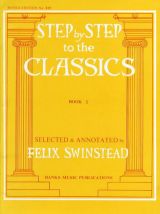 As children, I suspect many of us didn’t really question “Why?”. Perhaps we were simply pushed, gently or otherwise, by parents. As I recall (and I was only about 5), I was encouraged to learn the piano. I liked the instrument – my grandfather played the piano and I used to enjoy sitting next to him as he played, as well as rummaging through the piano stool, which contained old Methodist hymn sheets, music hall songs and albums like ‘Hours With the Masters’ and ‘Step by Step to the Classics’ by Felix Swinstead. As I grew up, I developed a very strong attachment to the piano: as an only child it provided a place where I could escape and create my own fantasies and stories, losing myself in music and my imagination for hours at a time. In addition, I was a dedicated student, who practised regularly and carefully and who progressed through the grade exams with relative ease. Now, as an adult who has returned to the piano after a long absence (some 20 years), it is my life and I would be bereft without it.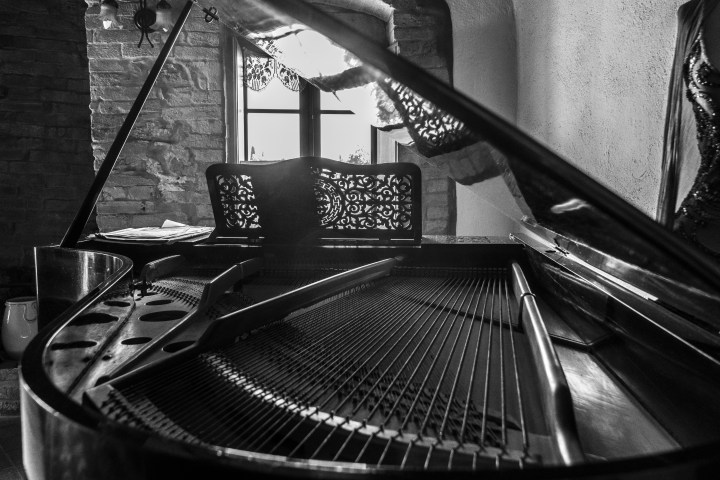




 The Cross-Eyed Pianist