
Meet the Artist……Francesco Tristiano, pianist

Who or what inspired you to take up the piano and pursue a career in music?
There has always been a piano at my house, perhaps a strategic move by my mother. Soon I found myself curious about which sounds I could trigger out of the instrument. Then I realized the piano is itself a world.
Who or what have been the most important influences on your musical life and career?
Growing up I found the most inspiration in three musicians of the twentieth century: Paco de Lucia, Ryuichi Sakamoto, and Joe Zawinul. And the discovery of Johann Sebastian Bach’s Goldberg Variations.
What have been the greatest challenges of your career so far?
Not to repeat myself, not to fall into a routine.
Which performance/recordings are you most proud of?
Pride is not a feeling I measure I measure my achievements with. Perhaps my album ‘Idioynkrasia’ (inFine, 2011) is my most personal, and ‘Piano Circle Songs’ (Sony, 2017) the most challenging.
Which particular works do you think you play best?
When I was 5 years old, I said to my piano teacher: “I only want to play the music of Bach, and my own music” She thought I was a cute little boy, and taught me how to play the piano.
How do you make your repertoire choices from season to season?
The complete works for keyboard of J S Bach is a project for a lifetime, not necessarily a season.
Do you have a favourite concert venue to perform in and why?
I like a variety of venues, and also alternating them. There are some fantastic concert halls in Japan for instance, really pristine acoustics. D-Edge, a club in Sao Paulo, Brazil, has a great sound system and vibe.
What is your most memorable concert experience?
Probably a show at Jeita Grotto in Lebanon. Stalactites and stalagmites, plus a 7-second reverb.
As a musician, what is your definition of success?
To be in line with what you do artistically. (Whether this works out commercially speaking is another question)
What do you consider to be the most important ideas and concepts to impart to aspiring musicians?
Wake up, listen up, be yourself.
What is your present state of mind?
Aspiring serenity.
Francesco Tristiano’s ‘Piano Circle Songs’ is released on the Sony label. Francesco performs music from his new album, with Canadian pianist and songwriter Chilly Gonzales with whom the project was developed, at the Southbank Centre on 20 September 2017 – details here
Francesco Tristiano’s biography
Artist photo by Marie Staggat
Revelatory late Schubert from Krystian Zimerman
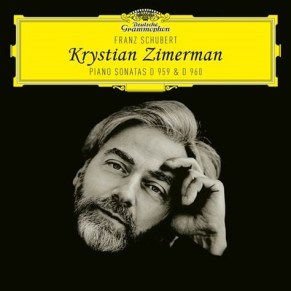
I missed Krystian Zimerman’s London concert last April when he stood in for the indisposed Mitsuko Uchida and gave what was by all accounts a remarkable performance of Schubert’s last two sonatas, works written in the dying embers of the young composer’s life yet imbued with nostalgia, warmth, an intoxicating bitter-sweetness and, ultimately, hope.
It’s rare for Zimerman to come to London; even rarer for him to release a new disc. He feels that high-quality digital recordings have created a homogeneous sound and style, robbing art music of spontaneity and leading audiences to expect perfection on disc and in concert (something I largely concur with, based on my regular concert-going). Thus, he’s very particular about what and when he records. This is his first recording of Schubert’s last two sonatas and his first solo album for a quarter of a century – and my goodness it was worth the wait! The recording was made in Japan using a Steinway with Zimerman’s own keyboard (which, incidentally, he made himself) inserted into the instrument (like the great pianists of the past, such as his mentor Arthur Rubinstein, he travels on the condition that his own instruments and/or separate, particularly-voiced keyboards accompany him, to suit the repertoire he is performing). The result is impressive, the bespoke action producing a sweetly singing tone and wonderful clarity. In the liner notes (which take the form of an interview) Zimerman explains that the special piano action “is designed to create qualities Schubert would have known in his instruments. Compared to a modern grand piano, the hammer strikes a different point of the string, enhancing the ability to sustain a singing sound…..”
But of course it’s not just the bespoke action which makes Zimerman’s sound so special. No, there is more, much more to this performance. Overall, there is an immaculate sense of pacing, so sensitive and natural; the first movement of the final sonata, for example, unfolds like a great river plotting its final course, the hymn-like first subject theme imbued with joyful purpose which gives the music forward propulsion without ever sounding hurried (it’s a leisurely mässig). In the first movement of the D959, the grandeur of the opening sentence gives way to the wistfulness and intimacy of an impromptu – and immediately Zimerman’s sense of phrasing is revelatory, shedding light on details hitherto skimmed over by others and demonstrating a complete understanding of Schubert’s architecture and narrative, both within movements and the works as a whole.
Throughout, there is subtle rubato in his contouring of phrases, thoughtful use of agogic accents to highlight intervallic relationships or strikingly piquant harmonies (so much a feature of Schubert’s late music), a Mozartian clarity in the passage work and repeated chords (for example in the development sections of both first movements) and an understanding of Schubert’s very specific rests and fermatas – attention to tiny details which create remarkable breathing spaces and enhance the structural expansiveness and improvisatory character and modernity of this music. Restrained use of the sustain pedal creates transparent textures, most notably in the slow movements: the Andantino of the D959, too often the subject of musical “psychobabble” and emotional wallowing, has a desolate gracefulness in its outer sections which contrast perfectly with the hysteria of the central “storm”. When they come, the Scherzi (both marked Allegro vivace) are light and ebullient, though Zimerman is always aware that Schubert is often more tragic when writing in the major key. In sum, every bar is carefully considered and insightful, yet at no point does this music sound fussy, overly precious or reverential. This is some of the most natural Schubert playing I have encountered and it suggests an artist with a long association with and deep affection for this music
As regular readers of this blog will know, I have spent the last three years studying and learning Schubert’s penultimate piano sonata, D959. It has become something of an obsession for me, initially forming the bulk of my programme for a Fellowship Performance Diploma and now a piece of music I simply can’t let go of. I have heard many recordings of the sonata from Schnabel and Cherkassy to Andsnes, Leonskaja and Barnatan, in addition to five live performances (including by Piers Lane, Andras Schiff, Richard Goode and mostly recently Paul Berkowitz). When one spends so much time with a single piece of music, one can grow fussy, pedantically so, about how this music is presented in concert and/or on disc – so much so that I have stopped seeking out the work in concert because I listen far too attentively and critically for my own good…..and talking of “Goode”, the one and only live performance I really enjoyed, the one which left me with the feeling that this was how Schubert would have wanted his music performed, was by the American pianist Richard Goode at the Royal Festival Hall in May 2016 (of which more here). In Krystian Zimerman I have found my new benchmark, not just for the D959 but as a demonstration of how Schubert’s piano music should be played.
Very highly recommended
Such is the spell of your emotional world that it very nearly blinds us to the greatness of your craftsmanship
– Franz Liszt on Franz Schubert
Franz Schubert/Krystian Zimerman/Piano Sonatas D 959 and D 960
Deutsche Grammophon
00028947975885
Music Marathon at St John’s Smith Square
A free 12-hour MUSIC MARATHON at St John’s Smith Square for Open House London Weekend
At 10am on Saturday 16 September, St John’s Smith Square opens its doors for Open House London Weekend 2017, inviting visitors to experience the stunning Baroque architecture while listening to and participating in musical activities.
There will be 12 hours of non-stop performance, open rehearsal and workshops from 10am on Saturday 16 September until 10pm that evening. All events are free of charge and people are encouraged to drop in at anytime to hear what’s happening. The schedule for the Music Marathon can be found on the St John’s Smith Square website at https://www.sjss.org.uk/events/open-house-2017-music-marathon
This year’s Music Marathon once again has a fantastic selection of pianists throughout the day. Blüthner artist Yuki Negishi performs works by Chopin, Liszt, and Nikolai Kapustin and we welcome back The Cross-Eyed Pianist’s own Frances Wilson with a programme of Britten and Schubert (from 5.15pm). Praised for “exceptional musicianship, poise and supreme confidence” at the Blackheath International Piano Festival, Harriet Stubbs features with Leo Nicholson to perform the first movement of Rachmaninoff’s Piano Concerto No. 3 on our two grand pianos. Késia Decoté returns this year with her programme of piano works by contemporary female composers (including works for toy piano) and Niamh Beddy continues her collaboration with dancer and choreographer Alice Weber to perform Carl Vine’s Piano Sonata No. 1 and a world premiere from Stevon Russell.
Soloists take the stage in the form of young award-winner Emmanuel Sowicz performing classical guitar arrangements of Bach and Scarlatti alongside Castelnuovo-Tedesco’s Sonata ‘Omaggio a Boccherini’ Op. 77. International percussionist Beibei Wang brings us Bach’s Cello Suite No. 1 on the marimba coupled with a work by kiwi composer John Psathas combining percussion with electronics, and a world premiere of one of Beibei’s own compositions. Having graduated from both the Royal College of Music and the Guildhall School of Music and Drama, violist Katherine Clarke brings her passion for contemporary music to St John’s Smith Square with works by Garth Knox and Paul Patterson.
The Wall of Sound Singing Ensemble make a welcome return to St John’s Smith Square with their uniquely-styled traditional folk arrangements. We’re also delighted to have back our London International A Cappella Choral Competition 2017 competitors, Iken Scholars, with a programme of Lobo, Scarlatti, and Lotti.
There is a variety of ensembles participating, from the Eos Trio opening the marathon with Stravinsky, CPE Bach, and Khachaturian, to baroque trio Musicke in the Ayre exploring the repertoire of 16th and 17th century art song from across Europe, accompanied by lute and bass viol. The marathon closes with a very special performance from experimental music collective Echoshed of their new piece Dialogues, written especially for the Music Marathon utilising the different spaces around St John’s Smith Square.
This year will also feature short talks on the history and architecture of St John’s Smith Square from Artistic Director, Richard Heason.
Richard Heason, Director of St John’s Smith Square said:
“One again we celebrate Open House Weekend with a 12 hour marathon of continual music making at St John’s Smith Square. There’s a huge range of music on offer, with both new and old, familiar and fresh. St John’s will resound to the sound of choirs, orchestras, solo instrumentalists and electronic music and all of it is available to listen to free of charge in this magnificent Grade 1 listed concert hall. Come and join us as we embark on our marathon of music making.”
#SJSSMarathon
Full details of the Marathon: https://www.sjss.org.uk/events/open-house-2017-music-marathon




 The Cross-Eyed Pianist