Guest post by Alison Mathews

During my career in music, I have always tried to find ways to balance the inevitably large amounts of time spent working alone – whether that be practicing, writing, preparing lessons or as now, composing works aimed at the intermediate pianist. Collaboration has always felt like the key to a healthy working life! At college, that meant a large amount of accompaniment and duet work. In private teaching, I developed and ran workshops with a like-minded colleague. As the focus of my career shifted to composing I naturally looked for ways to continue collaborating. This was not so easy to achieve!

True collaboration means inviting another individual into your creative process, which of course, requires trust and mutual respect. You need to have a shared vision that allows room for the expression of personal ideas. This of course, is true in many forms of musical collaboration, but in composition, where you essentially begin with nothing but an idea, perhaps something fairly abstract, it takes a special form of relationship for a partnership to be able to grow and flourish.

I was very lucky to make contact with the composer Barbara Arens through Facebook about two years ago. Over a few months we developed a friendship, which quite quickly became a working partnership. We discovered early on that we had many things in common, both musical and non- musical! Significantly, despite our differences in compositional style, we have a similar aim in composing, linked to our long experience as teachers. We both know that in setting a goal for a pupil, the imagination needs to be engaged through the music learnt. Progress through meeting technical challenges is important but above all it must be achievable – it cannot be out of reach. Engagement provides motivation and allows for expression, success leads to progress and development. To this end, we both aim to write music that is appealing, that uses the wide tonal range of the piano and encourages expressive playing. We take care to write as pianistically as possible, using shapes that fit well under the hand with potential technical challenges carefully placed. For example, my pieces may use wider stretches or leaps and Barbara’s may use cross rhythms.

So how does this partnership work in a practical way? Barbara lives in Germany and I live in the UK so we rely heavily on email and messenger, along with the regular sending of pdfs and mp3s. The free exchange of ideas early on in a project can spark creativity, which is especially motivating when perhaps one of us needs a push or a little inspiration! Very happily, similar things, for example art, history or literature, often inspire us, which will lead to time spent researching. This is an important part of the process as I know we both feel that no matter what level we are writing for or what the subject matter or theme is, background knowledge lends authenticity to the finished project.

When it comes to the actual process of composition we tend to send each other “work in progress” or pieces in various stages of completion. This is the point at which we invite each other into our individual process of creativity. This is where trust and respect is vital. We both value honest feedback and suggestions to improve the work shared. We both have a similar view on criticism – it can be healthy and constructive when balanced with a dose of encouragement or praise! Accepting that the joint goal is more important than the individual is so important. There has to be give and take and very often compromise! After some misgivings, I ended up rethinking the keys of several pieces to ensure they balanced with Barbara’s – a good decision. We would both be prepared to rewrite or discard work if ultimately it didn’t fit well within a book.

This summer, we did get the chance to work together at the same piano. I spent time with Barbara at her home, where we were able to explore new ideas for future projects. As we both compose at the piano and develop ideas through playing and listening, we naturally spent some time “noodling” as well as discussing and bouncing ideas between us. This was a particularly enriching experience. Not only in terms of working on specific ideas, but just the chance to play other music together and develop our friendship.

There is only one occasion so far when we have both independently wrote a piece at the same time, on the same subject matter without the other knowing! Not so much of a coincidence perhaps, when you consider the project was an exploration of the joys of winter, but interesting as the outcome differed so much. We both wrote a piece of music inspired by frost. For Barbara, this was after an early frosty morning walk. For me it was seeing the wonderful patterns created by frost on a windowpane. We both used similar compositional techniques such as ostinato patterns and syncopated rhythms as well as a similar tonal range with the higher register of the piano and yet each piece is individual in style. Barbara makes use of rhythmic devices such different groupings in each hand, which propels the music forward as well as giving a light, fresh, extrovert feel. Although mine also begins with an ostinato-like pattern in the left hand, it relies much more on harmonic shifts to provide colour and is more thoughtful and introverted.

These differences are another important feature of a good collaboration. Although we do consider aspects of our composing jointly, such as the keys we use, difficulty levels and the style or character of a piece, we are well aware our differences create variety within a similar genre of writing. Pieces which are complimentary but distinctly our own work best. There are plenty of differences between the way we work – Barbara much more quickly and usually late at night. I’m the opposite! Early morning can be a productive time for me and I find Barbara’s meticulous approach, especially to detail in scores, keeps me on my toes!

With any form of collaboration, if you are open and generous in your approach then it can be an excellent learning experience and a real opportunity to improve and develop. We began with a book of arrangements of ancient Christmas carols, transformed into contemporary, lyrical solos. Our second book mixed arrangements with original works and the following projects (one just complete, one planned) will be only original compositions.

As I said in my opening, collaboration provides a healthy balance to my work. I enjoy my solo projects and continue to work on more personal ideas but have found that working in partnership has increased my confidence, sharpened my critical ear and given me a far more objective and questioning approach to my own compositions. No matter what area of music you may be working in, collaboration and if you’re lucky, the development of a longer working partnership can be very rewarding and lead to personal development.


dscf5710_1Alison Mathews is a classically trained pianist and composer living and working in Surrey, UK. A graduate of the Royal College of Music, London, she holds both a Teaching Diploma and an Honours degree. Alison went on to complete a Masters degree at Surrey University, with the aesthetics of music at the heart of her studies. This led to a wider exploration of the links between art, myth and music with the award of a scholarship for a Doctorate at Surrey University. She was unable to complete this, as having a family intervened and a career in music education came to the forefront. Alison has been running a thriving private teaching practice for over 25 years along with workshops integrating art and music. Alison’s interest in composition grew out of a desire to provide students at all levels with imaginative music to play and the opportunity to explore the full range and sonority of the piano. Alison’s solo and collaborative works are published by Editions Musica Ferrum.

http://alisonmathewspiano.weebly.com/

The genius of George Gershwin in music and words

Viv McLean – piano

Susan Porrett – narrator

Thursday 21 December, 8pm

The vibrant music of George Gershwin is interwoven with his fascinating life story from birth in the colourful, teeming New York of 1898 to his tragically early death in 1937.

Featuring Viv McLean, international concert pianist and renowned Gershwin interpreter together with narrator, actress Susan Porrett,  this is an intriguing, eclectic mix of Gershwin’s music from the much-loved ‘Rhapsody in Blue’, ‘I got Rhythm Variations’ and ‘Swanee’ to the rarely-played, classical Preludes

Presented by 7 Star Arts in the iconic Jazz Room (known as “the suburban Ronnie Scott’s”) at The Bull’s Head pub overlooking the Thames in Barnes, SW London

Ticket £13 in advance, £16 on the door

BOOK TICKETS

“Vividly illustrated…..highly recommended.” 

“A terrific show!” 

“A glorious and intriguing celebration of Gershwin’s life and work” 


Guest post by Emma Williams

Finchcocks is a handsome manor house in the Kent countryside, which has been filled with music since its inception in the 18th century.

Until recently, it was home to a living museum of music – which I had visited as part of a private visit. We’d had a marvellous time being let loose on the collection, which included some fine harpsichords and clavichords, square pianos (including one which belonged to Queen Victoria, made by John Broadwood & Sons), fortepianos, and grand pianos by Clementi, Pleyel, Erard and Broadwood. It’s no surprise therefore that I was sad to hear the news that Finchcocks was on the market and its exceptional keyboard museum was to be closed.

But there’s great news: the wonderful musical tradition, established by Richard and Katrina Burnett back in 1971, will be continued at Finchcocks! The new owners have announced they will be hosting regular residential piano courses at Finchcocks, and guests will be accommodated in the stunning, recently renovated 18th Century Coach House.

The first weekend piano course was held in November, run by Finchocks’ Musical Director Dave Hall, who did an excellent job engaging and inspiring a group of advanced intermediate pianists. Finchcocks’ courses will also cater for complete beginners (a welcome addition to the piano course world, as most courses are aimed at advanced players), and there’s a fabulous range of pianos to play on by Steinway, Bosendorfer, Yamaha and Broadwood. In the cellar, there are eight high-tech digital grand pianos.

My lovely piano teacher, Graham Fitch, will also be leading a few piano courses at Finchcocks next year. For more information about courses, tutors and accommodation, please visit www.finchcocks.com

Emma Williams is a keen piano player and recently attended a Finchcocks Weekend Piano Course.


Further reading

Why go on a piano course?

Courses for pianists in the UK and Europe


217

Who or what inspired you to take up the piano and pursue a career in music?

Initially my grandmother who played, though not to a professional level, and taught me how to read music when I was about 5 years old. Also I think for a large part I have been motivated by my love of music and have always enjoyed the challenge that learning a new work brings. I remember as a teenager learning progressively more challenging pieces and there was a certain thrill in challenging myself. As I have got older it has been the desire to share the music that I love with as many people as possible, especially the music of Scriabin and less well-known composers. In addition, music is endlessly fascinating and you never really ‘master’ anything; each performance brings new challenges and the more you perform a work, the more you discover about it.

Who or what were the most important influences on your musical life and career?

I have been lucky enough to study with a number of fantastic teachers, including: John York, Charles Owen, Martin Roscoe and Ronan o’Hora, and have of course learnt a great deal from all of them. I have always been excited by discovering composers and works which are not so well known – from the age of around 19 I found myself being drawn away from what might be considered the ‘core’ repertoire. This curiosity has led me to the performance of a lot of contemporary music, which is an area I am still very interested in. Most importantly it led to my ongoing obsession with the music of Scriabin, and particularly Scriabin’s late music. My desire to understand this music, and to comprehend how it came about has really shaped my career in the past 5 years, leading to 2 recordings and the completion of my Doctorate (which was based on the performance of Scriabin’s Sonata no. 6).

What have been the greatest challenges of your career so far?

At times, simply keeping going. There are always periods where things are quiet, or perhaps teaching has momentarily taken over. During these times I have always tried to challenge myself with something new – this is partly why I decided to work towards a Doctorate, and partly what led me to crowdfund 2 recordings. The music profession is changing and you have to make your own opportunities, which can be tough at times, as well as daunting.

Which performance/recordings are you most proud of?

The two Scriabin discs I have recorded, which cover the complete ‘late’ piano music. Both records were organised by myself: everything from the crowdfunding, to the CD design. This is not easy music to record and the second disc (completed in January) was recorded in 18 hours over two days, which was very taxing, but completely exhilarating. The resulting recordings I have now heard and am quietly very proud of.

Which particular works do you think you perform best?

That’s difficult to say, but the works I enjoy performing best would certainly include the late music of Scriabin, Ravel and Debussy, Brahms and Schumann, as well as quite a lot of contemporary music – in particularly James Macmillan’s piano sonata and Thomas Adès’ ‘Traced Overhead’.

How do you make your repertoire choices from season to season?

It’s important to play to your strengths, as well as to perform only works that you enjoy playing (where possible). I like varied programmes, particularly as I often include quite a lot of more unusual repertoire, so it’s nice to break this up with something more familiar.

Do you have a favourite concert venue to perform in and why?

I love the new Milton Court hall [near the Barbican]; it has a wonderful acoustic. I have also been very lucky to be able to participate in the ‘En Blanc et Noir’ festival in the south of France for a number of years now. Their concert venue is open air, in the main square of a little village called Lagrasse, under the covered medieval market. Despite the odd gust of wind, this is a really magical setting, especially when the sun is setting.

Who are your favourite musicians?

I have become a very big fan of Stephen Hough’s playing, for me it encapsulates what I love about live performance; it is at once extremely exciting and passionate, and completely controlled. Having studied a lot of Scriabin, I have got to know the recordings of Norwegian pianist Hakon Austbo, and these have been a real inspiration to me throughout my preparation. I have been lucky enough to play to Hakon a couple of times and have always been struck by the reverence with which he treats the music, as well as his musical imagination. Finally I would have to add Martin Roscoe, who I studied with at Guildhall. He is one of the most exciting and versatile musicians I have ever met and I will never forget his performance of Beethoven’s Appassionata at Guildhall: it remains for me one of the most memorable concert experiences of all time.

What is your most memorable concert experience?

I have performed a couple of recitals of Scriabin by candlelight, which were both very special occasions. The first was in the monks’ dining room in an old monastery in France – it had a wonderful vaulted ceiling and was a perfect setting for the music. The second was in the Asylum chapel in Peckham, which was to launch my first Scriabin disc – it was extraordinarily cold, but no one seemed to care as the venue and music were so perfect together. It was this performance that convinced me that some works are simply better suited to certain locations – Scriabin in the concert hall works fine, but in the ruined chapel of the Asylum, it took on new dimensions.

What do you consider to be the most important ideas and concepts to impart to aspiring musicians?

The musical world changes and to survive you must be in touch with how this is happening. For instance Facebook is now arguably one of the most important methods of publicity, and artists must be able to engage with this form of promotion and communication. In addition, you have to make things happen for yourself, and cannot expect opportunities to be handed to you. This means being willing to put yourself on the line, as well as being forthcoming – not something I find easy. Constantly finding new and innovative ways of presenting yourself seems to be the way forward. I would also add that it is very important to know your strengths and play to them.

What is your present state of mind?

Determined.

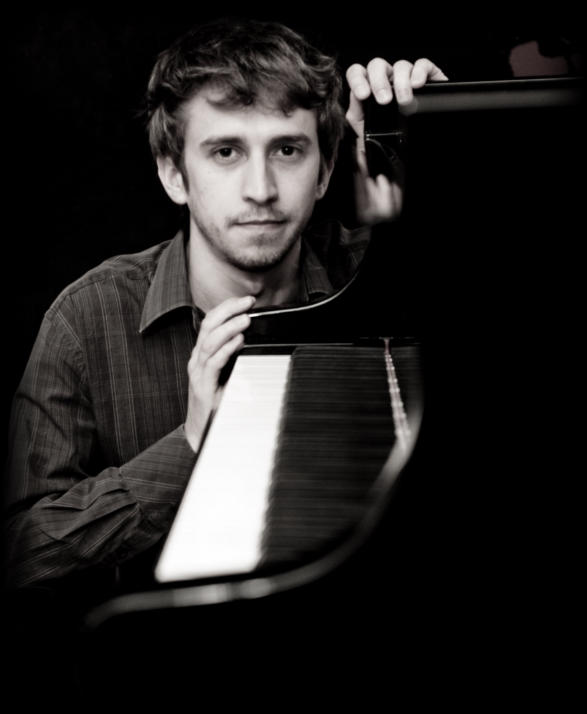
James Kreiling has performed in most of the major London concert halls, as well as throughout Europe. His interest in contemporary and new music has led to performances in the Royal Albert and Barbican Halls – most notably in the summer of 2007 he performed solo in the BBC Proms’ composer portrait of David Matthews. In 2008 James was selected as one of the Park Lane Group’s young artists and this resulted in a solo recital in 2009 at the Purcell Room to great critical acclaim, as well as recitals in St Martin in the Fields and in the Little Missenden Festival. In addition James has broadcast regularly for BBC radio 3, including performances of the music of Jonathan Harvey, David Matthews and Peter Eotvos. Together with his wife Janneke Brits, James is a member of the Brits-Kreiling piano duo. They have performed together regularly since 2009 and have been regulars at the En Blanc et Noir piano festival in Lagrasse, France. They have performed in many of the major venues in London, and broadcast for BBC radio. They are both teaching assistants at Music at Albignac, a summer course based in the south of France run by pianist and French music specialist Paul Roberts. One of James’ biggest passions is the music of Alexander Scriabin and he is currently working towards a performance-based research doctorate at the Guildhall school of music, which is focused on the analysis and performance of Scriabin’s late piano sonatas. He gives regular lecture-recitals on Scriabin’s piano music and as part of the celebrations for Scriabin’s centenary in 2015, he will be making his first commercial recording in June of this year, which will centre around Scriabin’s late piano music.