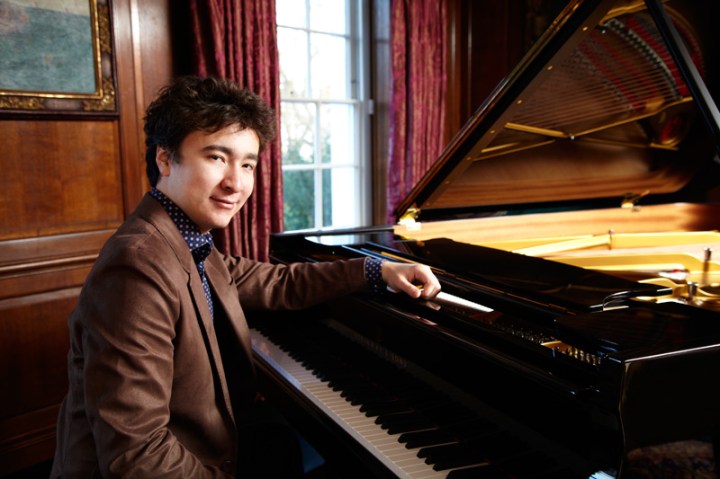
The genius of George Gershwin in music and words

Viv McLean – piano

Susan Porrett – narrator

Thursday 21 December, 8pm

The vibrant music of George Gershwin is interwoven with his fascinating life story from birth in the colourful, teeming New York of 1898 to his tragically early death in 1937.

Featuring Viv McLean, international concert pianist and renowned Gershwin interpreter together with narrator, actress Susan Porrett,  this is an intriguing, eclectic mix of Gershwin’s music from the much-loved ‘Rhapsody in Blue’, ‘I got Rhythm Variations’ and ‘Swanee’ to the rarely-played, classical Preludes

Presented by 7 Star Arts in the iconic Jazz Room (known as “the suburban Ronnie Scott’s”) at The Bull’s Head pub overlooking the Thames in Barnes, SW London

Ticket £13 in advance, £16 on the door

BOOK TICKETS

“Vividly illustrated…..highly recommended.” 

“A terrific show!” 

“A glorious and intriguing celebration of Gershwin’s life and work” 


Guest post by Emma Williams

Finchcocks is a handsome manor house in the Kent countryside, which has been filled with music since its inception in the 18th century.

Until recently, it was home to a living museum of music – which I had visited as part of a private visit. We’d had a marvellous time being let loose on the collection, which included some fine harpsichords and clavichords, square pianos (including one which belonged to Queen Victoria, made by John Broadwood & Sons), fortepianos, and grand pianos by Clementi, Pleyel, Erard and Broadwood. It’s no surprise therefore that I was sad to hear the news that Finchcocks was on the market and its exceptional keyboard museum was to be closed.

But there’s great news: the wonderful musical tradition, established by Richard and Katrina Burnett back in 1971, will be continued at Finchcocks! The new owners have announced they will be hosting regular residential piano courses at Finchcocks, and guests will be accommodated in the stunning, recently renovated 18th Century Coach House.

The first weekend piano course was held in November, run by Finchocks’ Musical Director Dave Hall, who did an excellent job engaging and inspiring a group of advanced intermediate pianists. Finchcocks’ courses will also cater for complete beginners (a welcome addition to the piano course world, as most courses are aimed at advanced players), and there’s a fabulous range of pianos to play on by Steinway, Bosendorfer, Yamaha and Broadwood. In the cellar, there are eight high-tech digital grand pianos.

My lovely piano teacher, Graham Fitch, will also be leading a few piano courses at Finchcocks next year. For more information about courses, tutors and accommodation, please visit www.finchcocks.com

Emma Williams is a keen piano player and recently attended a Finchcocks Weekend Piano Course.


Further reading

Why go on a piano course?

Courses for pianists in the UK and Europe


217

Who or what inspired you to take up the piano and pursue a career in music?

Initially my grandmother who played, though not to a professional level, and taught me how to read music when I was about 5 years old. Also I think for a large part I have been motivated by my love of music and have always enjoyed the challenge that learning a new work brings. I remember as a teenager learning progressively more challenging pieces and there was a certain thrill in challenging myself. As I have got older it has been the desire to share the music that I love with as many people as possible, especially the music of Scriabin and less well-known composers. In addition, music is endlessly fascinating and you never really ‘master’ anything; each performance brings new challenges and the more you perform a work, the more you discover about it.

Who or what were the most important influences on your musical life and career?

I have been lucky enough to study with a number of fantastic teachers, including: John York, Charles Owen, Martin Roscoe and Ronan o’Hora, and have of course learnt a great deal from all of them. I have always been excited by discovering composers and works which are not so well known – from the age of around 19 I found myself being drawn away from what might be considered the ‘core’ repertoire. This curiosity has led me to the performance of a lot of contemporary music, which is an area I am still very interested in. Most importantly it led to my ongoing obsession with the music of Scriabin, and particularly Scriabin’s late music. My desire to understand this music, and to comprehend how it came about has really shaped my career in the past 5 years, leading to 2 recordings and the completion of my Doctorate (which was based on the performance of Scriabin’s Sonata no. 6).

What have been the greatest challenges of your career so far?

At times, simply keeping going. There are always periods where things are quiet, or perhaps teaching has momentarily taken over. During these times I have always tried to challenge myself with something new – this is partly why I decided to work towards a Doctorate, and partly what led me to crowdfund 2 recordings. The music profession is changing and you have to make your own opportunities, which can be tough at times, as well as daunting.

Which performance/recordings are you most proud of?

The two Scriabin discs I have recorded, which cover the complete ‘late’ piano music. Both records were organised by myself: everything from the crowdfunding, to the CD design. This is not easy music to record and the second disc (completed in January) was recorded in 18 hours over two days, which was very taxing, but completely exhilarating. The resulting recordings I have now heard and am quietly very proud of.

Which particular works do you think you perform best?

That’s difficult to say, but the works I enjoy performing best would certainly include the late music of Scriabin, Ravel and Debussy, Brahms and Schumann, as well as quite a lot of contemporary music – in particularly James Macmillan’s piano sonata and Thomas Adès’ ‘Traced Overhead’.

How do you make your repertoire choices from season to season?

It’s important to play to your strengths, as well as to perform only works that you enjoy playing (where possible). I like varied programmes, particularly as I often include quite a lot of more unusual repertoire, so it’s nice to break this up with something more familiar.

Do you have a favourite concert venue to perform in and why?

I love the new Milton Court hall [near the Barbican]; it has a wonderful acoustic. I have also been very lucky to be able to participate in the ‘En Blanc et Noir’ festival in the south of France for a number of years now. Their concert venue is open air, in the main square of a little village called Lagrasse, under the covered medieval market. Despite the odd gust of wind, this is a really magical setting, especially when the sun is setting.

Who are your favourite musicians?

I have become a very big fan of Stephen Hough’s playing, for me it encapsulates what I love about live performance; it is at once extremely exciting and passionate, and completely controlled. Having studied a lot of Scriabin, I have got to know the recordings of Norwegian pianist Hakon Austbo, and these have been a real inspiration to me throughout my preparation. I have been lucky enough to play to Hakon a couple of times and have always been struck by the reverence with which he treats the music, as well as his musical imagination. Finally I would have to add Martin Roscoe, who I studied with at Guildhall. He is one of the most exciting and versatile musicians I have ever met and I will never forget his performance of Beethoven’s Appassionata at Guildhall: it remains for me one of the most memorable concert experiences of all time.

What is your most memorable concert experience?

I have performed a couple of recitals of Scriabin by candlelight, which were both very special occasions. The first was in the monks’ dining room in an old monastery in France – it had a wonderful vaulted ceiling and was a perfect setting for the music. The second was in the Asylum chapel in Peckham, which was to launch my first Scriabin disc – it was extraordinarily cold, but no one seemed to care as the venue and music were so perfect together. It was this performance that convinced me that some works are simply better suited to certain locations – Scriabin in the concert hall works fine, but in the ruined chapel of the Asylum, it took on new dimensions.

What do you consider to be the most important ideas and concepts to impart to aspiring musicians?

The musical world changes and to survive you must be in touch with how this is happening. For instance Facebook is now arguably one of the most important methods of publicity, and artists must be able to engage with this form of promotion and communication. In addition, you have to make things happen for yourself, and cannot expect opportunities to be handed to you. This means being willing to put yourself on the line, as well as being forthcoming – not something I find easy. Constantly finding new and innovative ways of presenting yourself seems to be the way forward. I would also add that it is very important to know your strengths and play to them.

What is your present state of mind?

Determined.

James Kreiling has performed in most of the major London concert halls, as well as throughout Europe. His interest in contemporary and new music has led to performances in the Royal Albert and Barbican Halls – most notably in the summer of 2007 he performed solo in the BBC Proms’ composer portrait of David Matthews. In 2008 James was selected as one of the Park Lane Group’s young artists and this resulted in a solo recital in 2009 at the Purcell Room to great critical acclaim, as well as recitals in St Martin in the Fields and in the Little Missenden Festival. In addition James has broadcast regularly for BBC radio 3, including performances of the music of Jonathan Harvey, David Matthews and Peter Eotvos. Together with his wife Janneke Brits, James is a member of the Brits-Kreiling piano duo. They have performed together regularly since 2009 and have been regulars at the En Blanc et Noir piano festival in Lagrasse, France. They have performed in many of the major venues in London, and broadcast for BBC radio. They are both teaching assistants at Music at Albignac, a summer course based in the south of France run by pianist and French music specialist Paul Roberts. One of James’ biggest passions is the music of Alexander Scriabin and he is currently working towards a performance-based research doctorate at the Guildhall school of music, which is focused on the analysis and performance of Scriabin’s late piano sonatas. He gives regular lecture-recitals on Scriabin’s piano music and as part of the celebrations for Scriabin’s centenary in 2015, he will be making his first commercial recording in June of this year, which will centre around Scriabin’s late piano music.

Part of a recent BBC Radio 3 Music Matters discussion on writing about classical music, for which I was a contributor, focused on the work of Ernest Newman, a music critic and writer on classical music from an earlier age. I admit I had not heard of Ernest Newman before I received a copy of the new critical biography which I read in preparation for the programme, and the book revealed a number of interesting parallels in writing about music in Newman’s time (the first half of the twentieth century) and today. With the seemingly all-pervasive influence and impact of the internet, one might think that Newman’s approach would have no relevance to writers on classical music today, so it was surprising, and also rather reassuring, to find some common themes.

53b14af573aa8_ernest_newmanErnest Newman, described by Grove’s Dictionary of Music and Musicians as “the most celebrated British music critic in the first half of the 20th century“, left an indelible mark on musical criticism in a career spanning more than 70 years. His four-volume Life of Richard Wagner is regarded as his crowning achievement, but he also wrote many other influential books and wide-ranging essays and of course concert reviews, and was a noted broadcaster. He also had strong views on how classical music and opera should be presented to audiences, and was a keen advocate of music making outside the metropolis, finding ways to bring classical music to a wider audience, music education and broadening the repertoire and ethos of festivals such as the Proms.

At the end of the nineteenth century writers such as Matthew Arnold and Anthony Trollope advocated an approach to literary criticism which was more detached and “sincere, simple, flexible, ardent, ever-widening in its knowledge” (Arnold, ‘The function of criticism at the present time’), and which should not be a platform for promoting personal agendas. Ernest Newman favoured a similar approach in music criticism, one which was founded on intellectual objectivity in contrast to the more subjective approach of other critics, such as Neville Cardus, and which might rescue the profession from accusations of bias, favouritism, anti-intellectualism and poorly-crafted writing.

…truly, there is much to be done in musical criticism; and the main necessity at present seems to be to clear away the obscurities from the subject, and to get critics to see the difficulties that lie in the very nature of criticism in general, and of musical criticism in particular

(Newman, ‘The Difficulties of Musical Criticism’, NQMR, November 1894)

Rather than inform the public for the “thousandth time that Paderewski played or Albani sang this, that or other concert in London“, Newman urged music critics to aspire to more ‘poetical criticism’, to avoid clichés and subjectivity, and to “lift the discussion of the art to a higher plane“. He suggested that music critics should write with intellectual rigour, erudition, clarity, intelligence and detachment. He felt a good music critic should be intimate with the music in order to write about it intelligently and objectively, such experience drawn from repeated listenings and/or detailed knowledge of the score. Newman also disliked personal bias, dilettanteism and impressionistic writing or overly “purple prose” in music criticism, regarding this as the realm of the hack journalist or ill-informed writer who uses extravagant word-smithing or “overwriting” to mask a lack of genuine knowledge. He urged writers to be transparent, and not to hide behind anonymity or a nom de plume to disparage performers or make personal attacks on them, nor should they patronise nor talk down to audiences. In short, he demanded that music critics write well.

Throughout his long career, Newman was, whether he liked it or not, part of a clique of  noted writers, critics and professional journalists whose opinions and reviews were respected by readers, concert promoters and even some musicians, and who were regarded by many as the ultimate arbiters of quality or good taste. Until fairly recently, reviews and articles by journalists and “professional” critics in broadsheet newspapers and specialist music magazines were still regarded as the last word in “proper” criticism. What these people reviewed represented what was valued in culture, and professional critics were regarded as the curators of culture and champions of talent. This attitude still prevails today, to some extent and despite the influence of the internet and the rise of the online reviewer/blogger, with some musicians, festivals and arts organisations setting great store by a five-star review in a leading broadsheet newspaper such as The Guardian or The Times over and above a longer, favourable and possibly more detailed write up on a blog or online reviews site.

Changing times for print media

In the age of the internet, where we find ourselves today, the music itself has not changed, but the technologies through which we discuss, transmit and share it have changed immeasurably.

For newspapers, the need to justify their existence to those who finance them has become a major preoccupation in the internet age, when free-to-access articles and content has become the norm. As newspaper sales decline, so print media must chase more and more “clicks” via their websites – click-throughs to articles and of course (and importantly) to advertising.  To make space for content which the editors and content managers believe their readers demand, arts coverage in newspapers has been squeezed to such an extent that only the “premier division” of concerts and artists merit attention in the mainstream media.

In the 1960s, when I was born, mainstream print publications took the arts seriously, covering and promoting exceptional contemporary talents across all styles of music. Thus did Thelonious Monk wind up on the cover of TIME magazine, for example. When I began covering music for a chain newspaper around 2000, stories were prioritized by the prior name recognition of the subject. Art/discovery stories were subordinate to celebrity news at a systemic level. Industry metrics (chart position and concert ticket sales) became a staple of music “news.” In the age of measured clicks the always-on focus grouping has institutionalized the echo chamber of pop music, stultifying and discouraging meaningful engagement with art music. 

– Craig Havighurst, The Devaluation of Music

Despite this, many readers, musicians, arts organisations, and venues still seem to regard newspaper reviews as more important/informed/accurate than a review on a blog or an online reviews site. A recent exchange on Twitter between a blogging friend of mine and a mainstream music journalist reminded me rather uncomfortably of this view, in this instance perpetuated by the journalist in question, who stated that “Quoting a blogger would……look a little desperate“, and thus inferring that because one is writing for a reputable magazine one’s opinion is somehow “better” or more valuable. It was a shame, but no surprise, to encounter such entrenched views when, fundamentally, we all exist in the same ecosystem of writing about music. I think this rather defensive attitude comes in part from the anxiety shared by many print journalists that their publications and jobs are in decline. A friend of mine, who used to work for a leading glossy magazine, said to me once “People like you [bloggers] are destroying our industry!“, and recent activity would seem to support this view: in January 2018 The Guardian moves to a smaller tabloid format, to save money, while the Birmingham Post, a respected regional newspaper where Ernest Newman cut his teeth as a music writer, has scrapped its classical music budget. Selected events will continue to be reviewed for the paper, but the reviewers will not be paid.

Bloggers and the “democritisation” of music criticism

Into this vacuum stepped independent bloggers and online review sites, and so a greater fluidity and democritisation in writing about high art and culture has developed. On one hand, this is a good thing: readers and potential concert-goers/listeners now have a far greater choice of reading matter and points of view to explore, and writers on classical music are impelled to consider what readers want from these different types of writing. Bloggers can be well-informed and articulate writers, and freed from the constraints of a 500-word (or less) newspaper review and/or a focus on premier league concerts and artists, bloggers can offer long-form or more personal writing and reviews of more diverse/non-mainstream music making, shifting the focus from the capital and the big metropolitan/prestigious concert halls to regional festivals and opera, music societies, young artist platforms, and even semi-professional and amateur music making. For this reason, bloggers have a significant place in writing about music today – they can help to keep culture in the forefront of the collective imagination, and as such their writing/contribution should not be disregarded. (I should add here that some bloggers are also professional (i.e. paid) writers/journalists – the most notably example being Alex Ross – who use the platform of a blog to provide extra or different content and offer “added value” for their readers.)

Such variety comes at a price, sadly, and alongside excellent, high-quality, intelligent, well-researched, and carefully edited writing, there also exists writing of questionable quality or value, by bloggers and professional writers – the kind of ill-judged, unintelligible, ill-informed, self-indulgent or sycophantic purple prose which would probably appall Ernest Newman.

The best of times, the worst of times

The difficulty is, as I see it and based on my experiences as a blogger (first on food and latterly on classical music) and a concert reviewer, is that many of us who blog have to learn and hone our craft in public through each post we publish. Of course professional writers do this too, to some extent, but they do so knowing that their writing is subject to copy-editing and the “house-style” (and ethos) of the publication for whom they write. Editors (apparently) ensure impartiality and objectivity in the reviews they commission, but as Chris Tookey says in his interesting book ‘Better Criticism’, newspaper critics should also “be wary not to be used by their editors as character assassins“, and should not seek to tell the artist how to do his or her job, or think they are somehow “better” than the artists they are reviewing (a rather nasty piece in The Spectator, a review of one of pianist Maurizio Pollini’s recent London concerts, comes to mind here).

Many bloggers are “untrained”, at least in the eyes of the professional journalist who may have had an apprenticeship with a newspaper or magazine; equally many of us who write blogs do have the requisite credentials (I’ve worked in academic publishing; another blogging colleague of mine is a professor of music at a leading London university and a published author, and I know a number of bloggers who are also professional musicians or music journalists/writers). But to maintain quality in one’s writing, the serious independent blogger, liberated from the constraints of a publisher’s “house style” and the sharp eye and red pen of a copy-editor, must be an assiduous self-editor and proof-reader, and be prepared do the necessary research to ensure accuracy and objectivity in what one writes.

Another criticism levelled at bloggers is that we are simply biased “cheerleaders” or fanboys/girls for certain artists, ensembles and composers, and as a consequence we lack objectivity or insight in our writing. This is true up to a point – a blogging friend of mine, who is a keen and very regular concert/opera-goer, writes by his own admission from the point of view of the “punter”, the audience member, and tends to write up concerts for which he has chosen to purchase tickets and enjoyed. But as someone who also writes for a living, his blog articles are intelligent, fair and well-argued – i.e. he can explain why he likes/dislikes a concert or opera performance. But why shouldn’t we celebrate the artists we like and admire? I think this accusation also misses the point of why many of us choose to blog – to share our passion for classical music. And an ability to write in a way which is both well-informed and accessible to fellow concert-goers is very appealing for some readers. I have also come across cheerleading articles in the mainstream press, celebrating whichever artist, orchestra or conductor is “flavour of the month”. (For the record, to preserve my own impartiality and objectivity, I do not review concerts/CDs by friends (except in very exceptional circumstances) and I don’t take payment for my reviews.)

Write – and write well

Considering some of the values espoused by Ernest Newman, I feel the role of critics and reviewers, whether professional writers, “citizen journalists” or bloggers is, first and foremost, to record the event, offering an objective overview of what happened in the concert. Since concert reviews nearly always report on a one-off event that happened in the past, the purpose of a review is to place the concert in some kind of context (a composer anniversary, for example). Additionally, reviews should record and explain the reviewer’s opinion (simply writing “I liked it” is not sufficient!), but this should not be at the expense of ad hominem comments on the performers. Reviews serve another important purpose too: whatever the source of the writing, good constructive criticism can encourage and publicise new talent or rediscover old talent. Above all, I believe we should all be on the same side, that of the music, and we should always endeavour to write well.

Like Newman in his time, I believe we need intelligent, well-informed and well-written music criticism – in the blogosphere and in the mainstream media. Such writing prevents mediocrity and dumbing down, and gives people like me a benchmark against which to measure my own writing, and, I hope, encourages variety, authenticity and objectivity while also retaining my personal, independent voice, on this site and in my writing for other organisations.

Good critics and their readers are exactly the opposite of the passive consumers that many in positions of power and influence would like us to become.

– Chris Tookey (Let’s hear it for good, honest critics)

Writers on classical music, wherever their writing is published and read, are ambassadors to potential new audience members and listeners, and anyone who writes about classical music, from a tweet to a long-form article, is part of a much bigger conversation about the artform – as such their view and input matters.

The internet has made this bigger conversation possible and more accessible like never before.


Further reading

Some examples of suspect ‘purple prose’ – here and here

Criticism needs to change, it’s not fit for purpose in the 21st century – article in The Stage (no paywall, but requires log in to read)

Critics are important – even in the blogosphere

The Devaluation of Music

Time for papers to review the dying art of the critic

Can a concert review be an act of love?

Some music blogs I regularly read and recommend

Thoroughly Good

Boulezian

Corymbus

Susan Tomes

Specs