Debussy at the piano! One had to have seen it to appreciate its magic. No words could describe the mysterious enchantment of his playing…
– Jacques-Emile Blanche, 1932
25 March 2018 marks the centenary of the death of French composer Achille-Claude Debussy. While rightly noted for his orchestral, chamber music and songs, it is in his piano music that we find the finest examples of his distinctive compositional language. He revolutionised piano music in his use of timbre, unusual tonalities, parallel chords used for colour rather than a strict harmonic progression or structural bridges, the use of whole tone and pentatonic scales, idioms drawn from eastern music. He absorbed many influences, from the music of the Far and Middle East, Russia, Spain and America to that of his Baroque antecedents, the French clavecinistes Rameau and Couperin, yet he created music which was distinctly French and modern, providing inspiration for a diverse range of composers including Ralph Vaughan Williams, Arnold Bax, Charles Tomlinson Griffes, Béla Bartók, Pierre Boulez, Henri Dutilleux, Olivier Messiaen, Ned Rorem, Steve Reich, Philip Glass, Toru Takemitsu, George Gershwin, Bill Evans, Thelonious Monk, and Duke Ellington.
He is all too frequently described as an “impressionistic” composer, a term he is said to have disliked, but his attempts to create musical effects certainly bring to mind a visual scene, or ‘impression’, and his music’s lack of fully-realized ideas, dissonant chords and occasionally a seemingly almost complete lack of structure certainly gives listeners the feeling that they are not just listening to a piece of music but to a soundscape.
The Preludes for Piano, in two books, became – and remain – his most popular music for piano, arguably his finest works for the instrument in their variety – from exuberance to bleakness (Feux d’Artifice, Des pas sur la neige), eccentricity and mischief (Hommage à S. Pickwick Esq., La Danse de Puck), languor and drama (La Fille aux cheveux de lin, La Cathedrale Engloutie) – and replete with daring perfumed harmonies, sparkling figurations, and atmospheric textural layers. To encourage listeners, and performers, to respond intuitively to these beautiful piano miniatures, their titles were placed at the end of each piece so that listeners would not call to mind stereotyped images as they listened.
I’m not sure how old I was when I first heard Debussy’s music – the work in question was almost certainly La Mer, which my parents had on LP, and I remembering hearing at the Proms when I was a little girl. When I became reasonably proficient at the piano, his Preludes caught my imagination, captivating me with their curious colourful harmonies, sensuous fragmentary melodies and dramatic intensity in miniature form. I learnt La Cathedrale Engloutie when I was about 12 or 13. It was too advanced for me, and my small hands couldn’t really cope with the large chords and octaves, but the work has remained a favourite, along with perhaps his best-loved Prelude, La fille aux cheveux de lin. As an adult, returning to the piano after an absence of nearly 20 years, I veered towards the more “grown up” works in Debussy’s oeuvre – Hommage à Rameau, Voiles, the Images Inédites (the forerunner to his better known Images) and the erotically-charged La Plus que Lente. And from Debussy came my interest in the piano music of Olivier Messiaen.
I adore Debussy’s piano music and I’ve been fortunate to hear some incredibly fine performances of it in concert in recent years – most memorably by Pavel Kolesnikov and Denis Kozhukin – and on disc (Stephen Hough’s new recording is a good starting point for anyone wishing to explore the variety and range of Debussy’s piano music).
His piano music is challenging to play, even the “easier” works. First, I think it is important to dismiss the notion that his music is “dreamy and ethereal” (the inaccurate and banal description given to it in a segment marking the composer’s centenary on Radio Four’s Today programme on 24 March). It is not a Monet painting in musical form. In fact, his music is tightly structured (for more detailed analysis on this see the writings of Roy Howat) and intellectually rigorous; paradoxically, it is this rigour which gives his music its uniquely delightful spontaneity and improvisatory qualities.
No other composer feels to me more improvised, more free-flowing. But then the player is conscious of a contradiction as the score is studied more closely: Music that sounds created in the moment is loaded with instructions on how to achieve this.
– Stephen Hough, pianist
Physically, much of his piano music demands that the pianist think in horizontal terms and forget that the piano is a machine of springs, wood and wires. Working on the Sarabande from Pour le Piano with my then teacher, in preparation for my first diploma, she urged me to forget that my arms had bones in them and to imagine instead two thick rubber bands of infinite freedom and softness.
While some works utilise sound washes akin to Monet’s brushstrokes – blurred lines and veiled textures – others have a clarity of expression with glittering virtuosic figurations, remarkable pianistic effects and distinct layers of musical colour (Pagodes, l’Isle Joyeuse, Jardins sous la pluie or Pour le Piano, which closes with a Baroque-inspired Toccata requiring extreme clarity of articulation on the part of the performer).
… the colour that only he could get from his piano. He played mostly in half-tint but, like Chopin, without any hardness of attack. […] His nuances ranged from a triple pianissimo to forte without ever becoming disordered in sonorities in which harmonic subtleties might be lost
A few months ago, I made the decision to start a new day job outside of the music industry. This choice, and temporary departure from constant musicality, has had immediate impacts on my career as a composer and artist.
Spending less time devoted to music taught me to give more value to musical moments. Taking some distance from musical instruments also showed me to approach music differently, and to hear differently—to see afresh—,and has improved my interest in other arts. Consequently, listening to music in a new way taught me to speak the language of music freshly, and therefore compose differently.
Having less time devoted to music taught me to organise myself differently, and to value the musical moments that remained. Music has always been in the foreground of my daily life, and having the feeling that I had all the time in the world to dedicate to music was sometimes synonym to neglect. On the contrary, realising that each musical moment that I spend is being timed has had the effect of making me self-conscious of what I want to hear, discover and learn about. Another consequence of having little musical time is that I have learned how to tame the muse—so it comes out when I need it. I have started writing differently, from necessity, and to quote Rossini: “Nothing primes inspiration more than necessity”.
Being left with a set of ears as my principal instrument made me start listening again, differently. By taking some distance I took my ears—and to some extent my eyes—off what I had been focusing in the past, and I started looking elsewhere, coming back to a greater variety of music and breaking the boundaries the instruments had made. As a result, I expanded my interests in different arts; photography, architecture, design, cinema and literature. I feel like I’m a different—if not better—aesthete.
Whoever learns to listen better has a lot of chances of ending up speaking better. Whether that is the case here is unknown yet, however I feel like I write differently, more freely. The absence of instrument—the translator—resulted in myself being forced to speak the language by taking more risks. The absence of the limits of my own technical abilities have also expanded my creativity, not only in terms of the language itself, but also in my choices of instruments and colours.
There are of course a few drawbacks to taking some distance from music. The main one being that I miss the instruments, which I have barely touched in months, both and contradictorily, by lack of envy and lack of time. Louis Armstrong used to say “If I don’t practice for a day, I know it. If I don’t practice for two days, the critics know it. And if I don’t practice for three days, the public knows it”. Similarly, I feel like my instrumental skills are getting weaker and weaker everyday. There are also things that I am probably missing out because of the limited approach I have on hearing and creating music. Inspiration used to come from improvisation and practical mistakes as much as ideas emerging from my brain.
Important decisions have impacts that spread towards different parts of one’s life. This change of route has had a direct influence on my career and growth as a composer and artist.
Being a little further from music taught me to give more importance to the moments I can devote to it.
Additionally, stepping away from the practice of an instrument seems to have made me a different—and perhaps better—musician. The multiplicity of mediums in approach and expression in regards to arts has allowed me to find alternatives in discovering and understand new music and arts.
It is said that Mahler was more of a composer than a performer, and Berlioz did not play any instruments—it did not stop them from composing great music, and hopefully this will apply to me.
Doug Thomas is a French composer and artist based in London. Since founding NOOX in 2014, Doug has released numerous solo projects, including Short Stories, Vol. 1&2, Angles and Cassiopeia. For his latest release, Ballades, he has collaborated with Piano & Coffee Co.
His interest in multi-media associations has also led to engagements with choreographers, photographers and visual artists from around the world, including London, New York and Reykjavík.
Doug has studied at the Institute of Contemporary Music Performance in London, as well as with Berklee Online College of Music. Some of his mentors include Jérôme Bechet, Dylan Kay, Audrey Riley, Maurizio Malagnini, Enrica Sciandrone and Stefania Passamonte.
“Music allows me to express ideas and feelings in a unique way. Each piece I compose is an attempt in finding balance between interest and beauty, within the limits of my own language and experience. I like the idea that music can provide us with an alternative to our daily life, whether it completes it, or helps us take some distance from it.”
Who or what inspired you to take up the violin and pursue a career in music?
I was so small that it is a little hazy but I think it went like this: my Mum asked if I would like to choose an instrument to play. We had an upright piano at home so I had already started playing that by myself as my older sister had begun lessons and I was trying to catch up alone…. but this was a whole different matter. I was just six. I remember being absolutely entranced with the shape of the violin, so when I had the chance to choose – after examining the curves, edges, the smooth tiger’s-eye stripes of the varnished wood and that high string tension of the violin – my imagination was absolutely caught. I began lessons locally and found there were many challenges to overcome, both musical and otherwise – but my strongest memory was that whatever the obstacle, I always knew above all else that I really just wanted to play the violin. My mum and dad were amazing too – they ferried me to early Saturday lessons and continued to enable practice even if i was, like any child, a little reluctant – and would far rather run up the garden to make my escape!
I think it was only when I met my teacher Xue Wei that I considered a career, and aged 15, it was just about the right time to be thinking about pathways ahead. In fact, if I look back, I realise that until then, most people tried to put me off a career in music. School teachers had been very keen to promote an academic musicology route, I had been begged “was there “anything” other than music that I could consider?”
When I was adamant, Xue Wei’s view was that I was spending far too much time at school and should go to China to practise. So aged 17, right before A-levels , I went to Beijing for six weeks to live with his own former teacher, the legendary Lin Yao-Ji, and had lessons twice a week or more.
Who or what have been the most important influences on your musical life and career?
I think the teaching of Professor Lin was without doubt exceptionally important to me. He was a teacher responsible for an elite group of students who were winning international violin competitions worldwide, left right and centre, and was possibly a little perplexed by the arrival of student from England with unreliable technique and no Mandarin! Happily, with his support, that all changed!!
Following the inspiration during my years of studying, it has always been my colleagues who have influenced and spurred me on. Working in duos and trios gives one an intimate insight into character and drive of chamber partners and travelling and essentially living with them through long rehearsal days and on tour brings people very close. Being witness to just how hard some musicians work whatever else is going on in their lives is always enriching.
What have been the greatest challenges of your career so far?
Seeing how little protection and support has been historically awarded to those at risk of and damaged by abuse of power in teaching. Thankfully this is now being faced more boldly by institutions.
Which performances/ recordings are you most proud of?
I think the invitation as the only British player to the International Roaring Hooves Festival in Mongolia in 2002 gave rise to a couple of my most personally meaningful performances – it was one of my first international trips as a soloist and I was among the most awe-inspiring gathering of musicians from the US, Australia, Europe and leading ethnic instrumentalists from Central Asia and the Far East too. In the capital city Ulaan Bataar, I played in the stunning Opera House and at the world famous Natural History Museum (right underneath a skeleton of a Tyrannosaurus Rex (not a cast but the actual skeleton)); within the walls of Erdene Zuu Khid, the former stronghold of Genghis Khan and among the high yellow dunes of the Gobi Desert – and it was at this final concert I played Maze Dances by John McCabe, as a line of nomadic horseman appeared in silhouette along the line of dune tops, against the setting sun, and I felt unbelievably lucky that choosing the violin enabled me to share that musical moment with that stunning landscape and the Mongolian people as well as my new musician friends..
A couple of those new friends invited me to play at the Lincoln Center, New York City in the following year and I was particularly proud to perform the Respighi Sonata with the legendary Joel Sachs on piano, my now friend , founder of Continuum Ensemble, conductor of the new Juilliard Ensemble and one of the most active performers and commissioners of new music anywhere in the world …
And I think a more recent highlight was the recording and launch concert of my first CD with Retorica (with partner-in-crime Harriet Mackenzie): our English Violin Duos disc. I absolutely loved our hard work that went into assembling the repertoire – trawling the British Library for early English works and discovering William Croft and the excitement of having three works written especially for the duo by John McCabe, David Matthews and Jim Aitchison and the stories behind the conception of each of those works. I remember the intensive weeks of preparation before we set off to Potton Hall in Suffolk to record and our total immersion in the music for the days we were there.. We then decided to challenge ourselves to what seemed a monumental task of playing all those works in one concert. It was such a celebratory night though, as we began the evening with a conversation with all three composers, and heard their thoughts on the pieces and crucially on the value and significance of the genre of two violins – and something that has been exceptionally important to me since my first exploration into the repertoire with the Croatian violinist Mislava Mikelic. John McCabe had been instrumental in encouraging my pursuit of two violin music and I still have all his letters in which he suggested I try various compositions to make up interesting programmes.
So many concerts mean so much but I would love to add that I was asked to play Meditation on Thaïs by Massenet at my dear friend Rudy’s funeral. He was a neighbour, a teacher, a confidante and surrogate grandfather – and he taught me to chop wood with a long handled axe like nobody else. He was 104 when he passed away and I had hoped he may defy death and would just live forever – I played my guts out for him that day. I think he would have loved it .. he always told me to break a string and laughed when I seriously told him what an inconvenience that would be! Dearest Rudy I was glad I got to play for you and say goodbye ……
Do you have favourite concert venue to perform in and why
Oh what a hard one to answer…. I want to cheat and mention my top five if I may:
I remember adoring the Wigmore Hall and Kings Place for the golden glow they gave the sound of the solo violin, but I think I might now say that my favourite two places are Sladers Yard in Dorset because I have built up a really enthusiastic friendly audience for my series there and I get to play surrounded by the most incredible art AND see the sea after the concert, and now the Shortwave Cafe in Bermondsey because the launch of the new series Shortwave Nights was such an exciting start for me and the acoustics are absolutely great! The fifth has to be the concert hall in Tianjin, China – one of the most beautiful and huge interiors I have ever played in and with the most perfect acoustic design, even two violins filled the place..
Which particular works do you think you play best
This is an impossible question to answer but I can tell you where I feel most at home – and although this changes all the time, I do find that the expressive and geographic demands of works by say, Strauss and Respighi have taught me more about getting round the instrument than any etude….. I love the soaring lyricism given to the violin in these excessively romantic works. I adore the grit and fire in composers like Prokofiev and Stravinsky and after numerous performances feel that Prokofiev’s Sonata for Two Violins is by now a true friend.. I love contemporary music and have adored the sheer agony of learning the only-just-within-technical-realms-of- possibility solo writing by Jim Aitchison such as his monumental work Shibboleth and his ultra finely crafted Fugue Refractions too… I cherish the opportunity to decide alone how to interpret a score for the very first time without the weight of tradition and it is always nice to be able to speak to the composer and ask what they really hand in mind in terms of colour and texture .. I would love to say Bach, but right now I am only exploring the full set of Solo Sonatas and Partitas in public for the first time so ask me again in a few years!
How do you make your repertoire choices season to season?
This is very much driven by the nature of the concert invitation and the colleagues involved. As a chamber player I am asked to play an enormous variety of music ranging from double violin concerti with full orchestra to directing chamber orchestras to piano trio and quartet programmes; from first performances of contemporary chamber operas to solo recitals in halls as well as in venues never originally intended for concerts.. Giving recitals with established groups like Retorica means that we can draw on our large body of repertoire and make programmes together with promoters and adapt to bring in new works wherever possible and my own solo series I am running in the gorgeous gallery Sladers Yard, Dorset affords me total freedom in selecting works to fit in with my series concept Partita, Fantasia, Caprice… I love the fact that there is nothing rigid here and programmes are always thought through with individual attention . On longer tours it is also fun to stick to one programme and take on the challenge of repeating works whilst looking for new ways to invest them with life! The options are endless!
Tell us more about your new project Tuned In to Shortwave Nights
I am so happy to have finally launched this brand new series Tuned In to Shortwave Nights in my local area, Bermondsey. I have long admired the series Tuned In London run by Eleanor Thorn who is a true music lover and has worked tirelessly to seek out acts and bring together a vibrant series of world music concerts in gorgeous locations in Rotherhithe for a number of years now. We have talked for a similar number of years (!) about joining forces to promote a classical strand, and she came up with the venue of the Shortwave Cafe which is part of the Peek Frean Biscuit Factory in Bermondsey and I came up with an absolutely stellar group of musicians to kick off our first six concerts.
The idea was simple – I wanted to find a relaxed and welcoming venue where the audience could get up close to the musicians and where the musicians could have total freedom to be experimental with their programming. The musicians introduce the pieces and where possible, I have programmed new music and invited the featured composers to talk about their music too so that the audience can witness the full triangle of work between composer, musician interpreter and listener..
Now we have had two concerts already, I can tell you that the audience have been buzzing with the standard of the programme as well as the atmosphere of the events, and our last concert was a sell out – which is remarkable, given the number of events competing for a musical audience in the capital on any one evening!
We are going to go on to welcome musicians from London: the viola player Timothy Ridout who won the prestigious Lionel Tertis International Viola Competition, the Grammy award-winning cellist Jakob Kullberg from Denmark and the phenomenal Danish percussionist Ronni Kot Wenzell who lives in Rio but has coordinated tour dates to fit in Shortwave Nights. The second concert held in February with the brilliant Swedish guitarist Martin Fogel was a triumph, and he showed off his expert knowledge of Toru Takemitsu alongside his own brilliant compositions and an exquisite Bach Suite (to name but a few works) leaving the audience wanting more.
For me – there is an immense joy hearing these players live, and performing alongside them is a real honour, so I already consider the series an achievement. I think the audience will also enjoy the excitement of one or two completely fresh collaborations.
Having spoken to members of the audience, I can also say that many of my hopes have already been fulfilled – people have been delighted by the music, delighted by hearing certain instruments live for the first time, delighted to chat to the artists and the composers , delighted by the informality and the fact they can sit with a drink and trust to see what happens.. and the majority have already come back which makes for a really friendly open listening experience.. we have also had a raft of composers, artists, authors and musicians in the audience so I am really excited about this and getting to plan the next series too.. Watch this space!
As a musician, what is your definition of success?
Having health, luck, determination and one or two basic practicalities in place to enable the love and the practice of music to flourish…..
What do you consider to be the most important concepts to impart to aspiring musicians?
Oh this makes me feel old! but I would say after knocks here and there and by now a bit of experience in my own way: learn to embrace hard work without expecting any particular trajectory of results. Look after your health and stay fit: performing can amount to a pretty punishing lifestyle with its long hours and ongoing physical exertion. What with travel and a myriad of other considerations, there can limited access to sensible food too so carry oatcakes and bananas! Keep listening to music and other musicians to stay interested and inspired and look for ways to share your gifts as well as earn from them. Pass on your knowledge generously – I have been taught by my friends that musicians are like a family – competition is a bit artificial beyond a certain basic point and there is always room for many interpretations. Look after your colleagues. Stay kind in rehearsals. Music is always personal, so choose the gentler words … and above all, keep going.
Where would you like to be in 10 years time?
Literally speaking – I think I adore London so much and all it has to offer artistically that I would like to be living here as I do now and maintain the freedom I currently enjoy to travel and to play wherever my music takes me in collaboration with musicians who make me feel glad to be alive.
What is your most treasured possession?
……unsurprisingly my violin. I forget sometimes how truly wonderful it is and how fortunate I am to be able to play it every day – when I do stop to think, I get a jolt and stop to admire it and polish it a little more carefully and yes I do talk to it kindly and thank it for putting up with some especially violent new music or extreme temperature change I just put it through….. it has certainly seen me through some highs and lows and I hope I am lucky enough to spend the rest of my life looking after it ..
What is your present state of mind?
Totally excited.
Details of Philippa Mo’s Shortwave Nights series here
Philippa studied at the Royal Academy of Music, London and at the Central Conservatory of Music, Beijing. Philippa now performs extensively as a chamber musician. She has given performances and live broadcasts worldwide, including her acclaimed debut at the Wigmore Hall, recitals at the Henry Moore Institute, Leeds, St John’s, Smith Square, London, the Deutsches Museum, Munich, the Natural History Museum, Ulaan Bataar, when she was invited as the only British musician to participate as soloist in the International Music Festival of Contemporary Music, Mongolia in 2002. Philippa has also been invited to play at the Centre for Contemporary Art, Glasgow, the Barbara Hepworth Museum and The Tate St Ives in the UK and more further afield at the Ankara International Music Festival and the Lincoln Center, New York.
A champion of contemporary music, Philippa has given workshops on British music at the Central Conservatory, Beijing and at Bilkent and Hacettep Universities in Ankara, Turkey. She coached students of the Kurmangazy National Conservatory of Kazakhstan in Almaty 2007-09. She has worked closely with many leading British composers including Gabriel Prokofiev, Robert Fokkens, Cecilia McDowall, Leo Geyer, Deborah Pritchard, David Matthews, John McCabe, Jim Aitchison, Wendy Hiscocks and Errollyn Wallen and has given premieres of their solo and violin duo works.
Philippa has established an ongoing relationship with the Tate St Ives and recently recorded a solo work written for her by Leo Geyer on the anniversary of Barbara Hepworth to be used as a sound installation at the Tate. She also premiered a new solo work by composer Jim Aitchison alongside his monumental solo work Shibboleth at CAST, Helston and at the Porthmeor studios, St Ives. Concerto appearances include a newly commissioned work for Truro Cathedral as part of the innovative Online Orchestra Project with the Philharmonia Orchestra. and Piazzolla’s Four Seasons of Buenos Aires in The Venue, Leeds with conductor Natalia Luis Bassa as well as John McCabe’s Les Martinets Noirs at the Lidköping Festival, Sweden.
Philippa has released critically acclaimed recordings for the NMC, Dutton and Nimbus labels.
She was appointed Senior Lecture in Violin at Leeds College of Music and awarded Associate of the Royal Academy of Music (ARAM) in 2015.
Philippa is also the founding member of the Retorica violin duo:
“The two violins are wielded with enough delicacy and charm to immerse the listener into some really penetrating expression on the vivid scale of a full symphony orchestra” – British Music Society News
“…faultless technique and unfailing insight.” Gramophone Magazine
Philippa Mo and Harriet Mackenzie met at the Royal Academy of Music, London. Since then, Retorica have performed worldwide to great acclaim. Highlights include recitals in the most prestigious halls in China, the Beijing NCPA and Shanghai SHAOC, Sweden, Italy, Ukraine, Japan, Germany and the Channel Islands. In the UK their performances include the Barbican Centre, International festivals of Bury St Edmunds and Ripon, Presteigne and the William Alwyn Festival.
Retorica’s debut CD English Violin Duos was chosen as Gramophone Magazine’s ‘Editor’s choice’ and the ‘must hear’ CD for chamber music: “superbly responsive playing from Harriet Mackenzie and Philippa Mo…. faultless technique and unfailing insight” . Retorica have also received critical acclaim for their Dutton recording of John McCabe’s Double violin concerto and most recently received five stars for their receding of Paul Patterson’s Allusions with the English Symphony Orchestra.
Philippa plays a violin by Julius Cesare Gigli from 1786.
My second visit to the Performance Space at City, University of London, and a second performance of John Cage’s infamous 4’33”. Last summer I heard a “straight” performance – the pianist silent yet fully present at the piano while the audience absorbed the myriad sound of the space; this time the piece was complimented by poetry – ‘A Kind of Silence’ by Ed Baker, and a reminder that Cage’s work was conceived with the idea that any sound constitutes “music”.
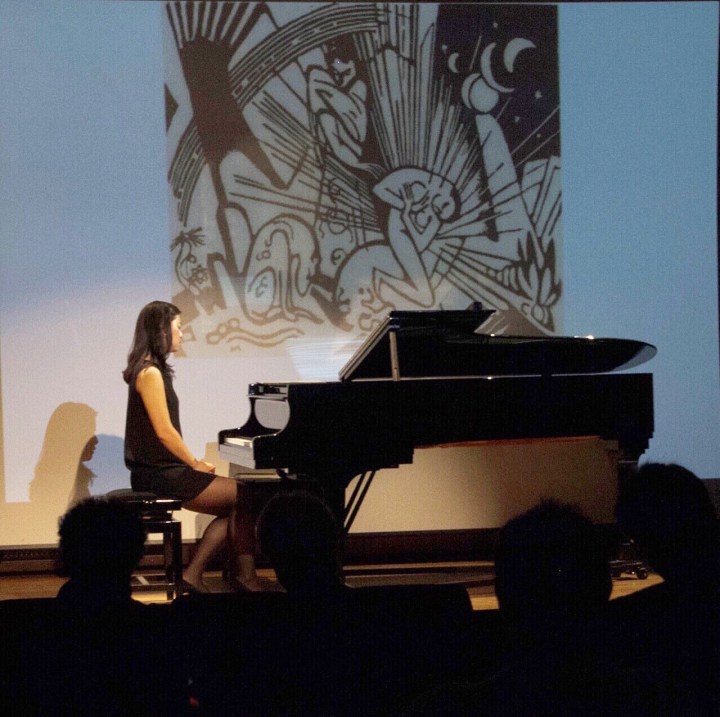
This was part of an intriguing and highly original concert by pianist Annie Yim in which music and words combined to reveal “tributes, friendships, and artistic affinities” (AY, programme notes). Annie is the creator of MusicArt London, a conceptual concert series which combines music with poetry and visual arts, creating interesting and unexpected dialogues and connections between the works in the programmes and across creative disciplines. Programmes include works by 21st century composers, juxtaposed with historical masterpieces. In this concert, Annie played music by Debussy, Ravel, John Cage, Arvo Pärt, Cheryl Frances-Hoad and Philip Glass, interspersed with readings from poems which sparked a musical impulse or which were written in response to music.
The concert opened with Annie reading Baudelaire’s Harmonie du Soir, a line from which Debussy drew inspiration for his Prelude Les sons et les parfums tournent dans l’air du soir (Sounds and perfumes turn in the evening air). To hear the words of the poet which influenced the composer created a quite different listening experience when the music began. This prelude is deeply sensual, rich in pungent harmonies and languid rhythms as Debussy’s responded to Baudelaire’s equally evocative and musical writing.
It is well known that Ravel drew inspiration from poetry for his Gaspard de la Nuit, and Aloysius Bertrand’s book of poems appealed to Ravel’s love of fairy tales. He set three of Bertrand’s poems to music – Ondine, Le Gibet and Scarbo – and printed each poem in full next to the piano score. Once again, Annie read the poem, seated at the piano, before launching into a characterful and vibrant portrayal of the grotesque gnome, “his fingernails scratching on the silk curtains round my bed!”
John Cage’s Dream, a minimalist work scored on a single stave music consisting of groups of tones that are freely sustained (either by holding the keys down or by using the sustaining pedal); the degree of resonance (as determined by the performer) creates the rhythmic and narrative flow of the piece and takes the listener into an otherworldly sense of time suspended. A gentle work, rather like a haiku in its simplicity and depth of expression, it was elegantly and sensitively played by Annie, accompanied by a reading of John Cage’s poem to Merce Cunningham (for whom the music was written) Poem. Cause: I love you. A rather touching addition to this performance was a projection behind the piano of Cage’s original typed manuscript of the poem.
And so to the performance of 4’33” where while the pianist remained silent and still at the piano, a recording of poet Ed Baker reading his ‘A Kind of Silence’ was played. This version of 4’33” was originally conceived in 2016 for a performance in an art gallery on the premise that “silence is musical – silence is poetic – silence is music is poetry“. In our frenetic world it is remarkable how long 4’33” feels and rather than “filling the silence”, the words and cadence of the poem offered special time for reflection and quiet contemplation.
This connected appropriately with Pärt’s Für Alina, a work whose “aesthetic is silence…..present not just as the silence framing the piece, but, paradoxically, silence has been written into the music as an acoustic space of sorts” (Kristina Korver, musicologist, Arvo Part Centre). Poet Zaffar Kunial wrote ‘Sunlight’ in response to the music, a short yet meaningful poem which perfectly complimented the simplicity and profundity of Pärt’s writing: “each line can be read after a pause or as a continuous train of thought” – just as Pärt gives few directions to the pianist as to how his piece should be played. This new poem was specially commissioned by MusicArt London and was reproduced in a delicate limited edition card, designed and handmade by the book artist, Pauline Rafal,
Cheryl Frances-Hoad‘s contemplative miniature Star Falling was composed “as a gift in an attempt to stop a partner from leaving me” (CFH) and is a calm reflection on lines from Else Lasker-Shuler’s poem ‘Reconciliation’. Delicate and expressive, with shimmers of star light, it was accompanied by the composer reading the poem which inspired her.
The final work in the programme was Philip Glass’s Wichita Vortex Sutra. which Glass wrote for a performance with poet Allen Ginsberg, whose poem of the same name (written in 1966) reflected the anti-war mood of the times. Glass’s music was intended as a portrait of America, complete with fragments of hymn tunes and the energy of the big city. At this performance, a collage of Ginsberg’s words was read by Ed Baker, who had selected sections from the poem to reveal his own response, as an American, to Ginsberg’s poem and Glass’s music. Annie performed the work with energy and commitment, bringing to a close this most interesting and engaging lunchtime concert.
The Cross-Eyed Pianist is free to access and ad-free, and takes many hours every month to research, write, and maintain.
If you find joy and value in what I do, please consider making a donation to support the continuance of the site






 The Cross-Eyed Pianist