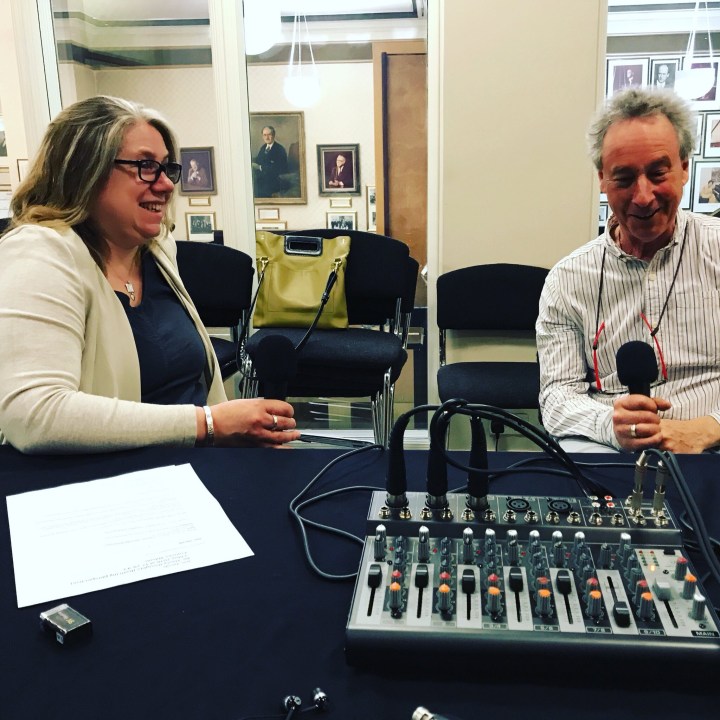
I had a great time in December putting together music for my friend Honor’s wedding in Singapore. We met each other through an immersive theatre company called Punchdrunk, whose shows we have both been to multiple times – on three continents. Their current production “Sleep No More” lured us both to Shanghai last year, and she wanted some of its atmosphere to permeate her wedding, meaning a large dose of 1930s and 40s jazz. But her fiancé (now husband!) is Russian and his family were obviously coming to the wedding, and we thought it would be nice to include something with a Russian flavour as well. So this mix includes not just obvious crowd-pleasers like Glenn Miller’s “In the Mood” or Artie Shaw’s “Begin the Beguine”, but also obscurities like “Morning and Evening” by the Leoníd Utësov Jazz Orchestra or the fantastically catchy waltz “Always Together” by Mikhail Mikhailov and the Michael Ginsburg Jazz Orchestra. It’s amazing how seamlessly they fit in. There are also a few deliberate hat-tips to “Sleep No More” in there, such as “Weep No More My Baby” by Al Bowlly and the Ray Noble Orchestra, which is featured on the show’s soundtrack.
TristanJakob-Hoff is a composer and arranger whose work is published by Edition Peters. He is also a freelance music engraver and provides professional music services at www.opus101.org.
Who or what inspired you to take up the piano and pursue a career in music?
My first piano was my uncle’s wedding gift to my aunt. At the time he was moving houses and the piano was ‘temporarily’ housed in my home, where it stayed for another 6 years! My first piano teacher (a small ballet company’s piano accompanist) was the person who really pushed me and my parents to think that it was really possible to consider a career path in Western classical music, a very new concept in China at that time. You must remember that this was merely only five years after the end of the Cultural Revolution!
Who or what have been the most important influences on your musical life and career?
The support of my mother throughout my life, and how she let me pursue what I loved to do, regardless of any social or financial consideration.
What have been the greatest challenges of your career so far?
Juggling being a ‘hands-on’ mother of two young children and pursuing a performing career!
Which performances/recordings are you most proud of?
There are some gems which I recorded for Pianist Magazine that turned out unexpectedly well. I have now recorded a large number of CDs for the magazine and I am very proud of issue 100, both for its significance and the music in it.
Do you have a favourite concert venue to perform in and why?
Not really. I would say perhaps the audience play a more important part in influencing my performance on the day rather than the venue itself.
Who are your favourite musicians?
I am not what you call a loyal listener, I go through phases. However, the old masters seem to always make me stop and pay attention whenever I hear them: Guido Agosti, Shura Cherkassky, Vladimir Sofronitsky, Pablo Casals, Alfred Cortot, Benjamin Britten, Louis Kentner… the list will go on and on.
What is your most memorable concert experience?
Collaborating with James Loughran and the Aarhus Symphony Orchestra on Mozart’s Piano Concerto K.488. Also a small recital I gave in the Scottish border when the front leg of the old Bechstein piano suddenly broke during the final movement of Beethoven’s ‘Les Adieux’ Sonata; in happiness I hope!
As a musician, what is your definition of success?
Great question! Without sounding a cliché and being corny, all I want is just to play to people. My definition of success is being able to make that special bond with the audience – even if it is just to one single person on the night – in a short magic moment music can touch special places deep within.
What do you consider to be the most important ideas and concepts to impart to aspiring musicians?
To be forever inquisitive – one always finds answers if one keeps asking questions.
Where would you like to be in 10 years’ time?
Pretty much the same as I am now, but perhaps travelling further afield to play more concerts, as the children will be more grownup. Also, dare I hope for much better gardening skills?!
What is your idea of perfect happiness?
Waking around with my family the day after a good concert.
What is your most treasured possession?
I am a very laid back Buddhist; I think that one of the main ideas of Buddhist teaching is to try not to hold on to many earthly possessions.
Chenyin Li performs two piano sonatas by Beethoven, Stravinsky’s Petrushka Suite and three Chinese transcriptions as part of the Bluthner Piano Series at St John’s Smith Square on 23 May. Further information and tickets here
The Chinese pianist Chenyin Li is internationally acknowledged as one of the most exciting and sought-after musicians of her generation. Her career was launched after winning the 6th Scottish International Piano Competition in Glasgow, as well as being the first prizewinner of the Campillos International Piano Competition, Dudley International Piano Competition and the European Beethoven Gold Medal. She has been described as a “gritty, fiery and athletic pianist, backed by a strong technique arsenal” (The Daily Telegraph), and “a player of remarkable subtlety” (The Scottish Herald), who “understands the original intentions of the composers as well as bringing her own individual interpretation which invests the music with a new life” (National Business Review). Read more
The Thoroughly Good Classical Music Podcast invites three people who play, listen or otherwise work in classical music to sit and discuss the subject they love. They’re unplanned conversations recorded as live, very nearly unedited, and more often than not take unexpected twists and turns.
In this the second Thoroughly Good Podcast to which I’ve contributed, Adam Gatehouse, co-Artistic Director of the Leeds International Piano Competition, outlines the changes the competition has undergone since the retirement of Dame Fanny Waterman (the competition’s founder), in addition to more general conversation about communication in performance and why the core canon of the piano repertoire is special.
Hugh Mather, the indefatigable director of concerts at St Mary’s Perivale in West London, introduces a major weekend festival of Chopin’s immortal piano music, and examines some of the rationale behind the festival.
We are holding the St Mary’s Perivale Chopin Festival from Friday 15th June to Sunday 17th. In summary, this comprises most of Chopin’s solo piano works played by 21 excellent pianists giving recitals of 24 to 44 minutes, providing about 12 hours piano music over a glorious weekend of piano-playing.
Firstly, it gives a chance to ‘show-case’ the amazing pianistic and musical skills of so many of our younger pianists. I currently have a shortlist of about 80 pianists who are certainly good enough to give a decent solo recital in my concerts, and the 21 playing in the festival include some of the best. In alphabetical order, they are Ashley Fripp, Artur Haftman, Tyler Hay, Dinara Klinton, Ilya Kondratiev, Renata Konyicska, Ke Ma, Viv McLean, Mikhail Shilyaev, Asagi Nakata, Luka Okros, Mengyang Pan, Mihai Ritivoiu, Tamila Salimdjanova, Colin Stone, Iyad Sughayer, Michal Szymanowski, Julian Trevelyan, Amit Yahav, Yuanfan Yang and Hao Zi Yoh. Most are young (aged below 30) and have won multiple awards in international competitions. Many pianists – possibly most – are at their peak when aged 25-30, after 15-20 years of excellent teaching, long hours of practice, sheer hard work, intense competition and financial support, with little need to divert their energies into piano teaching and other activities to provide an income. Our pianists come from all over the world, with different musical and pianistic backgrounds, and it will be endlessly fascinating to hear their varied approaches to Chopin. This is much preferable to hearing any single pianist – be it Perahia, Zimerman, Pollini or a re-incarnated Rubinstein or Cortot – playing through all this repertoire. I am always amazed to hear how the same piano can sound so different with successive pianists. It will be a heavenly weekend for all pianophiles.
Secondly, it provides an opportunity to hear much neglected Chopin piano music. In the concert hall, Chopin performances tend to be dominated by the same few ‘warhorses’ which most pianists feel obliged to learn and perform. I have undertaken an analysis of works played in over 700 concerts at St Mary’s Perivale in the past decade. Way out top is the ubiquitous G minor Ballade, which has been played 16 times, followed by the Barcarolle and 3rd Scherzo (11), the 3rd and 4th Ballades and Polonaise-Fantaisie (9), the F minor Fantasy, 2nd Scherzo and 3rd Sonata (7) and the 2nd Ballade, Polonaise Op 53 and 2nd sonata (6 times). By contrast, many of the smaller pieces are hardly ever programmed. When I assembled the programme, I asked all the pianists to list all the works they could offer, and it was instructive to see so many offering – yes, the G minor ballade – the A minor Mazurka Op 17 no 4 and the D flat Nocturne Op 27 no 2 , but surprisingly few other mazurkas or nocturnes. On CD, the situation is complicated by the almost universal practice of complete sets of nocturnes, polonaises, mazurkas and waltzes. Hearing all the mazurkas or waltzes in succession isn’t a satisfactory musical diet. Our festival provides a satisfying mix of all the different genres throughout the festival, and a chance to hear many under-performed works in concert. It comprises 12 hours of music, out of the approximately 16 hours in total of Chopin’s solo piano music, without any repetition of a single work. Some early works are omitted, such as the first sonata, and some early variations, but much gorgeous music which is rarely heard in concert will be included. This required a complicated jigsaw puzzle, and was achieved by asking all pianists to list works they could offer, and giving them a limit of one major work (sonata, scherzo or ballade etc), to ‘spread the jam’ evenly among all the musicians!
Thirdly, it is particularly appropriate to hold the festival this year, and in Ealing, which has the highest proportion of native Polish speakers in the UK. Many Polish soldiers who fought alongside British troops in the second world war settled in the borough after the conflict ended. Their numbers were boosted in subsequent waves – first, around the time martial law was imposed in Poland in the early 1980s, then at Poland’s accession to the EU in 2004. Chopin has, of course, always occupied a special place in Polish culture. And in this year, we mark the 100th anniversary of Poland regaining its independence in 1918. Our festival can be regarded as part of this celebration. It also marks the 170th anniversary of Chopin’s visit to London and Scotland in 1848, the year before his death. Our festival will commence with a short introductory lecture from Amit Yahav, entitled, ‘Chopin: A Polish Poet at the Piano in Paris’ to set the scene and to consider the main features of his life and the influences on his piano composition.
Inside St Mary’s PerivaleFourthly, it utilizes the special atmosphere of St Mary’s Perivale. This is a charming, small and intimate venue which has much more in common with the Paris salons of Chopin’s day than those other larger venues in Central London. It is a Grade 1-listed architectural jewel which is blessed with excellent acoustics and a glorious ambience. Its small size creates problems of its own, in that our church can only seat a maximum of 100 people, but we are confident that this will accommodate our audience. No tickets will be sold beforehand. All our pianists will be paid £200 for their performance, and we are charging £15 for admission to each long session. Since they contain between 3 and 6 piano recitals, we think that this is a reasonable charge, and compares well with those for piano recitals elsewhere. Please bring cash rather than cards or cheques.
In summary, this promises to be a very special weekend of exceptional piano-playing which should appeal to lovers of Chopin and the piano, in London and further afield. Come along to enjoy Chopin in Perivale!
St Mary’s Perivale Chopin Festival runs from 15 to 17 June 2018. Full details of all performers and programmes here
The Cross-Eyed Pianist is free to access and ad-free, and takes many hours every month to research, write, and maintain.
If you find joy and value in what I do, please consider making a donation to support the continuance of the site