Annie Yim, piano, with recorded voices

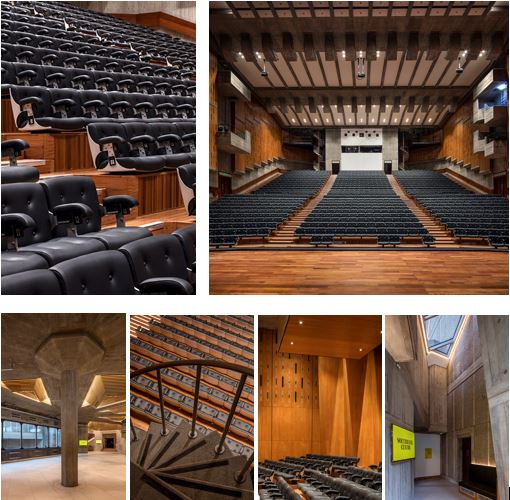
The Performance Space, City, University of London

Friday 16 March 2018

My second visit to the Performance Space at City, University of London, and a second performance of John Cage’s infamous 4’33”. Last summer I heard a “straight” performance – the pianist silent yet fully present at the piano while the audience absorbed the myriad sound of the space; this time the piece was complimented by poetry – ‘A Kind of Silence’ by Ed Baker, and a reminder that Cage’s work was conceived with the idea that any sound constitutes “music”.

This was part of an intriguing and highly original concert by pianist Annie Yim in which music and words combined to reveal “tributes, friendships, and artistic affinities” (AY, programme notes). Annie is the creator of MusicArt London, a conceptual concert series which combines music with poetry and visual arts, creating interesting and unexpected dialogues and connections between the works in the programmes and across creative disciplines. Programmes include works by 21st century composers, juxtaposed with historical masterpieces. In this concert, Annie played music by Debussy, Ravel, John Cage, Arvo Pärt, Cheryl Frances-Hoad and Philip Glass, interspersed with readings from poems which sparked a musical impulse or which were written in response to music.

The concert opened with Annie reading Baudelaire’s Harmonie du Soir, a line from which Debussy drew inspiration for his Prelude Les sons et les parfums tournent dans l’air du soir (Sounds and perfumes turn in the evening air). To hear the words of the poet which influenced the composer created a quite different listening experience when the music began. This prelude is deeply sensual, rich in pungent harmonies and languid rhythms as Debussy’s responded to Baudelaire’s equally evocative and musical writing.

It is well known that Ravel drew inspiration from poetry for his Gaspard de la Nuit, and Aloysius Bertrand’s book of poems appealed to Ravel’s love of fairy tales. He set three of Bertrand’s poems to music – Ondine, Le Gibet and Scarbo – and printed each poem in full next to the piano score. Once again, Annie read the poem, seated at the piano, before launching into a characterful and vibrant portrayal of the grotesque gnome, “his fingernails scratching on the silk curtains round my bed!

John Cage’s Dream, a minimalist work scored on a single stave music consisting of groups of tones that are freely sustained (either by holding the keys down or by using the sustaining pedal); the degree of resonance (as determined by the performer) creates the rhythmic and narrative flow of the piece and takes the listener into an otherworldly sense of time suspended. A gentle work, rather like a haiku in its simplicity and depth of expression, it was elegantly and sensitively played by Annie, accompanied by a reading of John Cage’s poem to Merce Cunningham (for whom the music was written) Poem. Cause: I love you. A rather touching addition to this performance was a projection behind the piano of Cage’s original typed manuscript of the poem.

And so to the performance of 4’33” where while the pianist remained silent and still at the piano, a recording of poet Ed Baker reading his ‘A Kind of Silence’ was played. This version of 4’33” was originally conceived in 2016 for a performance in an art gallery on the premise that “silence is musical – silence is poetic – silence is music is poetry“. In our frenetic world it is remarkable how long 4’33” feels and rather than “filling the silence”, the words and cadence of the poem offered special time for reflection and quiet contemplation.

This connected appropriately with Pärt’s Für Alina, a work whose “aesthetic is silence…..present not just as the silence framing the piece, but, paradoxically, silence has been written into the music as an acoustic space of sorts” (Kristina Korver, musicologist, Arvo Part Centre). Poet Zaffar Kunial wrote ‘Sunlight’ in response to the music, a short yet meaningful poem which perfectly complimented the simplicity and profundity of Pärt’s writing: “each line can be read after a pause or as a continuous train of thought” – just as Pärt gives few directions to the pianist as to how his piece should be played. This new poem was specially commissioned by MusicArt London and was reproduced in a delicate limited edition card, designed and handmade by the book artist, Pauline Rafal,

Cheryl Frances-Hoad‘s contemplative miniature Star Falling was composed “as a gift in an attempt to stop a partner from leaving me” (CFH) and is a calm reflection on lines from Else Lasker-Shuler’s poem ‘Reconciliation’. Delicate and expressive, with shimmers of star light, it was accompanied by the composer reading the poem which inspired her.

The final work in the programme was Philip Glass’s Wichita Vortex Sutra. which Glass wrote for a performance with poet Allen Ginsberg, whose poem of the same name (written in 1966) reflected the anti-war mood of the times. Glass’s music was intended as a portrait of America, complete with fragments of hymn tunes and the energy of the big city. At this performance, a collage of Ginsberg’s words was read by Ed Baker, who had selected sections from the poem to reveal his own response, as an American, to Ginsberg’s poem and Glass’s music. Annie performed the work with energy and commitment, bringing to a close this most interesting and engaging lunchtime concert.

annieyim.com

musicart.london

(Photos: Sophie Baker)

This seemed such a great idea, and it was, indeed, great fun! It was also really hard. I don’t know about others, but my instinct was to start sifting through CDs to pick out my favourite tracks, but really, it would never be possible to do that in an hour of music (and yes, apologies…mine is an hour and nine minutes). So, the intention of my mixtape is to say something about me and the music I play, enjoy and listen to.

I guess that my first love has, and probably always will be, choral music. I was lucky enough to go to a secondary school which was very musical. We had a SATB school choir, often with over 100 members (though I think having a pass to be first in the dinner queue was perhaps more of a draw for some!). My first selection is John Joubert’s O Lorde, the Maker of Al Thing which was one of the first pieces we sang in that choir. Some might say it’s a bit of a baptism of fire, but once sung, I was hooked. This particular recording with the Birmingham Conservatoire Chamber Choir, directed by Paul Spicer, is special to me as I was present at the pre-recording performance a couple of years ago.

John Rutter’s music has been much maligned over the years, often unfairly. Yes, we might argue it’s a formulaic, but my goodness, it works and it’s popular. I can’t help but feel that an awful lot of the disdain for his music comes purely from jealousy. Don’t get me wrong, I don’t like it all, and I wouldn’t want to listen to it all the time, but it’s played a big part in my life. His setting of All Things Bright and Beautiful was one of my early introductions to it.

I’ve included Douglas Guest’s For the Fallen as an example of what I might call exquisite choral writing. To me, this short anthem captures everything about what can be achieved with human voices in harmony.

I’m afraid to say, I’ve never had much time for music from the classical period, and I’m only just coming around to baroque, but I have always found enjoyment in early music, whether that be plainsong, or works such as Josquin’s Missa pange lingua.

I couldn’t possibly create this list without including something by Herbert Howells. Howells’ music is perhaps the music which speaks to me most closely and spiritually. I don’t think this is something we can explain, but I’m sure we’ve all come across pieces and composers like that. There is something about the harmony and rhythm of Howells’ writing which tugs at me deep inside. Even in this short extract, the Nunc Dimittis from his Collegium Regale setting of the Magnificat and Nunc Dimittis, there is so much to explore and enjoy.

Gavin Bryars’ work Jesus’ Blood Never Failed Me Yet was perhaps my first introduction to what then, we’d have called ‘contemporary music’. There is something quite magical in this work which makes for an almost hypnotic listening experience.

If you thought I was all about so-called ‘classical music’, you’d be wrong. I have always been interested in music for television, and in particular, ‘library music’. Keith Mansfield’s Superstar on the KPM LP Lifeforce is a fabulous example – pure 1970s. Over the years, I have collected hundreds of library LPs and CDs, all sadly being disposed of around the country as broadcasters go digital.

Then there’s pop music too…although my pop music knowledge probably ceases around 1989. Spandau Ballet’s True has always had a hold on my ears, and my only explanation is that it came out at about the exact time I was born. Spooky?!

I’ve always enjoyed musicals (apparently, we’re to call it ‘musical theatre’ now), but no surprise that I’m a fan of the musicals which no one really knows and didn’t catch on. So, I doubt anyone’s heard of The Goodbye Girl!

Of course, the precursor to musicals was operetta, and I couldn’t resist but to include some G&S. No surprises that it’s from Princess Ida which although my favourite, is not one of the popular ones! (Why not?! It’s very topical…)

Then there’s folk music too: here’s an Irish folk-song The Butcher Boy, but there are so many others I could have included. It’s perhaps the folk idiom which influences my choice of orchestral music. Here I’ve included an extract from Stanford’s Symphony No. 6 and Armstrong Gibbs’ Symphony No. 1. These, in my view are two totally underrated composers, and I guess, that’s always been part of me too…I like the things no one else has discovered!

Finally, just like Howells, I couldn’t leave this without including some Vaughan Williams, and it’s not one of the popular pieces, but instead, the first movement from his Symphony No. 6.


David Barton is a piano, flute and voice teacher, composer, mentor and writer based in Lichfield

www.davidbartonmusic.co.uk


Guest article by Michael Volpe, General Director of Opera Holland Park

At Investec Opera Holland Park (OHP), we have recently announced a special memorial gala event to mark the first anniversary of the dreadful Grenfell Tower tragedy and to remember its victims, especially our friend Debbie Lamprell who perished in the fire. By the time of the concert an inscribed stone in her memory will have been laid on the theatre site.

GetFileAttachment-1

As many know, OHP became entangled in the political fall-out of Grenfell but we have now spoken and written about that period extensively and feel no need to revisit the matter. Our immediate response was to give a performance of Verdi’s Requiem in aid of The Rugby Portobello Trust (RPT), who were in the eye of the storm at the time, and it is to them that the proceeds of the Hope For Grenfell gala will go. The charity, with which we have had a long association, will this time use the money raised to look forward, to help young people explore the countryside and coasts away from the inner city. The whole evening is dedicated to trying to look forward, with hope. A year on from the disaster, we will bring together members of the community, both in the audience and on stage, to show how even in the midst of such darkness, healing can – and must – begin. We believe music is, and will always be, a major catalyst for the expression of hope, memorial and healing.

memorial-concert-image-768x762

We know from bitter experience that healing is a long process and that hope is not easily fostered or acquired. We are still regularly in touch with Debbie’s mother and her recovery has scarcely begun. The pain is still raw and she, as her daughter had been, is now adopted into the OHP family, whose care and protection of her is unlikely to end anytime soon. Such is the nature of grand tragedy whose tendrils spread far and wide; there are thousands of people in a position similar to hers who have to manage the daily, grinding relentlessness of grief. Yet even in these circumstances, there comes a time when we have at least to attempt to draw inspiration for the future, when human instinct tries to extract something good from awfulness. We feel that we, along with those at RPT whose job it is to begin to master the reparative process, want to offer some hope.

The concert itself is on 13th June and will bring together many of our casts from the season in extracts from operas. There will also be readings, remembrance and a choir, drawn from local schools and other services and coached by Gareth Malone, will sing a new piece composed by Will Todd. We will announce more details in the coming weeks.

The money raised will fund RPT’s summer ‘residentials’, when kids from the community are taken out of the city to the countryside or the coast where they have space to think, breathe the air and learn new skills. For some, this is their only chance to escape the concrete surroundings of their home environment. RPT found itself right at the centre of the Grenfell tragedy and became a hub for the community in the immediate aftermath of the disaster, going on to act as the central distributing charity for the funds that were raised. This role is one that the charity was never set up to perform but it did so with dedication. But the resources it utilised need to be replenished; their wider activity in the North Kensington community did not stop and we hope this concert will make a significant contribution to this vital ongoing work.

The concert will also be Opera Holland Park’s way of remembering our friend Debbie. Her death in the fire had a profound affect on all of us and continues to do so, but we intend to honour her memory as best we can with music she loved and in a place to which she was utterly dedicated.

The Hope for Grenfell Memorial Gala, in memory of Debbie Lamprell and all the victims, will feature full scenes from OHP’s productions of La traviata and Cosi fan tutte, performances of classic arias by guests from across the operatic world, and an original composition by Will Todd, performed by a community choir led by Gareth Malone.

Tickets for the Grenfell memorial concert are available now via www.operahollandpark.com


Investec Opera Holland Park’s 2018 season will run from 29 May to 28 July. Full details of productions at www.operahollandpark.com


3 – 7 October 2018
Kings Place, London
2018 promo video here

Katya Apekisheva | Alexandra Dariescu | Margaret Fingerhut | Ingrid Fliter | Stephen Kovacevich | Konstantin Lifschitz | Leszek Możdżer | Charles Owen | Paul Roberts

“A reminder of what a fabulous variety of sound can be conjured from two pianos”
5* The Telegraph

  • Third annual London Piano Festival at Kings Place with Co-Artistic Directors Charles Owen and Katya Apekisheva
     
  • Solo recitals by Konstantin Lifschitz and Ingrid Fliter, amplified jazz performance by Leszek Możdżer and lecture/recital on Debussy by Paul Roberts
  • Two-piano Marathon with Stephen Kovacevich, Margaret Fingerhut, Konstantin Lifschitz, Ingrid Fliter, Charles Owen and Katya Apekisheva which will be recorded by BBC Radio 3 for future broadcast in Radio 3 in Concert
  • Family concert of The Nutcracker and I by Alexandra Dariescu with piano soloist, ballerina and digital animation

img2171sim-canetty-clarkecurated

Charles Owen and Katya Apekisheva announce the programme of their third annual London Piano Festival, taking place from 3-7 October 2018 at Kings Place, London.  This year the Co-Artistic Directors bring together seven pianists in addition to themselves for a programme of solo recitals, jazz, a family concert, lecture/recital and the highly anticipated two-piano marathon.  The theme of this year’s Festival is the centenary of the death of Claude Debussy which is seen throughout the 5-day series.  This year the London Piano Festival are bringing in a student ticket scheme, offering £5 tickets to a number of events during the 5-day Festival.

The highlight of the London Piano Festival is its Two-Piano Marathon, referred to as “altogether exemplary” by The Times (2016). In various pairings, Stephen Kovacevich, Margaret Fingerhut, Katya Apekisheva, Charles Owen, Konstantin Lifschitz and Ingrid Fliter perform a range of works by Brahms, Bax, Debussy, Adès, Stravinsky, Rachmaninov and more.  The Two-Piano Marathon will be recorded by BBC Radio 3 for future broadcast in Radio 3 in Concert.

The Festival opens with a concert by Co-Artistic Directors Charles Owen and Katya Apekisheva performing both solo and duo repertoire.  Katya opens the concert performing Schubert’s Moments Musicaux 1-3, Granados’ The Maiden and The Nightingale and Ginastera’s Three Argentinian Dances before Charles performs Ravel’s Gaspard de la nuit. The second half of the concert sees the duo perform Three Nocturnes by Debussy (arranged by Ravel), marking the composer’s centenary, and Milhaud’s Scaramouche.

“At the London Piano Festival we want to bring together a whole range of music appealing to piano lovers of all ages.  As 2018 marks the centenary of Debussy’s death, we felt it was important to mark this within our programming this year.  We also love to present contemporary music at the Festival and this year we’ll be performing an existing piece by Thomas Adès who is a great friend of Charles’.” Charles Owen and Katya Apekisheva

Both Owen and Apekisheva will be releasing solo albums to coincide with the opening concert of the London Piano Festival this year.  Katya is releasing an album of Scriabin, Chopin and Fauré impromptus on Champs Hill Records, a programme which she brought to the Festival in 2016.  Charles is releasing a double-disc of Brahms’ late piano works on Avie. This follows the recent release of their duo recording in January 2018, Rachmaninov: The two-piano suites; Six Morceaux, Op. 11 which Gramophone magazine called “a highly recommendable disc”.

The London Piano Festival features two solo recitals by pianists making their debuts at Kings Place. Russian pianist Konstantin Lifschitz performs a programme of works by Schubert, Janáček and Debussy, and Argentinian pianist Ingrid Fliter performs Beethoven Sonatas before they both join the Two-Piano Marathon.   Celebrated Polish jazz pianist Leszek Możdżer brings a night of amplified jazz to the Festival, following his sold-out show at Kings Place in 2017 which London Jazz News called “a great show that held the attention from start to finish”. 

Commemorating the centenary of Claude Debussy, concert pianist and writer Paul Roberts presents a lecture/recital in Kings Place’s Hall Two about Debussy’s Piano Music on Saturday 6 October, focussing on Debussy’s Images books I and II.  Paul Roberts is the leading authority on the music of Debussy and Ravel, having written Images: The Piano Music of Claude Debussy, Debussy: a biography and Reflections: The Piano Music of Maurice Ravel.

For this year’s family concert, Alexandra Dariescu brings her ground-breaking multi-media piece The Nutracker and I, by Alexandra Dariescu for piano soloist, ballerina and digital animation to Kings Place for the first time, following its critically-acclaimed world premiere last year.  Tchaikovsky’s beloved ballet music features throughout and includes favourites such as Dance of the Sugar Plum Fairy, Arabian Dance, Chinese Dance, Pas de Deux, and the Flower Waltz in 15 virtuosic arrangements by Mikhail Pletnev, Stepan Esipoff, Percy Grainger and three brand new variations by Gavin Sutherland.  Dariescu is releasing an album of The Nutcracker and I on Signum Classics on 27 April.

Full programme

Wednesday 3 October, 19:30pm | Hall One
OPENING NIGHT – Charles Owen and Katya Apekisheva
Schubert Moments Musicaux 1-3, D.780 (KA)
Granados Maiden and the Nightingale from Goyescas, Op. 11 (KA)
Ginastera Three Argentinian Dances, Op. 2 (KA)
Ravel Gaspard de la nuit (CO)
Debussy Three Nocturnes (arr. Ravel) (KA & CO)
Milhaud Scaramouche (KA & CO)

Thursday 4 October, 19:30pm | Hall One
ON AN OVERGROWN PATH – Konstantin Lifschitz
Schubert Sonata in A minor, D 784
Janáček ‘On an Overgrown Path’ 1st series
Janáček ‘On an Overgrown Path’ 2nd series
Debussy Preludes Book I

Friday 5 October, 19:30pm | Hall One
LESZEK MOŻDŻER IN CONCERT 

Saturday 6 October, 14:00pm | Hall Two 
IN THE MIND’S EYE – DEBUSSY’S IMAGES – Paul Roberts

Saturday 6 October, 16:00pm | Hall One
TEMPEST – Ingrid Fliter
Beethoven Sonata No. 18 in E-flat major, Op. 31, No.3
Beethoven Sonata No. 17 in D minor ‘Tempest’, Op. 31, No. 2
Beethoven Sonata No. 22 in F major, Op. 54

Saturday 6 October, 19:00pm | Hall One
TWO PIANO MARATHON – Stephen Kovacevich, Margaret Fingerhut, Katya Apekisheva, Charles Owen, Konstantin Lifschitz, Ingrid Fliter
Brahms Variations on a Theme by Haydn, Op. 56 (KL&IF)
Bax The Poisoned Fountain and Hardanger (MF &CO)
Poulenc Élégie (MF & KA)
Poulenc Capriccio (d’après Le Bal masque) (MF & KA)
Poulenc L’embarquement pour Cythère (MF & KA)
Debussy En blanc et noir (SK & CO)
Rachmaninov Russian Rhapsody (1891) (KL & KA)
Arensky Suite No. 1, Op. 15 (IF & KA)
Thomas Adès Concert Paraphrase on Powder Her Face (CO & KA)
Stravinsky Scherzo à la russe (CO & MF)

Sunday 7 October, 14:00pm | Hall One
THE NUTCRACKER & I BY ALEXANDRA DARIESCU


(source: Albion Media press release)