My first evening at Chetham’s International Summer School ad Festival for Pianists – or Chets – as it is affectionately called, offered me the opportunity not only to meet piano friends, make new connections and experience the unique Chets vibe, but also to enjoy three fine recitals by professional pianists, who are all members of the teaching faculty at this year’s summer school.
Canadian pianists Megumi Masaki is a keen advocate of contemporary and new piano music, with a specialisation in exploring interactions between sound, image and movement. Her concert featured three works which used electronics and live video art to create a unique audio-visual and multi-sensory experience. Two works, ‘Corona’ and ‘Touch’, by Canadian composer Keith Hamel opened and closed the recital. Both utilise electronics, gesture tracking, interactive visuals and interactive computer processing and the live electronics and visuals react to one another so that each performance is unique. ‘Corona’ depends on the sound of the piano to create the visuals (an abstract sequence of shapes suggesting the planets) and because the video is generated by the piano and is completely interactive, each performance is unique. Musically, this piece had shimmering filigree passages redolent of Debussy and the processional quality of John Adams’ ‘China Gates’, but the additional layers of sound created by the electronics created mesmerising almost orchestral textures. Throughout, Megumi’s clarity and precision of touch and musical sense was clear, making this piece atmospheric and uplifting.
Keith Hamel’s ‘Touch’ utilised similar technology, with the addition of balletic gestures by the pianist to create wondrous shimmers of sound. The work is inspired by bells and all the harmonic material is derived from the analysis of bells and change-ringing patterns. Once again, the piano sound combined with the electronics offered beautiful haloes and extraordinary layers of sound.
These two works book-ended another piece by a Canadian composer. Douglas FINCH’s ‘Epiphanies’ is inspired by the short stories of Alice Munro in which a character has a moment of sudden inspiration or revelation which happens at unexpected times in the narrative. Compared to Keith Hamel’s pieces, this suite of four movements had a spare elegance and understated grace, and the interplay between piano and words, with live interactive visuals by artist Sigi Torinus, was engaging and at times unsettling, almost portentous.
***
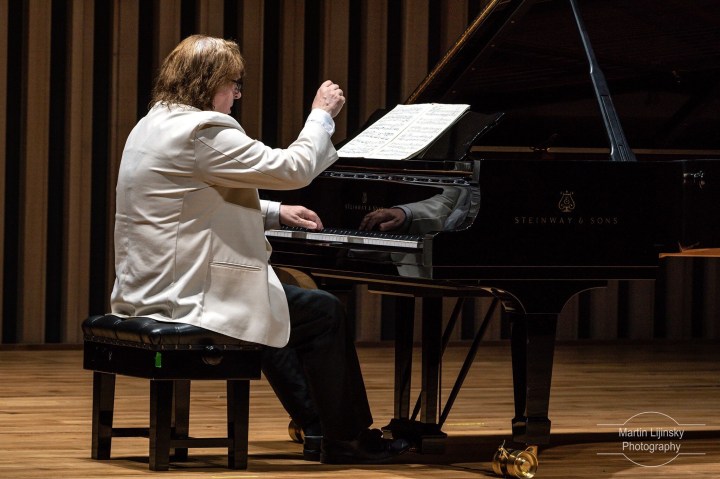
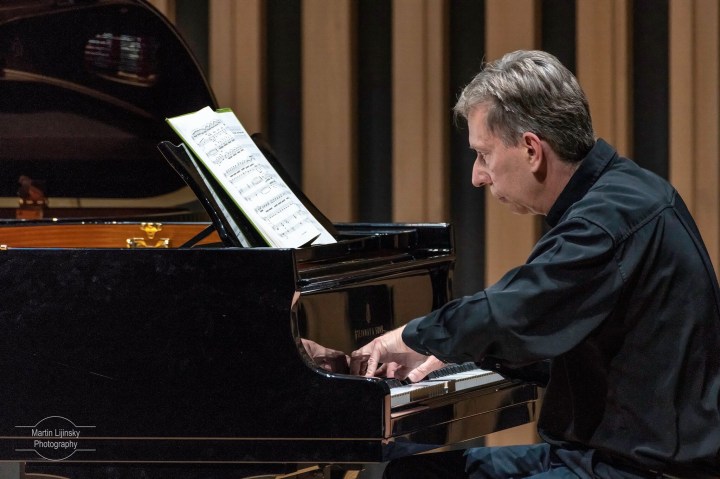
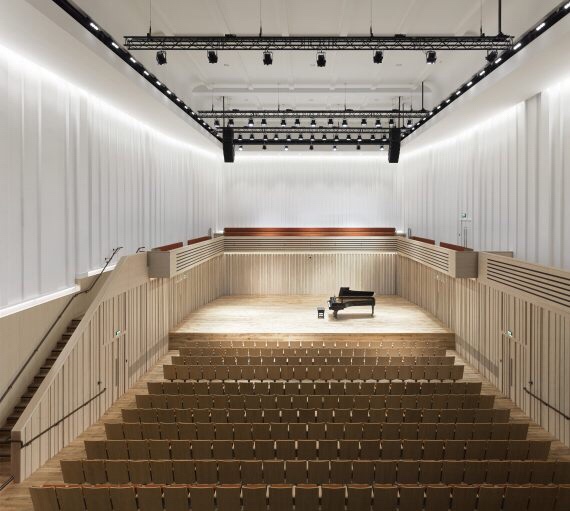
The second concert of the evening gave me my first experience of Stoller Hall, Chetham’s new multi-million pound concert venue. It’s a really beautiful contemporary shoebox hall, light and airy and finished with pale wood and stone, with an impressive acoustic. This was the setting for Norwegian pianist Einar Steen-Neckleberg’s performance of Bach’s remarkable Goldberg Variations – one of the high Himalayan peaks of the piano repertoire and an epic journey for player and audience. This was a highly personal and romantic account, with each movement shaped to highlight its individual character. This had the effect of suggesting each movement was a stand-alone work in its own right, and was particularly effective in the G-minor variations, especially the last one, which had a poignant intimacy. When the Aria returned, it was as if it came from another place, yet was wholly familiar.
***
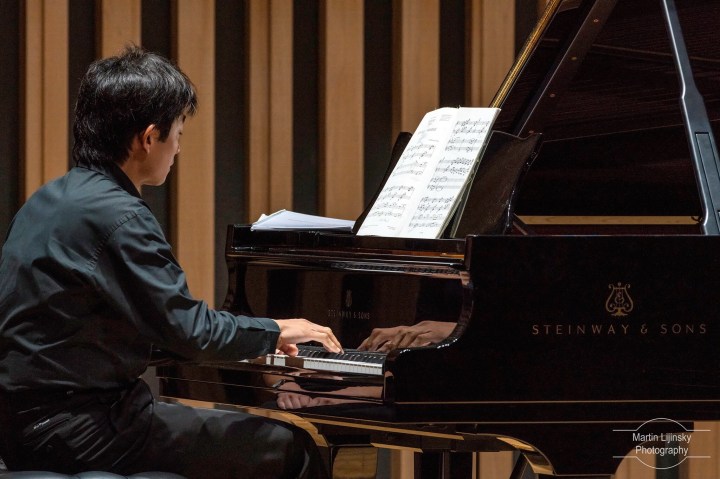
The final concert of the evening given by Bobby Chen and Douglas Finch in repertoire for two pianos. I have heard this piano duo before and I was once impressed by their pitch perfect timing and precision and musical understanding, so much so that one forgets there are two pianists playing as the music is given absolute priority. Rachmaninoff’s Suite No. 1 was lush, liquid and transparent, with elegant natural phrasing and a wonderful sense of ease, which I am sure comes from deep familiarity with the work and a special synergy between the two pianists. The second work was by the little known English composer Arnold Griller (look out for a new disc of his music on the Toccata Classics label for which Douglas Finch wrote the liner notes). His ‘Introduction, Cakewalk and Allegro’ opened with a rather sensuous section, redolent of 1920s cocktail jazz, before lively sections with rhythms reminiscent of ragtime and shifting moods, at times witty, then serious. It was vibrant and colourful and handled with understated panache by the performers. The final work, ‘Hapsburg Burlesques’ by Douglas Finch, was written at the time of the Brexit referendum and includes quotations and transcriptions of Rosenkavalier, Mahagonny, When You Wish Upon a Star, Shostakovich’s 8th String Quartet, and even the British National Anthem. With its intricate weaving of recognisable themes and rather decadent character, this work was both stylish and slightly surreal, but without any sense of irony or pastiche. For an encore, Bobby and Douglas performed Rossignols, written as a wedding dedication, and based on Granados’ The Maiden and the Nightingale, from Goyescas, a delicate, intimate miniature.





 The Cross-Eyed Pianist