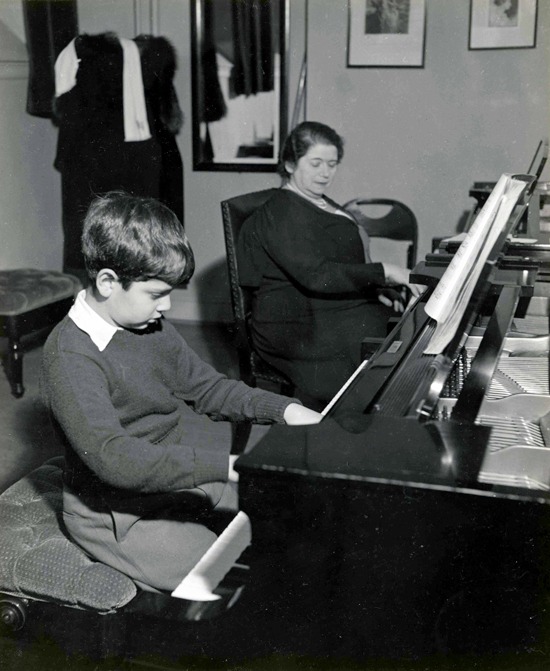
Guest post by Eleonor Bindman

Over the course of my work on arranging the Brandenburg Concertos many people would ask me: “Why not for 2 pianos?” Now that the project is completed and the recording has been released, I am still getting emails from fans of the new Brandenburg Duets CDs with the same question. Well, there are many reasons why and the teacher in me strives for thorough explanations, so here are a few paragraphs on the topic.

Of course, the question is perfectly legitimate, since two pianos would be much easier to work with when transcribing this piece, or any orchestral piece for that matter.  No need to decide which string parts to omit completely, no need to transpose up or down an octave, no need to worry about density of texture in the middle register or about dividing a harpsichord cadenza between two players. It would have been easier to have an entire keyboard for each pianist: no bumping elbows, no deciding whose hand goes into an awkwardly high or low position, no issues of balancing register volumes or exact sound and touch matching when sharing the same theme. The sheet music would have been easier to print as well, without having to fit the same measure numbers for each page of Primo and Secondo and to print the hard copies of music back to back.

The overriding reason for this being a piano-4-hands arrangement is elementary: two pianos are much harder to come by than one.  Think of how many times you have seen two pianos in the same room, unless you were in a concert hall or a music school. And now compare that to all the times you have seen one piano in a room, like in your own home, perhaps. You can play this music at home with a friend whenever you are both available, but imagine if you had to have two instruments? And for performances, bringing a second piano in for a concert always requires rental, extra tunings and (unless we’re talking about a major concert venue) moving/ transportation, ditto for a recording –all this means major expenses in a world were musicians barely get paid for anything. Incidentally, recording on 2 pianos is a lot more difficult than on one, as far as synchronicity goes.

My motivation for working on the Brandenburg Duets was to replace the old arrangement by Max Reger which was hastily done and has barely ever been performed. For the same practical reasons as above, his transcription was made for piano-4-hands, as were other transcriptions of Bach’s works, Beethoven’s symphonies, many opera overtures,etc.. There was a huge body of piano duet repertoire generated mostly in the 19th century when pianos were found in most bourgeois homes. Those duet transcriptions served the same function as the radios and records did in the 20th century: they made classical music accessible for the public’s enjoyment outside the concert hall.

All piano teachers know how important 4-hand playing is for one’s development as an ensemble player. Duets for beginners figure prominently in methods books, yet there isn’t much music for that medium written by great composers. Mozart’s Sonatas and Schubert’s works are the only extensive bodies of work that advanced students and adult amateurs can enjoy. I am hoping that Bach’s 6 Brandenburg Concertos – a total of 18 movements of the most wonderful and varied set of orchestral pieces ever transcribed for piano-4-hands – can give piano partners a new source of learning and enjoyment. The single-keyboard format dictates a thinner texture and therefore simpler parts for both pianists, suitable for intermediate/advanced levels.  Some slow movements are very easy to coordinate, some fast ones are quite difficult and there are many in between. Many faster movements sound equally good at a slower tempo and may be used for exercises in finger dexterity and coordination. And playing this in such close proximity, next to one another, has a unique sensation and feeling of partnership in music for pianists who normally don’t find themselves so close to others in chamber music.

Lastly, for me personally, meeting the challenge of adapting the music well to one keyboard and two players was the real purpose of this project.  The process exposed the complex polyphonic architecture of 6 very different pieces and somehow resulted in a version which seems to belong in our times as much as the original belonged in the 1700s. Bach’s music can be heard in a completely new way without losing its essence.

The Brandenburg Duets arranged by Eleonor Bindman and performed by Eleonor Bindman and Jenny Lin are available on the Grand Piano label, and also via streaming services. Further information here

Meet the Artist interview with Eleonor Bindman


Praised for “lively, clear textured and urbane” performances and “impressive clarity of purpose and a full grasp of the music’s spirit” (The New York Times), New York-based pianist, chamber musician, arranger, and teacher, Eleonor Bindman has appeared at Carnegie Hall, The 92 Street Y, Merkin Hall, Alice Tully Hall, and on solo concerto engagements with the National Music Week Orchestra, the Staten Island Symphony, the Hudson Valley Philharmonic, the New York Youth Symphony, and The Radio and Television Symphony Orchestra of Moscow, Russia. Ms. Bindman is a prizewinner of the New Orleans, F. Busoni and Jose Iturbi international piano competitions and a recipient of a National Foundation for the Advancement of the Arts award.

Born in Riga, Latvia, Ms. Bindman began studying the piano at the E. Darzins Special Music School at the age of five. Her first piano teacher, Rita Kroner, hailed from the studio of Heinrich Neuhaus, the venerable Russian piano pedagogue. After her family immigrated to the United States, she attended the High School of Performing Arts while studying piano as a full scholarship student at the Elaine Kaufmann Cultural Center. She received a B.A. in music from NYU and completed her M.A. in piano pedagogy at SUNY, New Paltz under the guidance of Vladimir Feltsman. The Poughkeepsie Journal describers Ms. Bindman as a strong pianist who attacks her work with great vitality and emotion…and mesmerizes her audiences with her flair and technique” (Barbara Hauptman).

More about Eleonor Bindman

Who or what inspired you to pursue a career in music?

Whilst on a German school exchange to Munich when I was fifteen I was taken to a performance of Berg’s Lulu in the Nationaltheater. I had never seen or heard anything like it before in my life and decided on the spot that I wanted to be a composer, especially of dramatic music (i.e. theatre, opera, ballet, film)

Who or what were the most significant influences on your musical life and career as a composer?

Meeting Olivier Messiaen while I was a student at the Royal College of Music confirmed my lifelong passion for his music. At that time I studied and loved Britten’s operas, and learned much about dramatic timing and word setting. I’ve also had a lifelong love of the music of Leoš Janácek, who still remains a strong influence. The concision of his writing, his limitless imagination in the development of motifs and his sophisticated melodic curves of speech continue to fascinate me.

What have been the greatest challenges/frustrations of your career so far?

I had the good fortune to be offered a lot of film commissions in my thirties and forties. One of the challenges was to put aside enough time each year to compose at least one major concert piece. It sometimes became frustrating not to have enough time in the year to develop compositional ideas. It was for this reason that, when I retired from film music four years ago, I decided to take a PhD at Bristol University in order to really get to grips with composition technique and to become more familiar with what is being written today.

Of which works are you most proud?

One of the works I wrote for the PhD was called Kalon, for string quartet and string orchestra. What is unusual about it is that the two string groups perform almost throughout in different simultaneous tempi. I nearly abandoned it twice, so difficult was it to write clearly in polytempo without it sounding a mess. When I heard the Czech Philharmonic play it for the Signum Classics recording I felt so glad that I had stuck with it and that the piece really works.

What are the special challenges/pleasures of working on a commissioned piece?

I’ve always needed to work to a deadline, even if the deadline is three years off. I have a fear of the piece either not being ready or not being the best I can write, so I tend to finish a commission months before it is due for delivery. This means I can sit with it, re-visit and change or improve large or small things before it is published and the parts are sent to the performers. With my second violin concerto Niobe I persuaded the Czech Philharmonic, who commissioned it, to let me have a playthrough with the wonderful soloist Tamsin Waley-Cohen four months before the first rehearsal. I learned so much from the experience and, as a result, revised several passages to give it even more punch and dramatic impact. In such circumstances my publisher Nimbus Publishing were endlessly patient in allowing me to re-print the score and parts for what turned out to be the definitive version that we premiered and recorded.

What are the special challenges/pleasures of working with particular musicians, singers, ensembles and orchestras?

Knowing the choir, orchestra or soloists is always a pleasure.

Pietà is my third commission for the Bournemouth Symphony Chorus and as well as knowing the choir very well I am always thrilled to work with their conductor Gavin Carr. Gavin heard the piece at different stages of the composition and made a number of incisive observations about voicing and the overall impact of the work’s structure and climaxes. I feel very lucky to have worked with collaborators like him, and Pietà is dedicated to Gavin in thanks for all his support and encouragement over many years.

How would you characterise your compositional/musical language?

Hard to answer this one meaningfully. I’ve always felt a need to communicate with my music and consequently have tried, without limiting the freshness or originality of the work, to make it accessible and direct. Having experimented with atonal and serial music in my twenties I am now more interested in using different forms of modal music, or even triadic harmony in new ways. During the PhD I chose my thesis topic as polyrhythm, polymetre and polytempo, and I think my music is characterised by a rhythmic dynamism and freshness. People have also told me that my music is very melodic, and creating well-crafted melodic material remains one of my preoccupations.

How do you work?

I mostly work in my studio in the village in Oxfordshire where I live. The studio has inspiring views on a small lake and I work on a lovely Yamaha grand piano that is also aligned to a computer on which I write with Sibelius. I often sketch on manuscript paper, then go into short score or full orchestral. Occasionally I have ideas in the middle of the night and come downstairs to work for an hour or so. Mostly, I put in about eight hours a day and never work during the evenings, as my brain would be too stimulated to be able to sleep.

As a musician, what is your definition of success?

Having people want to perform and hear my music is entirely my definition of success. Creating music that is good to play, sing or listen to is all I can hope for. If at a concert someone comes up after a performance and says they sincerely enjoyed the piece, or were visibly moved by it, makes all the hard work worthwhile.

What do you consider to be the most important ideas and concepts to impart to aspiring musicians?

If asked, I always tell composers to follow their hearts and their instinct, to write what they want to write rather than what is considered fashionable or in vogue. I hope they will write or perform out of love for what they do, rather than for the critics or the approval of a small elite. But this is just my own experience, and every musician has to follow their own path and create their own truth.

Where would you like to be in 10 years’ time?

At this stage of my life I have decades of experience behind me of writing music in every genre, from commercial to art music. I hope that, energy and good health permitting, I still have my best work to come. I am a great admirer of the Japanese artist Hokusai, who said that nothing he created before his seventieth year amounted to very much, but by the age of seventy he was just getting the hang of painting. I like to think that, aged 65, I am beginning to get the hang of writing music.


Richard Blackford studied composition with John Lambert at the Royal College of Music, then with Hans Werner Henze in Rome. Early awards include the Tagore Gold Medal, the Ricordi Prize and the Mendelssohn Scholarship. He was first Composer-in-Residence at Balliol College Oxford, and later Composer-in-Residence to the Brno Philharmonic in the Czech Republic. His works were performed in the major music festivals of the world, including Adelaide, Berlin, Brighton, Montepulciano, Cheltenham, Long Island. He has composed in virtually every medium, including opera, choral, orchestral, theatre, film and ballet, with his most recent ballet Biophony (2015) in collaboration with Bernie Krause and Alonzo King, winning “Best Contemporary Performance 2016” in the Italian dance magazine Danza&Danza. As a media composer Richard was nominated for an Emmy Award for Outstanding Achievement in Music for his 4-hour score for the CNN/BBC series Millennium, and in 2015 was awarded Die Goldene Deutschland for services to music in Germany. His literary collaborators include; Ted Hughes, Maya Angelou and Tony Harrison. He is a Director of the charity Music For Youth, President of the Bournemouth Symphony Chorus, a Trustee of the Aberystwyth MusicFest and Trustee of The Bach Choir.

Richard Blackford’s music is published by Novello and Nimbus Publishing.

Read more

Conductor and festival director Tom Hammond thinks we should all bother with music. In this guest post, he explains why and previews this year’s Hertfordshire Festival of Music.

marchteal

I’m writing this less than two weeks before the opening of the 2019 Hertfordshire Festival of Music (HFoM), with the sweaty brow of the accidental concert promoter desperately hoping to see more tickets flying off the shelves.

We’ve programmed some fabulous music and musicians in this our fourth year: Fauré, Haydn, Schumann, Ravel, Mozart….with Steven Isserlis, Orchestra of the Swan, Anthony Marwood, Clare Hammond, the Carducci Quartet, to name only a few.

It’s not just classical music traditionally presented (although there’s some of that, and no apologies for it!) with two performances from the effervescent ZRI mashing Brahms with klezmer and gypsy styles plus their need live-to-film performance Adventures with Charlie Chaplin, an amazing jazz trio in a magical venue, and even a guided visit to Haydn’s summer holiday home when he was here in 1791. Plus three Featured Living Composers (Peter Fribbins, Alan Mills, James Francis Brown) and three major outreach projects involving more than 200 young people. Basically shed-loads of stuff, and really good stuff!

Since the Festival began – the initial germ of the idea coming to me back in 2015 – we’ve welcomed around 2,500 people to concerts in Hertford and Hertfordshire, given education and performance opportunities to around 500 younger people (schoolchildren as well as conservatoire level students) and raised something like £150,000 in external funds and Box Office revenue. Raising that sort of money for music is incredibly hard work as anyone who’s ever tried will know, taking hours of your life that could be spent doing vastly more enjoyable things….

The money that we’ve raised has gone directly into the music economy via paying our artists – about £75,000 on musician’s fees alone, and we pay at a decent rate –  plus all the other elements of the musical food chain, including commissions, hire of copyright materials, piano tuners, keyboard hire, sound and lighting equipment, etc., etc. Where that money certainly isn’t going is into my back pocket, nor that of my co-Artistic Director. We’ve also got a very hard-working board of trustees, because we’re now properly formalised as a charity, plus our FOH team who also do it for the love of music.

And why on earth would anyone do this?!

I have asked myself that question many times, not least as so many areas of running a Festival are things for which I’ve had absolutely no training, experience or aptitude and I’m already pretty busy with my main work as a conductor and producer. But, when I read my social media newsfeeds, or see classical music mentioned in the national media, it’s too often report after report about cuts in music education and how music is being marginalised. Or how to make it ‘relevant’. Or how it’s seen as for only posh people…. You don’t need me to go on because it’s jaw-clenchingly boring to do so, and moaning is too easy and the time could be better spent doing something about it.

What I and my colleagues at HFoM are trying to do, albeit in a nascent way which needs constant refinement, is simply put amazing music on in appropriate spaces that heighten the audience experience, plus open out opportunities for young people, and try to buck the above trend. As a colleague of mine once said to me, we are attempting to act as incubators of this amazing art form and when the day finally comes and politicians actually read the gazillions of studies that show how music helps people in so many ways and fund it again, someone can buy us all a pint.

Until then, if anyone fancies coming along and helping us continue beyond this year we have plenty of tickets left to sell. With only two exceptions, you can walk to all our performances in less than twenty minutes from train stations, all of which are well-served in and out of London. It will be light well into the evening, hopefully sunny and warm too. Tickets are not expensive, indeed some events are totally free, many offer £5 seats for anyone in full-time education, and they are in nice places with good pubs, restaurants and countryside nearby.

Hertfordshire Festival of Music runs from Thursday 13 to Sunday 23 June 2019. This year’s principal artist is cellist Steven Isserlis who will be giving masterclasses and performances during the festival. Full programme of events

Tom Hammond is co-Artistic Director of Hertfordshire Festival of Music, and a conductor and record producer.

www.hertsmusicfest.org.uk

Meet the Artist interview with Tom Hammond

images

It could have been any night at the Wigmore Hall, London’s ‘sacred shoebox’: the grand piano stretched across the stage like a gleaming limousine, the anticipatory hum of conversation in the foyer, people chatting in the bar…

Except it wasn’t any other night.

For me, it was my first experience of jazz at the Wigmore. It felt right, because for a jazz ingénue like me, it was easy to walk into a venue I know well for music which I didn’t know. It felt comfortable. The atmosphere was different, however, and the audience younger.

It all began in a familiar way – the lights dimmed, the pianist crossed the stage to the piano, his body language quiet and composed. Then that first piece, hushed, tender, elegantly voiced. Not “jazz” as I understood the term, but something which transcended the boundaries of genre. I heard Debussy, Scriabin, Ravel, a dash of Messiaen, a hint of Radiohead in the colourful, piquant harmonies. The piano sound was gorgeous, restrained, perfectly nuanced.

After the second piece, jazz pianist Jason Moran turned to the audience.

“People like me don’t play in halls like this” he said.

There was a burst of laughter from the audience, but this was no joke. Go into the green room at the Wigmore, where performers, Moran included, wait before going on stage, and you’re surrounded by photographs of others who have performed in this hallowed hall: there’s not a single person of colour amongst them.

The enormity, the responsibility, the flow of history and heritage weighs heavily on every performer playing at the Wigmore. And Moran clearly felt it too – only more so. Added to this, the night before he’d played at the Beethovenhaus in Bonn, with a portrait of the Old Radical staring right back at him as he sat at the piano. Imagine how that felt? He dedicated his Wigmore concert to “everyone who has walked across this stage”.

History was felt too in the stride number Carolina Shout, a hommage to Moran’s jazz forebears James P Johnson and Teddy Wilson. It was the only piece in the programme which felt like “real” jazz to me. Contrast it with Magnet, an earthy, dark, rumbling piece largely confined to the lowest registers of the piano which revealed sonorities and resonances rarely-heard – the echo of a voice shouting into a cave, drums and strings, bassoons, even the thrum of helicopter rotorblades….it reminded me of Somei Satoh’s Incarnation II, another piece which capitalises on the piano’s resonance.

Another work had the pulsing, looping hypnotic repetitions of Steve Reich. In all the playing, and his introductions to the pieces, Moran revealed himself to be a compelling communicator, creating connections through words and sound which drew us in, made us listen attentively – and made us think.

But it was in the more soulful, expressive and introspective numbers that I found most to admire – never before have I heard so many colours, nuances, subtleties of timbres from the Wigmore Steinway as in Moran’s hands. His first encore was achingly tender, so poignant, so intimate; the second more upbeat, a piece with the rhythmic drive to rouse us from our seats to offer a standing ovation.

“It’s all just music!” said my jazz pianist friend Rick Simpson when we were having a drink after the concert. And he’s right – it is all just music, regardless of genre or period. And on Friday night it was just music – and music making – of the highest order.