Composer Sally Beamish has received an OBE (Order of the British Empire) in the 2020 Queen’s Birthday Honours, for services to music. Here she shares some insights into her influences and inspirations, the pleasure of working on commissioned pieces, and how talking to audiences can help explain the creative processes involved in making music.
Who or what inspired you to take up composing, and pursue a career in music?
My mother, a professional violinist, taught me to read and write notes when I was four – before learning to read and write letters. As soon as I grasped the relationship between the dots on the staves and the sound from her violin, I began to create my own music. It is something I still recognise in myself – the compulsion to ‘do it myself’ – to make, to draw, to write stories.
I don’t think I ever doubted that I would be a musician, and I was lucky that the professional musicians in my family were all female, so there didn’t seem to be any problem with that. My father’s sisters were both musicians, as was my paternal grandmother – though she had been discouraged from a professional career.
However, none of them composed, and I was not aware of any woman who did, apart from Clara Schumann, whom I adopted as my role model from an early age – even though I didn’t have the opportunity to hear much of her music. It was enough for me that she existed.
But, like her, I didn’t consider composition as a possible career, and decided to study viola to achieve a level whereby I could support myself, in order to be able to compose.
Who or what were the most significant influences on your musical life and career as a composer?
My mother and paternal grandmother were hugely important. Granny would play piano duets with me, teaching me to sight-read by refusing to wait for me, or slow down, when we played piano duets together. I had to keep going, even if it meant playing one of two notes per bar.
We gave many family concerts – my brother is an excellent trumpeter, and my father was a good amateur flautist and singer. Only my mother and I were shy about singing. Everyone else was happy to perform lieder, show songs and parlour duets, and I was the house accompanist.
Later, as a violin/viola student at the RNCM, I found myself in demand as accompanist and chamber pianist in lessons and master classes, and was able to learn first hand about the instruments I didn’t play myself.
But maybe the biggest influence was my father’s record collection. He worked for Phillips, and was often responsible for taking first-edit records home to check for faults. They were in brown paper sleeves: Ravel’s La Valse, Prokoviev’s Classical Symphony, Schubert’s piano trios. Through his collection I discovered Malcolm Arnold’s Tam O’Shanter, Walton’s viola concerto, and the classics – such as Dvorak’s New World Symphony. Arnold and Walton, in particular, had a profound affect on my orchestration and musical language.
When I was 15, a friend introduced me to Lennox Berkeley, and he became a mentor – encouraging me by telling me that I was ‘a composer, and must not forget it’.
What have been the greatest challenges of your career so far?
During my time studying viola at the RNCM I was quite often asked to write for friends, and also for my teachers – writing a violin sonata for Bronislaw Gimpel and a viola piece for Atar Arad. Several pieces were performed by students who went on to have solo careers. I gained confidence through these opportunities, and applied to study composition as a post-graduate at several institutions. I was turned down for all of them, one of them citing my tonal language as a barrier. This was a blow, and it was hard to keep my confidence. In those days, it simply wasn’t acceptable to write tonally, but I was baffled by the sounds I was hearing from the well respected composers of the time. Looking back, I’m glad I didn’t have to try and fit in with something that was alien to me, when I was still developing my own voice.
Later, as a viola player in London, I played a great deal of contemporary music, often with the composers conducting, and I became more comfortable with different languages to my own.
Many of these composers were extremely generous with their time and advice, and this was my period of study – with Oliver Knussen, Nigel Osborne, John Woolrich, Luciano Berio, Peter Mawell Davies and others, who kindly agreed to look at my scores.
What are the special challenges/pleasures of working on a commissioned piece?
I love the boundaries that come with a commission. I love having the scoring, length, and sometimes an extra-musical theme set out, so that I have parameters to work within. And it is always inspiring to listen to the players I’m writing for – to imagine the occasion of the premiere, and what I would like to hear them playing. I even, in a way, love the deadline – because it takes away a lot of the agonising. Like playing Sheep May Safely Graze with my granny, I just have to keep going. As the deadline approaches, there’s no time to look over my shoulder and wonder if it’s ‘any good’, or what people will say/think.
What are the special challenges/pleasures of working with particular musicians, singers, ensembles and orchestras?
Each musician brings something individual, and the alchemy between composer and performer is very important to me. Often a performer has their own idea of what the piece might be about, or of filling a particular gap in the repertoire – for instance Håkan Hardenberger, who wanted a lyrical trumpet concerto, and Evelyn Glennie, who asked for marimba plus ‘handbag-sized’ percussion; and Robert Cohen, who wanted a cello concerto to draw on his family roots in Poland and South Africa. These are the things that immediately start making sounds in my mind. My three piano concertos were all written within a year, and the inspirational starting points suggested by the three soloists (Ronald Brautigam, Martin Roscoe and Jonathan Biss) made it possible to find a fresh world for each work. The Cairngorm Mountains. The whirlpool at Corrievreckan. Beethoven’s first concerto/the 2016 US election…
Of which works are you most proud?
In 1993, violinist Anthony Marwood asked me to write him a concerto. I knew his playing well – having played for several years with him in the Raphael Ensemble. He sent me Remarque’s book ‘All Quiet on the Western Front’. I had never read it, but as soon as I did, I knew what he meant about it being a fantastic starting point for a concerto. The violinist as the protagonist – the lone soldier, pitted against the horrors and futility of war. It chimed in with my own pacifist convictions, and I think produced one of my strongest works. I was still very inexperienced at writing for orchestra, but almost for that reason, was bold and sometimes rash in my instrumental choices, which makes the work one of my most daring for orchestra.
The concerto Seavaigers is one of the few pieces I decided to write and then looked for performance opportunities. I knew I wanted to write for Scottish harpist Catriona McKay and Shetland fiddler Chris Stout, and to put them together with the Scottish Ensemble. The solo parts are mostly notated, but the idea was that Catriona and Chris took them off the page in their own direction, so their recorded version is in places quite different from what I originally wrote. The piece can be performed by non-improvising soloists, and even by soloists on different instruments – which have included nyckelharpa, accordion and recorder – but I loved that original conception of the piece, with the soloists responding freely and spontaneously to my music by extending, ornamenting and expanding.
How would you characterise your compositional language?
I find myself speaking different languages, and sometimes become quite a different composer for different projects. My music is very often informed by other genres – for instance jazz, and folk music. Increasingly, I let go of any anxiety about being ‘original’, and try to think of how I can use musical language and idiom to express the broadest range of emotion and ideas.
How do you work?
When I first started composing full-time, I was limited by the 4 hours a day that I had child care, and this worked extremely well. Once I no longer had this limitation, I struggled for years to regain that self-discipline. In 2013, a friend recommended the Pomodoro Technique. I have used it ever since – planning eight 25-minute composing sessions per day. One advantage is that I know when I have finished for the day! Another is that I never have the excuse of it not being worth starting, thinking I have too little time. One pomodoro can be crossed off the list in a spare half hour.
I work straight into Sibelius software, having made notes and planned a structure. Sometimes I start drafting the programme note before writing any notes at all. Now that I’m playing the viola again I do occasionally try out ideas, and I have a keyboard next to me which is useful.
But I tend to start by listening in silence, and waiting. Sometimes 25 minutes is simply a silent preparation. Showing up at my desk is vitally important.
Who are your favourite musicians/composers?
The folk musicians who’ve inspired me, such as Chris Stout, Catriona Mckay, and Donald Grant (member of the Elias Quartet, for whom I wrote a folk inspired fiddle part in Reed Stanzas). The American saxophonist Branford Marsalis, who I met in 2016, has become very important to my work and inspiration, and I’ve written several classical pieces for him, while planning a jazz collaboration which we hope will come to fruition in the next 10 years or so..! Composers I return to again and again are Knussen, Turnage, Bartok and Gubaidulina.
As a musician, what is your definition of success?
Communication. If I can express something through a score, via performers, to an audience. If someone in that audience is changed, moved or affirmed in some way by hearing the music.
What do you consider to be the most important ideas and concepts to impart to aspiring musicians?
I think it’s important for composers to be in touch with performing. Whether they sing, conduct, or play an instrument, they should be aware of how it feels to be onstage, and to be the direct transmitter of sound and emotion.
What do you feel needs to be done to grow and maintain classical music’s audiences?
It’s important to share the creative process – to talk to audiences. The pre-concert talk is good up to a point, but it tends to be talking to the converted. Much better for the composer to come onstage just before the new work, and talk about their process, their inspirations – preferably with examples. It is very difficult for a listener to assimilate a work on one hearing, and therefore to get something from it beyond a vague impression. This applies to the historical repertoire too, and in fact I think the language of the classical canon is very hard to identify with, if it is outside your experience. All the more reason to break down the 4th wall and chat to the audience, being careful not to use exclusive language (such as pizzicato, fugue, sonata form etc etc).
What is your idea of perfect happiness?
Collaborating on joint projects. My work with choreographers David Bintley and David Nixon on full-length ballets was transformative, and when I met my husband, a playwright, in 2016, I realised this was the way I wanted to continue to work. He is very often a ‘dramaturg’ in my work, suggesting stories, structures and dramatic trajectory. Our discussions are my idea of perfect happiness.
And being with my family!
What is your most treasured possession?
The viola made for me by my daughter in 2014. Having had a beloved instrument stolen in 1989, and then to have sold all my instruments in 1995 because I decided I simply didn’t have time to play any more, this viola has brought me back to a communion with performers, and reminded me what an important part of my life it is to perform.
Sally Beamish was born in London. She studied viola at the RNCM with Patrick Ireland, and in Detmold with Bruno Giuranna, and was a founder member of the Raphael Ensemble. She also performed regularly with the Academy of St Martin-in-the-Fields and the London Sinfonietta, and was principal viola in the London Mozart Players and Scottish Chamber Orchestra.
She moved from London to Scotland in 1990 to develop her career as a composer. Her music embraces many influences: particularly jazz and Scottish traditional music.
She has recently moved to Brighton, and is married to writer Peter Thomson. She still performs regularly as violist, pianist and narrator.
Read more
Sally Beamish to receive OBE – article in The Strad magazine
Photo credit: Ashley Coombes

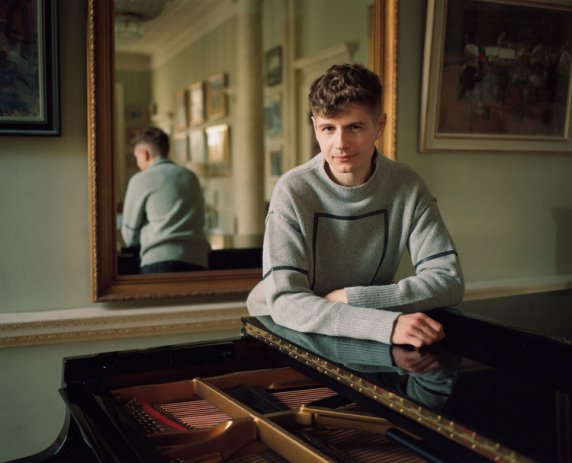




 The Cross-Eyed Pianist