
Pianist Peter Jablonski first appeared in the Meet the Artist series on this site back in 2016. In this updated interview, he reflects on his musical influences and inspirations, his new release for Ondine, and what the experience of lockdown has taught him, as a musician.
Who or what inspired you to pursue a career in music and who or what have been the most important influences on your musical life and career?
My first musical experiences were with jazz music, and I started learning jazz percussion at a young age. But piano came into my life very soon after, and it became obvious that it should be my main instrument when I started studying at the Malmö Music Academy, where I studied both percussion and piano performance. Everything in life can have an influence on a musician, big or small, and I count among those my performances at the Village Vanguard in New York when I was nine; meeting and playing to Miles Davis, playing with Buddy Rich and Thad Jones; playing to Claudio Abbado; working with Vladimir Ashkenazy; my first teacher in Malmö, Michał Wesołowski, who was so adept at describing music in colours, scents, feelings, and images; travelling the world as much as I have; reading Bertrand Russel, Pessoa, Oscar Wilde, Sabahattin Ali, Christopher Hitchens, Stefan Zweig, Dostoyevsky; learning my first Chopin mazurka; the realisation every time I play a concert that my profession is unique—one creates in a moment in time something that people can never hold in their hands, but something that they hopefully can carry in their memory for days, months, maybe years; my partner’s infuriating knowledge of obscure composers she continues to throw at me, and whose music often serves as a sad reminder of how unfairly many of them are forgotten. There are so many things that an artist can list as having been influential—it is the beauty of not only being an artist, but being a human.
What have been the greatest challenges of your career so far?
Overcoming an injury just before Covid-19 struck and wreaked global havoc. I was diagnosed with a condition called frozen shoulder, which took many months to heal, only to then migrate to the other shoulder. In a way, I can say that I experienced Covid-like restrictions imposed on my work two years before Covid appeared, and with it, a shock of suddenly not being able to practice, play, and even travel, and wondering if it would ever get better.
Of which performances/recordings are you most proud?
It is very difficult to listen to yourself, and many musicians would probably agree that it is often painful to hear one’s old recordings. These are just snapshots of those moments in time, and one has a tendency to always find room for improvement. But if I do look back, I would have to name my performances of the first piano concerto by Shostakovich, with Ashkenazy and the RPO and my recording of the Scriabin piano concerto with Ashkenazy and the DSOB. Tchaikovsky 2 with Dutoit and the Philharmonia isn’t too bad either, considering I had to learn the piece especially for the recording! Grieg’s Ballade and lyric pieces on Exton released in 2012 have been very dear to me, as I feel very close to Grieg’s intimate side in a Nordic kind of way.
I am also in a very different stage of my career now, where I am much less dictated to in the choices of my repertoire, and can really explore the long-neglected corners and all sorts of repertoire that I simply didn’t have time for until now. My collaboration with Ondine began last year, with the recording of Scriabin’s complete mazurkas, and continues with the upcoming release of piano works by Stanchinsky. These two composers are connected by their historical period, the city they lived in, and the professors they studied with. They knew each other, and were shaped by many of the same events that unfolded in the political and cultural life of Russia. I am absolutely delighted that in collaboration with Ondine, whose work I hugely admire, I have found a perfect mix of freedom to discover for myself the composers and works I long dreamt of knowing, and an impeccable quality control when it comes to all sorts of details and technicalities that I simply couldn’t think of myself.
Which particular works do you think you perform best?
This question can be answered differently depending on when it is asked. When I was a 17-year old pianist with a new Decca contract, I capitalised on my rigorous training in percussion and found particular enjoyment in performances of muscular, rhythmical, acrobatic works such as Prokofiev or Tchaikovsky piano concerti (I recorded all three for Decca), of performing and recording works by Gershwin and Ravel, and spending much of my time with Russian romantics and American 20th-century composers. But I am 50% Polish, so Polish composers always loomed large in my life, from Chopin to living Polish composers, and I am so glad I got to work on Lutosławski’s piano concerto with the composer himself, whose encouragement and guidance meant a lot. It was also an honour to have a concerto written for me by Wocjiech Kilar; to premiere works by Zygmunt Krause, Romuald Twardowski, and of course to always have in my repertoire works by Szymanowski, Maciejewski, and many others. Now I am very intrigued by the works by Grażyna Bacewicz, which I hope also to record for Ondine. So, I guess, to answer this question in another way: I like to think that I give my heart and soul to make sure every composer whose music I perform will get my best.
What do you do off stage that provides inspiration on stage?
Life is my inspiration. To wake up every day and to see outside my window how nature changes its colours and patterns in the most minute yet steady way is to be constantly inspired. No matter what, the spirit of nature continues its march towards each season, serving as a reminder to us humans, that we too should continue our pursuits with the same steadfastness, and always have time to stop and notice something wonderful and wondrous. You might say that being close to nature reminds me to try and bring this wonder to every concert.
How do you make your repertoire choices from season to season?
It varies greatly. A season might be dedicated to celebrating a particular composer, or one might happen to want to explore particular repertoire in a given year. Right now, for me, my choices are, of course, influenced by what recording I might be working on. For example, I can already say that 2022/23 season will be heavily focused on the music by Grażyna Bacewicz, which I am due to record for Ondine and which I will perform.
Do you have a favourite concert venue to perform in and why?
It is almost impossible to pick one, there have been so many. Suntory Hall in Tokyo has been a special place for me for many years—it is a large venue, and yet there is an intimacy one feels on stage during a recital that almost defies explanation.
What do you feel needs to be done to grow classical music audiences/listeners?
An eternal question! There are many elements to this answer: diverse programming, daring choices, fresh ideas that show people that there is a huge amount of interesting, worthy music out there that is still waiting to be heard. Hopefully, I will show this with my forthcoming release of piano works by Alexey Stanchinsky. But audiences do not grow just because we want them to—it starts in early childhood, at home, at school. Every child must have an opportunity to learn an instrument, to be exposed to great musical works just as they have to learn maths or learn how to read and write. Music should be embedded in education from the beginning—so many studies and experiments show the healing power of music, the effect it has on brain development, and on concentration, which is particularly suffering in our post-modern, social-media saturated, digital age.
What is your most memorable concert experience?
Again, an almost impossible question but certainly one of the most unusual was my first performance in Seoul, South Korea. It would have been around 1995 and I was due to perform Rachmaninoff’s Paganini Rhapsody with Myung-Whun Chung conducting the Philharmonia.
There was a public holiday in Korea that day so the orchestra bus was heavily delayed on its way to the concert venue. The concert was relayed live on Korean TV and the orchestra was not there at the time of the start, so I was asked if I could play something while we waited for the orchestra. I was still wearing jeans and a T-shirt, but it came to pass that Mo. Chung (who is a great pianist) and I had to take turns in giving an impromptu recital live on TV while the orchestra made its way through the Seoul traffic! Every time I play in Korea someone always comes up to me and reminds me of that day.
Of course I have to mention also the one when the cannon for the 1812 Overture (which was the next item in the programme) accidentally went off during a particularly peaceful moment in the slow movement of Tchaikovsky 1 in my debut with the Philadelphia Orchestra!
As a musician, what is your definition of success?
To be in a place that allows you to create at the piano, to be in the moment, for every performance to be an artistic experience and experiment, not just another concert. To be happy with the fact that the process of becoming an artist, a musician, a human being is ongoing and that there is no arrival point, only the journey full of ups and downs, possibilities, gains and losses, and most of all, continuous learning.
What do you consider to be the most important ideas and concepts to impart to aspiring musicians?
Learn how to know yourself, commit to a life-long process of discovering your artistic personality, be adventurous in life and in work, and most of all, do not to give up when things don’t work out straight away, and to keep a positive outlook even in the darkest of times. Remember the ancient Eastern proverb—‘Even after the darkest winter, spring will always follow’.
What has lockdown taught you as a musician?
To appreciate the space it has created around me, to appreciate the slower pace of life, and to find beauty in the smallest everyday things. To take a walk and to marvel at the beauty of nature, and of its indifference to us, humans, in a good way. It is obvious that without us, nature would do quite well, but we without nature—well, that’s a different story. The space, the quiet, the slowing down all help to restart the creative process, to recharge, and to find new energy for new projects.
Where would you like to be in 10 years?
Here in Sweden, still discovering new repertoire, as well as playing what I will forever love of Chopin, Beethoven, and so many others, and remaining open to what life brings.
What is your idea of perfect happiness?
Does it exist? To me, perfect happiness is perfect for a limited time only: if there is no strife, no challenges, no adversity of some kind, life has the danger of becoming boring. But waking up on a sunny morning and having a cup of coffee outside, listening to a spring song of a bird and being in that moment viscerally comes pretty close!
What is your most treasured possession?
My music scores.
What is your present state of mind?
Calm.
Peter Jablonski’s album of piano works by Alexey Stanchinsky (1888–1914), one of the most talented Russian composers of the early 20th Century, is released on 5 March on the Ondine label. Stanchinsky was not only a talent but a genuine innovator who, despite his early death, had a profound influence on the generation of composers to follow.
The album will be released one year after lockdown began. During these difficult and uncertain months, many people may have experienced poor mental health at times, just as Stanchinsky did during his lifetime. In honour of Stanchinsky’s memory, Peter Jablonski has partnered with Samaritans and will make a personal donation to assist their work. The official message from Samaritans is: When life is difficult, Samaritans are here – day or night, 365 days a year. You can call them for free on 116 123, email them at jo@samaritans.org, or visit www.samaritans.org.
Peter Jablonski is an internationally acclaimed Swedish pianist. Discovered by Claudio Abbado and Vladimir Ashkenazy and signed by Decca at the age of 17, he went on to perform, collaborate and record with over 150 of the world’s leading orchestras and conductors, including the Philharmonia, Royal Philharmonic Orchestra, Leipzig Gewandhaus, Mariinsky, La Scala Philharmonic, Tonhalle Zurich, Orchestre Nationale de France, NHK Tokyo, DSO Berlin, Warsaw Philharmonic, Los Angeles Philharmonic, Philadelphia and Cleveland Orchestras and worked with such acclaimed conductors as Vladimir Ashkenazy, Valery Gergiev, Kurt Sanderling, Esa-Pekka Salonen, Riccardo Chailly, Daniele Gatti, and Myung-Whun Chung, to name a few. He has performed and recorded the complete piano concertos by Beethoven, Tchaikovsky, Rachmaninoff, and Bartók and all of the piano sonatas by Prokofiev. During his three-decade-long career, he worked closely with composers Witold Lutosławski and Arvo Pärt. Jablonski’s extensive discography includes several award-winning recordings.


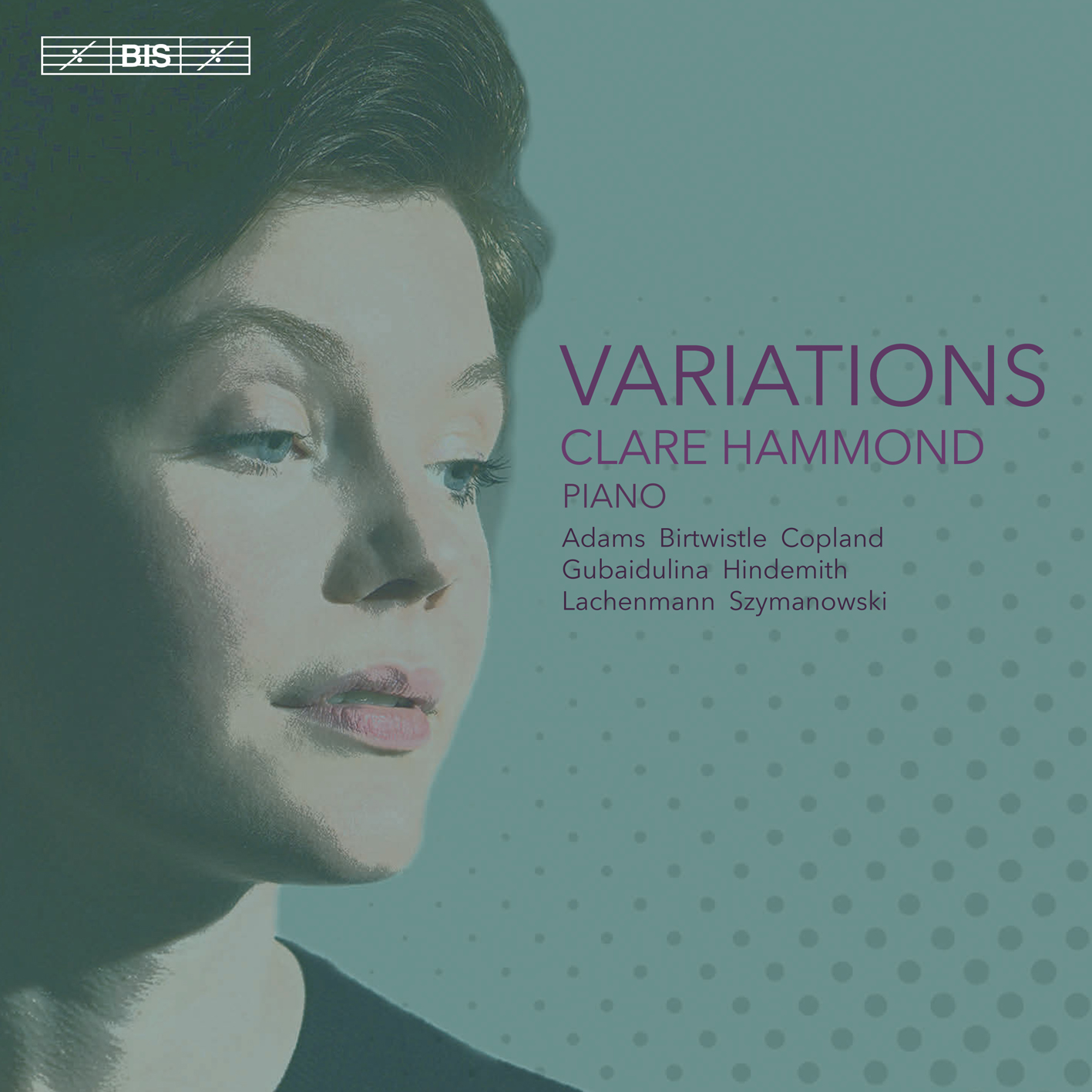 It’s a simple concept – a theme, or melody, initially stated in its original form, is put through a series of transformations, often quite complex and including textural, dynamic and key changes, to take player and listener on a fascinating musical journey. The Theme and Variations remains a popular genre amongst composers and the myriad ways in which composers respond to this simple form has resulted in some of the most inventive, intriguing and daring music in the piano’s repertoire.



 The Cross-Eyed Pianist