The sonatas of Mozart are unique; they are too easy for children, and too difficult for artists. ― Artur Schnabel
On the page the piano music of Wolfgang Amadeus Mozart looks simple (but never simplistic) yet for many pianists, the music’s greatest challenge lies in that simplicity. Its beauty, and profundity, is contained in a transparency of texture and expression which challenges the most technically assured and artistically insightful musicians.
As pianist Alfred Brendel says of Mozart, “everything in his music counts”. He reduces music to its most essential and it demands from the pianist a precision which easily matches the virtuosity required to play Liszt. Arpeggio passages and trills must shine with jeu perlé playing; literally “pearly playing”, a technique which creates fractional separation between rapid notes to bring a glorious opalescent sheen to the sound – easy to achieve on the lighter instruments Mozart would have known, much harder on a modern piano. His gorgeous melodic lines must sing like the most beautiful, sensual arias from his operas, accompaniments (Alberti bass lines, for example) need the balance of the best string quartet textures, while fioriture and cadenzas call for drama and spontaneity.
For many professional pianists, Mozart is regarded as the ultimate challenge. This may seem surprising, given that his piano scores contain far fewer notes than, say, those of Liszt or Ravel. But every one of those notes demands to be sounded and heard perfectly, and this requires an inordinate level of technical mastery to achieve such refinement, coupled with imagination and artistry to breathe colour and life into those deceptively simple passages. In the piano music of Schumann or Liszt, Brahms or Rachmaninoff there are thickets of notes which give one some cover; in Mozart there is nowhere to hide.
The beautifully-crafted simplicity of the notes belies unfathomable and infinite complexities, and an extraordinary breadth of expression, which easily equals that other master of musical chiaroscuro, of smiling through tears, Franz Schubert. Dismiss the image of Mozart as the giggling, farting Rococo man-child as portrayed in the play and film ‘Amadeus’; the range of emotion in Mozart’s writing is extraordinary: profound, poignant, tender, angry, joyous, witty, passionate, demonic, exuberant, his mercurial mood shifts often occurring within just a handful of bars, or even a single bar, sunshine one moment, dark clouds the next.
Mozart’s piano works should be for the player a receptacle full of latent musical possibilities which often go far beyond the purely pianistic. – Alfred Brendel
Another challenge for the pianist is Mozart’s complete mastery of orchestration. His musical imagination was not limited by the compass and timbre of the keyboard instruments of his day, or indeed the modern piano, and his solo piano works demonstrate his entire oeuvre in microcosm, from string quartets and wind divertimenti to symphonies, and operatic arias and recitatives. There are grand orchestral tuttis, brass fanfares, articulation drawn from string writing and woodwind, and of course the singing melodies which must speak with clarity, meaning and beauty. Many of the piano sonatas have a symphonic sweep and soundworld in their opening and closing movements, while the slow movements are soprano arias with dramatic interludes. Such piano writing demands that the pianist harnesses his/her imagination to evoke these instruments and sounds within the scope of two staves and just two hands.
The Cross-Eyed Pianist is free to access and ad-free, and takes many hours every month to research, write and maintain. If you find joy and value in what I do, please consider making a donation to support the continuance of the site
“Bach’s Goldberg Variations caused me misery – but I still can’t get enough”
– Jeremy Denk, pianist
Our relationship with our repertoire is personal and often long-standing. Connections with certain pieces and composers may be forged in our early days of learning our instrument, which remain with us throughout our musical lives. Many of us can clearly remember some of the earliest pieces we learnt as children, and returning to repertoire learnt in childhood and during student years can bring an interesting, and sometimes uncomfortable rush of memories. Opening the score of the first book of Bach’s Well-Tempered Clavier, I saw my teacher’s markings, her explanation of the structure of a fugue, and for a moment I was transported back nearly 40 years to her living room and the big black Steinway grand piano on which she taught me.
Sometimes these repertoire relationships forged during early study can be detrimental to our learning as mature players. Bad habits from childhood and student days are deeply ingrained, and all too easily recalled, and thus very hard to shift later on. This is interesting in itself as it demonstrates how carefully (or not) one has learnt the music previously, and sometimes the only way to step aside from these habits is to buy a new score and start the music afresh, as if learning it for the very first time.
Jeremy Denk’s comment on the Goldberg Variations is interesting and will resonate with many musicians, I’m sure. We all have pieces which have a particular hold over us, which fascinate and compel us to revisit them over and over again. Yet their technical and musical complexities make the learning and practicing process difficult and sometimes less than rewarding. Some repertoire, however beautiful, satisfying or intriguing, is simply a slog, and the more progress one makes, the more “just out of reach” it seems.
Other works, in comparison, feel relatively easy, the music flows in practice and performance, gives satisfaction to player and audience, and enters into one’s personal catalogue of “favourites”.
However, “easy” can be a myth, because everything, even the simplest little prelude by Bach, can be taken up a level each time we revisit the music. This setting aside of and returning to repertoire also affects our relationship with it, and we may observe how that relationship changes over time and with the benefit of artistic maturity. I have gone back to previously-learnt works and wondered what I found so difficult before. The passing of years, and accumulated experience and wisdom make the process of reviving repertoire stimulating and enjoyable. We are reminded of what attracted us to the music in the first place, while also continually finding new aspects to it. This curiosity also helps to keep alive our relationship with the repertoire.
Then there are pieces which we may never play, but, rather like the books you haven’t read, and may never read, remain special. Just knowing the score is there, on the bookshelf, can foster a particular relationship with that music (I often buy scores of music I know I will never play simply for the pleasure of reading the music or admiring the organisation of it on the page), and maybe one day you will open it, set it on the music stand, and start the process of learning it….
A personal journey through Schubert’s penultimate piano sonata (read previous posts here)
With a good deal of reading, of both the score and books and articles on this sonata and Schubert’s piano music in general, and listening, and thinking, by late November 2014, it was time to embark on some serious note learning……
As noted in an earlier post, Schubert’s late piano sonatas are large-scale works: their first movements alone, with exposition repeats intact, can last as long as an entire sonata by Beethoven, and this “heavenly length” can pose problems for the performer in terms of stamina (it takes me around 43 minutes to perform the D959 in its entirety, with repeats), retaining a clear sense of the cyclic elements which recur throughout the work, and appreciating the overall narrative of the work. From my reading of the score, and other materials, I had concluded that the second movement, the infamous Andantino was the most “difficult” (though this is all relative when considering such a large piece of music!). This is the movement which provokes the most discussion and theorising amongst pianists, musicologists, critics and audience members, many of whom believe this movement is the clearest indication we have of Schubert’s emotional and mental instability, probably due to his advanced syphilis. Musically, it feels like an aberration in the overall scheme of the D959, which is generally warm-hearted and nostalgic in its character and prevailing moods, and it is unlike anything else Schubert wrote. “Its modernity is incredible even today” (Andras Schiff, Schubert Studies). It has a “desolate grace behind which madness lies” (Alfred Brendel), the lyricism of the outer sections providing a dramatic foil to the savage intensity of the middle section. Its position in the overall structure of the sonata creates a striking contrast between the majesty and expansiveness of the opening movement and the quirky, playful Scherzo which follows it. In my own practical approach to this movement, I decided to ignore much of the psychobabble and work with what is given in the text.
The movement is in straightforward ABA (ternary) form, the A section reprised with a more intricate left-hand accompaniment and a haunting triplet figure in the treble.
The middle, B, section unfolds initially like a Baroque fantasia (bars 73-86), with descending diminished seventh arpeggios which take the music into C-minor. Gradually all the elements speed up (Schubert indicates this through note sub-divisions, striking modulations and volume of sound) and the music continues to build with increasing savagery via extreme registers and the use of trills to sustain tension, eventually arriving at C-sharp minor and culminating in dramatic fortissimo chords (bars 120/121). A short recitative-like section follows, interrupted by dramatic chords, before a serene passage reminiscent of the G-flat major Impromptu (D899/3). The A material returns at bar 159.
The opening A section combines a barcarolle bass line with a right-hand melody redolent of several of the Heine songs and ‘Der Leiermann’ from Winterreise, while its expressive qualities and character relate to the song ‘Pilgerweise’, also in F-sharp minor. Some pianists like to treat this movement as a barcarolle with a storm in the lagoon (the middle section). Daniel Barenboim has called A section “a melancholy folksong”, a description which I particularly like: the lilting style of a folksong is implied by the recurring bass figure and the simple melody from which is unleashed the turbulent and chaotic middle section.
A rather chilly, tread-like quality in the bass is created through the use of staccato on the first note and the slur on the second and third notes, with the third note lighter (although this is not indicated specifically after bar 2, we can safely assume that this is what Schubert intended throughout). I found it helpful to think of this in terms of a cello or bass pizzicato figure: it needs resonance but should also be balanced with the right-hand melody. I don’t sustain the staccato note with the pedal here, and indeed the pedal is used sparingly throughout this section. The repeated use of falling seconds and a limited range, together with largely understated dynamics, create a feeling of stasis and melancholy contemplation. With so many repetitive elements in this section, it is necessary to create contrasting musical colour (for example between bars 1-8 and 9-12). At bar 19 the music moves into A Major, one of those magical Schubert moments where the mood seems at once warmer and yet even more poignant because it is expressed pianissimo. I like to use the una corda pedal for this pianissimo passage, and the corresponding passage at bars 51-54 to create a sense of other-worldliness.
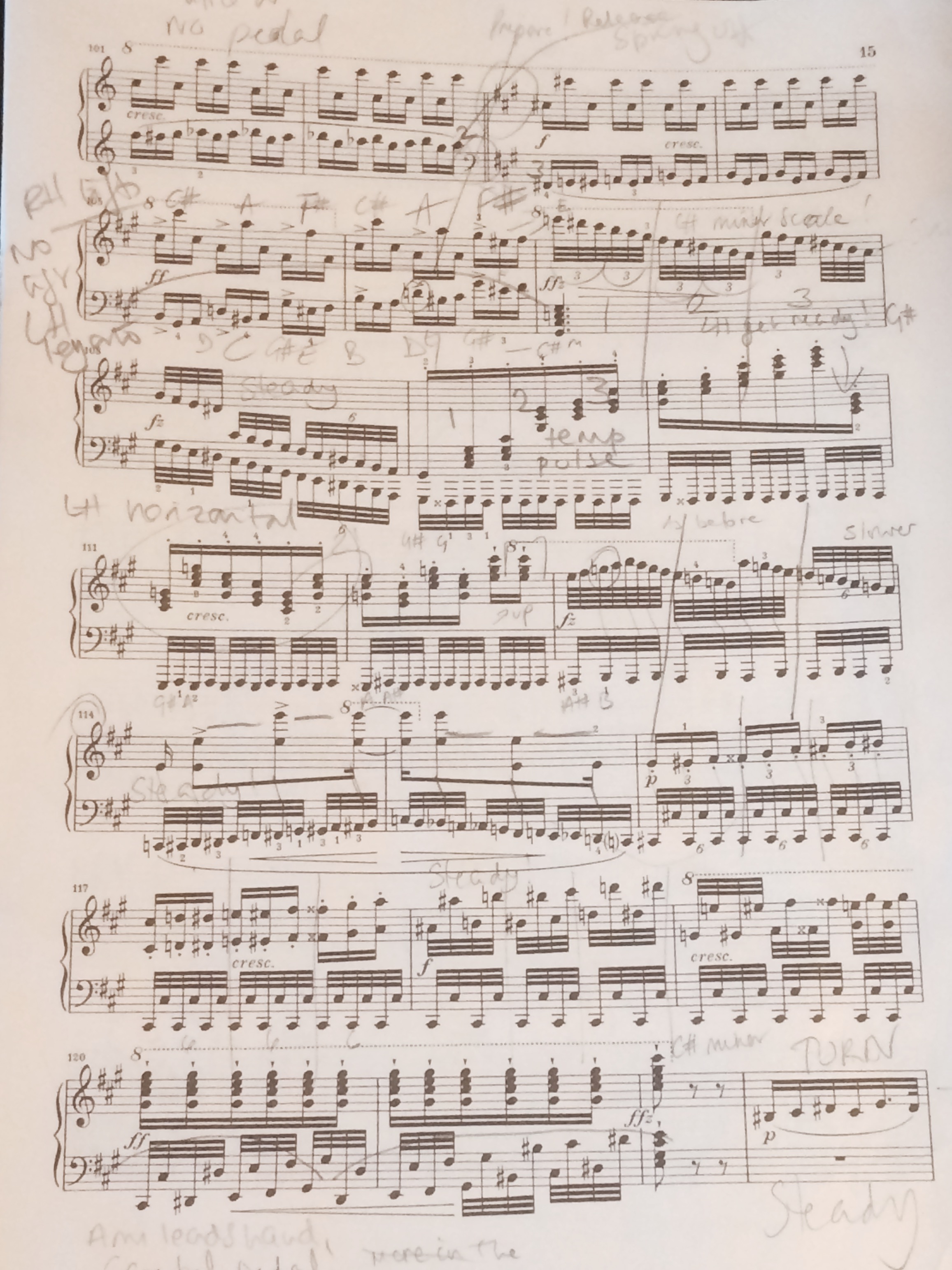
Page 3 of the Andantino with my annotationsOther details worth noting throughout this section (bars 1-32) are the inner voices in bars 7, 15, 16, 25, 29 and 31 (and then at bars 39 and 57), and the ornaments which should be played on the beat (though many celebrity pianists prefer to do otherwise, admittedly to beautiful effect). For example, in bar 15, the A sounds with the E sharp on the beat and the turn at bar 23 begins on the note above, but need not be pedantically with the bass C sharp. (See David Montgomery Franz Schubert’s Music in Performancefor more on ornaments.)
At this point I feel it’s important to mention the overall tempo of the movement. It is marked Andantino, and needs a sense of forward propulsion. Despite this, some pianists tend more towards Adagio, and at this speed there is, in my opinion, a very fine line between the music sounding meditative or funereal, or even boring, which I do not feel is appropriate. I have aimed towards a metronome mark of quaver = c90 bpm. A quick browse through Spotify reveals quite a broad range of tempi, with some versions of the Andantino coming in at well over 8 minutes (Schnabel, Pollini, Uchida, Perahia) and others at around or under 7 minutes (Lupu, Schiff, Goode).
Here is Uchida
And Lupu
And so on to the B section, which leads to the most passionately and extraordinary part of the movement and indeed the whole sonata. It is typical of Schubert to create sections in the music which are vividly contrasting yet also complementary: the A sections are reflective in their lyrical subject while the middle section completely destroys this frame of reference, only for it to return at the reprise of the A section. It is the strong contrast between the A and B sections which makes this movement so arresting and so powerful.
The bridging passage begins at bar 69, and is preceded by three bars whose dark, descending chords mirror in their reverse movement the chords which form the opening sentence of the sonata (and a figure which recurs elsewhere). I like to create a sense of mystery in bars 69-72 with a wetter pedal effect and a little rubato to suggest improvisation as the music unfolds. The main difficulty I encountered in the entire B section was maintaining a sense of the underlying 3-in-a-bar pulse and clarifying the different note hierarchies, while also continuing the improvisatory/fantasia feel. In order to achieve this, I drilled the section strictly with the metronome for several weeks, a tedious but necessary task for once the note hierarchies and subdivisions were well learnt, I could let the music break free, particularly in bars 102-122, to create a rising sense of hysteria.
A clear sense of pulse is required through bars 124-146, as the recitative section takes over. After all the “busyness” of the previous page, I like to create a sense of the music being restrained once again, with the contrasting disruption of the FFz chords. At bar 147 the music arrives in C-sharp major in a passage which seems directly drawn from the G-flat Impromptu. At bar 159 the A section returns, this time with the more elaborate LH figure and the triplet figure in the RH, which should have the quality of a separate, “other” voice. Throughout this section, it is important to retain a sense of the opening melody and a similar lightness in the LH to that in the opening bass figure (note the demi-semiquaver rests at the end of each bar). Bars 177-182 the RH accented E’s sound as tolling bells above the melody, and once again I like to use the una corda pedal here to give a more ethereal quality and to create contrast with the forte chords in bars 185/66 and the descending figure in bar 187. The movement closes with dark, arpeggiated chords which echo those at bars 65-68, and which are transformed into sparklingly joyful spread chords in the Scherzo which follows. I try to keep these in tempo until bars 198/9 at which I introduce a rit. to signal the close of the movement. The dynamic landscape here is very quiet and muted, and I feel una corda is perfectly acceptable in these closing statements.
It took me three months of fairly consistent work to bring the movement to a point where I felt confident enough to perform it for others (for friends at home). I then “rested” it for some weeks while I turned my attention to the first movement, the subject of the next article.
My slightly unusual recording of this famous nocturne was inspired after the discovery of a remarkable book over the summer of 2014: Neal Peres da Costa’s Off the Record: Performing Practices in Romantic Piano Playing. The basic premise of the book, argued painstakingly and meticulously throughout, is that early recordings (those by pianists born in the nineteenth century) provide a vital and often overlooked window onto 19th-century piano playing. Far from being the mannerist distortions that later schools of pianism dismissed in favour of so-called fidelity to the score, Peres Da Costa argues that these recordings embody a performance tradition that is quite probably quite close to the playing of Schumann, Brahms and Chopin. He also charts some of the changes in playing style that occurred during the course of the twentieth century, during which some of the older expressive approaches were deliberately derided and discarded. He refers to a wealth of recordings, pedagogical texts and contemporary accounts of piano playing in support of his argument, and focuses on Chopin’s D flat Nocturne amongst other works.
The musician who spends time listening to the many audio examples Peres Da Costa provides (via an associated website) as well as to full length recordings available elsewhere (see discography below), will be at the very least intrigued by this remarkably different pianistic universe, though to begin with the sound quality and some of the expressive habits of particular pianists can be annoying or puzzling. Above all it is an emotional, improvisatory, sometimes wildly spontaneous world, though perhaps for that very reason unsuited to the definitive act of recording in the modern sense, in which a masterpiece is perhaps interpreted in an idealised way that will stand the test of being listened to many times.
Dr Charles Tebbs is a pianist, accompanist and piano teacher based in Nottingham, with a wealth of experience and a diverse range of musical expertise. He gives regular concerts and recitals and has made a CD of Bach’s Goldberg Variations. His doctorate is in musicology (concerning musical endings) and he has also written prize-winning compositions and music for TV.
The Cross-Eyed Pianist is free to access and ad-free, and takes many hours every month to research, write, and maintain.
If you find joy and value in what I do, please consider making a donation to support the continuance of the site






 The Cross-Eyed Pianist