“Never play faster than you can think”

This well-known maxim by pianist, teacher and composer Tobias Matthay has, for me, a relevance both in day-to-day practice, and also in performance. When we practice, in our eagerness to move on to a new section or movement, we may rush ahead without taking the time to fully absorb what we are learning. I am as guilty as the next person of this habit, though I now practice in the way the great Russian pianist Sviatoslav Richter claimed to: I do not turn the page of the score until I have learnt it properly. There is also the habit, particularly among young students, of playing everything too fast without taking the time to think. And how often have we played a piece marked Allegro and taken it at such a lick that the fingers work ahead of the brain and we end up in an unholy muddle?

At the recent EPTA-organised piano day at Steinway Hall, pianist Murray McLachlan talked about allowing the music to “breathe”. This is a perfect analogy, not least because the melodic line in piano music can, and should, be approached as sung line. On a practical level, where a singer might take a breath marks the natural end and beginning of a phrase, but singing also lends shape to music: the human voice has a natural rise and fall and cadence, something we should strive to imitate at the piano. Other physical gestures and body language can also help to enhance both sound and mood: the wistful lifting of the fingers off the keyboard to allow the music to float around the room; the speed and angle of attack and lift off, to suggest different moods; differentiation between the various “layers” of sound/melodic line within a piece; “implied dynamics” rather than actual volume of sound (for example, a fortissimo marking in Schubert or Chopin can be suggestive rather than actual).

In his book The Craft of Piano Playing, pianist and professor Alan Fraser talks about ‘entasis’ in music, the careful distortion of pulse, melodic shape or harmonic colour to enhance innate musical content. The term, derived from architectural language, means a slightly convex curve given to a column, pier or similar structure to correct the illusion of concavity created by a straight shaft. ‘Aural entasis’, Fraser says, can, just as in architecture, create the illusion of greater lengthening or shortening, thus highlighting the contours of the music, and should suffuse every bar we play (note: not to be confused with Rubato, which is a more deliberate action in music). At the simplest level, this can be the increase in dynamic level as the music ascends the register, and a softening the lower the music descends. It can also refer to rhythmic elements, such as waiting an instant longer before sounding a syncopation, or the shortening of the first part of a dotted rhythm to increase vitality, emphasis and drama (something I have been working on in the opening measures of Bach’s Toccata from the 6th Partita). Waiting a microsecond longer before playing the next note in a sequence offers a wonderful sense of delayed gratification to the listener, especially if combined with ambiguous harmonic shifts, such as in Chopin’s First Ballade, or at the end of the Opus 62 Nocturnes, which have the most mezmerising harmonies. No two beats will ever last exactly the same amount of time: only a metronome has this exacting regularity, and music that is played with such a rigid pulse will never sound natural.

It is hard to teach such subtle elements as these, which are often very personal to the individual performer, but a good performer will employ ‘entasis’ almost unconsciously, thus giving the music its human, ‘speaking’ quality, an innate sense of an inner pulse, and natural colour and shaping. Music which lacks these qualities can sound static, flat and dull, no matter how well it is played technically, and audiences will soon lose interest because mechanical music lacks a spiritual quality: as Aristotle observed “sameness of incident soon produces satiety” (Poetics XXIV). Mistakes, even very small slips or smudges, can also be far more obvious in music that is played without ‘entasis’, and the requirement to play with extreme accuracy, both of pitch and metre, is the cause of much performance anxiety amongst musicians.

Of course, too much ‘entasis’ may produce chaos in music, which listeners can find confusing and uncomfortable. To achieve a natural sense of pulse in music, drill the piece with the metronome until it is almost too fast, and then allow it to relax as you sense its metre from within, as you might your own heartbeat. The musical beat must fluctuate according to the emotional content of the music – just as the human heartbeat fluctuates at times of stress, excitement, contentment or relaxation. Remember, true musical perfection is in the soul of the listener, rather than in the performer’s ability to produce a performance in which each and every note is metrically and pitch perfect. ‘Entasis’ can be seen as the balance between a feeling of predictability and one of uncertainty, and this is what gives music its sense of anticipation, delayed gratification, excitement and ‘musical thought’.

Evgeny Kissin playing Chopin’s Ballade No. 1, Op 23

Alan Fraser’s website

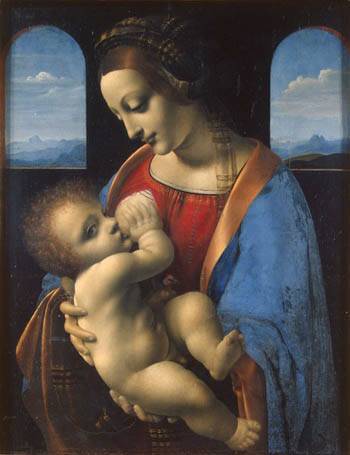
Madonna and Child (Madonna Litta) by Leonardo da Vinci 1452-1519

French composer, organist, ornithologist and devout Catholic Olivier Messiaen began his masterpiece Vingt Regards sur l’enfant Jésus in 1944, and the work was premiered in 1945 by Messiaen’s piano student and future wife, Yvonne Loriod. The French title roughly translates as ‘Twenty gazes/ contemplations on the infant Jesus’. The entire work is a meditation on the childhood of Jesus, and it utilises recurring “themes” or leitmotifs to highlight certain ideas, such as the Star, the Cross, and the Father.

Messiaen’s music is rhythmically complex (he was interested in the rhythms of ancient Greek and Hindu music) and draws inspiration from many sources, including Indonesian Gamelan music (which also interested and inspired Debussy), Japanese music, the landscape of Utah in the USA, and the legend of St Francis of Assisi. My own serious interest in Messiaen’s music began after I discovered he was a fellow synaesthete, who experienced colours when he heard or imagined music. He devised his own system of modes (scales) based on his synaesthesia, and in certain scores he actually notated the colours, to help the conductor in interpretation, rather than to express exactly which colours the listener should experience. He also wrote descriptions of the colours of chords, ranging from the simple “gold and brown” to the highly complex “blue-violet rocks, speckled with little grey cubes, cobalt blue, deep Prussian blue, highlighted by a bit of violet-purple, gold, red, ruby, and stars of mauve, black and white. Blue-violet is dominant”. My own synaesthesia manifests itself in a similar way to Messiaen’s, though each synaesthete’s experience is of course unique and personal, and I find his concept of colour in music – in the sense of real colours, as opposed to shadings of dynamics and articulation – entirely understandable. Indeed, my own score of the ‘Regard de la Vierge’ (No. 4 of the Vingt Regards) is littered with notes about colour.

As I teenager, I visited the Église de la Sainte-Trinité in Paris where Messiaen was organist (my mother had a penchant for visiting places with ‘artist associations’: the same trip to Paris included a fascinating tour of the studio of symbolist artist Gustave Moreau, and a pilgrimage to the Père Lachaise cemetery to see the tombs of Oscar Wilde and Fryderyk Chopin). As a pianist, I was for a long time fearful of attempting any of Messiaen’s music – indeed anything atonal (Schoenberg, Hindemith) I regarded with extreme trepidation – but I heard the ‘Regard de la Vierge’ played at a piano course I attended last year, and was very taken with it. Hearing the Quator pour le fin du temps (‘Quartet for the end of time’) at the Wigmore last winter (with Stephen Osborne on piano), a deeply arresting and emotional experience which left me in tears at the end of the concert, confirmed that this was a composer whose music I should explore.

Hearing a selection of his Preludes (1928/9) at a recent concert at the Wigmore Hall, I was struck by how close these pieces are to Debussy and Ravel, with their uncertain harmonies (chords chosen for timbre and colour rather than strict harmonic progression), and impressionistic titles, such as La Colombe (‘The Dove’) or Les sons impalpables du reve (‘The Impalpable Sounds of Dreams’). The Vingt Regards were composed some 15 years later, his compositional style had evolved a great deal, and by that time Messiaen had also experienced the full horror of the Second World War as a prisoner of war, after the fall of France to the Nazis in 1940. While his deeply-held faith undoubtedly informs this music, one does not have to be religious oneself to be affected by it. The sheer scale of it (20 movements, a work lasting around 2 hours), the sounds and images it suggests, it is music that expresses something far greater than us.

While each Regard is different, they are linked by the use of recurring motifs (Messiaen’s “themes” of all-embracing love, the Virgin, the Star, the Cross, God the Father), “flashes” (clusters of notes or fragments which reflect Messiaen’s belief that it was only possible to comprehend the totality of God in “flashes”), tolling bells and chimes, references to devotional texts, portentous passages, suggesting Jesus’s fate, repeating chord progressions, and birdsong. While Messiaen is absolutely specific in his writing, there is room for individual interpretation and variation, and, for me, this links the pieces back to the earlier Preludes, and the impressionist writings of Debussy and Ravel.

Messiaen prefaced his masterpiece with a detailed commentary, and each Regard has its own short explanatory paragraph which offer fascinating insights into his very personal visual, devotional and compositional landscape for these pieces, as well as offering useful pointers for performance.

In the ‘Regard de la Vierge’, the Virgin Mary contemplates the infant Jesus with a simple tender lullaby which demonstrates affection and recognition. A contrasting middle section, with birdsong, “flashes”, tolling bells and portentous double octaves interrupts Mary’s devoted gaze, and is a reminder of Jesus’s fate. The naive rocking theme is then restated with bell-like notes in the upper registers, as an expression of Mary’s intimate motherly response and God’s love for humankind.

Pianist Stephen Osborne is an acclaimed Messiaen-player, but for me Pierre-Laurent Aimard’s recording of the Vingt Regards is sublime, capturing the mysticism and magnitude of this great work.

Interestingly, while looking up something unrelated to Messiaen, I heard this track by Radiohead, Pyramid Song, which contains a piano riff which could easily have been lifted from one of the Vingt Regards.

Radiohead – Pyramid Song

Messiaen on Debussy and Colour

Regard de la Vierge, No. 4 of Vingt Regards, played by Pierre-Laurent Aimard

More on synaesthesia and music here

technique |tekˈnēk|
noun
a way of carrying out a particular task, esp. the execution or performance of an artistic work or a scientific procedure.
• skill or ability in a particular field
• a skillful or efficient way of doing or achieving something

Everything you do, sounds. All your movements, both intended and unintended, have their effect on the sound you produce

Alan Fraser

Technique lies at the foundation of piano playing, and good technique can serve the beginner student right through to advanced level. However, it should never be the “be all and end all”. Rather, it should serve the music – to create when required, for example, the lightest staccato, the most cantabile melodic line, a bubbling Alberti bass, sprightly trills and tremolandos, the most fluid legato.

Pianists are often praised for having “fine technique” or “superb technique”: this can range from obvious things such as physical agility/velocity and stamina to more esoteric, “hidden” aspects such as arm weight, wrist rotation, and alignment. These days, with the prevalence amongst mostly oriental generic pianists for putting technique above all else, piano “technique” has come to mean sheer physical capability, speed and sound production (usually too loud!) without a true understanding of how a particular technique specifically relates to the music, and the effects the composer is asking for.

Perhaps the most obvious example of this is staccato, of which there are different kinds:

  • Arm staccato gives equal measure to each note and is particularly useful for a crisp, short or bouncy sound. Involve the forearm and keep the wrist soft. Avoid pure wrist staccato as this pulls up the fingers and creates tension. Aim for a free drop of the arm and then bounce off the keyboard on the rebound.
  • Jeu Perlé literally “pearly playing”, this is particularly useful for semi-quaver passage work in Mozart and the like, also in Debussy, where such passages should be played quickly, lightly and clearly, and where too much obvious articulation would create dryness. It is a type of staccato playing that creates the tiniest sense of separation between each note (like the knots between the pearls in a necklace), and requires small movements and a close attack. Play the note and let it bounce up at you – i.e. do not pick the fingers up.
  • Finger staccato/flicking staccato Possibly the hardest staccato technique to perfect, this requires the fingers to flick off the keys and back towards the palm of the hand. Beware of tension in the hand and wrist when practising this technique, and employ the alignment of arm and wrists to fingers. To play repeated notes with finger staccato, practice using different fingers (say 1,2,3,4) but allowing the wrist and arm to take the fingers into position with a “polishing” movement in the wrist (I imagine there is a tiny pencil under my wrist, drawing an ellipse shape).

A pianist who has done their homework, and has fully studied, understood and absorbed the composer’s intentions and instructions in the score, will know what kind of staccato technique to employ for a particular section or passage.

When starting out with any new aspect of technique, whether teaching it or doing it for yourself, it helps to enlarge the movement. Thus, when I am teaching rotary movement, I get the student to make the movement in a broad brush away from the piano. I like to use the image of windscreen wipers for this – a visual cue which children find particularly easy to understand. Also, one is trying to suggest an ‘outwards-inwards’ movement rather than the reverse. Never attempt to teach a technique you have not learnt and understood yourself first.

Don’t practice technique in isolation, but rather understand how it should be employed in your music and then make a technical exercise out of a small passage or section from that music. Doing exercises like those by Czerny or Hanon are, in my view, less worthwhile than a technical exercise you have devised yourself to practice a particular aspect of your repertoire; it is also more interesting! Having said that, I have found Brahms’s ’51 Piano Exercises’ helpful, and also tuneful to play.