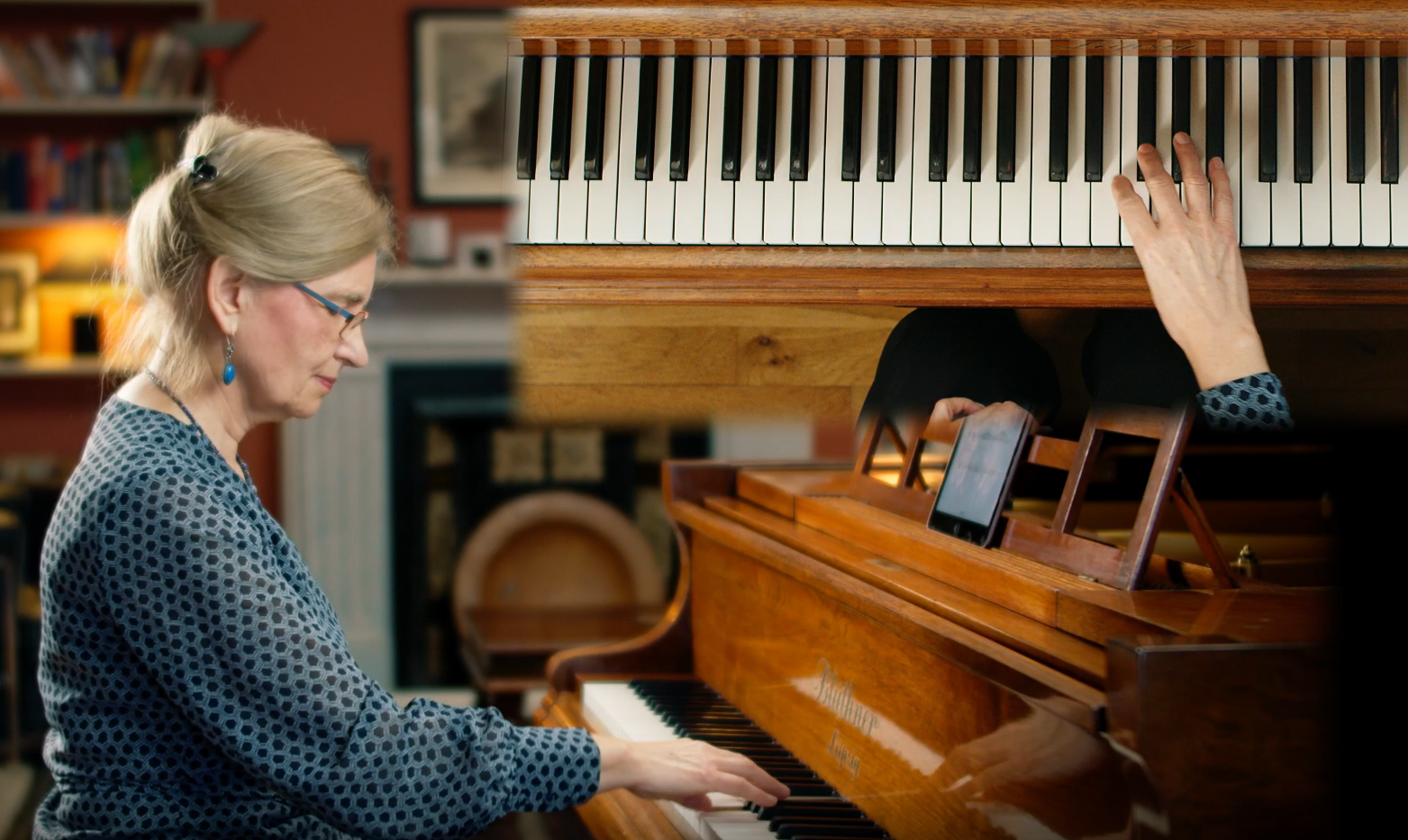
Guest post by Lizzie de Lacey

The covid-19 pandemic has forced many of us to reinvent ourselves in one way or another. For some this has involved having to find a completely new way to earn a living; for others it has meant searching for ways to keep ourselves busy and, importantly, to keep our spirits up. It is therefore perhaps unsurprising there has been a huge increase in the number of people buying puppies…and pianos. As someone with both pup and piano, I can’t advise you on which might give you more pleasure, but I can offer some advice about learning the piano, although I have to declare a vested interest.

At this point I need to thank Fran The Cross-Eyed Pianist for very kindly asking me if I would like to write a guest blog for her website. So here I am, putting my head over the parapet to talk about what I have been cooking up during lockdown, while others have been getting to grips with sourdough. In fact my ‘piano method’ has been simmering for much longer than that. For many years, I have felt uncomfortable with the glaring gaps in the way we approach piano playing and teaching. As a result of those gaps, most of us are reliant on the printed page for every single note of music that we play. Playing by ear and improvisation are a completely alien concept.

For myself, I never really believed that I could call myself a musician if I could not make music without a printed sheet in front of me. The fact that I could not was a source of shame and embarrassment. Then one day I decided to teach myself. Working on the basis that the best way to learn a subject is to teach it, I found a group of willing friends and set about teaching improvisation. What resulted from those weekly sessions taught us, I believe, something even more important than how to add harmony to melody; it gave us a much greater understanding of how music ‘works’.

As a piano teacher during lockdown, I began to teach (with some trepidation) using video exchanges on WhatsApp. This approach was more successful and rewarding than I had anticipated, and brought me to some interesting conclusions about teaching in general. For my own part, the need to produce video lessons that were absolutely clear and concise, gave me new motivation, and stimulated fresh insights into my own teaching. As far as my pupils were concerned, learning from videos forced them, in their own space and time, to figure things out for themselves. Having to prepare videos to send back to me also seemed to give my pupils a new motivation to practice, until they were happy watching their own performance. Gradually it began to dawn on me that now was the perfect time to finally release my own piano ‘method’, which has been steadily germinating for longer than I care to admit. Despite lengthy dialogues with music publishers over the last three decades, my ‘book’ was ultimately turned down for being too ‘gimmicky’, too ‘different’, and, on one occasion, for teaching only pieces in C major for the whole of the first chapter.

Being different was always my intention. It has never surprised me that so many people ‘give up’ the piano so quickly (quite apart from the considerable, and often prohibitive, expense of regular lessons). Our obsession with teaching music-reading from the start, and the discouragement of any kind of improvised playing, means that many slow readers ‘fail’ before they have even started. At this uncertain time for musicians (and for classical music itself), it is even more vital for those of us who make and teach music to be flexible, so that we can adapt our style and our teaching in ways which will bring us and our pupils success, or at the very least, joy. For many classical musicians, the reality has always been a life of long working hours and low pay. Of course, there is money in music, as those successful in the popular music industry well know, but few classical musicians ever tap into this other world, even if they are struggling to sustain their careers. The reason? Their highly specialized training frequently has not included improvisation or composition, even at the simplest level. Almost unbelievably, it is still possible to graduate from a top UK music college, without ever having been encouraged to play by ear, or improvise. Yet armed with three or four chords, popular musicians come up with catchy tunes which are whistled and sung the world over, and which make millions, if not for the composer, at least for someone, somewhere along the line.

Learning to play the piano is a lifelong journey, and it should be a journey that we enjoy, every step of the way. In recent years there has been much evidence to tell us that, at all stages of our lives, we learn best when the process is enjoyable and playful. Instead of ‘learning to play’, this course encourages ‘playing to learn’. It is designed to keep the joy of learning and playing alive at every step, introducing colours to enhance the whole experience, and to impart a deeper understanding of what we are doing. Chopsticks to Chopin takes the student right back to the beginning – to Chopsticks, in fact – and then progresses via a very different route. It is easy, fun and creative, and can teach a beginner to play real music with two hands, from day one. It opens the door to improvisation, and encourages playing ‘from the heart’, not merely from the ‘dots’ on a page. The system can, I believe, be an effective alternative way into music for children or adults who face challenges such as dyslexia, dyscalculia, and ADHD, who may previously have tried and ‘failed’. It also has much to offer an experienced player who might be aware that there are important things which have been missed out of their music education.

So how does it work and how is it different?

My aim in this course is to be absolutely systematic and clear so that an adult beginner can teach themselves without difficulty, and without a teacher present. Equally, I would claim that an adult beginner can use the course to teach a child, or an older child a younger sibling, in exactly the way that Chopsticks has been handed down over generations. Chopsticks to Chopin is a ‘bottom-up’ method which starts with harmony, allowing you, perhaps for the first time, to tap into your own creativity. It will introduce you to vitally important concepts which traditional methods so often ignore, and which make playing so much easier and more fun. The use of colour makes learning and memorising pieces much easier and less daunting, so that tackling a new piece of music becomes a joyous and thrilling experience. Working in only one key at a time greatly speeds up the process of learning to hear harmony. Once these keys have been mastered it is easy to apply the system to any other key. Though not specifically designed for children, the system is appealing to all, and can be used from the earliest stages, so that children learn to play with two hands long before they have learned to read music.

One of the biggest challenges for any piano teacher is sourcing the right musical material for their pupils at exactly the right time. Music which is just too hard, or with insufficient appeal, can put a pupil off for life. To encourage playing by ear, however, it is vital to begin with familiar music with very simple harmony. For this reason, Chopsticks to Chopin starts out with well-known children’s music and folk songs. Whilst children’s music may not appeal to all, it does mean that this course is also perfectly suited to primary school teachers who wish to sing and play music in the classroom, and of course to parents and grandparents.

You can find the course at www.patreon.com. As a platform, Patreon has much to recommend it. Subscribers can work at their own pace; they can also ask questions and send feedback, so that anything that is less than crystal clear can be edited and improved. The course is designed to be fully interactive, and feedback from participants will help to shape its trajectory. With the addition of the linked Instagram page, the idea is to create a friendly community where people can learn from the video lessons, and from each other, in a stimulating and enjoyable way.

Chopsticks to Chopin is virtually free to use. Subscribing for one year will cost you less than the price of most single piano lessons. Fifty percent of proceeds will go to support selected music therapy charities, starting with Chiltern Music Therapy. Chiltern Music Therapy is a not-for-profit organisation which brings the joy and healing powers of music to people with diverse medical, psychological and neurological conditions.

Do come and join us. You can subscribe to the course from as little as £3 per month (for beginners). For experienced players, Level 2 costs £5.

REVIEWS

“As an early childhood music specialist, and as a timid pianist myself, I believe that Lizzie’s ‘colourful’ approach to piano can support the musical development of a wide range of students. Her method is suitable for beginners of any age, and also can give experienced music ‘readers’ a sense of freedom and the confidence to improvise.”

“When I have the colours, I only have one element to focus on. That gives me complete freedom to make music. Whereas if I have the score I have to focus on every single note.” “Much easier with colours! It’s also easier to be more expressive when you can see what’s coming up. Your playing can be more fluid.”


The creator of this course, Lizzie de Lacey, is a two-times graduate of the Royal College of Music, London. Her qualifications include ARCM (teachers); dip ABRSM (performers); and MSc in Performance Science. 

Guest post by Alexandra Westcott


An article in response to Andrew Eales’ excellent article Making Peace with your Inner Musician, which was in turn prompted by this quote from the Bhagavad Bita: “Better indeed is knowledge than mechanical practice…But better still is surrender of attachment to results, because there follows immediate peace

I’ve already written about mechanical practice versus knowledge and clarity. But I find I am developing my thoughts on this even more with regard to some of my students. In his article Andrew Eales’ discusses having less of an attachment to and more of an appreciation of results and goals; to be kinder and more accepting of ourselves and our piano playing journey; and to find ways to enjoy our playing and what it gives both to ourselves and others. I agree with this wholeheartedly.

I read this quote from the Gita and understood it slightly differently; I interpreted it to mean that in letting go of attachments to goals we let go of those goals altogether; taking away ALL judgement about our playing (even with regards to right or wrong notes) and immersing ourselves in the moment; surely it is this that this leads to immediate peace? I’m not saying that there are not times and situations when results are useful and necessary (whether extrinsic or intrinsically motivated), but that there can be another option for pianists.

As COVID struck I noticed my teaching changed; I was more interested in my students being able to play music than any amount of right notes or technical achievements (hard to do the latter online anyway), so we found ourselves focussing on the sounds, using improvising and ear games. I have already written about how this can help with improvising so I won’t reiterate all those points here, other
than to say if a student can withhold judgement about their playing then they can make music, however little they know or practice; when unable to concentrate on notes on a page, many of my students found solace through the piano and kept playing through both lockdowns.

More recently though, one of my students had an injury and couldn’t play, but got fed up with this and wanted to just get her fingers on the keys, so we have been talking about moving away from any ‘result’ at all, trying instead to focus on being in the moment, and the process of actually playing, whatever that playing is (i.e. whether improvising or learning a piece), and relinquishing all judgement about whether it is good, or right, or even sounds ‘nice’ (there is plenty of published classical music, or jazz improvising, from highly respected musicians and composers, of which I don’t like the sound, so if they can produce such music, why can’t we?!). The student is not learning for either a concert or exam, so why get upset about the notes…? Radical! We can aim at the right notes (assuming we are learning a composed piece), but judge ourselves less, or not at all, for getting them wrong, and enjoy the process in any case.

The Alexander Technique talks about ‘end gaining’; the mistake we make in focusing on the end result rather than how we get there. Understood correctly this is a huge part of how the Alexander Technique can benefit a piano (or any other) student. I think it can go further than aiding our clarity and technical grasp of the music and take us to a place where we are in the moment and finding peace, whether it is in enjoying the physical nature of playing the piano (which is one of the things I myself love about the piano, whereas I didn’t like the particular physical demands of playing the flute, for instance) or getting absorbed in the moods we can evoke. Sometimes we might enjoy the former but not like the latter we produce but does it matter; if it is ephemeral then is has gone in a whisper but we have lived the moment with peace and pleasure.

If you want a left brain reason to do this then be reassured, letting go of all our preconceptions and ‘goals’ completely can produce much more freedom; from judgement, from tightness of technique, or from musical and physical rigidity, and lead one to being more comfortable at the keyboard from whence ‘traditional’
results and goals are more easily attained.

So along with Andrew’s suggestion to be kinder of and more appreciative of where we end up, I also encourage you to be more mindful of, and kinder to yourself, in the moment. Take away an interest in the results completely, and with it any judgement of how you get there or what you are doing. As I’ve said once before and which reflects Andrew’s own words, once we get out of the way, there is only the music, whether is it ours, or Mozart’s.


Alexandra Westcott, BA, FRISM, is a piano teacher and accompanist based in north London.

Twitter @MissAMWestcott

autonomy: the ability to make your own decisions without being controlled by anyone else – Cambridge Dictionary definition

The best teachers want to be made redundant – that is, their aim is to help their students become confident, independent musicians. In other words, they want to encourage autonomy in their students.

As a teacher, perhaps the simplest way to encourage autonomy in one’s students is to give them a choice in the music they play and learn. As a child in the early 1970s, I had my first piano lessons with an elderly and very traditional teacher who decided which pieces I would play and selected all my grade exam repertoire. I would have to practice pieces until I could play them perfectly and then I would move on to new pieces. I can still recall the excruciating boredom of some of those piano lessons and intervening practicing, when the same piece of music, which I disliked, confronted me on the music stand day after day. Looking back, I’m amazed that I stuck with the piano, but when I reached around Grade 5 standard, I began to realise that I had enough ability to strike out on my own and choose which music I really wanted to play. It was around this time that my mum bought me a score of Schubert’s Impromptus and Moments Musicaux and I sight-read these pieces voraciously. (I loved them, without really understanding much about them at the time, and that affection for these pieces remains with me today.) This was also a great learning tool, although I may not have realised it at the time: finding my own way through the intricacies of Schubert’s writing improved my sight-reading, problem-solving abilities, confidence and musicality. When I took this music to my new piano teacher, she never said “Oh you shouldn’t be playing this, it’s far too advanced for you“, but helped me around some of the trickier corners, and encouraged me to explore more repertoire on my own. This was the start of my personal musical autonomy.

It seems obvious to say, but most students will be more motivated and progress better if they actually enjoy the music they are learning and playing. So don’t impose repertoire on them, in the mistaken notion that it will be “good for them”, but involve them in the selection of the repertoire by playing pieces to them. Even very young or beginner students will know what kind of music appeals to them – it may be something as simple as an attractive melody or rhythm. And if a student comes to a lesson with a piece they have selected and worked on without teacherly input, celebrate this as an important stage in their growing independence and musical autonomy.

Actively involving students in the direction and progress of their learning, seeking their opinions on the learning process, asking them what their musical goals are or how they plan to approach their practicing, all foster confidence and autonomy. For the teacher it needn’t require a huge change of approach; I found that by simply changing some of the vocabulary I was using in my teaching made the student feel far more involved in what they were doing – it was their music after all, not mine! For example, instead of saying “you should practice this passage like this“, I would ask “how do you think you might practice this passage?” or “what do you think would be helpful here?” – a simple shift from a didactic to a more collaborative approach.

Encouraging students to think about what they can do for themselves, based on their accrued technical and artistic skills, musical knowledge and experience, coupled with specific and applicable feedback and support from their teacher, helps foster a greater sense of investment in their own musical pursuits, which, hopefully, leads to increased motivation. Showing students what they need to improve and how to improve it, and helping them understand the reasons for doing what they are doing, can give them better insight, involvement and control over their own learning and leads to a deeper form of motivation than simply practicing for the next grade exam because you feel you should be practicing.

In addition, encouraging regular self-critique during lessons and in practicing, and equipping students with the tools to exercise self-critique – mindful practice, self-recording, reflection and adjustments – provides them with a framework for success when similar challenges come up later and encourages them to become intrinsically motivated. With these autonomous skills in place, students have the confidence and ability to become independent, self-fulfilled learners; above all, they enjoy their music.

The Pianist’s Autonomy – Part 1: Going It Alone


This site is free to access and ad-free, and takes many hours to research, write, and maintain. If you find joy and value in what I do, please consider making a donation to support the continuance of this site

Make A Donation

Acclaimed pianist and pedagogue Penelope Roskell announces the launch of her new digital course ‘Teaching healthy, expressive piano technique’.

Following on from the success of her award-winning book, The Complete Pianist: from healthy technique to natural artistry (publ. Peters Edition in 2020), Penelope has teamed up with publisher Informance to produce a nine-hour series of videos which gives teachers, both new and experienced, an in-depth understanding of how to teach all aspects of technique to students of all levels.

The course offers thirty-one high-quality videos complemented with copious notes and musical examples to illustrate a healthy, sustainable approach to technique. Each aspect of technique is presented in a practical step-by-step approach, starting with simple exercises which are then developed into more complex intermediate and advanced examples. Concepts are demonstrated in numerous repertoire examples from all levels, including several pieces written by Penelope for this purpose.

Key features:

  • Thirty-one videos (total approx. nine hours) on all aspects of teaching technique with very clear multiple camera angles.
  • The videos are supplemented with detailed notes and numerous musical examples which will help you put the exercises into practice immediately in your teaching.
  • Excellent navigation options will enable you to follow the course sequentially at your own pace, at times convenient to yourself (especially beneficial for those in other time-zones), and to try out exercises immediately at your own instrument.  You will also be able to reference specific topics easily as and when needed.  

The course is suited to all teachers, both new and experienced, who wish to improve their teaching and learn how to teach all aspects of technique to students of all levels. This is a very comprehensive conservatoire-level course, which already forms the core of Penelope Roskell’s new Piano Pedagogy course at Trinity Laban Conservatoire of Music and Dance. 

A healthy piano technique not only avoids injury but also helps to achieve a more beautiful sound, greater artistic freedom and faster progress. This comprehensive course will help teachers to resolve common problems and instil a well-coordinated, confident approach to technique in their students, paving the way for a lifetime of fruitful, expressive and injury-free playing.

Students of the new course will also be able to access feedback from Penelope and former students via follow-up Q&A sessions and the dedicated Roskell Academy support group on Facebook. They will also have the opportunity to work towards accreditation in the Roskell Method if they wish.  

As part of the launch, Informance are offering readers and followers of The Cross-Eyed Pianist the opportunity to pre-order the course at a 20% discount off the normal price of £125. Order via this link or use code 67EHW6XPU47U at the checkout.


Workshops on November 6th

As part of the launch celebrations, Penelope is offering two live online workshops on November 6th. Both workshops are interactive so do be near your keyboard so you can try out all the exercises as they are demonstrated. 

6th November 13.30-15.00 GMT: Play Scales and Arpeggios evenly, fluently and expressively

In this workshop, Penelope will discuss her approach to fingering and demonstrate new techniques for evenness, fluency and speed.  Click here for more information.  

6th November 15.30-17.00 GMT: Improve your chord technique

Here Penelope will demonstrate how to use different types of chord technique to produce rich arm-weight chords, fast repetitive chords and powerful, vibrant fortissimo.  Click here for more information

Penelope Roskell is a renowned international performer, inspirational teacher and professor of Piano and Piano Pedagogy at Trinity Laban Conservatoire of Music and Dance, and a visiting professor at the Royal Welsh College of Music and Drama. She is the author of The Complete Pianist and the leading UK specialist in healthy piano playing. 

peneloperoskell.co.uk