Guest post by Ann Martin-Davis, pianist and teacher


‘Dum diddle diddle dum dum dum.’

How can it be that this simple tune that we all know isn’t counted in three? Yes, you heard me, not in three, but in fact in four plus two.

Try it out right now in your head – go on – and then go through all those other Baroque minuets that you have been humming for years and you’ll see that the shape of the melodies and the articulation that follows fall into the same pattern.

Now fast forward 200 years to Ravel; Menuet sur le nom d’Haydn, the Sonatine, Menuet Antique, and you’ll find the same patterns, and why? Because this is how it’s danced.

Learning the dances of the Baroque period doesn’t just sort out your understanding and playing of these composers, but it can inform pretty much everything else dance related that you might be involved with.

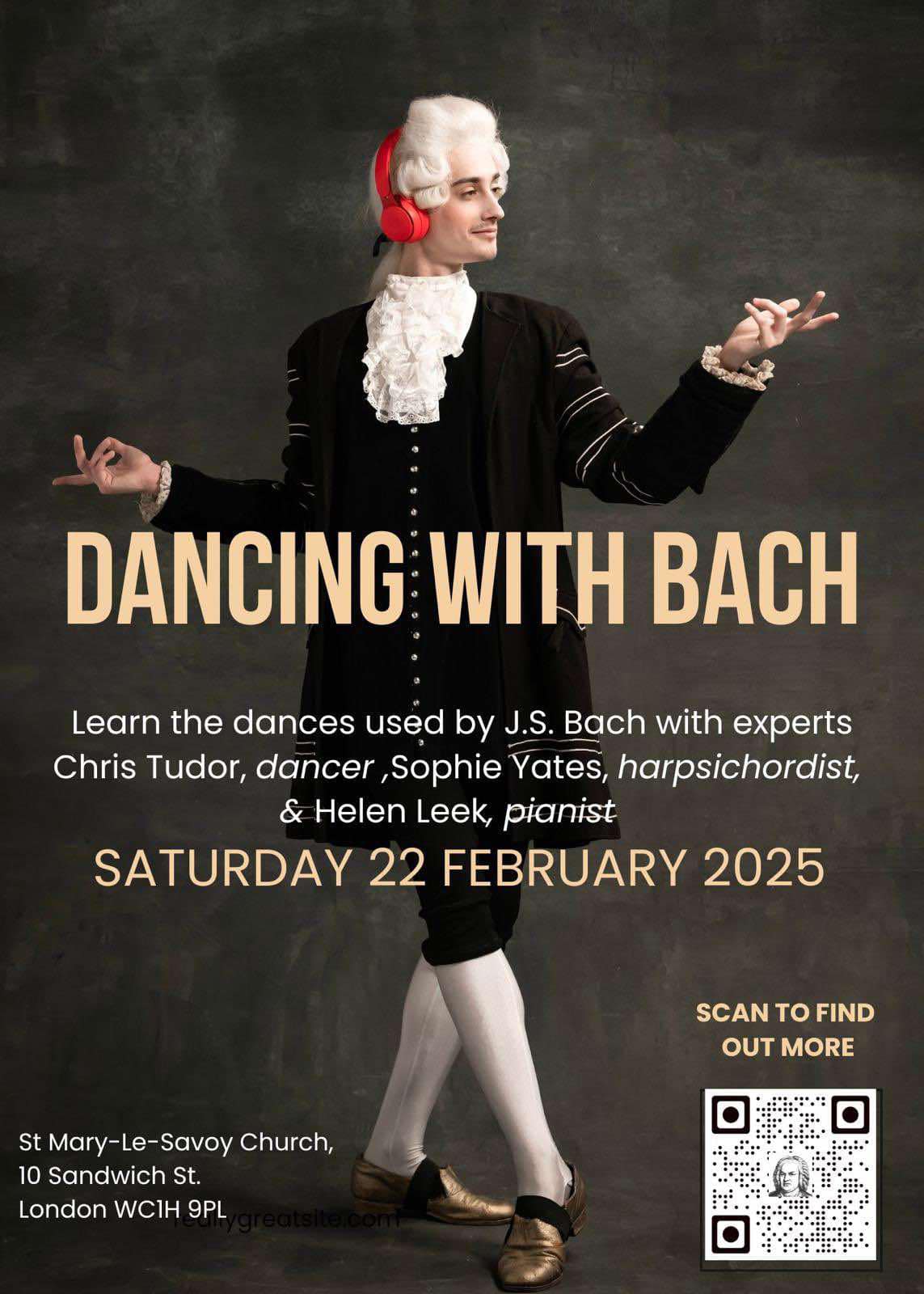
I’m with the dancer and historical coach Chris Tudor, and I’m joined by harpsichordist Sophie Yates, and Bach specialist, Helen Leek. We’re here to learn some of the basics and after intros in our ‘comfortable clothing’, we’re warming up with a simple hand held chain called a linear carole.

Caroles, or carols as we now call them, always used to be danced and sung, but at some point we lost the dance element. The origins go way back to the ancient Greeks and to the choros, or circular sung dance. Remember the dancers on Achilles’ shield in Homer’s Iliad? The magic of the shield creates a moment of escape from the pressures of reality and of the battle; I too quickly forget my parking battle off the Euston Road and settle into the conviviality of it all.

Next up is a renaissance dance, the Branle, which Chris tells us is a surreptitious way of introducing some of the steps to a minuet. We take one step to the right, close, then one step to the left and over with the right. Always rotating clockwise as we don’t want any negative energy.

We make swift progress and then I drop the bomb.

‘How about a Courante?’

Chris grimaces a bit and at this point I suddenly have a flashback to a grade exam, where I galloped through a Bach Courante and landed with a grateful ‘ta dah-like’ placement of the final ‘G.’

Sophie steps in and tells me that the Courante was fast in the Renaissance, but by the time J S Bach got busy with it, the metre had moved to 3/2 making it one of the slowest of all of the Baroque dances. She continues, ‘it could be apocryphal, but gossip colomnist in Chief in Versailles, Titon du Tillet said it slowed down because of Louis XIV’s long-toed shoes, meaning an extreme turn-out was necessary.’

So the Courante gets us talking about the ‘cadence’ of a dance which can relate to two ideas. We have cadence, as in the cadence of your voice, the qualities of the dance (a Courante has a noble and stately quality), but there is also the exploration of the cadences in the music and how these are going to relate to the cadences in the dance.

This is blowing my fuses now, so we all agree it’s time for coffee…

‘Dancing with Bach’, hosted by Ann Martin-Davis, with Chris Tudor, Sophie Yates and Helen Leek is a one-day workshop for pianists exploring the dance forms familiar to Bach that he used in his Partitas, Suites, and throughout his other collections of keyboard music.

Saturday 22nd February at St Mary-Le-Savoy Lutheran Church, London WC1H 9LP

Find out more here

Bring your dancing shoes!

Guest post by Charlotte Tomlinson

January 2025 will mark the 3rd anniversary of the Oxford Piano Weekends, and the thirteenth weekend. I can hardly believe that what started on the back of an envelope in late 2021, has developed into such a fixture in the piano course market that pianists return again and again.

We started in 2021 with the legacy of Covid and all the social and musical anxiety that came with that. It was essential to find a way of getting people to know each other quickly so I devised a mini workshop to be held before supper on the first evening, in which people get into pairs to chat about a particular musical and performing issue. Within a short space of time, the conversations are animated, social anxiety disappears and people feel relaxed and comfortable. By the time we start the evening session, a united and supportive group has already established itself.

It can’t be underestimated how important this group bonding is. A good number of pianists who come on the Oxford Piano Weekends struggle with performance anxiety and physical tension, and feeling emotionally safe within the group is essential to move through these issues.

I used to have crippling performance anxiety and now I really enjoy performing, something that would have been previously unimaginable. The weekends have helped me immeasurably.

Right from the start, Oxford Piano Weekends have had a wonderfully diverse pool of advanced and committed pianists taking part: bankers, medics, piano teachers, lawyers, choir directors, pianists returning after many years, battered and bruised pianists from a legacy of harsh teaching, students preparing for final recitals and many, many more. Pianists come from all over the UK, as far afield as Dublin, Finland, Malta and most recently, Canada.

The weekend is a chance to reflect deeply on your playing with expert guidance to take away and improve your practice.

On any one Oxford Piano Weekend, the numbers are kept deliberately low with six or seven as the ideal. Each pianist has twenty minutes teaching within the group, in rotation over the weekend, and it’s extraordinary how much can be packed into that short time. I listen to each pianist to see what they need, and then make sure that my response is valuable not just for the pianist themselves, but also for the group. Participants learn so much from watching and listening to each other, seeing their own challenges reflected in other pianists and then observing that pianist transform in front of their eyes.

A truly wonderful weekend. Charlotte is so caring, and teaches with such empathy, understanding & musical knowledge and expertise.

And what’s more important than the meal times? Homemade, tasty, nutritious food with free flowing wine in the evenings, the now-famous homemade flapjacks for coffee breaks, all provide a wonderful back drop for lively, stimulating conversations among like-minded people. They truly are full and rich weekends, and I, for one, come away at the end of each one feeling exhilarated and all ready to go for the next one.

Next weekend: January 17th -19th 2025

For more details go to: https://www.charlottetomlinson.com/oxford-piano-weekends

Watch a podcast with Charlotte Tomlinson and The Cross-Eyed Pianist

Pianist friends Alison Bestow and Claire Vane set up Pianissimi, an adult piano course, five years ago. I caught up with them to find out how their venture is progressing….

Pianissimi has been running for five years now; what is the secret of its success?

Claire: We have both been to many other piano courses, both in the UK and abroad. We are therefore very clear about what we want from a piano course; maximum face-to-face tuition, both in masterclasses and in individual lessons, and opportunities to perform every day. We also want to create a supportive, friendly environment and excellent organisation to keep the whole thing running smoothly. Many people have been with us for several iterations of the course, so we think we’re on the right track.

What do people most enjoy about Pianissimi?

Alison: Our tutors are first-rate. Warren Mailley-Smith and Penelope Roskell have been with us from the start, and this year we have achieved our ‘dream team’ which includes Graham Fitch and Nicholas Moloney. The tuition is intensive and so we make sure to keep participants fuelled with home-made cakes during the day and wine and snacks in the evenings, which people always appreciate, especially after performing following dinner.

Claire: Participants always say how friendly everyone is. The location is really beautiful, on the side of the river Orwell with spectacular views, so the environment is inspiring.

Alison: For me one of the highlights is playing the Fazioli grand in the recital hall with its tiered seating. Although I know you prefer the Bechstein, Claire….

What are the challenges of both running and attending the course?

Alison: We split up the organisation between us, and we have very different skills, so it works very well.

Claire: I do publicity, networking and the loot. Alison does the tedious timetabling which would drive me mad.

What have been the best moments of the course?

Alison: I love all the evening concerts; there is always such a variety of performances and I always come away with something new that I am inspired to learn. I have made many new piano friends.

Claire: We did a scratch eight hands two piano duet last year which was hilarious. I loved the visit from Chris Norman of 1066 pianos who told us more about how pianos work, Steinways in particular, and how he goes about voicing them.

Alison: And the talk from Colin Hazel about women composers was fascinating.

Any sticky moments?

Claire: The accommodation is in school boarding houses, and one year we were given high bunks beds with a desk underneath – not ideal for one participant who was pregnant and another with a dodgy knee. The school sorted it out for us; never again!

Alison: The staff at RHS are brilliant.

Who is this course aimed at?

Alison: We want the course to be very inclusive for anyone who loves the piano as much as we do, so we suggest that attendees are grade 7 onwards and including diploma level and post-diploma. The levels of experience and performance are varied, but we try to ensure that everybody feels comfortable and confident playing in a group. The course is also ideal for those with a specific aim, such as preparing for a graded or diploma exam, or getting ready for a particular performance. There will be lots of performance opportunities for those who want them. But there won’t be any pressure on people to perform if they don’t want to.

How can I book?

Claire: There are a few places left for the June course. All the information about the course is on our website: http://pianissimi.wordpress.com/


Pianissimi is held at the Royal Hospital School, 8 miles from Ipswich, Suffolk.

Course dates: Thursday, 2nd June 2022 (5 pm) to Sunday, 5th June 2022 (5 pm)

View the location and facilities here

Guest post by Lizzie de Lacey

The covid-19 pandemic has forced many of us to reinvent ourselves in one way or another. For some this has involved having to find a completely new way to earn a living; for others it has meant searching for ways to keep ourselves busy and, importantly, to keep our spirits up. It is therefore perhaps unsurprising there has been a huge increase in the number of people buying puppies…and pianos. As someone with both pup and piano, I can’t advise you on which might give you more pleasure, but I can offer some advice about learning the piano, although I have to declare a vested interest.

At this point I need to thank Fran The Cross-Eyed Pianist for very kindly asking me if I would like to write a guest blog for her website. So here I am, putting my head over the parapet to talk about what I have been cooking up during lockdown, while others have been getting to grips with sourdough. In fact my ‘piano method’ has been simmering for much longer than that. For many years, I have felt uncomfortable with the glaring gaps in the way we approach piano playing and teaching. As a result of those gaps, most of us are reliant on the printed page for every single note of music that we play. Playing by ear and improvisation are a completely alien concept.

For myself, I never really believed that I could call myself a musician if I could not make music without a printed sheet in front of me. The fact that I could not was a source of shame and embarrassment. Then one day I decided to teach myself. Working on the basis that the best way to learn a subject is to teach it, I found a group of willing friends and set about teaching improvisation. What resulted from those weekly sessions taught us, I believe, something even more important than how to add harmony to melody; it gave us a much greater understanding of how music ‘works’.

As a piano teacher during lockdown, I began to teach (with some trepidation) using video exchanges on WhatsApp. This approach was more successful and rewarding than I had anticipated, and brought me to some interesting conclusions about teaching in general. For my own part, the need to produce video lessons that were absolutely clear and concise, gave me new motivation, and stimulated fresh insights into my own teaching. As far as my pupils were concerned, learning from videos forced them, in their own space and time, to figure things out for themselves. Having to prepare videos to send back to me also seemed to give my pupils a new motivation to practice, until they were happy watching their own performance. Gradually it began to dawn on me that now was the perfect time to finally release my own piano ‘method’, which has been steadily germinating for longer than I care to admit. Despite lengthy dialogues with music publishers over the last three decades, my ‘book’ was ultimately turned down for being too ‘gimmicky’, too ‘different’, and, on one occasion, for teaching only pieces in C major for the whole of the first chapter.

Being different was always my intention. It has never surprised me that so many people ‘give up’ the piano so quickly (quite apart from the considerable, and often prohibitive, expense of regular lessons). Our obsession with teaching music-reading from the start, and the discouragement of any kind of improvised playing, means that many slow readers ‘fail’ before they have even started. At this uncertain time for musicians (and for classical music itself), it is even more vital for those of us who make and teach music to be flexible, so that we can adapt our style and our teaching in ways which will bring us and our pupils success, or at the very least, joy. For many classical musicians, the reality has always been a life of long working hours and low pay. Of course, there is money in music, as those successful in the popular music industry well know, but few classical musicians ever tap into this other world, even if they are struggling to sustain their careers. The reason? Their highly specialized training frequently has not included improvisation or composition, even at the simplest level. Almost unbelievably, it is still possible to graduate from a top UK music college, without ever having been encouraged to play by ear, or improvise. Yet armed with three or four chords, popular musicians come up with catchy tunes which are whistled and sung the world over, and which make millions, if not for the composer, at least for someone, somewhere along the line.

Learning to play the piano is a lifelong journey, and it should be a journey that we enjoy, every step of the way. In recent years there has been much evidence to tell us that, at all stages of our lives, we learn best when the process is enjoyable and playful. Instead of ‘learning to play’, this course encourages ‘playing to learn’. It is designed to keep the joy of learning and playing alive at every step, introducing colours to enhance the whole experience, and to impart a deeper understanding of what we are doing. Chopsticks to Chopin takes the student right back to the beginning – to Chopsticks, in fact – and then progresses via a very different route. It is easy, fun and creative, and can teach a beginner to play real music with two hands, from day one. It opens the door to improvisation, and encourages playing ‘from the heart’, not merely from the ‘dots’ on a page. The system can, I believe, be an effective alternative way into music for children or adults who face challenges such as dyslexia, dyscalculia, and ADHD, who may previously have tried and ‘failed’. It also has much to offer an experienced player who might be aware that there are important things which have been missed out of their music education.

So how does it work and how is it different?

My aim in this course is to be absolutely systematic and clear so that an adult beginner can teach themselves without difficulty, and without a teacher present. Equally, I would claim that an adult beginner can use the course to teach a child, or an older child a younger sibling, in exactly the way that Chopsticks has been handed down over generations. Chopsticks to Chopin is a ‘bottom-up’ method which starts with harmony, allowing you, perhaps for the first time, to tap into your own creativity. It will introduce you to vitally important concepts which traditional methods so often ignore, and which make playing so much easier and more fun. The use of colour makes learning and memorising pieces much easier and less daunting, so that tackling a new piece of music becomes a joyous and thrilling experience. Working in only one key at a time greatly speeds up the process of learning to hear harmony. Once these keys have been mastered it is easy to apply the system to any other key. Though not specifically designed for children, the system is appealing to all, and can be used from the earliest stages, so that children learn to play with two hands long before they have learned to read music.

One of the biggest challenges for any piano teacher is sourcing the right musical material for their pupils at exactly the right time. Music which is just too hard, or with insufficient appeal, can put a pupil off for life. To encourage playing by ear, however, it is vital to begin with familiar music with very simple harmony. For this reason, Chopsticks to Chopin starts out with well-known children’s music and folk songs. Whilst children’s music may not appeal to all, it does mean that this course is also perfectly suited to primary school teachers who wish to sing and play music in the classroom, and of course to parents and grandparents.

You can find the course at www.patreon.com. As a platform, Patreon has much to recommend it. Subscribers can work at their own pace; they can also ask questions and send feedback, so that anything that is less than crystal clear can be edited and improved. The course is designed to be fully interactive, and feedback from participants will help to shape its trajectory. With the addition of the linked Instagram page, the idea is to create a friendly community where people can learn from the video lessons, and from each other, in a stimulating and enjoyable way.

Chopsticks to Chopin is virtually free to use. Subscribing for one year will cost you less than the price of most single piano lessons. Fifty percent of proceeds will go to support selected music therapy charities, starting with Chiltern Music Therapy. Chiltern Music Therapy is a not-for-profit organisation which brings the joy and healing powers of music to people with diverse medical, psychological and neurological conditions.

Do come and join us. You can subscribe to the course from as little as £3 per month (for beginners). For experienced players, Level 2 costs £5.

REVIEWS

“As an early childhood music specialist, and as a timid pianist myself, I believe that Lizzie’s ‘colourful’ approach to piano can support the musical development of a wide range of students. Her method is suitable for beginners of any age, and also can give experienced music ‘readers’ a sense of freedom and the confidence to improvise.”

“When I have the colours, I only have one element to focus on. That gives me complete freedom to make music. Whereas if I have the score I have to focus on every single note.” “Much easier with colours! It’s also easier to be more expressive when you can see what’s coming up. Your playing can be more fluid.”


The creator of this course, Lizzie de Lacey, is a two-times graduate of the Royal College of Music, London. Her qualifications include ARCM (teachers); dip ABRSM (performers); and MSc in Performance Science.