Pianist, teacher and writer Catherine Shefski studied at Smith College, Massachusetts, and at the Guildhall School of Music & Drama in London, where she was taught by EPTA founder, Carola Grindea.  Catherine has performed as a soloist and chamber musician, has taught “virtual” piano lessons, and writes an informative blog, All Piano, with the mission to “make piano lessons relevant for the digital generation”.

During my piano playing “formative” years, age eight to seventeen, I studied with four piano teachers. Two teachers at college and four post-grad brings the total to ten. Each teacher contributed something to my growth as a pianist and as a teacher. I find myself passing along choice tidbits of information to my students, clearing up confusion about musical terminology and offering practice tips.

I’d like to share just a few lessons I learned along the way, in addition to all the repertoire, which made certain teachers (and lessons) memorable.

  • Piu means “more” and peu means “little.”
  • Piu mosso means more motion and meno mosso means less motion.
  • Accidentals do not affect the same note of a different octave, unless indicated by a key signature.
  • Senza means without and sempre means always.
  • To shape the melodic line it usually makes sense to go to the long note.
  • If there is no fingering written in the score, follow the “next note, next finger” rule.
  • Una corda means use the soft pedal (one string); tre corda means release the soft pedal (three strings).
  • When you have two phrases with identical notes and rhythm, make them different by dynamic contrast or a change in touch.
  • Grace notes in Chopin are generally played on the beat.
  • F# minor melodic scale is the only scale that changes fingering on the descent.
  • m.d. (main droite) right hand and m.g. (main gauche) left hand.
  • With a ritardando at the end of a piece pay attention to the space between the notes. Should be incrementally longer with the longest wait before the last note.
  • When working on very soft passages, practice “excavating the pianissimo.” In other words, begin from nothing and then gradually you’ll get to the softest sound possible.
  • Before playing extended octave passages, try flipping your arm over and reaching an octave with your hand upside down, fingers pointing to the floor. It a good stretch!
  • Sopra means above.
  • Sotto voce meas “under voice”, or soft.
  • A staccato note under a slur is a portato. Think of it as a “plump staccato.”
  • When working for dynamic contrast, practice stopping and preparing before the change.
  • When working with large complicated chordal passages, practice squeezing the chord to shape the hand. Your muscles will remember.
  • Sightread chords from the bottom to the top.
  • To play a passage of thirds, fourths, fifths, etc. legato lift the finger that is to be repeated while connecting the rest.
  • When in doubt sing the melody.

© Catherine Shefski

http://allpiano.wordpress.com


OVERCOMING PERFORMANCE ANXIETY

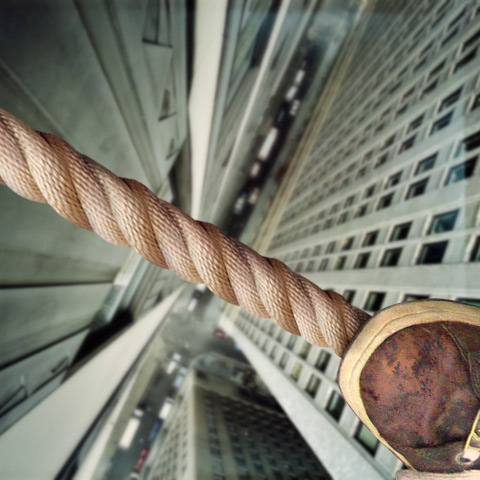
At my recent kids’ masterclass, the class leader, pianist Graham Fitch, likened playing in different situations – at home, for teacher, in a festival or exam, in a concert – to walking a tightrope. When practising at home, often alone, or with the family getting on with their own things around you, the tightrope is easy to negotiate, very close to the ground, and should you fall off, you won’t hurt yourself. When you play for your teacher, you may feel a little anxiety initially, but once you start playing, you settle into the music and look forward to your teacher’s feedback. The tightrope is still manageable, not too high, not too scary, and not far to fall.

However, when we put ourselves in more stressful situations, the tightrope is suddenly yanked up, and is sometimes dauntingly vertiginous. We view it with trepidation, and the nerves may well set in from the moment we receive the exam date, book the concert venue or send off the competition application form. Dealing with performance anxiety can be a major issue for many musicians and is, for some, the reason why they choose not to perform at all (most famously, perhaps, Canadian pianist Glenn Gould). As I prepare for my diploma exam (mid-December), coping with anxiety on The Day has been up there at the forefront of my mind, along with ensuring my repertoire is ready, my programme notes are accurate, the page-turner is primed, and my dress is appropriate for the occasion.

Everyone has their own way of dealing with anxiety, but there are some well-established strategies which can help, from physical exercises, deep breathing, sensible diet and rest, to psychological activities to help encourage a positive outlook on the event, and thorough preparation. For me, anxiety manifests itself mostly in physical symptoms: dry mouth, racing heart, trembling hands, feeling hot, feeling cold, headache and light nausea. Lately, I have learnt how to counteract this with positive thinking, Bach Flower Rescue Remedy and the “piano pilates” exercises from my teacher.

In preparing for a concert, exam or similar situation, where one knows one’s playing will be held up for scrutiny, it’s important to set that tightrope slightly higher, even if one is working in the relatively stress-free environment of one’s home or piano studio. This past week, my practising has incorporated recording myself playing, using a neat digital recording device (Olympus LS-5). It’s amazing how just having that little machine behind me as I played has upped the anti: knowing that there is an extra pair of “ears” listening has either made me play better, or caused me to crash through my repertoire with all the finesse and poise of a grade one schoolgirl. I posted the recordings on Soundcloud, and have been surprised at the positive feedback. It all helps!

It is also important to present one’s concert or exam repertoire to an uncritical audience ahead of The Big Day. Playing for friends, in the informal surroundings of one’s own home (if space permits), can be very useful. Ply the friends with coffee and cakes, don’t expect them to sit in hushed reverential silence, and just play for pleasure. You know you’re on show, but no one’s going to boo or slow hand-clap you.

Ahead of the event proper, try on your concert clothes and ensure everything fits and is comfortable. As a female pianist, it is crucial (for me at least) to have shoes with a heel which is comfortable on the pedal, and will not slip (much as I love high heels, they are impossible for playing the piano). Match your concert attire to the venue and time of the concert: you don’t need to wear evening dress for a lunchtime or early evening recital. Find out how to get to the venue well in advance, especially if you have to rely on public transport, and work out a route that will ensure you arrive in good time.

Even in the concert setting, on The Big Day, you can engage in psychological strategies to counteract the nerves. Imagine yourself walking across the stage, greeting the audience, sitting at the piano and placing your hands on the keys. Visualise the opening page of the first piece you will play and hear the music in your head. Take a deep breath and as you exhale, allow your hands to float onto the keys ready for the opening measures. Deep, thoracic (“Pilates”) breathing can also help when you are playing: in our anxiety, or extreme concentration, sometimes we do actually forget to breathe (I know I do this in the second half the Schubert Impromptu Opus 90 No. 2 – I have marked a reminder to myself on the score!). A deep breath in and slowly exhaled can help refocus, and can even have a softening effect on the music, especially during sections where a bugbear error has always cropped up in practice, or which are just plain difficult. Remind yourself that you are well-prepared, that you are ready,  looking forward to sharing your music with others, that you fear nothing, and that the experience will be fun, exciting, and instructive.

When helping my students prepare for our end of term concerts, we talk about performance anxiety and I remind them that playing the piano is very hard. The audience (parents, grandparents, siblings and friends) is sympathetic, nay, gobsmacked that anyone has the guts to get up on the stage and play. My own mantra in this situation is “I can do it. And you can’t”. Bullish? Egocentric? Of course – but you need a degree of chutzpah to drive you out onto the stage in the first place. And it makes you play better.

It is adrenaline (the “fight or flight” hormone) which causes the unpleasant symptoms of performance anxiety, but it can also be harnessed to create the right excitement, daring, poise and sprezzatura to perform – and perform well. My teacher has a lovely anecdote about her daughter, who was taking part in a school drama show. The child asked her mother excitedly “I wonder if I’ll get adrenaline on The Day?”, knowing that it would enhance her performance.

On a more prosaic level, it is important to go into a performance or exam situation well-rested and properly fed. Don’t hammer through your pieces on the morning of the concert or exam. Do gentle practice, eat a light lunch, preferably not overloaded with rich salad dressings or carbohydrates which will make you sleepy, take a nap, prepare your concert clothes, put your music in your brief case. At the venue, familiarise yourself with all the key entrances and exits, and facilities (including fire exits). Move calmly and quietly. Avoid too much conversation with venue staff, house manager etc. Get dressed and warm up. Now, start to think yourself into the music…..

The Inner Game of Music and The Mastery of Music, both by Barry Green, and The Musician’s Way by Gerald Klickstein all contain sound, sensible, and reassuring advice on how to prepare for a concert, strategies to overcome performance anxiety and how to “become a performer”. The accompanying Musician’s Way website is also extremely helpful.

“Never play faster than you can think”

This well-known maxim by pianist, teacher and composer Tobias Matthay has, for me, a relevance both in day-to-day practice, and also in performance. When we practice, in our eagerness to move on to a new section or movement, we may rush ahead without taking the time to fully absorb what we are learning. I am as guilty as the next person of this habit, though I now practice in the way the great Russian pianist Sviatoslav Richter claimed to: I do not turn the page of the score until I have learnt it properly. There is also the habit, particularly among young students, of playing everything too fast without taking the time to think. And how often have we played a piece marked Allegro and taken it at such a lick that the fingers work ahead of the brain and we end up in an unholy muddle?

At the recent EPTA-organised piano day at Steinway Hall, pianist Murray McLachlan talked about allowing the music to “breathe”. This is a perfect analogy, not least because the melodic line in piano music can, and should, be approached as sung line. On a practical level, where a singer might take a breath marks the natural end and beginning of a phrase, but singing also lends shape to music: the human voice has a natural rise and fall and cadence, something we should strive to imitate at the piano. Other physical gestures and body language can also help to enhance both sound and mood: the wistful lifting of the fingers off the keyboard to allow the music to float around the room; the speed and angle of attack and lift off, to suggest different moods; differentiation between the various “layers” of sound/melodic line within a piece; “implied dynamics” rather than actual volume of sound (for example, a fortissimo marking in Schubert or Chopin can be suggestive rather than actual).

In his book The Craft of Piano Playing, pianist and professor Alan Fraser talks about ‘entasis’ in music, the careful distortion of pulse, melodic shape or harmonic colour to enhance innate musical content. The term, derived from architectural language, means a slightly convex curve given to a column, pier or similar structure to correct the illusion of concavity created by a straight shaft. ‘Aural entasis’, Fraser says, can, just as in architecture, create the illusion of greater lengthening or shortening, thus highlighting the contours of the music, and should suffuse every bar we play (note: not to be confused with Rubato, which is a more deliberate action in music). At the simplest level, this can be the increase in dynamic level as the music ascends the register, and a softening the lower the music descends. It can also refer to rhythmic elements, such as waiting an instant longer before sounding a syncopation, or the shortening of the first part of a dotted rhythm to increase vitality, emphasis and drama (something I have been working on in the opening measures of Bach’s Toccata from the 6th Partita). Waiting a microsecond longer before playing the next note in a sequence offers a wonderful sense of delayed gratification to the listener, especially if combined with ambiguous harmonic shifts, such as in Chopin’s First Ballade, or at the end of the Opus 62 Nocturnes, which have the most mezmerising harmonies. No two beats will ever last exactly the same amount of time: only a metronome has this exacting regularity, and music that is played with such a rigid pulse will never sound natural.

It is hard to teach such subtle elements as these, which are often very personal to the individual performer, but a good performer will employ ‘entasis’ almost unconsciously, thus giving the music its human, ‘speaking’ quality, an innate sense of an inner pulse, and natural colour and shaping. Music which lacks these qualities can sound static, flat and dull, no matter how well it is played technically, and audiences will soon lose interest because mechanical music lacks a spiritual quality: as Aristotle observed “sameness of incident soon produces satiety” (Poetics XXIV). Mistakes, even very small slips or smudges, can also be far more obvious in music that is played without ‘entasis’, and the requirement to play with extreme accuracy, both of pitch and metre, is the cause of much performance anxiety amongst musicians.

Of course, too much ‘entasis’ may produce chaos in music, which listeners can find confusing and uncomfortable. To achieve a natural sense of pulse in music, drill the piece with the metronome until it is almost too fast, and then allow it to relax as you sense its metre from within, as you might your own heartbeat. The musical beat must fluctuate according to the emotional content of the music – just as the human heartbeat fluctuates at times of stress, excitement, contentment or relaxation. Remember, true musical perfection is in the soul of the listener, rather than in the performer’s ability to produce a performance in which each and every note is metrically and pitch perfect. ‘Entasis’ can be seen as the balance between a feeling of predictability and one of uncertainty, and this is what gives music its sense of anticipation, delayed gratification, excitement and ‘musical thought’.

Evgeny Kissin playing Chopin’s Ballade No. 1, Op 23

Alan Fraser’s website

There was an expectant hubbub of chatter, and some rather nervous laughter, when we arrived at Steinway Hall on Saturday for the first EPTA Piano Day, hosted by Scottish pianist and UK EPTA Chairman, Murray McLachlan. I met my friend Lorraine ahead of the event for strong coffee, and, in Lorraine’s case, a big breakfast, at a nearby Carluccio’s. Thus fortified, we walked the short distance from St Christopher’s Place to the hallowed ground that is Steinway & Sons London showroom on Marylebone Lane.

Like many an aspiring pianist, I have pressed my nose to the windows of the Steinway showroom ever since I can remember, marvelling, as a kid, at the big black shiny beasts squatting in the spotlit window displays. I’ve never, until now, had the chutzpah to go in and actually play one. My friend Michael, a fine amateur pianist with a penchant for Rachmaninov and Debussy, bought his Model B there a few years ago: apparently, the level of service was beyond superb. Well, so it should be if you are spending a cool £67,000 on what is, for some people, a glorified piece of sitting room furniture.

The piano - Steinway Model D

Behind the grand showroom, and the Steinway Hall of Fame, there is a small recital space, complete with a big black shiny Model D, a full-size concert grand. The event, the first, (hopefully of many) organised by EPTA, was open to EPTA members and their adult students, and was run in the form of a workshop, with verbal and written feedback on each individual performance by Murray McLachlan.

Although I have attended several courses at my teacher’s house, and performed in her house concerts, I had never participated in an event like this before, which would involve playing in front of 30 people I’d never met before. However, I regarded it as useful preparation for my performance Diploma – plus an opportunity to play a really fine piano.

The repertoire offered was quite varied, with, perhaps unsurprisingly, a good helping of Liszt, some Chopin Nocturnes, two of Schubert’s Opus 90 Impromptus, the opening movement of Beethoven’s Opus 109 Sonata and his Rondo  ‘Rage Over a Lost penny’ (energetically played by my friend), Messiaen’s Prelude La Colombe (‘the Dove’) and my own piece, his Regard de la Vierge, from the ‘Vingts Regards de l’enfant Jésus’. The standard was generally advanced; thus, we all had great admiration for a woman who played a piece from her Grade 4 repertoire. As she told me afterwards, “I was determined to come, no matter. I just wanted to play this piece in front of other people.”. The atmosphere was supportive and sympathetic, and, as Murray kept saying, there was a strong sense of a real love for the instrument and its literature amongst the participants: we were all there because we love it!

Formerly a very reluctant performer, I have learnt the benefits of playing for other people. Interesting things can emerge from a performance and can offer a wholly new perspective on one’s music. Also, it is very important to put it “out there” and to offer it up for scrutiny before an audience. Performing also endorses all those lonely hours we spend practising, and reminds us that music is for sharing. After a fairly rigorous morning the day before having my playing critiqued by a pianist friend, I was fairly clear about what I wanted to do with the Messiaen. It was therefore very cheering and encouraging to receive such positive feedback after my performance. Murray was extremely understanding, kind to those people whose nerves got the better of them, or those who stumbled. This was not a professional concert, after all, but rather a gathering of committed amateurs. It was a very enjoyable and encouraging day; my only criticism is that is was perhaps too long. The day finished with a performance of Liszt’s Italian Années de Pèlerinage by Angela Brownridge, but I did not stay for this as I had to get home – and Lorraine was playing in a competition.

Just before we left, we nipped into the Steinway Hall of Fame, and, like proper “piano tourists”, photographed each other at a Model D with a price tag of £115,000.

It was an excellent day of piano music, and I do hope EPTA will organise further events like this in the future.

EPTA

Steinway & Sons

Some of the repertoire played (links open in Spotify):

Bach/Busoni – Chaconne in D Minor

Beethoven – Rondo a capriccio in G, Op.129 ‘Rage over a lost penny’

Schubert – Impromptus, D. 899 (Op. 90): Impromptu No. 1 in C minor. Allegro molto moderato

Chopin – Nocturne No.13 in C minor Op.48 No.1

Liszt – Années de pèlerinage: 2ème année: Italie, S.161 – 6. Sonetto del Petrarca no. 123 (Più lento)

Ravel – Sonatine: Modéré

Messiaen – 8 Préludes : I La colombe

The author playing Messiaen’s Regard de la Vierge