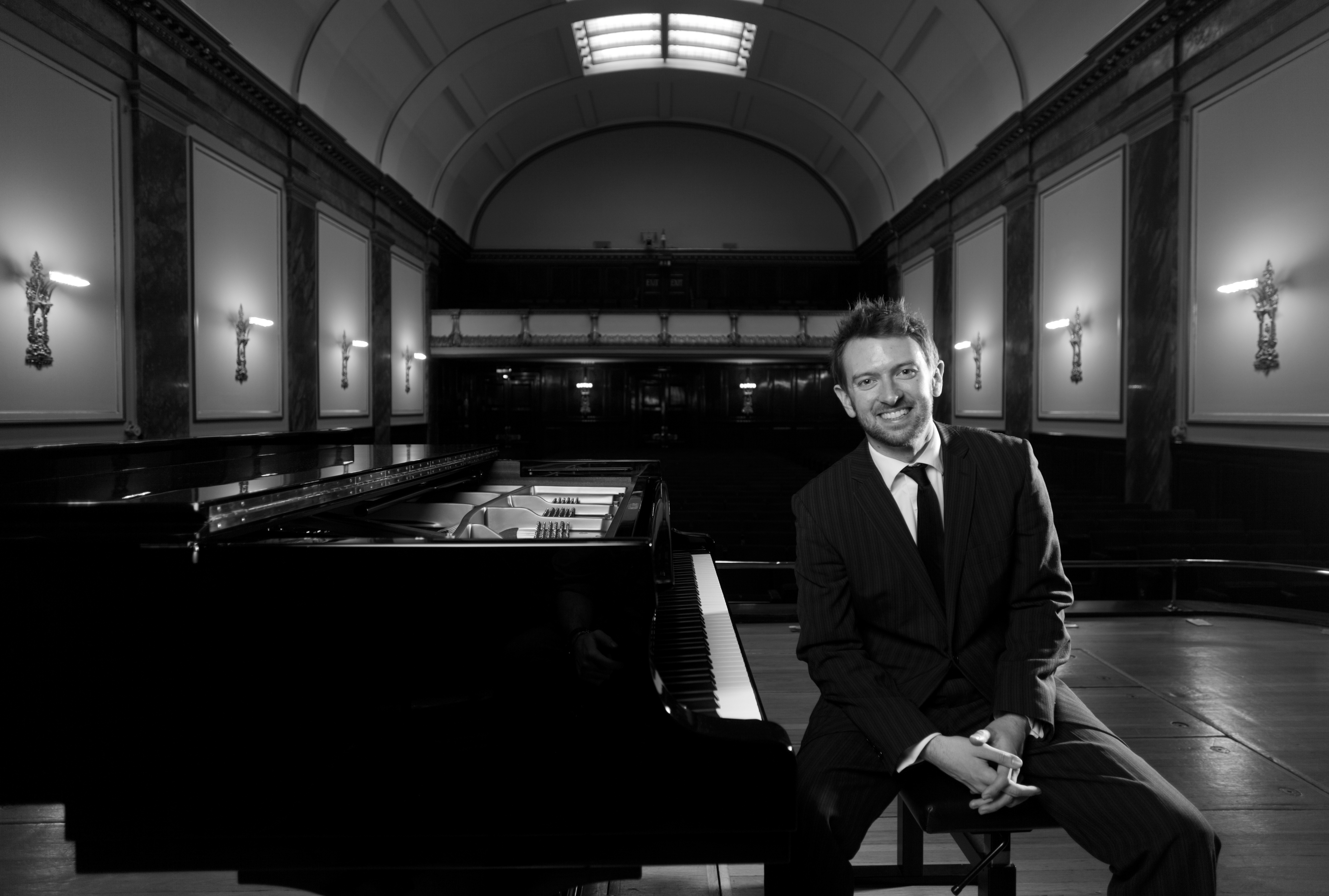
Clare Hammond (image credit Julie Kim)

Who or what inspired you to take up the piano and make it your career?

I was given piano lessons for my sixth birthday. My mother had always wanted to learn but had never had the chance so she was keen that I had the opportunity. I enjoyed the lessons, but didn’t consider making a career of music until I was 8 and was taken to an orchestral concert at the Royal Centre in Nottingham. I can’t remember which orchestra I heard now, unfortunately, but I was absolutely swept away by the music and decided then and there that I wanted to be a pianist. Of course, I had no idea then what this would entail, but the seed had been sown!

Who or what are the most important influences on your playing?

I think it’s important as a musician to be open to all sorts of influences so I couldn’t really point to any dominant strains in my playing. I try to listen to as many live performances and recordings as possible, and also to take what I can from observing theatre, dance and even sport. I enjoy teaching and learn a great deal both from explaining things in novel ways to my students and from the phrases they use to articulate their problems or thoughts to me.

What have been the greatest challenges of your career so far?

I spend a great deal of time working by myself and have found, as a result, that the greatest challenge of my career is to maintain perspective. It’s very easy to be thrown off course temporarily by minor setbacks and I sometimes feel that there is so much to achieve, in such a short space of time, that it can be extremely daunting.

What are the particular challenges/excitements of working with an orchestra/ensemble?

I adore working with orchestras and ensembles as it’s such a pleasure to be able to react to somebody else’s sound. You are forced to collaborate in real time, which is both risky and incredibly exciting. It’s easier to track the emotional and psychological development of a work when you’re not solely responsible for it, or at least it’s less exhausting to sustain!

Which recordings are you most proud of?

I’m most proud of my debut album, ‘Piano Polyptych’, which is a collection of contemporary piano music by British composers. It was quite a strain to learn all the repertoire in time for the recording, especially as much of it is extremely complex, but I have had so many opportunities as a result of the project. It was a particular pleasure to collaborate with the composers. It’s a completely different experience when you’re working on music by living composers as they can tell you exactly what kind of sound they’re aiming for. It brings an element of dialogue into what can otherwise be a very solitary pursuit.

Do you have a favourite concert venue?

I’ve performed in a number of venues with wonderful acoustics, but my principal concern when playing in concert is the quality of the piano. Recently, the best that I’ve encountered was at St George’s Hall in Bristol. Their newer Steinway is extremely responsive and has a very pure, glowing tone, supported admirably by the acoustic of the hall itself.

Who are your favourite musicians?

Personally or musically? In either case, I’m not sure I can answer this question. I know so many wonderful musicians who have so much to offer that to place them in any kind of order would be impossible!

What is your most memorable concert experience?

My most memorable experience of performing was not for an official concert per se but at my parents-in-law’s house. My father-in-law is a vicar and I gave a recital for a music society near to his parish a few months ago. Several of his parishioners were keen to hear me but couldn’t make it to the recital so we arranged a coffee concert the following morning. I performed on an upright piano in their front room, surrounded by about 12 people many of whom had never been to a classical music concert before. I’m not sure if it was due to the intimacy of the venue, or the fact that I knew many of these people personally, but I felt that my playing was at its most communicative. I now try to recreate that, with varying levels of success, in larger halls!

What is your favourite music to play? To listen to?

Again, I can’t give a specific answer to this question. Different works or styles of music are suitable for different occasions and express wildly varying emotions. In fact, one of things I love about being a pianist is the breadth of the repertoire. However hard you work, you can never learn everything that has been written for the piano so there are always new horizons to strive towards.

What do you consider to be the most important ideas and concepts to impart to aspiring musicians/students?

I’ve found that the most important skill in teaching is to be able to tailor what you’re trying to explain to the particular skills and aptitudes of the student. Of course, there is a broad ‘syllabus’ of concepts that you need to communicate to students depending on the level that they’re currently at, but you also need to draw out what is individual and unique about them as a person. When I was studying with Ronan O’Hora, at the Guildhall School of Music & Drama, I had the impression that he never taught two students in the same way. First, you have to understand the student as a personality, and then you can start teaching them music.

What are you working on at the moment?

I’ve been working on Piani, Latebre by Piers Hellawell, whose Das Leonora Notenbuch and Basho I recorded as part of ‘Piano Polyptych’. Piani, Latebre was commissioned by the pianist William Howard who premiered it at the Spitalfields Festival in 2010. I performed it as part of my inaugural recital as Artist-in-Residence at Queen’s University Belfast on 11th October 2012. My programme also included two pieces, Portrait and Spring Fantasy, by the Northern-Irish composer, Hamilton Harty, which have only recently been discovered. It’s quite exciting to give a world premiere of pieces which were written nearly 80 years ago!

What is your present state of mind?

Calm, on the whole, and drowsy. I’ve just eaten an enormous meal and the resulting haze of contentedness is impeding my ability to think clearly…

Acclaimed by The Daily Telegraph as a pianist of “amazing power and panache”, Clare Hammond has performed across Europe, Russia and Canada and has appeared recently at the Wigmore and Barbican Halls in London and the Bridgewater Hall in Manchester. Her Purcell Room debut for the Park Lane Group concert series was praised by The Guardian for its “crisp precision and unflashy intelligence”.

A passionate advocate of twentieth and twenty-first century music, Clare combines a formidable technique and virtuosic flair onstage with stylistic integrity and attention to detail. Since her debut with orchestra at the age of eleven, she has acquired a concerto repertoire of over 20 works which she has performed at major venues across the UK and on the continent. Solo engagements have included recitals in concert series and festivals across Britain, in France, Italy, Germany, Belgium, Denmark and Russia.

Clare Hammond’s full biography

Recordings, film clips and an interview at www.clarehammond.com/recordings.html

Forthcoming concerts:

Monday 24 June, City of London Festival

Saxton – Chacony for left hand alone; Bach-Brahms – Chaconne in D minor, transcribed for left hand; Harty – Portrait, Spring Fantasy; Sibelius – Five Pieces for Piano, Op. 75 “The Trees”; Saxton – Hortus Musicae (world premiere)

Tickets and further information here

Further information at www.clarehammond.com/concerts.html

Who or what inspired you to take up composing and make it your career?

I heard a ‘cello being played on the radio (I can’t remember who was playing) when I was about 6, and just knew that was the instrument I had to play. I fully intended to just become an internationally famous concert ‘cellist (as you do!) but gradually composing took over.

Who or what are the most important influences on your playing?

As a composer I think my greatest influences came from the music I played at the Yehudi Menuhin School (I studied ‘cello, piano and composition there for 10 years). But some of my favourite composers are Britten, Ligeti, Beethoven and Prokofiev, as well as many composers who are writing today.

What have been the greatest challenges of your career so far?

Trying to get a balance between composing and life: I’ve still not quite worked it out, although, after hardly going out the house for six months whilst writing an opera, I’m determined to be a bit better at it!

What are the particular challenges/excitements of working with an orchestra/ensemble?

Working with any group is exciting for me. I think as long as you treat musicians with the respect they deserve, and prepare parts properly (enough time for page turns!) then they will hopefully be receptive to your music.


Do you have a favourite concert venue?

Not really, as a composer you are just very grateful that your music is being played! Perhaps I’ll get pickier about this later in life! I had a mini opera performed in park in Hammersmith – a group of children gathered round and started answering the questions the singers were posing – it was fantastic!

Who are your favourite musicians?

I’ve mentioned the composers above…I’ve been so lucky and had such a fantastic time with all the performers who have performed my work: there are too many to list!

What is your most memorable concert experience?

I had my Concertino for Cello, Piano, Percussion and orchestra performed by the BBC Philharmonic as part of the BBC Young Composers Competition (when it still existed, back in 1996). I think that experience more than any other convinced me that I wanted to make composing my career. It was just mind-blowing to hear something that I’d only heard in my head played by a massive orchestra.

What is your favourite music to play? To listen to?

I don’t regularly play in public any more, but I play keyboards in a salsa band and am also learning jazz piano. I played in a rock band until recently and am soon to join a hip hop band – all very different from my composing life, and my past life as a cellist at the Yehudi Menuhin School!

Recently I’ve hardly been listening to music not directly related to my work (for my opera I listened to a lot of 1930’s dance music for instance as this was one of the main influences) because I’ve been writing so much – something I’m determined to rectify soon.

What do you consider to be the most important ideas and concepts to impart to aspiring musicians/students?

I think you just have to be determined to the point of utter bloody minded-ness. Part of the reason why I’ve managed to make a kind-of living out of composing is that I have always just refused to acknowledge that it might not be possible. I recently got a new composing job after applying for it twice – although I’ve applied for other opportunities up to ten times before I’ve finally been awarded them. A thick skin for rejection is very useful I think, and somewhere (however deep down) you need total self confidence in what you are writing, even if this partly achieved by self-deception…

What is your present state of mind?

My present state of mind is probably calmer and happier than I’ve ever been. Everything seems to be fitting into place recently and I’ve come to realise that life outside of composing is also very important (something which I perhaps didn’t when I was younger). The older I get, the happier I get, which is rather fortunate for me!


Cheryl Frances-Hoad was born in Essex in 1980 and received her musical education at the Yehudi Menuhin School, Gonville and Caius College (University of Cambridge) and Kings College London. She currently divides her time between Cambridge and Leeds, where she is the first DARE Cultural Fellow in the Opera Related Arts in association with Opera North and the University of Leeds. Cheryl won the BBC Young Composer Competition in 1996 at the age of 15 and since then her works have garnered numerous prizes and awards, including the Royal Philharmonic Society Composition Prize (UK, 2007), the Sun River Composition Prize (China, 2007), The International String Orchestra Composition Competition (Malta, 2006), The Bliss Prize (UK, 2002), the first Robert Helps International Composition Prize (University of Florida, 2005), the Mendelssohn Scholarship (UK, 2002) and the Cambridge Composer’s Competition (UK, 2001). In 2010 Cheryl became the youngest composer to win two awards in the same year at the BASCA British Composer Awards (her setting of Psalm 1 won the Choral category, and Stolen Rhythm for solo piano won the Solo or Duo category). Many of her works have been generously supported by the RVW Trust, the Britten Pears Foundation, the PRS for Music Foundation, the Nicholas Boas CharitableTrust and the Bliss Trust.

In 2008 Cheryl was awarded a Leverhulme Trust Artists in Residence Fellowship at the University of Cambridge, enabling her to investigate aspects of the mind at the Psychiatry Department, which resulted in a new work for piano premiered at the 2009 Cambridge Clinical Neuroscience and Mental Health Symposium. Also In 2008, Cheryl was awarded the Wicklow County Council Per Cent for Arts Commission (Ireland), which enabled her to compose her first piano concerto, premiered by Bobby Chen and the Greystones Orchestra in May 2009.

Cheryl’s work has been premiered in some of the world’s most important chamber music venues, including the Wigmore Hall (Melancholia (piano trio), Excelsus (solo ‘cello) and My fleeting Angel (piano trio)) and the Purcell Room (The Glory Tree (for soprano and six instruments), and The Ogre Lover (for string trio)). Her debut CD of chamber works, The Glory Tree, was released in 2011 by Champs Hill records and received excellent reviews in The Times, Telegraph and Guardian, and was chosen as “Chamber Music Choice” by BBC Music Magazine in October 2011.

www.cherylfranceshoad.co.uk

Interview date: January 2013

Organist Stephen Farr

Who or what inspired you to take up the organ and make it your career?

Two simple events: first, sitting next to the piano on my first day at primary school (I asked to have a go after assembly was over, and started piano lessons soon after); second, the local church organist breaking the world record for non-stop organ playing the same year. My parents took me to hear him one afternoon, and I was hooked. No great philosophical epiphanies; it really was as simple as that.

Who or what are the most important influences on your playing?

Some really superb teachers; and many other musicians, some organists, some not. Good singers, increasingly.

What have been the greatest challenges of your career so far?

In an obvious sense there have been plenty of tricky pieces to learn, and a few times I’ve been called in to learn very difficult things at short notice – overnight, more than once. But probably most people have a story like that to tell. If you’re an organist I think it can be easy to get into a rut; that sort of comfort zone can be very alluring, so the constant challenge of my career is to give myself a nudge at the right time and keep looking outwards as a musician.

What are the particular challenges/excitements of working with an orchestra/ensemble?

Concertos are always a bit of an exotic experience for organists – opportunities to play them don’t come up all that often. In orchestral/ensemble situations, being one of a team who has to conform to someone else’s requirements, when you spend most of your performing life being your own musical boss, is demanding. There’s also the added dimension of having others reliant on you. The most stressful week by far of my career to date involved playing the (horrendously difficult) organ part in a contemporary orchestral score – an hour of counting and a minute of terror. But it’s satisfying being part of a group rather than a lone recitalist – I especially love continuo playing for just this reason.

Which recordings are you most proud of?

Judith Bingham’s ‘The Everlasting Crown’ I think, but I really can’t bear listening to my own playing, so ‘proud’ in this context is a relative term. I just can’t be in the same room with my playing of 10 years ago.

Do you have a favourite concert venue?

Sacred – St Paul’s Cathedral, London; secular, Royal Albert Hall. No matter how hard you try to be hard-bitten about it, walking out to perform in the Proms is a genuine thrill. As a listener, I like Symphony Hall in Birmingham.

Who are your favourite musicians?

Alfred Brendel; Wilhelm Furtwangler; Dietrich Fischer-Dieskau; Carlos Kleiber; J S Bach.

What is your most memorable concert experience?

I’m going to cheat a bit here because some of the most memorable moments for me are to do with recordings. First, hearing Elgar 1 for the first time; the slow movement was playing in a London record shop where I had gone to buy some Dufay or something, and I had never heard anything so beautiful as that slow movement. I was literally (much-abused word, but accurate here) rooted to the spot for 10 minutes. Second, hearing ‘authentic’ instruments for the first time (English Concert, Brandenburg Concertos, c. 1983); I can remember the clarity and brilliance of No. 2 as if it was last week. And, very much less properly, having a helpless giggling fit all the way through Ligeti’s ‘Atmospheres’ in the RFH when I was 8 – we had been taken on a school outing by our very thoughtful music teacher, and I’m ashamed to admit I disgraced myself. Mr Cole, if you’re reading this – I’m sorry.

What is your favourite music to play? To listen to?

Bach and Jehan Alain. Bach, late Beethoven, Brahms. Schubert, Schumann, Mahler, Messiaen, R Strauss…

What do you consider to be the most important ideas and concepts to impart to aspiring musicians/students?

Work very hard; don’t fool yourself that second best is ever acceptable. Keep your eyes and ears constantly open, your mouth mostly shut, and be open to the possibility of learning things from anyone, anywhere, no matter how apparently unlikely the context. Read Schumann’s Musical Rules for the Young, there’s a lot of good sense in there, however quaint some of his recommendations seem now. ‘Studying is unending’.

What are you working on at the moment?

Mainly contemporary things – Judith Bingham, Nico Muhly, some Jonathan Harvey. Bach’s Clavierübung Part III needs revisiting. A Wagner transcription which I have been asked to play for a special occasion and would really much rather hear played by an orchestra than by me, but I’m stuck with it. Shortly to start writing a PhD dissertation, so spending a lot of time in libraries.

What do you enjoy doing most?

Playing, when it’s going well.

What is your present state of mind?

Pensive, a bit sleep-deprived

Recognised as “one of the brightest and most active English recitalists” who “plays with immaculate finish and buoyancy” (Classic CD), Stephen Farr is widely regarded as one of the finest organists of his generation, with a virtuoso technique and an impressive stylistic grasp of a wide-ranging repertoire. He combines a busy freelance playing career with the posts of Director of Music at St Paul’s Knightsbridge in London, and ACE Foundation Director of Music at Corpus Christi College, Cambridge.

Read Stephen’s full biography here

www.stephenfarr.co.uk

Alisdair Hogarth

Who or what inspired you to take up the piano, and make it your career?

Initially I used to hear both my mum and dad playing a lot of different piano repertoire and I remember really wanting to be able to play some of those pieces like they did. They both studied with an excellent teacher in County Durham and they had a big range of repertoire, but I loved the impressive stuff…Liszt and Chopin Etudes, Impromptus and Ballades. I used to try to play these pieces myself way before I was ready but it was all good fun! My mum actually studied at the RCM which is where I studied after going to university. So they were my initial inspiration to play. I also remember my dad playing me a record of Ashkenazy playing the Chopin Ballades which I loved; I think I wore the record out, along with my parents’ sanity! I decided to make it my career after I began studying with the British pianist Philip Fowke; after one year with him I made my debut with the London Philharmonic Orchestra, which was an incredible experience with his guidance, and it inspired me to take things further.

Who or what were the most important influences on your playing?

My main teacher, Philip Fowke, has been the biggest influence on my playing, and I still play things to him now before big concerts. He is a person of great humility, but such incredible gifts, both in his playing and his teaching. I went to him when I was 13 and he had a refreshingly healthy attitude to the piano; he was and still is, always willing to think outside the box. I remember at my first lesson, we worked backwards through the piece! Your At the Piano interview with him sums up a lot of his teaching very well, but the thing that stands out for me was the way he would cut through to the heart of what was difficult about a certain passage. And armed with that knowledge he’d find a solution that always seemed to work for me. The result of all this was that he encouraged me to explore lots of ways of doing things rather than following ‘methods’, which I still do to this day. He was also able to demonstrate exactly what he meant at the keyboard, and immaculately, which I believe is really important in a teacher; that they can practise what they preach. I have been to so many master classes where the teacher has suggested something wacky, and I feel like standing up and saying “Well that’s great in theory; now show us!”

Philip studied with the great teacher Gordon Green (who also taught John Ogdon, Stephen Hough, Martin Roscoe to name a few) and when I went to the Royal College of Music after university I was lucky enough to study with one of Philip’s best mates, John Blakely, who had also studied with Gordon. John was equally brilliant and was a master of helping you completely get your head around an issue in a piece by summing it up in one sentence. Technically, a lot of the things he taught were very similar to Philip, so it was great getting continuity on this front; I never had conflicting views. My final influence is Peter Katin, with whom I studied for two years after the RCM. Peter gave me some very detailed technical work and I studied the Rachmaninov Preludes with him; his recording of them remains one of my favourites. He also recorded Saint-Saens Carnival of the Animals with Philip Fowke, so all three of my teachers are linked really.

What have been the greatest challenges of your career so far?

I think balancing a career in performing and teaching, and at the same time balancing this with a family life. I’m lucky that a lot of my work can be done from home, so I get to see my wife and two kids during the day when we can have fun; then I’ll be off to work later in the afternoon and evening. Although…when I’m practising at home sometimes my 1 year old and 4 year old decide to play too; I’m used to shutting it out now and it almost makes it easier when I play a concert because I finally get to concentrate on what I’m doing with no distractions!

Which performances/compositions/recordings are you most proud of?

The recording I’m most proud of is the first recording I did with my group The Prince Consort for Linn Records: ‘On an Echoing Road – Songs by Ned Rorem’. Also our debut at Wigmore Hall with Graham Johnson joining me at the piano was a pretty special time too. Graham gave us some great insights into how to make the most of Wigmore’s amazing acoustic; tips that we still take on board when we perform there now.

Do you have a favourite concert venue to perform in?

Well there are lots of places I love playing, but the place that I’ve performed the most is Wigmore Hall in London; it’s a beautiful hall to play in, with an incredible acoustic. Most of my work is with singers and they love it too. The Director there, John Gilhooly, is extremely forward-thinking but also realises the importance of respecting traditions which is something I try to bring into my own work too, so I enjoy working with him on new programmes for the venue. I also like Perth Concert Hall in Scotland, for its amazing pianos, great space and forward thinking programming led by James Waters.

Favourite pieces to perform? Listen to?

I think my favourite solo piano piece to perform is the Rachmaninov Sonata No. 2 Op. 36 and I play it in the original 1913 which I prefer to Rachmaninov’s revision (as do many pianists). In the song repertoire, I always enjoy playing the Brahms Zigeunerlieder; I just recorded it with my buddy, the mezzo Jennifer Johnston for the BBC.

Who are your favourite musicians?

Too many to mention, but I enjoy hearing musicians who are great at what they do in all fields of music, including jazz and musicals.

What is your most memorable concert experience?

It’s not really a concert experience, but when we (Prince Consort) were performing in the Gramophone Awards, we were told by the Dorchester Hotel that there was no rehearsal room available as it had to be used for press, so they told us to rehearse in the room where they were serving cream teas. We were performing a particularly turbulent piece by Stephen Hough, that included hitting the keys with your fists; Simon Lepper and I looked up from the keyboard to find Sharon Osborne looking straight back at us, eating a scone. Then we all got told to leave; it felt like the X-Factor!

What do you consider to be the most important ideas and concepts to impart to aspiring musicians?

My best advice would be to find other musicians and people that work in the music industry that you admire and trust, and really listen to their advice; both about how to play, but also how to manage the myriad of other things involved in being a musician. Having said that, I also think it is important to find your own personal way of doing things once you have taken this advice on board. I also think it’s important to play music you love and that you are really excited to learn, as well improvising and generally messing about at the keyboard.

What is your most treasured possession?

Apart for the obvious things like my wedding ring and personal items, my Steinway Model A; it was owned by Benno Moiseiwitsch, and then Philip Fowke, and I had all my lessons on it from the age of 13 – 21.

What do you enjoy doing most?

Hanging out with my wife, who is awesome, and our two beautiful kids.

What is your present state of mind?

Chilled, I’m having a pint!


With a prominent background in both solo and song-accompaniment, Alisdair Hogarth is a versatile pianist combining a robust technique with a fresh, contemporary edge.

He made his concerto debut in 1996, at the age of fifteen, as soloist with the London Philharmonic Orchestra at the Queen Elizabeth Hall broadcast live on Classic FM, and has since performed many concertos with a variety of orchestras, including tours of Hungary and the Czech Republic (Rudolfinum).

He regularly broadcasts for BBC television, BBC Radio 3 and World Service, Classic FM and New Zealand Concert FM. Recent performances have included the Queen Elizabeth Hall, Wigmore Hall, Purcell Room, Cadogan Hall, Bridgewater Hall and Philharmonic Hall, as well recitals for British music societies and international festivals. Most recently he performed Gershwin’s Rhapsody in Blue in New York with the National Symphony Orchestra under Anthony Inglis as well as a performance at the 2010 Gramophone Awards. Future performances include many appearances at Wigmore Hall as well as recitals abroad including the Concertgebouw, Amsterdam.

Committed to song-accompaniment, Alisdair formed a group of young professional singers, The Prince Consort, which focuses on piano-accompanied song. Following their highly-acclaimed recital debut at the Purcell Room as part of the ‘Fresh’ Young Artists Series they perform frequently at music societies and festivals throughout Europe and the USA. They made their Wigmore Hall debut in 2009 where they were joined by Graham Johnson for the Brahms Liebeslieder Walzer. Their first commercial CD, a recording of songs by Ned Rorem released on Linn Records, was Gramophone Editor’s Choice and won an Outstanding award from International Record Review. They also have a close relationship with the Britten-Pears School in Aldeburgh where they held a residency to prepare for the recording and performed a recital in the prestigious Britten Weekend. Alisdair has performed with Sir Thomas Allen, Rosemary Joshua, Lillian Watson, Donald Maxwell and is the regular accompanist to many of his generation’s finest young singers, including Anna Leese, Jennifer Johnston, Andrew Staples, Jacques Imbrailo and Tim Mead. He has just returned from Korea where he gave two recitals with Barbara Bonney. Current projects include a recording on Linn Records with Philip Fowke and Stephen Hough, performing Brahms Liebeslieder and a new song cycle written by Stephen Hough specifically for The Prince Consort. This CD was selected as Classic FM Editor’s Choice in October 2011.

Alisdair studied privately with Philip Fowke and subsequently with Peter Katin, and also at the Royal College of Music with John Blakely and Roger Vignoles where he won all the major prizes for piano accompaniment. In the same year he was selected as a Park Lane Group Young Artist. He was an RCM scholar supported by the Fishmongers’ Company Music Scholarship, Michael Whittaker and Robert McFadzean Whyte Awards and is an alumnus of the Britten-Pears Young Artist Programme. Alisdair acknowledges the kind and generous support of Simon Yates, and Philip and Chris Carne.

www.alisdairhogarth.com

www.theprinceconsort.com

The Prince Consort’s new album, Other Love Songs, is now available for high-quality download on http://www.linnrecords.com/recording-other-love-songs.aspx