Ayriel Studios is a new residential recording studio and creative retreat set within the spectacular landscape of the North York Moors National Park. Against all odds, the studio was launched during the pandemic and is attracting world-class musicians inspired by its idyllic rural location.
The brainchild of internationally-renowned cellist, artistic director and cultural entrepreneur, Jamie Walton, it has taken six years from inception to completion. The studio is in a large, converted barn, with three adjacent self-catering farm cottages that sleep up to 12 people, surrounded by stone-walled fields on one side and heather moorland on the other. It is a musical haven, where artists enjoy an extremely personal and bespoke service that starts from before they arrive with help for travel arrangements. Artists may stay on site and have everything taken care of, including home-cooked meals, so they can relax and focus fully on their project.
The L-shaped, oak-floored studio is expertly designed, offering a unique sound – rich, clear, natural – with great acoustic versatility and an unusually broad reverberation range (from 0.8 to 2.6 seconds) suitable for all musical genres. The studio space is overlooked by a comfortable, well-equipped control room housing the latest SSL Origin 32 channel analogue mixing desk, ideal for an all-digital workflow and easy to use. Both spaces are flooded with natural light.
“We aim to provide the optimum working conditions for our guests,” comments owner and technical director, Simon Hopkins. “The studio is temperature controlled and benefits from a continual air exchange, keeping the air as fresh inside as it is outside. We offer the studio on a 24-hour day rate, so artists can work whenever they want and for as long as they want. Noise is never an issue as the building is so well soundproofed.”
“A sense of timelessness and freedom is what helps this studio stand out from the norm” observes artistic director, Jamie Walton. “We’ve created a space for musicians to do their best work, to focus on their creativity and self-expression, and to completely immerse themselves without distraction.
“It seems to be working – pianist, Peter Donohoe, surprised himself by recording 17 sonatas in one visit, Viktoria Mullova and Alasdair Beatson recorded a disc of Schubert and finished early, and I recently recorded The Bach Suites in three days.”
Other notable classical artists to have discovered Ayriel Studios include oboist, Nicholas Daniel OBE, who described it as “the most beautiful place imaginable to record.” To find out more about Ayriel Studios visit www.ayrielstudios.com, or call the studio manager, Hannah Ahrens, on 01287 669900 for rates and availability, or email bookings@ayrielstudios.com.
It seems that whenever Icelandic pianist Vikingur Ólafsson touches a piano, beautiful sounds flow from the instrument – whether it’s Bach, Rameau, Debussy or Philip Glass. His latest release, From Afar, is no exception, with the added sonic treat of two pianos, offering contrasting colours and timbres.
This new album, the most personal of all Ólafsson‘s recordings to date, reflects his musical DNA, from childhood memories growing up in Iceland to his international performing career and contemporary inspirations, including the pianist, composer and pedagogue György Kurtág, whose music appears on this disc interleaved with works by J S Bach, Schumann, Brahms, Mozart, Bartok, Ades, and Icelandic composers Kaldalóns and Birgisson.
The inspiration behind the album comes from a life-changing meeting with Kurtág in Budapest in September 2021, which left Ólafsson with “a feeling of lightness and joy” and sparked memories of music he loved as a child – the pieces on the album by Bach, Mozart, Schumann and Bartók. FromAfar, its title inspired by Kurtág’s Aus der Ferne, is both a tribute to his hero and a return to his musical roots.
On the first sight, the track listing looks eclectic – we move from Bach to Schumann, Mozart to Kurtág in the space of a few moments (and each piece is no more than around four minutes long), but the selection, organisation and of course the playing of the pieces succeeds in creating a pleasing and intriguing listening experience – and I love the way Ólafsson segues from piece to piece, creating an almost uninterrupted flow of music.
The other intriguing aspect of this recording is that it’s a double album, with the pieces recorded on both a Steinway concert grand piano and an upright with a layer of felt covering the strings, effectively a permanent soft pedal. György Kurtág and his wife Marta recorded many of their four-hand Bach transcriptions and pieces from Játékok on a felt-softened upright piano “with marvellous results” (Ólafsson), and so this aspect of the recording is another homage to Kurtág. It also creates a wonderful, nay “marvellous” soundworld – delicate, hushed, intimate, tender (and if you, like me, have had the privilege of hearing Mr & Mrs Kurtág performing you will recognise and appreciate this very distinctive, almost whispered sound that the felted piano offers). Here, the microphones are set so close to the piano that you can hear the keys being depressed and released, and the occasionall rattle and tap of the keys connecting with the keybed. The upright also calls for a different kind of playing to a grand piano: of course it has its limitations in terms of breadth of sound, colours, dynamic palette, but there is something deeply appealing about the more hushed timbres of the upright piano. For Olafsson its “its imperfections become acoustic opportunities.” It also makes a connection with countless music students and domestic piano players whose most familiar instrument was or is an upright piano.
With two distinct soundworlds provided by the different instruments, the album explores evocative, wistful themes of home, childhood and family, Hungarian and Icelandic folk songs, nature-inspired works, homages and three previously unreleased transcriptions by Ólafsson: the Adagiofrom Bach’s Sonata for solo violin in C major, Mozart’s Laudate Dominum – which he dedicates to Kurtág – and Icelandic composer Sigvaldi Kaldalóns’ Ave Maria (the first work Ólafsson ever transcribed). This piece was the first single from the album, which Ólafsson performed as Lockdown Artist in Residence for BBC Radio 4’s Front Row programme in 2020. Broadcasting live from an empty Harpa concert hall in Reykjavík, his tender, thoughtful performances brought comfort and a much-needed connection to live music to millions of listeners around the world.
This album offers a similar kind of comfort, with its flow of miniature works, exquisitely, often caressingly played, with Ólafsson‘s beautifully luminous sound, crystalline articulation and sensitively colouring. It feels homely and intimate, the kind of music one would play at home, by oneself or with a small group of friends.
There are some real jewels in this album – Schumann’s Vogel als Prophet from Waldszenen, played on the felted upright, Bartok’s 3 Hungarian Folksongs from the Csik, and Mozart’s Vesperae… are stand out tracks for me, but there is much to enjoy here, such is the variety of repertoire and Ólafsson‘s sensitive lyricism. It’s an album to curl up with on a winter’s evening.
F.J Haydn (1732-1809) Piano Sonata 47 h.o.b. 32 in B minor
F. Liszt (1811-1886) Deux Legends S. 175 – 1. St. François d’Assise: La prédication aux oiseaux S. 175; 2. St. François de Paule marchant sur les flots
Stephen Gott, piano
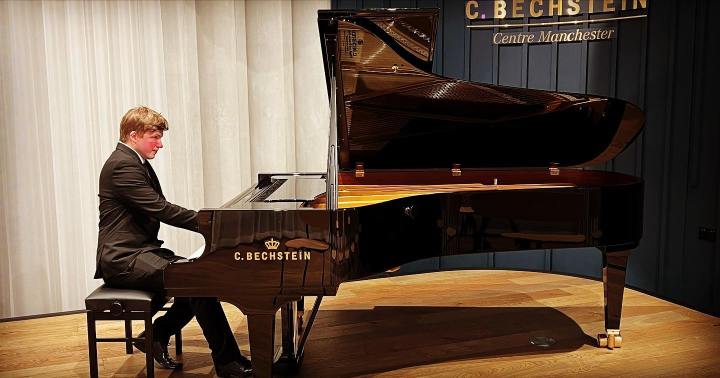
The splendid new Bechstein piano showroom in Manchester, the piano maker’s first purpose-built showroom in the United Kingdom since the Bechstein (now Wigmore) Hall was opened in London in 1901, boasts an attractive recital room with a C. Bechstein Model C 234 concert grand. The showroom hosts regular recitals and on Thursday 13 British-American pianist Stephen Gott performed music by Bach, Haydn and Liszt.
I have known Stephen for nearly 15 years now: we first met on a piano course hosted by our teacher, Penelope Roskell, where he gave a mature, thoughtful performance of Chopin’s Fourth Ballade, the memory of which has stayed with me ever since. Stephen is a very dedicated, hardworking young pianist, who started to learn the piano relatively late, in his teens. He studied at London’s Trinity-Laban and the University of Huddersfield, and is currently studying privately with Pascal Nemirovski.
His programme for his Bechstein recital displayed a nicely balanced range of repertoire from Bach to Liszt. The Bach Toccata in E minor was suitably serious in mood (E minor being perhaps Bach’s darkest, most serious key) and Stephen neatly portrayed the fantasia elements in the opening section, while the section second had energy and focus, with a good sense of forward motion.
The Haydn sonata was spirited, its elegant middle movement a pleasing contrast to the drama of the outer movements. But it was in the Liszt Legendes that Stephen really impressed and in which I felt he seemed most comfortable (and I know from conversations with him that he adores the music of Liszt, especially the more serious works such as these). From the fluttering, twittering birds of the first Legende (‘St Francis of Assisi preaching to the birds’) to the rolling, swelling waves of the second, Stephen played with sensitivity, expression and a clear understanding of not only the structure of these pieces but also the Biblical narratives which inspired Liszt. The second Legende was particularly rich in drama, the rise and fall of its narrative tension masterfully managed by Stephen, and providing an exciting, virtuosic close to this recital.
The Royal Choral Society (RCS) celebrates its 150th anniversary with a season of concerts which reflect its illustrious history and its connection with some of the most significant names in the musical world, including Charles Gounod, Giuseppe Verdi, Antonin Dvorák, Samuel Coleridge-Taylor, Edward Elgar, Ethel Smyth, William Walton, Ralph Vaughan Williams and Malcolm Sargent, who had a 39-year association with the choir. The current music director, Richard Cooke, who joined in 1995, sang in King’s College Choir under David Willcocks and was chorus master under the batons of Bernstein, Abbado and Tennstedt among others.
A much-loved British institution, the Royal Choral Society has a long-standing association with the Royal Albert Hall where it gave its first performance on 8 May 1872 under the baton of its founder-conductor, Charles Gounod, at a time when live performance was the only means to hear music. Independent and self-funding, the Society has striven to keep the artform alive with performances of the great works of the choral repertoire, including during wartime with its morale-boosting concerts of Messiah, Elijah and The Dream ofGerontius.
Under the direction of Richard Cooke, the choir has sung rarely performed works by Berlioz – TheDamnation of Faust & Grande Messe des Morts – while Mahler symphonies and Requiems by Verdi, Mozart and Britten have been performed to acclaim. The choir has also premiered many works in the UK, including Verdi’s Requiem, Dvorak’s Stabat Mater and Ramirez’s Misa Criolla. The choir’s Easter tradition of the Good Friday Messiah at the Royal Albert Hall has become something of a national event, with near sell-out annual performances, and the Society is now firmly established in the Royal Albert Hall’s Christmas programme, with 16 festive performances to look forward to this year.
In May 2021, the choir found itself in the national spotlight when, in something of the spirit of its wartime performances, it gave a socially-distanced performance of Messiah at the Royal Albert Hall at a time when it was forbidden for amateur choirs to rehearse or sing indoors in groups of more than six. The performance, deemed ‘professional’ by the DCMS, led the way for non-professional choirs to return to Covid-safe rehearsals and performance.
A celebration of the music of Samuel Coleridge-Taylor including the epic Hiawatha’s Wedding Feast.
Born in Holborn and raised in Croydon, Afro-British Samuel Coleridge-Taylor was regarded, by Elgar no less, as the most talented composer in Britain. He was a household name in the early twentieth century, thanks to the popularity of his biggest hit Hiawatha. Every summer for some 30 years, thousands of people descended on the Royal Albert Hall for ‘Hiawatha Season’ – a dedicated two-week stint of Coleridge-Taylor’s immense choral work, sung by the Royal Choral Society, with the Royal Albert Hall turned into a Native American ‘reservation’, a tradition only brought to a halt by the Second World War.
In this concert Hiawatha’s Wedding Feast is reimagined for a modern audience, surrounding it in music from Coleridge-Taylor’s contemporaries – Elgar’s The Spirit of the Lord and Vaughan Williams’ Fantasia on a Theme by Thomas Tallis. The programme also includes Coleridge-Taylor’s Violin Concerto, performed by Fenella Humphreys, the score of which was lost on RMS Titanic and had to be subsequently rewritten.
It is interesting to note that the Performing Rights Society was founded as a direct result of Samuel Coleridge-Taylor selling the publishing rights to Hiawatha to Novello. He never earned a penny more from his blockbuster hit and died in 1912 in relative poverty.
Today, Samuel Coleridge-Taylor is being ‘rediscovered’, but the RCS has a long-standing association with him.
The RCS has sung at the Royal Albert Hall every Christmas since 1872 and this year celebrates its 150th Christmas in its spiritual home. Its festive programme will be packed full of glorious carols old and new and includes best-loved carols for the audience to join in singing.
Fifteen carol concerts in the lead up to Christmas at London’s favourite venue, these events are a firm favourite for families wanting a traditional, fun, singalong festive concert featuring Christmas classics and popular carols. The brilliant Greg Beardsell hosts all 15 concerts.
Royal Albert Hall, Good Friday 7 April 2023, 2.30pm
Royal Philharmonic Orchestra
Richard Cooke: conductor
Keri Fuge: soprano
Marta Fontanals-Simmons: mezzo-soprano
Andrew Staples: tenor
James Clerverton: bass
The Royal Choral Society’s 147th year performing this beloved oratorio at the Royal Albert Hall on Good Friday. The choir performed Handel’s Messiah in its first season in 1872, but 1876 saw the first Good Friday performance at the Royal Albert Hall, and it quickly became an annual Easter tradition, only interrupted by the Blitz in 1940/1 and the 2020/1 Covid pandemic. The choir is thought to have performed this work more than any other choir with an estimated 280 performances.
In 2020, the RCS’ Messiah on Good Friday was an early lockdown casualty and the choir produced one of the first ‘multivideo’ performances – Hallelujah Chorus, broadcast on Good Friday to launch the Royal Albert Hall’s #RoyalAlbertHome initiative.
In 2021, due to Covid, the choir performed Messiah on Trinity Sunday instead of Good Friday, with 119 singers socially distanced on stage, only organ and trumpet accompaniment, and just 800 in the audience at the Royal Albert Hall.
The RCS’ video of the ‘Hallelujah Chorus’ has had 11.5 million hits on YouTube and is the ‘go to’ video for all manner of celebrations.
The Royal Choral Society’s special 150th anniversary concert, featuring the best in choral music.
Join the Royal Choral Society in its spiritual home to enjoy the drama of the Dies Irae from Verdi’s Requiem, the emotion of Elgar’s The Dream of Gerontius and the ebullience of Parry’s Jerusalem – works inextricably linked to the choir’s illustrious history. Also on the programme is Mozart’s Ave Verum Corpus and Handel’s Hallelujah Chorus both of which featured in the choir’s first concert in 1872, works specially commissioned for the choir by Malcolm Sargent and Roxanna Panufnik, plus a few other surprises along the way.
And for the singers in the audience, the opportunity to join in ‘beltissimo’ with favourite anthem, Parry’s I Was Glad.
The Royal Choral Society will be accompanied by the Royal Philharmonic Orchestra, with Richard Pearce on the organ, all under the baton of the choir’s Music Director of 27 years, Richard Cooke. After the Covid woes, the choir intends to raise the roof of London’s favourite venue in celebration of the sheer joy of singing.
The Cross-Eyed Pianist is free to access and ad-free, and takes many hours every month to research, write, and maintain.
If you find joy and value in what I do, please consider making a donation to support the continuance of the site








 The Cross-Eyed Pianist