I was browsing the sheet music in Blandford Forum’s Oxfam bookshop at the weekend. Tucked behind a vocal score was a slim volume of early piano music which brought a rush of involuntary memory (the so-called “Proustian Rush”), and which took me right back to Mrs Scott’s pink and mauve piano room in Sutton Coldfield, circa 1973. Mrs Scott was my first piano teacher, an elegant, and, to me, very elderly, white-haired lady, whose husband would silently bring her cups of tea in a bone china teacup and saucer while she was teaching. When I was a little girl, I would be dropped off at her house by car, or would walk there with my mother, but when I was older (around 10 or 11), I would cycle to her house, my music flung in the basket on the front of my bike. Sometimes my cat would follow me and as I pedalled along the road, he would dart across gardens. Fearing he would get so far and then be lost, I often had to take the cat home, lock him in the house and then pedal at high speed to get to my lesson on time. Mrs Scott was never terribly impressed if my lateness was caused by my pet!
The music which released this rush of memory was Felix Swinstead’s The Way Ahead. The volume was identical to the one I had, with the typeface suggesting a road, the long, lonely road of study, perhaps. The book contained pieces with trite titles such as ‘A Tender Flower’, ‘The Water Mill’ or ‘March Wind’. He also compiled and edited a number of other volumes which I probably had as a child – for example, Step by Step to the Classics and Work and Play.
Swinstead (1880-1959) was a pupil of renowned teacher Tobias Matthay, and is primarily remembered (just!) as a composer of educational music, though he did compose other music. His entire working life was spent at the Royal Academy of Music, from scholarship entry to full professorship and eventually retirement. He was also an examiner for the Associated Board, and his pieces still appear regularly in ABRSM exam repertoire lists as well as study books and albums of music for young players. ‘A Tender Flower’ is in the current ABRSM Grade 1 syllabus, though my Grade 1 students have tended to select Pauline Hall’s rather more racy ‘Tarantella’ as their list B piece!
Radio Three’s Breakfast programme is also cashing in on the ‘Proustian Rush’ by inviting listeners to contribute music which has a particular resonance for them: “…..a piece that evokes strong memories of childhood, or reminds you of long lost friends, or perhaps a piece you associate with a particular time in your life”. We all have pieces like this, tucked away in the recesses of our memory, which, on hearing, can take us to back to a certain place or point in our lives. Here is just a handful of my choices (links open in Spotify), though I am not sharing the actual memories!
As a postscript to this, I also came across the score of Cesar Franck’s Prelude, Chorale & Fugue in the same Oxfam bookshop. I opened it, read some of it and decided it was too advanced for me, and returned the score to the shelf. The next afternoon, I heard the piece performed in its entirety at an ‘at home’ recital given by the student of a friend of mine. A rather neat coincidence. (Incidentally, the student, who is working towards his Masters at the University of Cape Town, played the piece with huge conviction and impressive bravado.) Here is Richter playing the Chorale.
For further information on Radio Three’s Your Call feature click here.
If I read all these books while I’m in France, I’ll consider it a thoroughly good holiday! There is, after all, no telly in the chalet, and limited internet, and it is quite probable that the weather will be uncertain…. If the weather is really appalling, we have a contingency plan to visit the Large Hadron Collider at CERN.
The Very Thought of You – Rosie Alison
Solar – Ian McEwan
Never Let Me Go – Kazuo Ishiguro
This Thing of Darkness – Harry Thompson
Liszt – Sacheverell Sitwell. (Haven’t got time to read three-volume life by Alan Walker.)
And on my iPod:
Mazurkas, Opus 50 – Karol Szymanowski. I’m learning the first two at the moment. Might as well listen to the rest of ’em!
Director’s Cut – Kate Bush. Reworkings of tracks from Kate’s 1990s albums, The Red Shoes and This Sensual World
The Best of Arvo Part – useful reference listening for refining the Messiaen I am working on currently. Very beautiful, ethereal, meditative music.
Piano Works – Takemitsu. More useful reference for Messiaen.
Flight of the Concords – this is required listening for holidays, especially when there are long car journeys to be completed. We know all the lyrics and will happily sing our way down the autoroute to Geneva. Hugely entertaining and very clever, my favourite track is ‘Inner City Pressure’, a parody of the Pet Shop Boys’ ‘West End Girls’.
Legende, S 175, St Francis of Paola walking on the water, Fantasia and Fugue on the theme of B-A-C-H, Bénédiction de Dieu dans la solitude, Venezia e Napoli – Franz Liszt. I’m going to hear these pieces in a late-night Prom the day after I return from holiday, so I should probably familiarise myself with them ahead of the concert.
Road Movies – John Adams
Complete Piano Music – Ravel (Anne Queffelec)
On my Ipad….
I keep meaning to test all the music/piano-related apps I’ve downloaded so that I can recommended them to others (or delete the really useless ones).
Another opportunity to see Alan Yentob’s superbly insightful and myth-dispelling programme about the tortures and the triumphs of making it as a concert pianist. With contributions from Benjamin Grosvenor (aged 12), Stephen Hough, Evgeny Kissin, Vladimir Ashkenazy, Joanna Macgregor, Lang Lang, and rare interviews by Arthur Rubenstein. Available via the BBC iPlayer here…….and a taster from YouTube
This time last year I wrote a piece for this blog arguing for a change of venue for the Proms, London’s two-month summer classical music festival. We’re a fortnight into the current season, and I have already attended two Prom concerts, courtesy of Bachtrack. One was at Cadogan Hall, a lovely venue just off Sloane Square, with comfy seats, a great view of the stage wherever you sit, a fine acoustic (it’s a converted church), and a champagne bar. Here I heard the young harpsichordist Mahan Esfahani give an exquisite and at times idiosyncratic performance of Bach’s iconic Goldberg Variations (read my review for Bachtrack here). And then, last Friday, I attended the Proms ‘proper’, if you will, for a lively evening of Franco-Hispanic music by Debussy, Ravel and de Falla: from Bach’s Baroque world in microcosm to a sweeping panorama of Spain evoked in lively and atmospheric orchestral music.
As a child and teenager, I used to go to the Proms every year with my parents, who would pour over the programme as soon as it was published (this, of course, many years pre-internet, and the Proms booklet would be for sale in WH Smith). There wasn’t such competition for tickets then, although tickets for the First and Last nights were allocated by ballot. I heard a wide variety of music, and sometimes we would sit in the choir stalls behind the stage, affording one a wonderful view of the orchestra at work. About 10 years ago, I heard Lang Lang, playing Tchaikovsky, before he shot to superstar status, and before that Evgeny Kissin. The last time I was at the Proms, before last Friday, we sat high up in the vertiginous upper circle, where we sweltered, and from where Stephen Hough, the soloist, was but a speck on the stage, and Rach Three was rather lost in the vastness of the Albert Hall. In the interval we drank warm white wine out of plastic glasses and had to sit on the stairs near the ladies’ loo. Not especially enjoyable. The whole experience was rather tiring, fraught and effortful. After that, I decided I would avoid the Proms.
The Proms have not always been resident at the Royal Albert Hall. The concert series was pioneered by a Mr Robert Newman, and its first home was the Queen’s Hall. In those early days, the programmes were far more varied, and somewhat eccentric or lacking in coherence (a trawl through the BBC Proms Archive site reveals some interesting programmes, cram full with a huge variety of music in one single concert), and often included unscheduled musical offerings. For example, the violinist Fritz Kreisler liked to warm up both himself and the audience with an unprogrammed “appetiser” such as his own ‘Praeludium’. Robert Newman conceived the Proms to encourage an audience who would not normally attend classical music concerts, enticing them with the low ticket prices and more informal atmosphere. From the earliest days, promenading was permitted, as was eating and drinking. Smoking was also allowed, though patrons were requested “not to strike matches between movements or during quiet passages”. After Newman’s sudden death in 1926, Henry Wood took over the directorship of the concert series. The Proms took up residence at the Royal Albert Hall in 1942 after the destruction of Queen’s Hall, though they moved again during the war to Bedford Corn Exchange, home of the BBC Symphony Orchestra since 1941, and remained at this venue until the end of the war.
What is so wonderful about the Proms is that the original spirit in which they were conceived continues today. Even as we approached the hall last Friday (I went with a friend who had never been to a Prom before), there was a buzz of excited expectancy amongst the people milling around the hall, queuing to “promenade” (pay a fiver and stand in the arena, or up in the gods), or for returns at the box office. It was a fine summer evening, the Albert Memorial gleamed in the setting sun, the park was still full of people enjoying the last warmth of the day, lovers strolling hand in hand, children running across the grass, a patient queue at the bus stop.
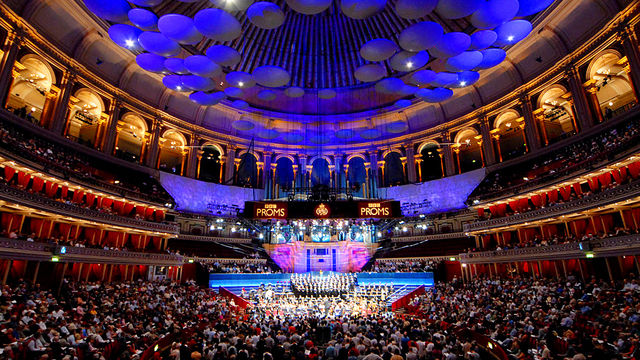
After picking up the tickets at the Press Office, we had a drink in the bar near door 9 and at the appointed hour drifted into the hall where we had excellent seats in the circle. Inside, the hall vibrated with the hum of 5000 people in that special state of eager expectation a few minutes ahead of the start of a concert. The orchestra were taking their places, the ‘prommers’ claiming their ‘pitch’ in the arena. Above the stage, a plush red and gold velvet swag proclaimed that these were the ‘BBC Proms’. Then the formalities began, first with the arrival of the assistant leader of the orchestra, then the leader, and finally the ‘master of ceremonies’, conductor Juanjo Mena (who takes over as principal conductor of the BBC Philharmonic Orchestra in September). With the raise of his baton, the evening’s entertainment was underway.
I am well aware of the limitations of the Albert Hall as a music venue: small scale, chamber and solo recitals are often lost in its vast space, and its dodgy acoustic can give the sense that the music is being heard from a next door room. Even the full-size orchestra last Friday struggled at times to be heard, especially in the quieter passages of the opening piece (Debussy’s ‘Gigues’ from his Images for orchestra), but at other times, the woodwind and brass sections (who were particularly fine throughout the concert) sang through perfectly, clear, bright, melodious and mellow, while the strings were silky and translucent.
(c) BBC Proms
“Where are they off to?” my friend asked after the applause for Ravel’s wonderful Rhapsodie Espagnole and the orchestra started to drift off the stage. I pointed out it was the interval and therefore time for another glass of perfectly chilled rosé in the bar. Nick expressed his delight at being there, spoke intelligently about what he had heard and what we would hear in the second half. He seemed intrigued by the idea that I could have come to any Prom I care to, courtesy of Bachtrack. Around us people chatted and laughed; the atmosphere was friendly and relaxed. Afterwards, walking back to the tube station along the tunnel at South Ken, we overhead other people’s responses to what they had heard (always useful grist to the reviewer’s mill!). We talked all the way home on the train and agreed that we’d had a great night out.
And this, to me, is what the Proms is all about. Too often people are put off attending classical music because they perceive it as stuffy, elitist and populated by (largely) snooty octogenarians who demand hushed reverence. The Wigmore audience is perhaps the very worst example of this, although it doesn’t bother me any more, and without those people the Wigmore probably wouldn’t exist. But at the Proms, everyone is welcome. In recent years, the programmes have definitely become more “populist”, with themed concerts such as a Dr Who Prom, and, this year, a Human Planet prom and forthcoming Horrible Histories and Spaghetti Western proms. Music snobs and critics may throw their hands up at this, but I think these concerts are a great way of introducing classical music to people who may have no previous knowledge or experience of it. The atmosphere inside the Albert Hall is very friendly and good-natured, with its special Prom traditions: the Prommers always yell “heave-ho!” as the piano lid is raised, for example. And if people applaud during movements, so what? To me, it’s a spontaneous, instant response to something they have enjoyed, and should not be sneered at as ignorance of “concert etiquette”. (The habit of not applauding between movements had not existed before the twentieth century.) So, hip hip hooray for the Proms and all they stand for, and long may they continue. You can be guaranteed a huge variety of music, from new commissions to old favourites, works on a vast scale (Havergal Brian’s monumental Gothic Symphony), to intimate chamber music and solo miniatures.
I am back at the Proms towards the end of August for a late-night recital of Liszt, including the beautiful Benediction de Dieu dans la Solitude, performed by Marc-André Hamelin. I am not sure how Liszt’s solo piano works will fare in the vastness of the Royal Albert Hall, but I have little doubt that this is the kind of venue, and concert experience, of which Liszt himself would have thoroughly approved.
The Cross-Eyed Pianist is free to access and ad-free, and takes many hours every month to research, write, and maintain.
If you find joy and value in what I do, please consider making a donation to support the continuance of the site

 I was browsing the sheet music in Blandford Forum’s Oxfam bookshop at the weekend. Tucked behind a vocal score was a slim volume of early piano music which brought a rush of involuntary memory (the so-called “Proustian Rush”), and which took me right back to Mrs Scott’s pink and mauve piano room in Sutton Coldfield, circa 1973. Mrs Scott was my first piano teacher, an elegant, and, to me, very elderly, white-haired lady, whose husband would silently bring her cups of tea in a bone china teacup and saucer while she was teaching. When I was a little girl, I would be dropped off at her house by car, or would walk there with my mother, but when I was older (around 10 or 11), I would cycle to her house, my music flung in the basket on the front of my bike. Sometimes my cat would follow me and as I pedalled along the road, he would dart across gardens. Fearing he would get so far and then be lost, I often had to take the cat home, lock him in the house and then pedal at high speed to get to my lesson on time. Mrs Scott was never terribly impressed if my lateness was caused by my pet!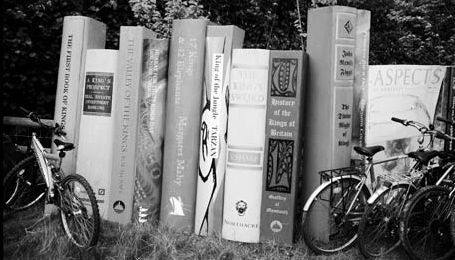




 The Cross-Eyed Pianist