Who or what inspired you to take up the violin, and make it your career?
No one individual directly; we were asked in school assembly if we would like to learn the violin and I said yes. Still not sure why! Over time I realised I couldn’t imagine doing anything else and threw myself into it. I was quite a late starter so I felt I had some catching up to do.
Who or what were the most important influences on your playing/composing?
At the start of my career it was my teacher at music college, Rodney Friend. He showed me that any problem can be overcome quickly and easily, he taught me to be my own teacher. He also gave me the confidence to enter a highly competitive environment.
In the profession, working with the English Chamber Orchestra shaped my approach to different kinds of repertoire. It was immediately apparent that it was an orchestra who knew how it wanted to play classical repertoire and beyond. This made it very easy to fit in with and assimilate this stylistic approach.
What have been the greatest challenges of your career so far?
Time management! When you have a lot of work, preparation at home to do and admin/planning/promotion etc. time becomes a valuable commodity. You quickly learn to do all of these things faster.
Which performances/compositions/recordings are you most proud of?
With the ECO there have been many occasions over the years, often tours as you have the opportunity to develop performances over time. We toured Germany at the end of last year, by the end of the tour we were playing a mean Britten Frank Bridge Variations!
I also had the opportunity to lead the orchestra at Kings Place this year where I thought the orchestra sounded terrific.
With my group the Tippett Quartet I’m very proud of our Bernard Herrmann recording for Signum.
Do you have a favourite concert venue to perform in?
This depends on the repertoire and so the size of the orchestra. When it’s the ensemble you simply can’t beat Wigmore Hall. Kings Place also sounds great and is a welcome addition to London’s venues. Our home at Cadogan Hall is a really good venue and an appropriate size for the repertoire we play. A lot of the best halls are out of London though; personal favourites are Symphony Hall Birmingham, The Sage Gateshead and the Royal Concert Hall in Perth.
Favourite pieces to perform? Listen to?
With ECO I have a list! Bartok Divertimento, Britten Frank Bridge Variations, Strauss Le Bourgeoise Gentilhomme, any symphony by Beethoven or Mozart…
On a smaller scale, Schubert string quintet, string quartet Death and the Maiden, anything by Mendelssohn but specifically string quartets Op. 12 & 13 and late Beethoven.
Who are your favourite musicians?
I’ll restrict this to people who have worked with ECO recently or the list is endless! Isabelle Faust, Plamena Mangova, Sergie Krylov, Marianna Thorsen, Lawrence Power and ECO’s own Stephanie Gonley!
What is your most memorable concert experience?
I suffer from a terrible memory and after about a month most things start to blend in together. However, there are a few dates that linger in the memory for different reasons: my first ECO date I was at the back of the 2nd violins and there wasn’t room on stage for me in the piano concerto! I turned pages… We played in Eisenstadt a few years ago where Stephanie played Haydn C major violin concerto in the home of Haydn live on radio. She turned an average piece into a masterpiece. My first concert leading the orchestra is also a very fond memory.
With the quartet it is playing Beethoven Op. 131 in Wigmore Hall.
What do you consider to be the most important ideas and concepts to impart to aspiring musicians?
The most important thing is that they love doing it, you can work on the rest. In our field, it is harder than ever to make a living as pay and opportunity have dropped dramatically over the years while competition is now global. Loving what you do gets you through the frustrations and helps you stay creative. With the right perspective, we can view ourselves as very lucky people doing what we love, otherwise it becomes just a job, a grind with few benefits.
What are you working on at the moment?
ECO has a little time off after Grange Park Opera at the moment so it’s mostly my own projects. I’m listening to edits of a forthcoming Rozsa string quartets disc for Naxos with my group the Tippett Quartet. I recently played a very last minute Elgar violin concerto for the 1st time; chastened by the experience I’m getting in some early preparation for a Glazunov concerto that I’m playing with Bath Symphony Orchestra in November. It’s a work I’ve played twice before but as I mentioned earlier, time management!
What is your most treasured possession?
I always feel the real value of a possession is the pleasure you get from using it rather than the possession itself, so a qualified entry here. I don’t actually own my violin but have had it on loan for 7 years now. It has been an amazing journey as I have learnt to play it and it has changed out of recognition over the years. At nearly 300 years old you could forgive it for being stuck in its ways, but we have both adapted to each other remarkably.
John Mills began studying the violin in Southampton in 1990 and in 1996 he gained a place at the Hampshire Specialist Music Course and joined the National Youth Orchestra. Two years later John gained a place at the Royal College of Music where he studied as a scholar under professor Rodney Friend, one of the great orchestral leaders, for five years. He also participated in master-classes with Hugh Bean CBE, Ida Haendel and Zvi Zeitlin. He became a ‘Making Music’ (National Federation of Music Societies) recommended artist in 2003-2004.
John is well known as a chamber musician and is the leader of the highly acclaimed Tippett Quartet, performing, and broadcasting widely across the UK and worldwide. He has recorded extensively with the quartet for EMI, Naxos, Signum, Classic FM, Dutton and Guild record labels.
John is the co-leader of the English Chamber Orchestra and is in demand as an orchestral leader, including a trial with the Bournmouth Symphony Orchestra and guest work with the London Mozart Players, Rambert Dance Company and others.
John is gaining a fine reputation as a soloist, performing and broadcasting the major violin concerti across the UK and abroad, including the Liszt Hall in Hungary and concerts in Auckland, Wellington and Christchurch, New Zealand. He has also appeared as soloist with the English Chamber Orchestra and will be appearing with them next year in a performance of the Bach Double violin concerto.
An intriguing envelope, postmarked from Ireland, dropped through my letterbox this morning, a welcome change from the daily deluge of Christmas mail. The A4 sheet of text, which accompanied the enclosed CD, immediately caught my attention when I saw the name Joyce Hatto, and initially I misread the text, thinking I’d been sent a recording to review by one of the artists Joyce and her husband ripped off in the course of their great classical music scam.
Pianist Archie Chen with actress Maimie McCoy who plays Joyce Hatto (right) as a young woman
In fact, the CD, a collection of works by Chopin, performed by pianist Archie Chen, relates to the upcoming BBC biopic of Joyce Hatto, Loving Miss Hatto. Written by Victoria Wood and starring Francesca Annis and Alfred Molina, the film will be aired on Sunday 23rd December on BBC One.
Archie Chen is indeed the pianist “behind the hands” – in that he provides the music for the film, under the direction of the musical director Niall Byrne. Chen himself is the pianist playing in the film, and he was also charged with teaching the actress Maimie McCoy, who plays Joyce as a young woman, how to play convincingly for the camera. The challenge for Chen was to learn some of the most difficult works in the repertoire in a very short space of time. As Chen himself says of working on the film: “I’m in such a privileged position to be involved in this project……I really relished the challenge of learning the most fiendishly difficult Godowsky Studies…..The hardest part was putting in the mistakes!”.
The release of the film coincides with the launch of Chen’s new CD ‘Chopin’, which features some of the composer’s best loved works, including the Ballade No. 3, the Scherzo No. 2 in B-flat minor op. 31, and all of the Impromptus, as well as the B minor Sonata. The opening Impromptu, in A-flat major, is a joyful outpouring, Chen opting for a more relaxed tempo than some performers, with restrained rubato and a thoughtful middle section. The Ballade No. 3 is graceful and elegant, with tasteful rubato and an enjoyably lilting tempo, which calls to mind the chime of a carriage clock (perhaps on the mantelpiece at Nohant?). In the Scherzo, once again a more spacious tempo allows us to enjoy all the contrasting elements and drama of this work. Likewise in the Sonata, tempos are measured and well thought out, in particular in the final movement (marked Presto non Tanto, far too many pianists, in my opinion, take this movement at such a gallop many of the details of the music are lost). Clean and expressive playing throughout, coupled with considered tempos and spare use of rubato, make this a CD to enjoy over several listenings.
Archie Chen ‘Chopin’ is available on CD or as a download
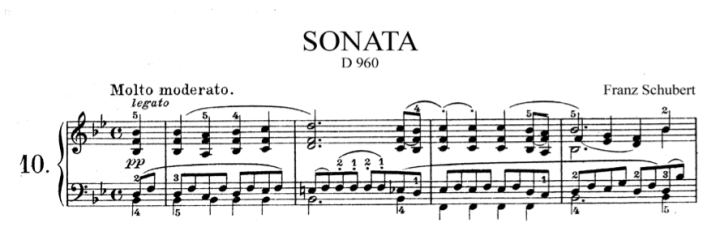
Whether or not to meticulously observe the exposition repeat in Schubert’s final sonata, the D960 in B-flat major, is a question which continues to trouble pianists, musicologists and listeners alike. The debate concerns aspects such as authenticity, personal taste, prevailing musical fashion, and timing. It has cropped up the press this autumn as British pianist Paul Lewis completes his cycle of Schubert’s sonatas, and has exercised myself, colleagues and other musical friends in discussion.
The opening bars of the first movement of Schubert’s Sonata in B-flat Major D960
When I first started learning the D960, the day my new piano arrived from Chappells in January 2007, I did not doubt the correctness of adhering to the score and repeating the exposition. Throughout my musical studies, I had been taught to trust the composer’s intentions, that composers know what they are doing, and that repeats are there for a reason.
In Baroque repertoire, sectional repeats are commonplace, often used to reinforce material and to offer soloist and/or ensemble the opportunity for some interesting extemporisation or ornamentation in the repeated material. At a recent harpsichord masterclass I attended at Handel’s House with some of my students and those of a teaching colleague, the harpsichordist, Claire Williams, encouraged students to experiment with different effects in repeats, such as using the upper manual of the harpsichord, or employing a lighter touch. Bach and his contemporaries would have expected and encouraged it.
In the piano sonatas of Mozart, for example, a repeat of the exposition in the first movement is often a reinforcing device, a reminder that this is a sonata, in Sonata Form (Exposition, Development, Recapitulation). And Mozart would have expected his keyboard player to offer some extemporisation – changes in dynamics, ornamentation and so forth – in a repeat. As musicologist, pianist and noted Mozart expert Robert Levin states:
“If you take a repeat, for instance, heaven forefend you should play exactly the same way you did before. It’s like telling somebody, ‘Look, if you could go back five years and relive your life would you change anything?’
Some people might say, ‘Nah, I think I basically did what I wanted to do,’ but a lot of people would say, ‘Oh boy. I can name you a dozen things that I would done differently.’ A piece of music is an almost cinematic opportunity to revisit a situation and reinterpret it.”
In a repeat of the exposition, the musical experience does not stay the same – there can never be a “straight repeat” because we are human and do not seek to replicate MIDI recordings – but the repeat of the same material helps the listener to assimilate the musical ideas expressed in the composition, and makes it easier to comprehend the structure of the piece.
In Schubert’s last sonatas, the repeat sign is written for an exceedingly long exposition, while the material of the exposition is repeated a third time in the recapitulation with little alteration. This has led some pianists to omit the exposition repeat in performance. But in the last Sonata (and, indeed in the penultimate Sonata, D959 in A), the first ending of the exposition contains unique material, leading the music back to the movement’s opening. If the music is performed without the repeat, this material is missed out completely as it does not appear in the second ending of the exposition (if one does not observe the repeat, one goes straight to the second time bar and thence to the development section). These bars contain striking material, which does not appear anywhere else in the piece, and is significantly different from the second ending. When the exposition ends a second time, Schubert introduces an extraordinary bridging section, three ethereal chords a single bar, which seem to come from somewhere else completely, and lead the music into darker, minor-key territory.
The first and second time bars at the end of the exposition
British-Hungarian pianist Andras Schiff feels that the omission of the exposition repeat is as “the amputation of a limb” (Schiff, “Schubert’s Piano Sonatas”), while Alfred Brendel declares the exposition repeats in the final two sonatas to be “unimportant”, that the transitional bars in the D960 are too unconnected to the rest of the movement, and that their omission actually contributes to the coherence of the piece. Brendel also states that “repeat marks must not be taken as orders to be automatically obeyed, as if the repeatable section were written out by the composer.” (“Schubert’s Last Sonatas: An Exchange”; Frisch and Brendel). But the last two sonatas have more than mere “repeat marks”: the bars of music specifically written out by the composer suggest that Schubert requires the repeat to be observed.
Personally, I have never doubted the inclusion of the exposition repeat, and it irritates me when I hear performances, either live or on disc, which omit it.
In reading reviews of live performances of Schubert’s last three sonatas, it strikes me that many pianists omit the exposition repeat/s simply to save time. Most concerts last around 90 minutes (plus interval); any longer and the audience starts to get restless, worrying about last trains etc. Critics, who praise the omission of the exposition repeat, are similarly impatient, presumably keen to get out of the Wigmore and into the pub before last orders! Played in its entirety, with all repeats intact (including in the third movement Scherzo), the D960 comes in at around 40 minutes.
Another issue which relates to this is the tempo of the first movement. It is marked Molto Moderato, and in some pianists’ hands (Richter), this can verge on Adagio! Moderato means “not rushing or dragging”, and Schubert also used the German term mässig, implying the calm flow of a measured allegro. A quick glance through Spotify of recordings of this work reveals that most versions which include the repeat come in at around 20 minutes; Richter’s is 25 minutes, which is verging on self-indulgent, while Pollini’s is 18 minutes. At this length, the opening movement of the D960 is as long as an entire sonata by Haydn or Beethoven.
It is customary to programme Schubert’s last three sonatas together, just as Beethoven’s last three are, to stress the interrelations between the three. The D958 and D959 are played in the first half of a concert, and the D960 after the interval. It can feel like a long haul for the audience, and one of the solutions to this problem is to shorten the programme by omitting repeats, mainly those of the opening movements’ expositions. However, it irks me when I read reviews of pianists such as Paul Lewis (a protégé of Brendel), who is completing his survey of Schubert’s piano and lieder music with performances of the final three sonatas, in which critics praise the omission of the repeat without outlining at least a little of the background to this ongoing debate. I feel that without the exposition repeat the audience is cheated of the opportunity to experience Schubert’s compositional intent, and the drama, which comes from the tension between the contrasting harmonies in the exposition, and the transition between exposition and development, is lost.
To my mind, a well-played opening movement of the D960, with repeat, need not feel unnecessarily long. The music has an spaciousness (its key and scale always calls to mind, for me, a great river charting its final course towards the sea) which is offset by a considered interpretation of the Molto Moderato marking. I particularly like Pires and Uchida in this work. I have enjoyed all three sonatas in a single concert, or the D960 on its own, preceded by one of the D899 Impromptus in a lunchtime recital at the Wigmore (Andreas Haefliger – repeat omitted!). Both programmes work equally well.
The Cross-Eyed Pianist is free to access and ad-free, and takes many hours every month to research, write, and maintain.
If you find joy and value in what I do, please consider making a donation to support the continuance of the site