Returning to old repertoire can be extremely satisfying, and one often discovers new things about the music when returning to it after a break. I also recall all the reasons what I like about the repertoire and why I selected it in the first place.

My teacher has cautioned me about reviving repertoire I learnt as a teenager. This is good advice, for despite a gap of over 30 years, all the impetuous errors of youth seem ingrained in the piece and the fingers, and undoing these problems can be nigh-on impossible. Against my teacher’s advice, however, I revived Schubert’s E-flat Impromptu for my ATCL Diploma in 2011, because I needed a “fast piece” in the programme. I had not touched the piece seriously for over 30 years, yet I was pleasantly surprised at how much of it I could remember (it must be said that this is not a particularly difficult piece to memorise, being constructed from repeating patterns and motifs). But working from the old Editions Peters score I had as a teenager meant that all the errors were still there, as well as my then teacher’s annotations. In order to learn the piece carefully, I ditched the dog-eared score and purchased a new Henle urtext edition. In effect, I started again from scratch with the piece: I learnt new fingering schemes, thought carefully about the structure and atmosphere of the piece, and was delighted to have it described as “an assured and stylistically accurate performance” by the diploma examiner. Having taken the trouble to re-learn the work carefully, it is now very securely lodged in fingers and memory.

People often ask me whether it is “hard” to revive old repertoire. In general, I have to say I have found it relatively easy to return to previously-learnt repertoire, though this isn’t always the case (the ‘Toccata’ from Bach’s 6th Partita will take some careful work if I want to revive it). However, one can take steps to ensure that once learnt a piece can be revived and made ready for performance relatively quickly.

Lately, I have been enjoying revisiting some of Szymanowski’s Opus 50 Mazurkas, the first two of which I played for my ATCL recital. The pieces felt different without the pressure of an exam hanging over me, and I felt I was playing them in a freer way as a result. I am also working on Rachmaninov’s G minor Etude-Tableau (Opus 33, No. 8), for my debut in the South London Concert Series in May (the piece will be paired with Szymanowski’s Mazurka no. 1). It is a mark of how carefully I practised the piece in the first place that within an hour of practising earlier today, I felt it coming back together nicely. Of course there are elements that will need some careful, detailed work (the cadenza, for example), but overall, it is still in pretty good shape. Getting it “concert ready” should not take too long.

Professional pianists will have many pieces “in the fingers” which can be downloaded and made ready for performance in a matter of days. This may include 20 concertos or more, most of Beethoven’s 32 Sonatas, many of Bach’s 48 Preludes and Fugues, plus other pieces which are ‘standard’ repertoire: Mozart and Schubert sonatas, works by Chopin, Schumann, Brahms and Liszt, much of Debussy and Ravel etc., and popular ‘standards’ from the 20th Century repertoire by composers such as Messiaen, Bartok, Stravinsky, Ligeti, Berio, Berg, and Schoenberg. Careful learning and preparation mean that repertoire can be learnt, revived and kept going simultaneously. It is this kind of deep, thoughtful practise that is essential for ensuring repertoire remains in the fingers (and brain) even if one is not practising it every day.

Some thoughts on reviving repertoire successfully:

  • Recall what you liked about the pieces in the first place. What initially attracted you to the pieces? Rekindle your affection for the pieces when you revisit them
  • Don’t play through pieces at full tilt. Take time to play slowly and carefully.
  • Trust your practise skills. Be alert to issues as they arise and don’t allow frustration to creep in.
  • Look for new interpretative and expressive possibilities within the music. Try new interpretative angles and meaningful gestures.
  • Don’t hurry to bring the piece up to full tempo too quickly. Take time to practise slowly and carefully.
  • Schedule performance opportunities: there’s nothing better to motivate practise than a concert date or two in the diary.
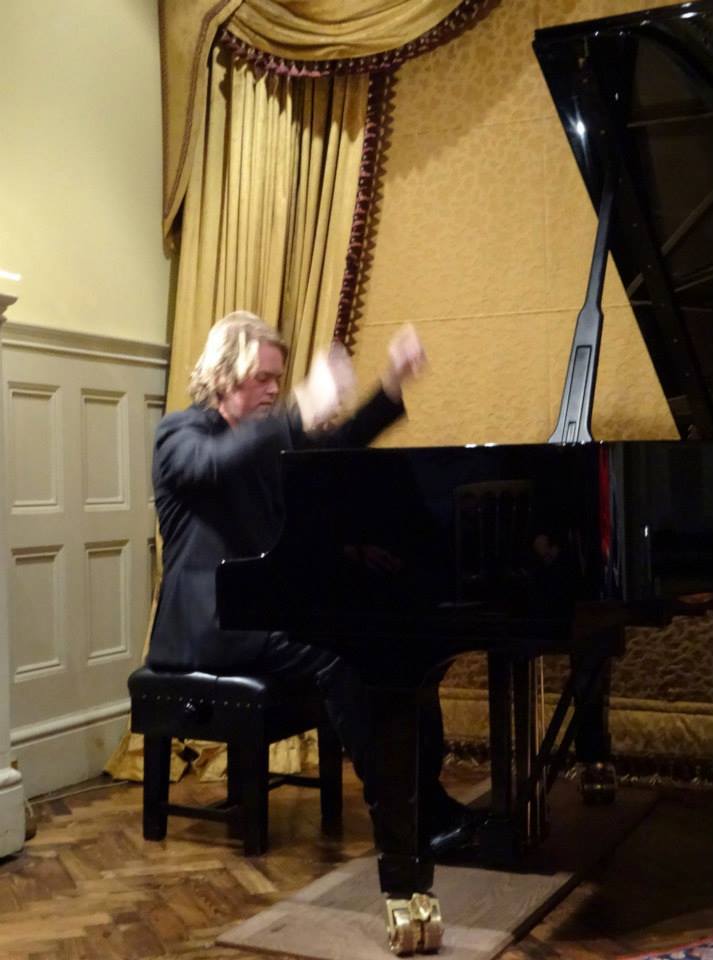
 

Daniel Roberts performing at the 1901 Arts Club

Who or what inspired you to take up the piano, and make it your career?

My Grandfather. When I was very young, I would watch him playing in his house, and even though he didn’t play professionally, his deep passion for music must have transmitted to me.

Also I went to a live performance of Rachmaninov’s 2nd Concerto in St David’s Hall Cardiff, with pianist Stephen Hough, and the thrill and intensity of that performance pushed me more into playing for a career.

Who or what were the most important influences on your playing?

I had a wonderful teacher called Alison Dite who introduced me to the composers I enjoy now, such as Chopin, Beethoven, Rachmaninov, and many more. Helen Reid taught me at Leeds College of music, and I learnt great ways to practice, and how to project the meaning of a piece to an audience.

Now I’m studying privately with Peter Feuchtwanger, and his vast knowledge of styles of playing, along with his unique technical approach, have been incredible for my development, and I’m constantly amazed at his generosity, and commitment to teaching. In every single lesson I discover something that can benefit all pieces.

What have been the greatest challenges of your career so far?

In March 2013 I gave the world premiere of a duo piece by a hardly-known composer Peter Hatfield, called ‘Infatuation’ with violinist Hannah Woolmer, and I felt a huge responsibility in giving a good first performance of this work, and bringing it to life. We enjoyed a successful performance, and felt very happy when people told us they loved the music.

Which performances are you most proud of?

A few I’ve really enjoyed and given everything in:

  • My final recital in Leeds College of music for my Degree, including Chopin’s lovely 3rd Sonata, along with the kind support of fellow students, some of whose are now colleagues, friends, and the teaching staff.
  • A London recital at Schott’s music shop, where I played Sonatas by J.C. Bach, which deserve so many more performances, Songs Without Words by Mendelssohn, and Tariqa No. I (Iranian) a piece composed by my teacher Peter Feuchtwanger. Pieces that I love sharing with audiences, and can be viewed here http://www.danielrobertsmusic.com/videos/
  • Performing the ‘Rhapsody on a Theme of Paganini’ by Rachmaninov for the first time. I listened to this work along with Rachmaninov’s piano concerti countless times growing up, so it was one of my biggest dreams to play this incredible piece. I entered a beautiful colourful world during the piece, that Rachmaninov has created with his genius variations on Paganini’s Caprice 24. It was very nice to play second piano in the orchestra for ‘Carmina Burana’ in the last half of the same concert too!

Do you have a favourite concert venue to perform in?

Although I haven’t performed there I would love to play the Royal Albert Hall, as I’m sure its huge space combined with a fantastic acoustic, gives a performer the potential of performing with no limits, and a great sense of rapport with audience.

Favourite pieces to perform? Listen to?

I love performing Prokofiev Sonatas, Mendelssohn’s Andante Cantabile and Presto Agitato, Beethoven’s ‘Tempest’ Sonata, Rachmaninov Preludes, Chopin, Beethoven Concerto No. 1, and of course the Paganini Rhapsody.

I love listening to large-scale works such as Messiaen’s ‘Turangalila Symphony’ the Busoni Piano Concerto, music by Karl Jenkins, as well by Alkan, Saint-Saens’ Piano concerti in the wonderful recording by Stephen Hough. Also I love listening to jazz artists such as Oscar Peterson, and Hiromi Uehara.

Who are your favourite musicians?

Martha Argerich, Jools Holland, Valentina Lisitsa, Peter Donohoe, Marc André-Hamelin, Hannah Woolmer, Harry Connick Jr, Noriko Ogawa, Clara Haskil, Vladimir Horowitz, Erna Sack, John Ogdon, and many others.

What is your most memorable concert experience?

A few years ago I heard Martha Argerich performing Prokofiev’s Piano Concerto No 3, and I still think this is the best concert I’ve been to in my life! It was a masterful, and timeless performance, which left a positive mark in my musical heart forever.

What do you consider to be the most important ideas and concepts to impart to aspiring musicians?

Stick to the music you love, and give unfamiliar pieces time to grow on you, because as you mature you begin to love a whole different collection of works. Remember that the music is to be shared with the audience, and that you are the narrator of the musical adventure you present to the world. Remember that everyone responds to music differently, so it’s important to listen to different perspectives from people’s experience of your performance, to gain valuable insights into the true power of music.

What are you working on at the moment?

I’m practising Beethoven’s ‘Emperor’ Concerto, Peter Feuchtwanger’s ‘Variations on an Eastern Theme, Books 1 & 2’, Medtner’s ‘Fairy Tales’ and Saint-Saens’ ‘Wedding Cake’ valse for piano and orchestra.

How do you make repertoire choices from season to season?

I always aim to include lesser known works, which will sometimes be a premiere performance, as well as more populars ones. This comes from pieces I’ve been listening to for years, and a wish to experience in a personal way performing them.

Which works do,you think you play best?

Two pieces that I believe I play well at Feuchtwanger’s incredible ‘Tariqa 1’, which I’ve always enjoyed performing, and Mendelssohn’s beautiful ‘Andante Cantabile & Presto Agitato’.

Where would you like to be in 10 years’ time?

Sharing music with people around the world, whether it’s in a live concert, an online broadcast, or through recordings that I plan to produce during this time. I also want to be helping young musicians to love music, and encouraging them to explore new pieces, relate it to their lives, and how it can help them. Most importantly I would still wish to be learning new things, and gaining inspiration each day so the music can be healthy and alive.

What is your most treasured possession?

My brain, because with it I can ‘work’ anywhere in the sense of imagining a piece I’m working on, and listening to music stored in my ‘mental iPod.’ Also you can recall life’s most fantastic experiences through the audio, visual and kinaesthetic memories, and this for me is better than anything else.

Daniel Roberts’ biography

Isaac Albeniz (1860-1909)

The British pianist Jonathan Powell, who lives in Poland with his family, will be giving a London performance of the complete cycle of 12 pieces that comprise Isaac Albéniz’s Iberia. Direct, passionate, complex, haunting and original, this suite of pieces is rarely heard in its entirety. Jonathan’s concert is on Thursday 27th March at Rosslyn Hill church, Hampstead.

I asked Jonathan to explain what makes this music so interesting and challenging for the pianist, and his own particular connection with it.

When and how did you first encounter Albéniz’s Iberia?

In my late teens I was studying Granados’ Goyescas, and someone told me they would like to hear me play them and Iberia in the same concert! Up until then I had only been aware of Albéniz’ collection, so I decided to look at them for the first time then. Oh, and I’ve not yet taken up that challenge …

What is the particular appeal of this suite of pieces to you?

Well, there are really so many things about Iberia that appeal to me greatly: the brightness and vividness of the colours; the amazing sonorities Albéniz conjures from the instrument; the Mediterranean ambiance; the daring originality of the use of folksong-type materials; the sheer brilliance of writing matched with exquisite atmosphere …

What are the technical and musical challenges of learning and performing the entire suite?

Well, most of the pieces have particular technical challenges: there’s a lot of crossing of hands, big leaps, dense textures which require careful stratification, and you have to keep very cool on the metrical front; musically, you need to carry, shape and project a line while maintaining what is often a very complex texture ‘underneath’. Also, it was quite hard to memorise, especially some of the later pieces which, while still completely tonal, use lots of chords with unexpected added notes that are slightly different each time they appear.

Is this the first time you will have performed the entire suite?

Oh no! I’ve been doing it for about two years now. When I passed 40, I thought “you’re a grown up now, stop putting this off”, so I got down and learned it. To date I’ve played the pieces in Belfast, London, Oxford, Glenfinnan, Esbjerg (DenmarK), Levoča (Slovakia), Gliwice (Poland), Kiev (Ukraine), Kirovograd (Ukraine) and probably a few other places I can’t remember just now.…

Do you have any favourite recordings of this work?

Yes, Alicia Delarrocha made three, they’re all good. Other Spaniards like Rafael Orozco and Esteban Sánchez are also outstanding. I’d love to hear Yvonne Loriod’s recording, but unfortunately (and, to me, completely inexplicably) it’s out of print.

Which works by Albéniz would you recommend for someone just beginning to explore his piano music?

Well, Albéniz wrote a huge amount of piano music, completing some 200+ opus numbers – most of which are for the piano – before he even embarked on Iberia in the mid-1900s. The Chants d’Espagne might be a good starting point, as might the Recuerdos de viaje; there are also Suitas Españolas, several sonatas and hordes of miniatures. Rest assured that pretty much none of the pre-1900 pieces contains any of the challenges of Iberia!

Jonathan Powell performs Iberia at Rosslyn Hill Chapel, 3 Pilgrim’s Place, Hampstead, NW3 1NG London on Thursday 27th March 2014 at 7.30pm

Meet the Artist……Jonathan Powell

All the enjoyable and engaging features of ‘Pianist’ magazine are included in this new piano techniques app: informative and easy to understand articles on technique and repertoire, how to play a particular work with guidance from a top teacher, free sheet music (18 pieces in fact, from beginner to advanced level), an interview with Lang Lang, contributions from expert teachers, and more, all presented in an interactive and accessible format.



The organisation of the content will be familiar to anyone who reads Pianist magazine regularly. Clear, well laid out articles are enhanced by video tutorials by renowned teachers and pianists, and soundclips, which enable the reader to listen to the pieces presented in the free sheet music section.

The app is easy to navigate, with clear swipe commands and helpful notes and asides which enhance the articles. In effect, the app offers the very best of ‘Pianist’ magazine in a user-friendly and portable format – read it at the piano or in bed – and is ideal for the beginner, intermediate or more advanced pianist.

Download the app from the iTunes app store