Pianist Stephen Gott taking a bow after his performance at Normansfield Theatre, May 2012

‘Stagecraft’ refers to a number of aspects of performing and preparation for a performance from seemingly simple things such as appropriate dress and deportment to managing anxiety, programme planning and notes, communication (both verbal and musical), energy and emotional intensity, and movement and gestures.

Stagecraft is not just the ability to walk onto the stage without tripping over. From the moment the performer enters the stage, his or her communication with the audience begins, and the way one greets and acknowledges the audience can have an important effect on the way the audience receives and enjoys the performance which follows.

An understanding and appreciation of good stagecraft is very important and can help one produce a good performance, regardless of the level at which one plays. Stagecraft is an important factor in music diplomas and candidates are marked on their stage deportment, communication, programme notes and attire. Good stagecraft can also increase one’s feelings of confidence in a performance situation. Get into the habit of building good stagecraft into your practising and preparations and you will find you can pull off a poised and engaging performance.

Here are some suggestions on how to hone good stagecraft:

Preparation
This ties in with managing anxiety. If you are well-prepared and know your pieces you are far more likely to pull off a polished performance while also keeping nerves at bay. Play within your capabilities and make sure all tricky passages have been thoroughly ironed out.

Programme planning
This is an important aspect for people who taking are performance diplomas where one is judged on the ability to produce an interesting and varied programme. Think about the music from the listener’s point of view, rather than simply playing pieces you think the examiner wants to hear. Good programmes are like stories, with a beginning (perhaps a Prelude or short albumleaf), middle and an end, and the ability to vary degrees of energy in a programme will prevent it becoming too ‘samey’ or dull. Interesting and surprising juxtapositions – for example, a Baroque piece paired with something contemporary – can be very exciting and can help throw a new light on familiar repertoire. The late Phyllis Sellick apparently used to describe a programme by all one composer as ‘a list’, but single composer programmes can work really well if the performer has thought about differing levels of energy and emotional content in the pieces selected.

What shall I wear?
Choosing the correct attire for the time of day and venue is important. Full evening dress is not appropriate for a lunchtime or afternoon concert, and the style and atmosphere of the venue is also a factor in deciding what to wear. The performer’s concert attire is a means of differentiating you from the audience and defines your role for them. Getting ‘dressed up’ for a concert allows you to appreciate that this is an ‘occasion’, distinct from the practising and work done at home at the piano. The most important aspect is that you feel comfortable in your concert clothes, with plenty of freedom of movement and no distractions such as tickly labels or zips.

Walking to the piano
No matter how anxious you feel, your stage deportment should not betray your nerves. Walk confidently across the stage, greet the audience or bow, and sit at the piano. Take a moment to compose yourself before you play: this ‘breathing space’ at the start of a concert is vital, not just for you as the performer, but also for the audience, making them sensitive to the music about the wash over them.  Likewise at the end of the piece, don’t hurry away from the piano, nor scurry off the stage immediately. Take time to acknowledge the audience.

Talking to the audience
This is becoming more and more popular at professional concerts I attend, and a few words about the music being performed can immediately make the audience feel more engaged and connected to the performer. Talk clearly and don’t simply repeat the programme notes. Most people are interested in why the performer has chosen the repertoire and what makes it special for them. Never pre-empt your performance by telling the audience you played the piece well in practise at home, or that you are very nervous!

To play from memory or not?
The debate about whether playing from memory results in a better performance rages on, but if you do use a score, try not to cling to it as if you life depends on it. In particular, make sure tricky sections and page turns are memorised. Have someone turn for you, as this can increase the professionalism of your performance.

After the performance
Enjoy the compliments from the audience and never apologise for errors or slips in your performance. Save these things for when you next go to practise, for all these issues are useful and help prepare for the next performance.

Above all, learn to enjoy performing. It is a wonderful cultural gift to be able to share so much fantastic piano music!
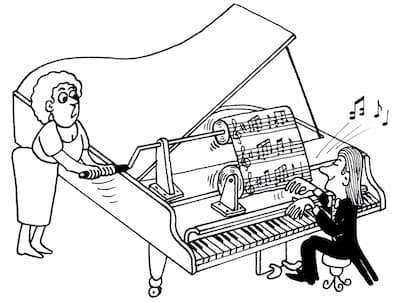
People assume that if you can read music, you can be a page turner for another pianist. 

You read music! You play the piano! You must be able to turn pages!” is the cry I frequently hear, and while all these statements are true, many people do not realise that page turning is an art in itself, a specialist skill which can help a performance go brilliantly, or turn a concert into a Feydeau farce.

These days at piano concerts it is still quite unusual to see a page-turner in attendance. The ongoing – and to my mind rather ridiculous – trend/burden of having to perform from memory (a habit which developed during the second half of the nineteenth-century, thanks in no small part to Franz Liszt and Clara Schumann) means that the turner is a fairly rare sight. It is more common if the pianist is playing as part of a chamber ensemble, though many pianists these days play from an iPad or similar device.

Page turning can be a nerve-wracking experience as the turner feels a great responsibility to “get it right” for the performer. Turns should be discreet and silent (turn from the left of the pianist, using the left hand to turn the top of the page). In effect the turner should be “invisible” – and the turner should be sure never to turn too early or too late.

In addition, the turner has to be able to understand and act correctly upon repeats, da capo and dal segno markings, and other quirks of the score. Turners also need to be alert to concert hall conditions: drafty halls can be stressful as stray gusts and breezes may blow the pages around. Page turners have to observe correct on-stage etiquette: they must follow the performer on to the stage and know not to rise from their chair nor fidget during pianissimo passages. They leave the stage after the performer has taken his or her applause and only step forward to receive plaudits if invited to by the performer.

Much of the turner’s role is about being able to “read” the performer’s body language and be acute enough to act upon sometimes highly discreet signals. Turners should not discuss their anxiety with the performer, nor expect the performer to give them tips or advice about their own playing or musical careers.

In fact, being able to read music is not necessarily a prerequisite of being a competent page turner as someone who gets too involved in reading the music may miss a crucial turn.

A quick poll around Facebook and X (Twitter) revealed some page-turning horror stories (turning the wrong pages, a severely damaged score with pages held together with sellotape, pages out of order) but also anecdotes celebrating page turning and page turners. One turner confessed that pianist Francesco Pietmontesi’s performance of the Liszt transcription of Beethoven’s ‘Pastoral’ Symphony had moved her to tears, and many people describe the privilege and pleasure of being able to turn for top international artists. 

Modern times call for modern page-turning techniques and gagdets: scores stored on an iPad or other tablet device can be turned using a bluetooth foot pedal such as the AirTurn. Music publishers go to some lengths to engrave and print music in such a way as to facilitate easy page turns, but when this is not possible, one either ends up with photocopied sheets taped to the score, uses an automatic turner, or opts to have a page-turner, which can look more poised and professional.

Whatever route you choose, make sure your page turns are tidy, quiet and discreet – oh, and always thank your page-turner after the performance!

(Image credit: The Student Music Organizer on Facebook)


Who or what inspired you to take up the piano, and make it your career? 

I cannot pin point where the inspiration came from, I guess I was just very passionate and still am about the piano.

Who or what were the most important influences on your musical life and career? 

My first teacher, Edvin Alamshah, who was a former student of Arturo Michelangeli, was a huge influence in my younger days.  But I think the greatest influences are the great composers, and great music.

What have been the greatest challenges of your career so far? 

I like to think of the challenges more like journeys; however I think for most pianists the greatest challenges are communication.  Once you have the ability to communicate with your audience you have overcome one of the greatest challenges.

Which performance/recordings are you most proud of?  

I haven’t recorded a CD yet but I have made many videos for YouTube and radio broadcasts. I think my favourite performances/recordings have to be the Scriabin and Janáček piano works.

Which particular works do you think you play best? 

It depends on how the coffee tastes in the morning!  There is no work I think of in that way, each piece of music has a soul and its own personality which breathes like we do, and on many occasions I’ve been proven wrong with a work I thought I could play best. However, Janáček sits very closely to me and agrees with me.

How do you make your repertoire choices from season to season? 

By reading lots and lots of music and seeing what speaks to me. I never listen to recordings to make these decisions.

Do you have a favourite concert venue to perform in and why? 

I have to say the Sydney Conservatorium of Music Verbrugghen Hall. It has lots of memories and a huge acoustic which fits my personality on stage.

Favourite pieces to perform? Listen to?  

I absolutely adore Haydn and all of his works, and I have so much fun with him while I perform.

Who are your favourite musicians? 

Really don’t have favourites, just very open/honest interpretation from many musicians young and old.

What is your most memorable concert experience? 

I think my most memorable was a recital where I performed lots of Galina Ustvolskaya’s chamber works. She was a student of Shostakovich.

What do you consider to be the most important ideas and concepts to impart to aspiring musicians? 

My friends and colleagues will laugh at this, but I always believe you must spend more time outside your practice room, meet people, go to concerts, classic or not, drink lots of whisky and take it easy.  I am not saying you should never practice – it’s very important: however some people really lose the sight of how it really is in real life. Spending 8-9 hours in a practice room can get very lonely: how are you supposed to communicate with people on stage when you can’t do that in real life?

What are you working on at the moment? 

I am working on the complete works of Janáček to perform and record in 2015.

Where would you like to be in 10 years’ time? 

Where I am now, happy and healthy.

What is your idea of perfect happiness? 

Where I don’t feel happy 24 hours of the day.

What is your most treasured possession? 

My piano scores

What do you enjoy doing most? 

Eating

What is your present state of mind? 

Panic (about to start teaching)

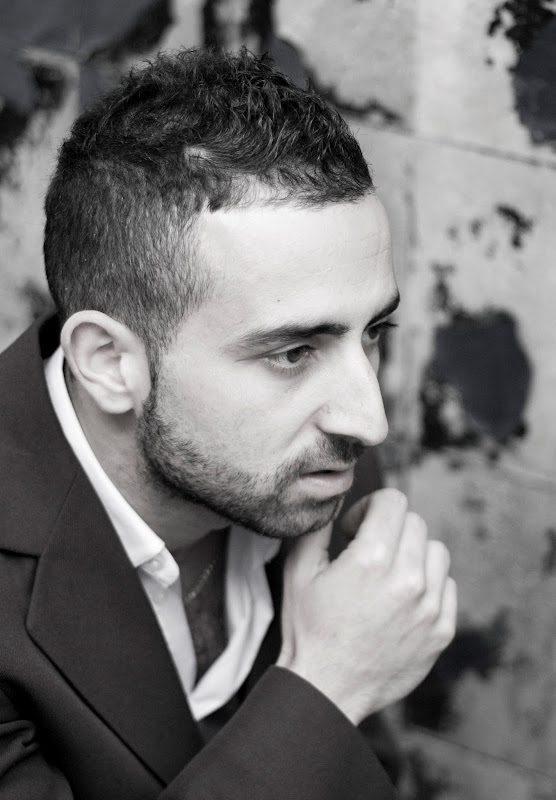
Vatche Jambazian performs works by Shostakovich, Mozart and Ustvolskaya at the 1901 Arts Club on Friday 16th May as part of the South London Concert Series. This concert is now **sold out**. Details of future South London Concert Series events here

Vatche Jambazian recently completed his BMus at the Sydney Conservatorium of Music and is now based in London performing many recitals in the UK and abroad. He has been a prizewinner in many international piano competitions such as The Russian Music Piano Competition in San Jose and the Australian National Piano Award. He is a highly dedicated piano teacher who aims to bring enjoyment as well as discipline to the lessons.

Vatche has recently been appointed Ambassador for the Commonwealth Piano Foundation.

We all have favourite performers, orchestras, venues, recordings and memorable concert experiences. Some works have special resonances and associations which connect us with experiences from our childhood, teenhood, early adulthood and beyond, or are potent reminders of a particular event, person or occasion. Sometimes a few bars of a certain piece can take me back to a particular time and place in my life and trigger a very distinct ‘Proustian rush’. There are recordings we return to again and again, performances we would revisit every night if we could, or pieces that we would happily have playing on a continuous loop.

‘Music Notes’ is a new occasional series, mostly comprised of guest posts, in which contributors discuss favourite or significant concerts, performances, artists, recordings or musical experiences. More ‘Private Passions’ than ‘Desert Island Discs’, the series is an opportunity for people to share their love of music and attempt to explain why certain pieces, places and artists have such distinct resonances and associations for them.

Guest contributions are now invited. The brief is wide – write about what you care about, what you love; nor is the remit strictly classical music. If you would like to submit an article, please use the Contact page to get in touch.

The series will begin with my own musings on a particular recording of Schubert piano music…..Read more here


