The Old Sorting Office (OSO) arts centre in Barnes, SW London, provides a vibrant and busy community for artists and audiences to gather and interact. The Centre opened in September 2002 and provides a venue for theatre and live performances, art exhibitions, dance classes, music, drama for all ages and abilities, writers’ groups, Yoga, Pilates classes, education opportunities… in fact, anything and everything!

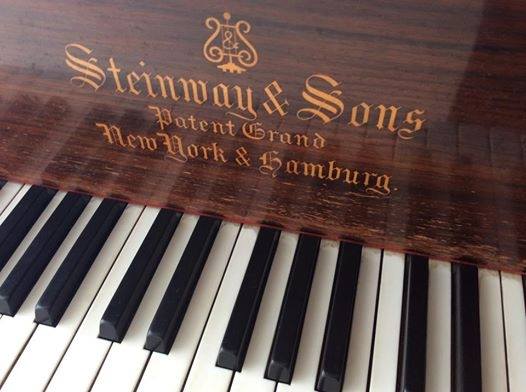
Yvonne Evans, Barnes resident and indefatigable concert promoter, is currently engaged in a fundraising campaign to secure £10,000 for the purchase and upkeep of a Steinway grand piano for the OSO, a beautiful historic instrument with a fascinating provenance, generously donated by Susan Tod Boyd, whose late husband David Tod Boyd, was a long time Barnes resident and an illustrious member of London’s musical life. For details of how to contribute to the OSO Steinway Fund, please contact Yvonne direct on Yvonne7star@live.co.uk

10579992_903606133112854_1779029172401043231_n

The piano will be unveiled in a special concert at the OSO on Saturday 9th August. ‘Classic Gershwin’ explores the world of ever-popular composer George Gershwin  by weaving his vibrant music with the fascinating story of his life – from his birth in the colourful, teeming New York of 1898 to his tragically early death in 1937. David Tod Boyd loved Gershwin so, fittingly,  this concert will be dedicated to him.

With prize-winning pianist and famed Gershwin interpreter Viv McLean and renowned classical actress Susan Porrett narrating, this music and words concert presents an eclectic mix of Gershwin’s music from the much-loved Rhapsody in Blue, I got Rhythm Variations and Swanee to the rarely-played, classical Preludes and the virtuoso challenge of the Piano Concerto and offers an intriguing insight into Gershwin’s little-known, many faceted personal history.

‘Classic Gershwin’ is the third words and music collaboration between actress/writer Susan Porrett and pianist Viv McLean, and comes in the wake of their much-loved Shakespeare show ‘Touches of Sweet Harmony’ and the critically acclaimed ‘Divine Fire’ – the story of Fryderyk Chopin and George Sand, which has now toured throughout the UK for three years.

‘Classic Gershwin’ is at the OSO Barnes on Saturday 9th August at 7.30pm. Book tickets

The formal dedication of the Tod Boyd Steinway will be on 23rd September at the Grand OSO  Black & White Piano Party – a celebration of  the piano and musical theatre in music and words featuring pianists Bobby Chen, Anthony Hewitt, Viv McLean and GeNIA, poet Graham Roos and actress Susan Porrett and friends. The legendary Fenella Fielding will officially launch this very special piano. Further details and tickets here

www.sevenstarconcerts.com

by Guy Rademaeker.

He is 25, lives in Brussels, and things are going well for pianist Matthieu Idmtal. He just organised the second edition of the ‘Brussels Chopin Day’, next month he goes to France and Switzerland to perform with his violin partner Maya Levy, and his concert agenda for the future looks full. “I try to find my way” he says almost laconic.

We sit in a bar in Ixelles, the town where he lives, and during our conversation he will order three coffees. Nevertheless, the calmness of this young man will never disappear.

How did you start playing the piano?
I always found that I walked a rather atypical path to arrive at where I am now. I don’t come from a musical family, and compared to many others I started relatively late with playing the piano. I never went to a music academy and so on.

I remember we had an old upright piano standing in our house to which I was always going as a child. On a good day my mother kind of decided that she maybe had to do something with the kid that was always plucking that piano, and she searched for a private teacher for me. I must have been 7 or 8 at that time. Thinking about it, I believe that she was a very good teacher: a Russian pedagogue who was able to give me a good foundation. She noticed a certain talent, but I had no clue at that point that playing piano could or would become my profession. Maybe the people around me noticed faster than myself my potential and my need to play music. I remember how I would walk to school, and midway just decide to walk back home because I considered playing the piano a much nicer way to spent my day than sitting in a classroom. The problem was that I took these decisions more and more often. And that is how I entered to the Kunsthumaniora Brussel, a high school in Brussels that offers, next to standard courses, music courses as well which prepare you for entering conservatoire. From that moment, there was no doubt anymore. Music took me every day more and more. Till now.

Who do you consider as your significant teachers?
Without doubt, I must mention Vitaly Samoshko. I could say that he taught me how to play the piano. Of course we’re all made out of our lived experiences, what we hear and see, how much we invest in our art….… but Samoshko is the one I refer to.

You’re not studying in conservatoire anymore. Do you still work with him or do you study on your own now?
We still see each other. Less often than before, but I regularly visit him as a kind of……touching base. It is true that I work much more on my own, but that is what we all will have to do. At a certain moment you must become your own teacher. And it makes you think a hundred times more about each note and decision you take. When, after a concert, someone comes to you and asks “why did you play that piece that way?”, you can’t answer “because my teacher wanted it so”. Everything I do now is my own decision. I follow my intuition.

You also teach yourself. What advice do you give your students?
To give you the best answer you should actually ask my students how I teach, but I believe that it is a mix of my own experiences as a student, together with my own personality and ideas that I formed myself during over the years. I see my role as a teacher a bit like a sounding board. I prefer to suggest than to oblige, and I like to see a lesson as a moment between two friends who try to work and search together for the best possible solution to play a certain piece. Of course, some things can be radically wrong and I will say them, and I have some general ideas. Never to imitate for example, search for your own way. I also encourage them to experiment, try something, to dare. If it’s wrong, it’s wrong and you will learn from it, but dare to do something wrong. Take a risk, surprise me and yourself..… and at the end of the trip, remember and take all the best of these experiments. Sometimes I will ask a student to exaggerate something, to make something more clear, or just to give it all a bigger dynamic range. I also notice that I speak a lot about pulsation in the lessons, or to see a piece in orchestral terms, or to imagine a singer. And of course, sound is crucial.

It goes with your last question. When teaching, you’re very much faced with questions that force you to think how to play a certain thing very concretely. That helps yourself tremendously. For example, in a recent lesson, some of my better students asked me how to position the fingers on the keyboard, flat or curled. Honestly, there is not one answer to me. Everything depends on the sound you want to create. When I play a Scarlatti sonata for example, I can imagine myself playing with curled fingers, but I would never do that which a Chopin Nocturne. It all depends on sound. Play with your nose if you wish, if it sounds fantastic, do it!

What about your chamber music collaborations? I noticed that you have two regular duos?
I do. I have a piano duo with Ukranian pianist Anastasia Kozhushko. We met years ago in the class of our teacher, and started playing together. We won some competitions, mostly in the Netherlands, and most of the time we perform there. We aim to include less familiar pieces and composers in our programs. In combination with the more known works we play works by Cui, Rosenblatt, Vilensky, Clementi, etc. Absolutely amazing music but unfortunately underplayed.

I have also formed a duo with violinist Maya Levy. I consider her one of the young upcoming violin talents. We’ve worked together for about a year now, and some nice projects are coming up.

Playing chamber music is a real joy to me. You know, being a pianist is a lonely profession most of the time, you sit for hours a day alone behind your instrument – something that other instrumentalists rarely do because they all need a pianist to play with them! – and so it is a very welcome change to collaborate with someone. To have some interaction, to search together and to find compromises. And the repertoire is also fantastic.

Do you have any favorite pianists?
This generation has amazing pianists, absolutely amazing. But for most of them, the individuality has rather disappeared. Before you could hear two bars of a piece, and nearly say: “ah, that is Gould playing!” or “no doubt, that’s Horowitz”.

To answer your question, the latter is absolutely one of my favorites. I generally like the old generation. I think of Cortot, of Friedman. No one plays Chopin Mazurkas like Friedman.

Do you have a particular system how for selecting and learning  the pieces that you play?
Good question because I wondered about it myself recently. More and more it seems that a work “chooses” me, and not the other way around. What very often happens is that a work is floating in the air for a very long time. The work attracts me, in a free moment I will open the scores and play it a little, I listen to it, it is present in my life but I don’t study it. That process can be very long, years even. And than, at an inexplicable moment, it’s like the work is calling me. And there is no way back, I just have to learn it. So I lock myself in my flat and study all day long that one and only piece. That happens very often to me. It’s a bit like a love story: when you fall in love with someone, there is nothing to do about it anymore, your whole being is focused on that one person.

Besides playing the piano, do you enjoy other kinds of music or activities?
In every genre you can find good music. But I must admit that I don’t often listen to non-classical music. I feel a big affection to the work of Jacques Brel, and I regularly listen to his music. And I enjoy jazz. In my younger years, there were periods when I listened more to Oscar Peterson than to anybody else.

Considering real activities, I’m afraid I must disappoint you. Music became my life, and my life music.

Recently I have enjoyed playing chess, or having a coffee on a terrace in the sun with some nice company, that’s a perfect activity to me.

What would you be doing in life if you weren’t a pianist?
[thinking] I don’t know. Maybe I would have been a writer. I enjoy writing, and I’ve always wondered what I would be able to do when fully engaged in writing a book, or poetry. But that’s not for now.
In my youth, like many children I guess, I thought of becoming a tennis player.

When I’m into something, I am quite fanatic. So also with tennis: when I had my period of playing tennis, it was the only thing I could think of, doing it from morning til evening. But I don’t think the music will ever stop. It’s a gift for life.

May I conclude that you consider music as the most beautiful thing in life?
No, that is love. But music is more faithful.

This week I returned to the Cobbe Collection at Hatchlands Park with my friend and pianist colleague Elspeth Wyllie, to see and play a square piano which had belonged to Elgar. Elspeth has been working on and performing Elgar’s own transcription for piano of his Enigma Variations and so the visit was part curiosity (on both our parts) and part research.

The first thing which struck us on being shown the piano is its very small size, and the delicate strings and hammers. Examining this tiny piano, it was easy to imagine it in a room in the composer’s cottage in Great Malvern. The piano came into the possession of Edward Elgar’s father and uncle who together ran a piano business in Worcester, and Elgar chose it from his father’s stock. He inscribed on the soundboard the names of some of the works he composed on it, including ‘Caractacus’ and ‘Sea Pictures’. The Enigma Variations were composed in 1898-99: of course we don’t know if Elgar used this piano to work on the Variations, but in any case, the experience of playing his music on his piano was most enlightening and very touching, for both of us.

Despite its size, the piano has a remarkably colourful voice and a rich bass. In the treble there are string quartet sonorities which brought a wonderful vibrancy to the music and revealed strands of melody, sub-melody and accompaniment which are sometimes lost in the lush resonance of a modern grand piano.

Hear Elgar’s Broadwood here:


More about The Cobbe Collection

An earlier post about the ‘Chopin’ pianos at the Cobbe Collection

Who or what inspired you to take up the piano, and make it your career?

Initially it was my older sister. She started taking piano lessons and we were very competitive so anything she did I did too! Then it was really my mother who encouraged me to continue. She took me all over the country for lessons and competitions and really invested a lot of time in my early musical career.
Who or what were the most important influences on your musical life and career?

I have been really lucky to study with the most incredible teachers and they have definitely influenced the direction of my career. My teacher at the Purcell School, Carole Presland, had a fabulous career and ever since we met, I have always strived to have a career like hers. And then my current teacher Douglas Finch really nurtured my love of contemporary music. We have been working together now for 5 years and he has really been an invaluable source of encouragement and inspiration.

What have been the greatest challenges of your career so far?

All the knock backs I have had. There were many people who told me that I wasn’t good enough so I will always be grateful to those who have had faith in me!

Which performance/recordings are you most proud of?

I am very proud of my latest performance at the 1901 Arts Club. It really took a lot of pain and suffering to get there and I feel I really gave the audience something new and special. Shortly after that I recorded some Chopin Preludes which have turned out really well so I am very proud of them!

Which particular works do you think you play best?

Contemporary works are definitely my thing. I love compositions by my teacher, Douglas Finch. I have performed his work Preludes and Afterthoughts quite a lot recently and it is just the most fun! The more obscure the better!

How do you make your repertoire choices from season to season?

It depends on what I have got going on further down the line. I listen a lot. I do, to some extent, go out of my way to find the weird and wonderful pieces that people don’t hear so much. I like to bring something new to the performance platform with every concert I do. I also get asked by composers to perform their works also, which is always a privilege.

Do you have a favourite concert venue to perform in and why?

The 1901 Arts Club is just phenomenal. It is the most intimate and friendly venue in London. It’s a different kind of concert there. Audience members talk to each other and as a performer you really feel like you are performing to a room full of friends, even though you maybe don’t know a soul!

Favourite pieces to perform? Listen to?

That’s a very difficult question. I like to perform all pieces. Performing is just too much fun to not enjoy performing everything! Chamber music is particularly enjoyable. I work with a violinist and we have had particular fun performing Schnittke – Violin Sonata No. 3. To listen to, always Argerich playing Prokofiev Piano Concerto no. 1.

Who are your favourite musicians?

So many it is difficult to pick! I love Pierre-Laurent Aimard, he is an inspiration. Argerich as well. I cannot live without her Prokofiev

What is your most memorable concert experience?

When Charles Rosen came to perform and give a master class at the Purcell School. I will never forget that day!

What do you consider to be the most important ideas and concepts to impart to aspiring musicians?

To enjoy what you are doing. I think a lot of musicians forget we are not only doing this for a job but out of choice. We made that choice because we love music. You can hear when people have forgotten to love their art.

What are you working on at the moment?

Takemitsu – Litany, Scriabin Fantasy in B Minor, Schnittke – Little Piano Pieces and Prokofiev Sarcasms.

Where would you like to be in 10 years’ time?

In 10 years’ time I would like to be doing something that makes me as happy as I am now.

What is your idea of perfect happiness?

Days off where I can practice, sit in the sun, read a good book and do everything at my leisure. Generally do all the things I never have time to do.

What is your most treasured possession?

My rabbit, Sausages. And my sanity (sometimes wavers!)

What do you enjoy doing most?

Practicing… sometimes… only when it goes well! I am a keen powerlifter so I really enjoy working out. Drinking copious amounts of tea with Mili Leitner, the violinist who I work with.

What is your present state of mind?

Stressed but excited about studying with Corey Hamm at the University of British Columbia in September!

British born pianist Rosie Whiting is a musician who likes to get under the skin of contemporary performance and bring something new to the performance platform. In every concert she performs the audience can be guaranteed of hearing something new and unexpected.

Rosie started playing the piano at the age of 7 after hearing her sister practice. In 2007 she won a place to study at the prestigious Purcell School of Music, with a full scholarship. Under the tutelage of Carole Presland she explored music from all the epochs and soon realised that her passion was with the contemporary repertoire.

In 2009 Rosie began to study with Douglas Finch at Trinity Laban Conservatoire of Music and Dance, London, and under his guidance immersed herself in modern music. During her time at Trinity, Rosie was able to work with many composers including Tansy Davies, Errollyn Wallen, John White and Mark Grey to name a few. Rosie graduated in 2013.

In 2013 Rosie was awarded first prize in the John Halford Competition for contemporary piano music for her performance of Boulez Piano Sonata No. 1 and Messiaen L’Alouette Lulu. She also made her concerto debut with a performance of Mozart Piano Concerto K. 449.

www.rosiewhiting.co.uk


