On a fine mid-September afternoon a group of adult pianists, piano fans and music lovers gathered at Craxton Studios for a recital and talk by acclaimed pianist, teacher and writer Graham Fitch.

Craxton Studios, a beautiful Arts & Crafts house in Hampstead, north London, has an important musical heritage and is therefore the perfect place for concerts and gatherings of musicians. Originally built by the artist George Hillyard Swinstead for his family and as his art studio, the house was bought by Harold Craxton and his wife Essie in 1945 after they and their family were bombed out of their home in St. John’s Wood during the Blitz. Professor Harold Craxton OBE was an eminent and much-loved pianist and teacher (he was a Professor at the Royal Academy of Music), and those of us of a certain age will know his name from ABRSM editions of Beethoven and Co, edited by him and Donald Francis Tovey. The house on Kidderpore Avenue became a meeting place for musicians to come together and the house became a focal point for the artistic and musical milieu of London. This tradition continues today, as the house is used not only for concerts but also rehearsals, auditions and as a film location.

When Harold Craxton died in 1971, a trust was established in his name to support young, extremely talented musicians embarking on a professional career.

I first visited Craxton Studios in December 2013 for a concert by pianist Sarah Beth Briggs. I was impressed by the warm atmosphere and particularly the special ambiance and decor of the venue. Concerts are held in the artist’s studio, a large airy room at the back of the house, adorned with paintings, which looks out over the garden. The piano, which was Harold Craxton’s own instrument, is an early 20th-century Blüthner. (There is another grand piano in the small rehearsal studio on the top floor of the house.) The Craxton family still manage the property and it continues as a lively hub for musical activities in London.

‘Notes&Notes’ with Graham Fitch was a new concert concept for the South London Concert Series. I have always found concerts in which the performer introduces the music most interesting, and I find audience members enjoy hearing anecdotes about the music or why particular pieces are important, and as such offer something more personal and interesting than a standard written programme.
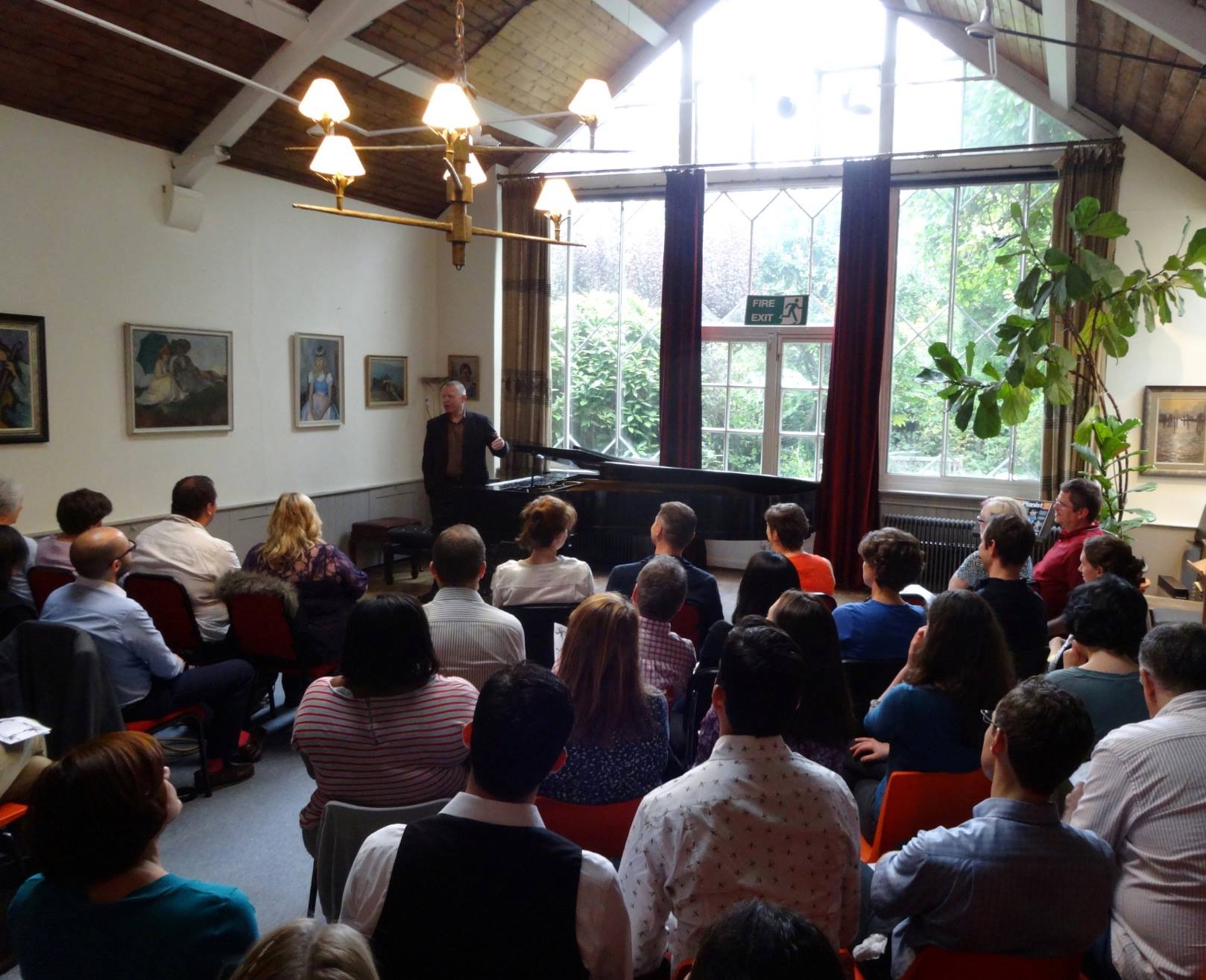
Graham Fitch introducing his programme

Graham’s programme consisted of Bach’s Partita No. 1 in B-flat and the French Suite, No. 5 in G, both popular and accessible works, and Haydn’s Piano Sonata No. 50 in C, Hob. XVI/50, written while the composer was living in London. Graham introduced the music, explaining that Bach was drawing on a tradition of presenting a suite of stylised dances popular at the time (Allemande, Courante, Sarabande, Gigue etc). He also described his first encounters with this music and his studies with Andras Schiff, who has received high praise for his own intepretations of Bach, and who “gave” Graham the ornaments in the French Suite. Graham also explained that there is no “right way” to play Bach and that a romantic interpretation is as valid any other.

Graham combines a vibrant, colourful sound with an ability to highlight all the different strands of melody, voices and interior architecture in the music, together with subtle use of pedal, sensitive phrasing and restrained rubato. As his introduction to the Haydn Sonata, he explained that Haydn was working with John Broadwood, the London piano maker, and the Sonata shows the composer experimenting with the range of possibilities afforded by an English piano (as opposed to the Viennese instruments which Haydn had previously been used to). Graham’s performance sparkled with wit and humour, while the middle movement had a lovely arching melody, warm and supple.
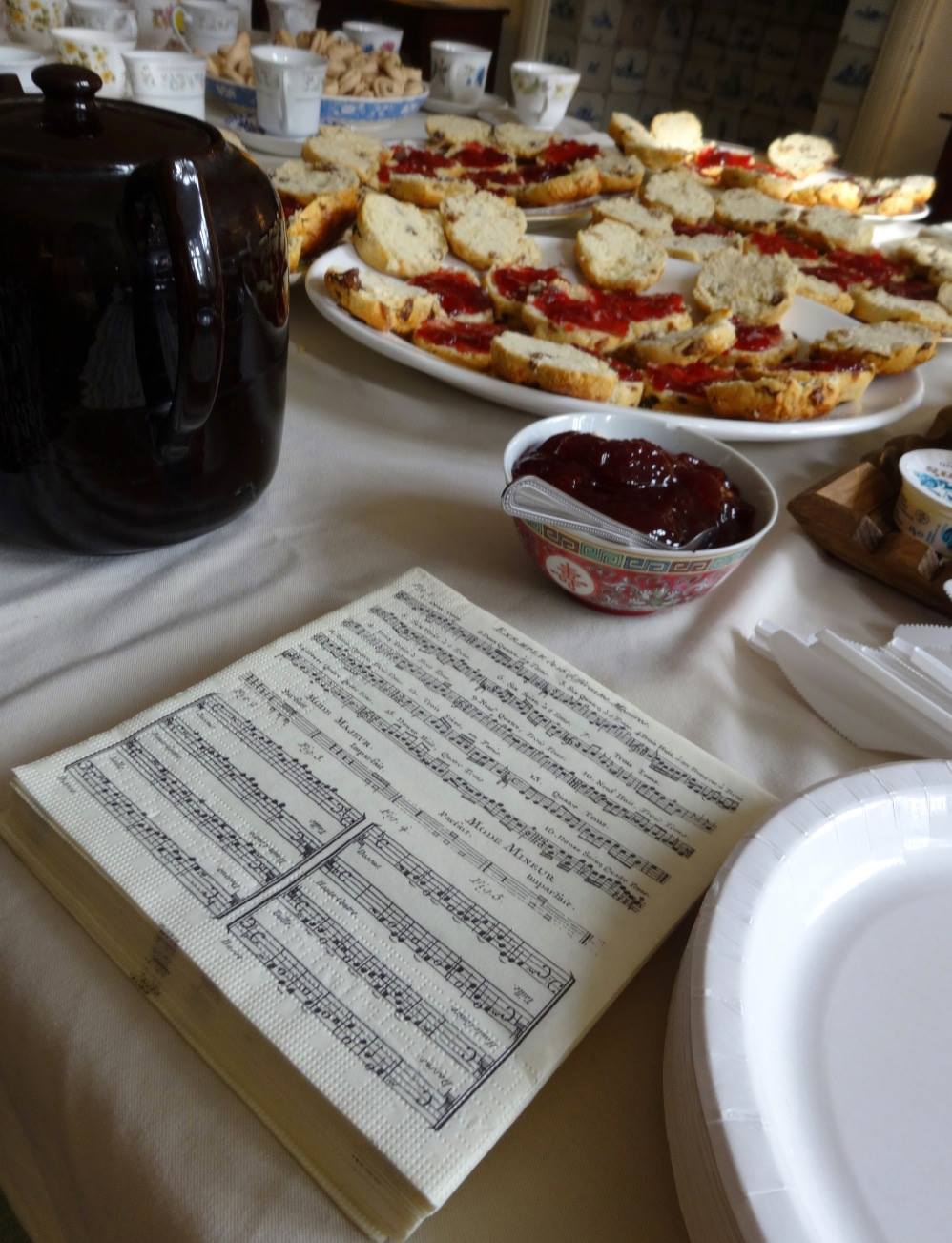
Afternoon tea & scones

After the music came the tea party and guests gathered in the dining room to enjoy tea and scones (with clotted cream, of course) and the chance to meet Graham and talk to other pianists and piano fans. There were many friends amongst the audience and the house was full of conversation. Some people even went to try the piano, before the studio was cleared ready for an audition the following day. The general consensus was that this was a really lovely event, combining music, words and conviviality, and we hope to host a similar concert at Craxton Studios next year.


Craxton Studios website

Meet the Artist……Graham Fitch


(photo Marco Borggreve)

Who or what inspired you to take up the piano and make it your career?

I don’t remember not playing the piano. As my parents were also musicians, it was probably a rather obvious thing to do. I never thought of music as a career per se, but it was clear to me rather early (certainly before my teens) that music would consume my life.

Who or what were the most important influences on your musical life and career?

So many people! Obviously my teachers, Sulamita Aronovsky and the late Susan Bradshaw, have both been crucial. I learnt very different things from each of them. In a way they were very contradictory, but I have never felt confused, rather enriched by having multiple views on so many issues. I am hugely grateful to them both. Beyond that, clearly the influences on a musician who is even slightly inquisitive will be very wide-ranging.

Several pianists have been personally very important to me, most obviously perhaps David Tudor – who helped me most generously in my early 20s, as I was preparing a major Cage project – and Maurizio Pollini, whose work was influential on me in many ways from an early age, and who in recent years I’ve come to know personally. He invited me to share a concert with him at Suntory Hall last season, which was a huge pleasure – I played a work of Manzoni in the first half, and he played Beethoven Sonatas in the second.

I have had the honour of working with many living composers over the years and have learnt many things from them. When that honour has been dubious, I have learnt what to avoid rather than what to embrace. But in the case of a composer like Birtwistle, whose “Variations from the Golden Mountain” I am premiering at the Wigmore Hall on Sunday 14th September, the relationship has been only fruitful and enjoyable (for me at least).

Conductors, studying works in other genres (string quartets, orchestral works), visual arts – everything goes into the artistic pot and influences the flavour like herbs in a stew.

What have been the greatest challenges of your career so far?

Challenge in what sense? Every concert, every confrontation with a work of music, is a challenge. And practical life is a challenge. And bad conductors are a challenge.

Yes, that’s it: bad conductors are definitely the greatest challenge.

Which performance/recordings are you most proud of? 

A composer was once asked which piece he was most proud of, and said it’s always his most recent. I guess the same is true for me. I’m just seeing a disc of the concertos of Birtwistle through the press, and have also just finished a disc of the complete piano music of Brian Ferneyhough. So I guess they’re the ones I’m most proud of.

How do you make your repertoire choices from season to season?

There are many things I think about for ages but don’t programme for many years, and on the other hand sometimes I decide quite quickly that I want to do a particular work. One of the joys of my situation is collaborating, and bouncing ideas off a trusted promoter can be extremely stimulating.

You are performing a new commission by Sir Harrison Birtwistle at your Wigmore Hall concert on 14th September. What is especially exciting about working on new music such as this?

Working with great composers personally is something that can only happen with contemporary music. All the others are dead. I can’t work with Beethoven or Debussy, but I’m overjoyed to have the opportunity to work with Birtwistle, for example. So much is made clear in our personal meetings and discussions; at the same time one understands the freedom available with more precision.

Do you have a favourite concert venue to perform in and why? What is your most memorable concert experience?

Well there are many remarkable acoustics around the world, and many halls with intelligent and searching programming. But what makes a concert really memorable is the situation – the programme, the audience, my mood, my collaborators (dead or alive). When everything aligns the experience is unforgettable.

What do you consider to be the most important ideas and concepts to impart to aspiring musicians?

The most important starting point for young musicians is the score. Students sometimes seem to view it more as a hint, rather than as the least indirect link to the composers intentions, which is what it is. Understanding notation in the deepest manner is one of the most important things which can be taught.

What are you working on at the moment?

After the Wigmore, I have to prepare a new piano concerto by Simon Steen-Andersen, and will also be working on Brahms 2nd Concerto for a concert in Finland in November. And many other smaller things in between!

Where would you like to be in 10 years’ time?

No idea. I am sure though that I won’t be anywhere I could now guess.

What is your idea of perfect happiness?

I am still trying to work that out.

What is your most treasured possession?

My Steinway (which is beyond obvious).

What do you enjoy doing most?

Watching my children develop.

What is your present state of mind?

Expectant before the birth of a new work at the Wigmore tomorrow!


Nicolas Hodges performs music by Mozart/Busoni, Debussy and Sir Harrison Birtwistle in an 80th birthday tribute concert at London’s Wigmore Hall, Sunday 14th September. Further information here


Born and trained in London, and now based in Germany, where he is a professor at the Stuttgart Conservatory, Hodges approaches the works of Classical, Romantic, 20th century and contemporary composers with the same questing spirit, leading The Guardian to comment that: “Hodges’ recitals always boldly go where few other pianists dare … with an energy that sometimes defies belief.”

Full biography


Who or what inspired you to take up the piano, and make it your career? 

My mother was a piano teacher; my father a musicologist and piano tuner. I was far from imagining that I wanted to be a professional pianist, though. When during the one hour of career counseling I received in college it was suggested that I learn to type, I thought that I can already play the piano, and the two skills are somewhat similar.

Who or what were the most important influences on your playing? 

Of course, my parents. As a child I spent every summer at the Aspen Music Festival, and heard many concerts. I was especially moved by the Juilliard String Quartet, whom I heard play the complete Beethoven Quartets, the complete Bartok, and the Carter Quartets as they were being written.

What have been the greatest challenges of your career so far? 

The daily challenge is to remain positive and with focus.

Which repertoire/composers do you think you play best? 

I find it personally necessary to practice a variety of music each day. I have had wonderful experiences with composers whom I know and have had significant works written for me. I have also performed all the Beethoven piano sonatas. At the moment, some highlights of my daily practice are the very different, but both very romantic Franck Piano Quintet and Carter Night Fantasies.

How do you make repertoire choices from season to season? 

They are a combination of my own thoughts and the wishes of presenters.

Which performances/recordings are you most proud of? 

In recent years, I have been asked to perform Frederic Rzewski’s The People United Will Never Be Defeated to commemorate various historical anniversaries: The 40th anniversary of the Portugese “Carnation” revolution, and the 50th anniversary of the coup that resulted in the Brazilian dictatorship on the 60’s.

Do you have a favourite concert venue to perform in? 

In New York City these range from Carnegie Hall to the Barge on the East River

Favourite pieces to perform? Listen to? 

I am always excited by whatever I perform. I love to go to operas, both those written by my friends and the greatest of all the classics, Wagner, Mozart, Verdi, etc.

Who are your favourite musicians?  

It is impossible to name all the truly exciting musicians – there are so many. Right now, I am listening to pianists from Claudio Arrau to Yuja Wang.

What do you consider to be the most important ideas and concepts to impart to aspiring musicians? 

Always remember that performance is communication with another person. What you will say will change all the time, and that is good.


Ursula Oppens makes a rare UK appearance in Brighton on Friday 19th September, performing music by Carter, Ravel, Rzewski, Bolcom and Wuorinen. Further details and tickets 

Pianist Ursula Oppens, one of the very first artists to grasp the importance of programming traditional and contemporary works in equal measure, has won a singular place in the hearts of her public, critics, and colleagues alike. Her sterling musicianship, uncanny understanding of the composer’s artistic argument, and lifelong study of the keyboard’s resources, have placed her among the elect of performing musicians.

Ursula Oppens studied piano with her mother, the late Edith Oppens, as well as with Leonard Shure and Guido Agosti. She received her master’s degree at The Juilliard School, where she studied with Felix Galimir and Rosina Lhévinne. After 14 years as the John Evans Distinguished Professor of Music at Northwestern University, Ms. Oppens is now a Distinguished Professor on the faculty of the Conservatory of Music at Brooklyn College and the CUNY Graduate Center. (source: Colbert Artists)

Full biography


