Guest post by pianist Christopher Guild 
There’s quite a bit of repertoire for a live performer with a fixed audio track of some kind, where the player of the acoustic instrument needs to keep in synchronisation with in performance. Jonathan Harvey’s Tombeau de Messiaen is the most obvious example I can think of, and a work that I’ve performed on two occasions now. It’s written for piano and pre-recorded piano – actually, the track is an electronic keyboard with a piano sound (and a very 1994 keyboard piano sound at that – the work dates from that year). The prerecorded piano is a quarter tone out from the standard A440Hz tuning of the live piano, and there are fluctuations in pitch throughout. But there is no fluctuation in tempo: it is fixed, and even if there is some rubato, it’s obvious that it’s going to be the same with each performance.

This is challenging for the classical musician; brought up to listen to, and react to, the other performers we are playing with. We can’t do this with an audio track. My impulsive reaction to considering the idea of playing a piece the same way, time after time, with no scope for spontanaiety, used to be, ‘well why include a live performer at all? Why not write it as a piece of recorded music?’. There are many reasons why, and they will differ depending on which piece one considers. 

Tombeau de Messiaen could, I suppose, be arranged for two live performers, so that we gain the flexibility and indeed human magic of performing with another pianist (and sound diffuser); we have the technology now to play with a second live piano, or perhaps keyboard, linked to a laptop from which the pitch and the other synthesiser effects could be manipulated. That sounds like a fun idea to me and one I’m thinking of trying to realise when I have the time!

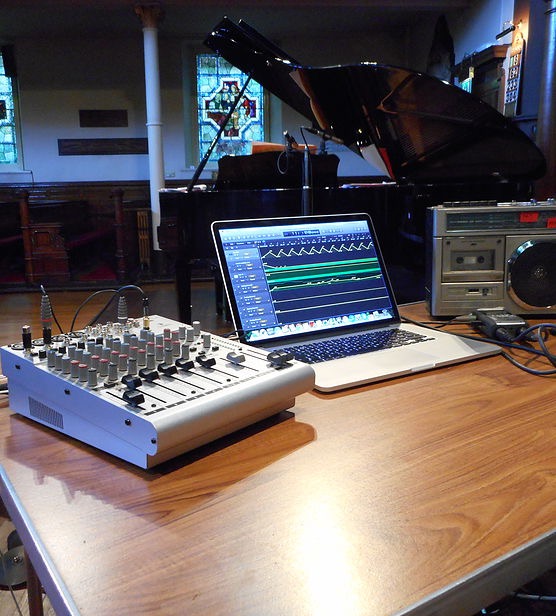
Piers Tattersall’s I Work With Care To Open My Heart, which I’ll be playing for the fourth time in public on Saturday 20th February at the Schott Recital Room in London, is a work for live piano, analogue radio, and electronics. The electronics part is predetermined and fixed. The piano part is too, and the ‘script’ or instructions for the radio operator is too, though part of the point of the piece is that no two performances will ever be the same because different programmes will be on the radio when we play them! The volume of the radio signal is controlled using automation. This means that the radio has predetermined instructions inputted to Logic and runs exactly in synchronisation with the electronics part played by the midi sequencer.

Early on we found it necessary to add a click track for me, along with low-level signal from the radio and midi sequencer, via an earpiece. 

This brings me to my main point, which is to describe the experience of performing a piece of (extremely hard) classical music with a clicktrack. One practises with a metronome, but isn’t in the performance mindset in the practice room, so I can’t count that as an experience to draw upon really.

Something I found with Tombeau de Messiaen is that I had to carefully work out how long I had during the stiller moments, when the resonance of the piano was left to decay and nothing was happening in the audio track. This is because quite often the live pianist has to come in exactly with the track without any warning, or, often, very little: there are moments in the score where Harvey has indicated the piano should play very quickly after the audio track enters. One needs to be ready, but to minimise the surprise one has to learn where it comes in. This is fine if the moment of stillness is measured in beats – one counts – but it never is in Tombeau de Messiaen, so the entry of the electronics is harder to anticipate. Sometimes the performer is given ‘c.6”‘, for example. So it’s important to build up what initially only feels like a sense of when to play, and with that, exactly how fast to play the rapid, unmeasured and extensive acciaccatura flourishes in order to finish at about the right time in order to begin the next musical event in synchronisation with the audio track. Such practice might be called building up procedural memory. I was able to do this through a huge amount of repetition, so that it all became habit. 

I Work With Care To Open My Heart is similar, but presents additional challenges. 

When I come to a particularly technically difficult passage, usually where I’ve got to tackle a tricky dart across the keyboard or where I need to negotiate semiquavers with uneven distribution between the hands, I slow down. I do this musically, not in the sense of bad practise whereby I might immediately stop playing so quickly simply because I can’t play this bit: that isn’t effective and holds back progress. I prepare for it by means of a rallentando in to the tricky section. Then, I accelerando once I’ve got out of the bad patch, and carry on. Essentially, I’m making my own music out of a problem, but I lessen the application of this practice method with each repetition. Then – somehow! – it begins to hang together better, and before too long I can rattle through the passage in question unhindered. It’s a big paradox of my experience of piano playing, but it really does work. Additionally, in order to make myself feel more comfortable when playing any big piece where the technical demands are great, I push myself to use extreme (and silly) rubato in practice – it’s a good test of how comfortable and in control one is, and it means if I can do it with total assurance, then I’m in control.

Whilst the element of risk in a performance is exciting for the performer and the audience, it should never be so great so as to really worry everybody! Letting the music almost play itself is a great feeling. I remember one teacher of mine (Andrew Ball) say to me once that the best concerts he ever gave were the ones where he felt like he was sailing a boat: the weather was such (metaphorically) that the boat was able to sail happily without much effort from the skipper, but only a nudge on the rudder now and again according to (musical) will or fancy was required to keep the journey interesting. Otherwise, the skipper/performer could sit back and let it happen. Feeling in control applies very much to I Work Carefully.

Importantly, the reason I can’t practise I work carefully… with the metronome is because there is a metric modulation almost every bar. ‘Irrational’ time signatures play an important role in this piece, and there are often passages going from 3/4 to 4/5, leading in to 4/4 leading in to 5/10, etc. The principle beat of each bar changes too often to make practice with the metronome worthwhile. (It’s worth just pointing out that this is obviously what the clicktrack is programmed to do!). After several rehearsals with the click, the piece does begin to play itself, and I can begin to sit back as described above.

It wouldn’t be fair to leave the idea of suppressing one’s own artistry, though. There is scope for playing the plentiful rapid passagework in I work carefully… with a wide variety of touches, articulation, and dynamics. One can interpret it as capricious in places, martellato (I believe, even when the composer hasn’t explicitly called for it), and staccatissimo. But it just all has to take place within the very fixed temporal framework dictated by the electronics.

The Edison Ensemble (Christopher Guild and Piers Tattersall) will be performing at Schott Music, 49 Great Marlborough Street, London W1, on Saturday, 20th February at 19:00. Tickets £7 in advance, or £12 on the night.


Meet the Artist……Christopher Guild

Meet the Artist……Piers Tattersall


Fans of acclaimed teacher and performer Graham Fitch’s insightful, instructive and highly readable blog Practising the Piano and eBook series, his regular contributions to ‘Pianist’ magazine, his YouTube videos on piano technique, and his inspiring and supportive workshops and courses will be excited to learn of his latest initiative for pianists, the Practising the Piano Online Academy.

ckrzfuvgi6b1nyn4vxa6

The Ultimate Online Resource for Pianists and Teachers 

The aim of the project is create the ultimate online resource for mastering the piano. Building on Graham’s hugely successful eBook series and blog, this will take his tried and tested methodologies to the next level with a comprehensive library of lessons, masterclasses and resources combined with insights from other leading experts. Aimed at piano teachers and pianists, these materials will be presented in an intuitive, interactive manner and will transform the way you approach teaching and playing the piano. The crowdfunding goal is £10,000 and funds raised will be used directly for creating additional content and resources.

Graham tells us more about the project:

I’m passionate about teaching and playing the piano. The art of practising is a special area of interest to me and is rarely taught specifically enough. Our practice time at the piano is just as significant to the end product as the hours of training undertaken by professional athletes, but this time can so easily be wasted unless we have the know-how.  Effective practice is essential to mastering the piano and it’s for this reason that I have spent decades researching and experimenting in the art of practising to find the optimal approaches.

I’ve developed a methodology comprising practice tools, strategies and techniques which I’ve tested and refined in my work with students of varying ages and levels of ability. I would love to see as many people as possible benefit from my work but obviously not everyone can get to me for one-to-one lessons. Therefore I’ve embarked upon a number of initiatives to make my work more widely accessible including my blog and eBook series. These provide a conceptual introduction to my approach and I am now planning to build on this foundation with the Practising the Piano Online Academy.

  • My blog (www.practisingthepiano.com) which is regularly updated and contains hundreds of articles on subjects relating to piano playing

  • Multimedia eBook series which combines text, video, audio and numerous musical examples to introduce my methodology and approach

  • A print version of my eBook series which is currently being developed due to popular demand

 The Practising the Piano Online Academy will build on these solid, tried and tested foundations and will take Graham’s work to the next level.

The Practising the Piano Online Academy is an extensive, searchable, and regularly updated library of lessons, articles and resources which will:

  • Illustrate my methodologies and approach in more depth with multimedia content, interactive features and resources including musical examples, worksheets and annotated scores which can be downloaded and printed.

  • Expand on practice tools and strategies with masterclasses and tutorials applying them to popular pieces in the repertoire, exam syllabuses and specific technical challenges.

  • Share the expertise of guest experts on subjects including applied theory, improvisation and healthy piano playing.

  • Be regularly updated, easily searchable and allow for personalisation with bookmarking and notes.

  • Be shaped by your input, responding to your questions and suggestions for new content to meet your needs.

 lfcyulnz44w2jcvvna08
What will it do for you?

Whether you are a budding student, keen amateur, passionate piano teacher or a professional musician, the Practising the Piano Online Academy will provide you with the knowledge and resources at your finger-tips to:

  • Get the best possible results from your time spent practising the piano.
  • Avoid injury and overcome technical difficulties with panache.
  • Learn new pieces quickly and master trouble spots or challenging areas within the repertoire.
  • Deliver performances or achieve examination results which reflect your full potential.
  • Inspire your students and enhance their enjoyment of the piano.

How can you be involved?

We’ve already started creating content for this project and are now seeking the further support of pianists and teachers via our crowdfunding campaign to help us make this resource as good as it can possibly be. A number of great rewards ranging from discounted subscriptions through to opportunities to sponsor lessons and obtain a one-to-one consultations with me are on offer. Supporters will also have an opportunity to shape the Online Academy by suggesting and voting for topics and content they would like to see featured.

To show your support for the project and to read about it in more detail, please visit https://www.indiegogo.com/projects/the-practising-the-piano-online-academy#/

https://www.indiegogo.com/project/the-practising-the-piano-online-academy/embedded

Development of the Practising the Piano Online Academy is already underway with Informance (see below), with an expected launch in July 2016.

ABOUT THE AUTHOR 

8481e4cf3afe7f10c19eGraham Fitch has earned a global reputation as an outstanding teacher of piano for all ages and levels.  He is a popular adjudicator, a tutor for the EPTA Piano Teachers’ Course, and a regular writer for Pianist Magazine with several video demonstrations on YouTube.  His blog www.practisingthepiano.com features hundreds of articles on piano playing and together with his multimedia eBook series is read by thousands of musicians all over the world.
 

ABOUT INFORMANCE

Informance ™ is a publishing imprint which creates rich, interactive digital publications aimed at musicians.  By combining state of the art technology with expert insight, Informance enables musicians to reach their full potential in the most effective and enjoyable manner.  It offers a modern way to engage with the timeless art of music making.

Informance is published by Erudition (www.eruditiondigital.co.uk), a next generation digital publishing company which partners with publishers and content owners to create purposebuilt digital publications from new or existing content.

hermes-experiment-publicity-group-shot1

(photo credit: Thurstan Redding)

Who or what inspired you to form the ensemble and pursue a career in music?

As an ensemble we wanted to create something completely new and innovative, and believed we had creative ideas that could make us different to other groups.  The aim was ultimately to build something that could become a central part of our careers as freelance musicians.

Who or what were the most important influences on your musical life and career?

In the two years since we formed our ensemble, we have been lucky enough to meet and work with a number of individuals and organisations that have inspired us and influenced our work. There have been so many, but a notable experience was a gig we did with the experimental composer collective, Bastard Assignments; we saw such bizarre and new things and this was so eye-opening for us musically! Equally, we continue to be inspired by the composers we work with; we all remember a workshop with Stevie Wishart during which she pushed us to discover so many new techniques and completely challenged our approach to the sounds we made.

What have been the greatest challenges of your career so far?

There have been several challenges we’ve had to overcome as an ensemble, and there continue to be new challenges as the group moves forwards. Initially, it was getting started in London and balancing studying with developing as an ensemble. A constant challenge is developing concepts and programmes that encourage people to come and watch us: attracting an audience for experimental music. And of course one challenge we continue to face on a regular basis is learning extremely complex pieces of music!

Which performance/recordings are you most proud of? 

Our season concerts are always a feat to bring together, but also hugely rewarding and inspiring; we get to explore our own themes, and every organisational element lies with us from the beginning. One we are particularly proud of was our LOVESCAPES concert in June 2015 which brought us together with six young composers and a photographer, and culminated in a concert-exhibition in a beautiful crypt in Clerkenwell.

Which particular works do you think you perform best?

We are very proud of our semi-improvised (devised) pieces, which require an unconventional approach in their preparation in that we as an ensemble take on more of a compositional role.  These are works that more traditional ensembles might perhaps struggle with, but we find they bring us much closer together as an ensemble. Similarly, we really love improvising and experimenting with our sounds.

How do you make your repertoire choices from season to season?

We start off by choosing themes for our season concerts (which have included Metropolis, Sonic Visions, Soundscapes, Rhythm…) and we then commission new pieces around these themes, and choose pertinent arrangements to supplement them. We always try to think as creatively as possible and nearly always have full control over our repertoire choices.

Do you have a favourite concert venue to perform in and why?

We really enjoy playing at The Forge in Camden, and will be playing there for the third time on 16 February. The Aubazine Abbey in France was also a fantastic and beautifully atmospheric venue to play and sing in. We have been very lucky to perform in some amazing museums (the Fitzwilliam Museum in Cambridge, New Walk Museum in Leicester, and looking forward to the National Portrait Gallery in May). The Wigmore Hall, albeit full of kids for For Crying Out Loud and Chamber Tots, always has a special atmosphere too!

Favourite pieces to perform? Listen to?

We love performing Giles Swayne’s Chansons devotes et poissoneuses, one of the first large-scale pieces written for us, as well as our more upbeat arrangements, for example Meredith Monk’s Double Fiesta, Bernstein’s I Got Rhythm and Richard Rodney Bennett’s Slow Foxtrot (we do most of the arrangements ourselves) – and of course our free improvisation!

Who are your favourite musicians? 

We all have our own individual heroes that we look up to: instrumentalists and singers who inspire us to bring something different and unique to the group and to aim for the highest possible musical standards.

What is your most memorable concert experience? 

We all had different answers to this! We vividly remember our first ever gig at the Rag Factory in December 2013, as well as the marathon that was our Soundscapes concert in November 2014.

Héloïse’s (accidental) improvised singing at Aubazine Abbey at the start of the concert was also pretty memorable! One of the audience members came up to us afterwards saying ‘Hallelujah!’ so it must have made a good impression regardless.

What do you consider to be the most important ideas and concepts to impart to aspiring musicians?

We’re learning a lot still but here are a few things we have learnt already:

  • Don’t take shortcuts with any aspect of work (e.g. learning pieces / publicity), it’s not worth it in the long run
  • Dare to be different
  • Be confident in what you are doing and why
  • But consider carefully all advice you are given (even if you then choose to ignore it!)

The Hermes Experiment presents ‘Sonic Visions’ at The Forge, Camden, London NW1 on Tuesday 16th February 2016. The concert includes premieres of new works by Kate Whitley and Soosan Lolavar, together with works by Ed Scolding, Richard Rodney Bennett, Claude Debussy and Don McLean

Full details and tickets

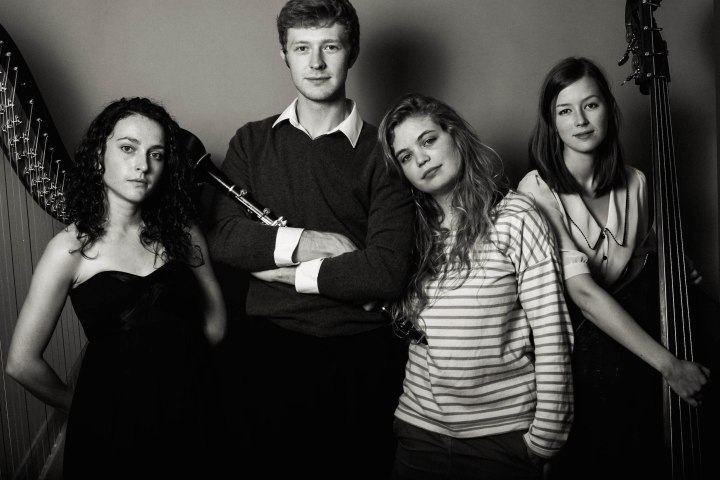
The Hermes Experiment is:

Oliver Pashley, clarinet

Marianne Schofield, double bass

Anne Denholm, harp

Héloïse Werner, soprano / co-director

Hanna Grzeskiewicz, co-director

soosan-220x220Who or what inspired you to take up composing, and pursue a career in music? 

I always enjoyed music as a child and played recorder and then oboe growing up. I only really got into composing at the age of 16 when I was experiencing such horrific stage fright that it became clear I needed a different outlet. However, I came from a completely non-musical family so had no concept of how to turn this thing I enjoyed doing into an actual career. Perhaps the penny dropped at some point in my third year of undergraduate – studying Social and Political Sciences – when I realised that composing gave me the greatest pleasure of any activity in my life, and that if I wasn’t doing something creative I would lose my mind.

Who or what were the most significant influences on your musical life and career as a composer? 

All of my teachers who have helped me more than I can say, but especially Cecilia McDowall, Oliver Leaman, Dominic Murcott, Stephen Montague and Reza Vali. Also, hearing ‘Atmospheres for Orchestra’ by Ligeti completely changed my life.

What have been the greatest challenges of your career so far? 

Believing that I can do it, having the courage to make an artistic statement, dealing with failure, organising my life and work despite the total absence of a schedule, making money.

What are the special challenges/pleasures of working on a commissioned piece? 

Commissioned pieces are wonderful because you know you are working with people who are excited about contemporary music and keen for a challenge. There is always that worry that you’re going to deliver something that they will absolutely hate, but you can’t think about that, as then you will simply never write anything. You just have to believe that if you do something with enough integrity, it will work as a piece of art.

What are the special challenges/pleasures of working with particular musicians, singers, ensembles and orchestras? 

I’ve done quite a bit of work with children and voluntary musicians so that has its own challenges in terms of how difficult you can make the parts, but also how interesting they have to be too. If you’re writing for an orchestra of children and you make the trombones count 200 bars rest then it’s likely those trombonists will be put off contemporary music forever. I feel that in a case like that, I have a duty to make their parts interesting so in the past I have experimented with handheld percussion and singing in the context of a large ensemble. The great thing about working with an ensemble like The Hermes Experiment is that you feel nothing is off limits. When I told them I wanted to write a piece that combined the melodies of Iranian classical music with Renaissance Counterpoint, they didn’t even bat an eyelid. And that was wonderful.

Which works are you most proud of?  

The pieces where I held onto an artistic idea in spite of being terrified it wouldn’t work; working my way through that vulnerability and coming out the other side intact always makes me feel quite proud.

Who are your favourite musicians/composers? 

Ligeti is my shining beacon of inspiration at all times. Also Stravinsky, Berio, Morton Feldman, Rebecca Saunders and Xenakis. And I believe Bach is good for the soul.

What is your most memorable concert experience? 

Memorable concerts seem to either be incredibly exciting or make me sob uncontrollably. One was Johannes Moser playing the Lutoslawksi Cello Concerto and then a Bach Cello Suite as an encore (I sobbed in my cheap seat). Another was Lisa Batiashvili performing Shostakovich’s 1st violin concerto which was just incredible. And also a rehearsal of the Berlin Phil conducted by Simon Rattle performing Mahler 2 (I couldn’t get a ticket for the performance), in which I cried throughout.

What do you consider to be the most important ideas and concepts to impart to aspiring musicians? 

That self-doubt is both productive and good and will make you a better artist in the end. That you should strive at all times to do something new, whatever that may mean. To remember to be nice to people, as everyone in music is baring their soul and doing the best they can. To not neglect your personal life and relationships: practising the piano for 8 hours a day may make you a great pianist but it won’t ultimately make you happy, only people can do that.

Where would you like to be in 10 years’ time? 

I actually wrote a 10 year plan as an exercise with some friends last year. It involved composing, teaching, travelling and love. I don’t want to tell you the details as for some reason I’m scared it won’t then come true.

New works by Soosan Lolavar will be premiered by The Hermes Experiment at The Forge, Camden, London on 16th February, together with works by Giles Swayne, Ed Scolding, Claude Debussy and Richard Rodney Bennett. Further information

Soosan Lolavar is a British-Iranian composer, sound artist and educator who works in both electronic and acoustic sound, and across the genres of concert music, contemporary dance, installation, film, animation and theatre.

Her work has been performed at the Royal Festival Hall, V&A,  National Maritime Museum,  ICA, Chisenhale Gallery,  LSE New Academic Building, Blackheath Concert Halls,  Jacqueline Du Pré Music Centre,  Bonnie Bird Theatre, Circus Space and broadcast on BBC Radio 3.

In 2013 she was selected as one of two Embedded composers in residence at the Southbank Centre and received funding from Arts Council England, Jerwood Charitable Foundation and Iran Heritage Foundation to pursue ‘Stay Close’, a ten-month project exploring contemporary classical music as a means of cultural exchange between the UK and Iran. In 2012 she won the John Halford Prize for Composition awarded by Ian Pace and was selected as part of the Adopt a Composer scheme funded by PRS for Music Foundation and run by Making Music, in partnership with Sound and Music and BBC Radio 3.

She holds degrees in Social and Political Sciences (University of Cambridge), Musicology (University of Oxford) and Composition (Trinity Laban Conservatoire of Music and Dance) and her research interests include the politics of gender and sexuality, post-colonialism and the music industry and postmodernism in electronic musics. She has worked as an Assistant Lecturer at Trinity Laban Conservatoire, leading a course on music, gender and sexuality and at City Lit Adult Education college where she teaches classes on music and opera appreciation, film music and music gender and sexuality.

www.soosanlolavar.com